
Estimation Strategies Strand 1 Concept 3 PO 1
- Slides: 15
Estimation Strategies Strand 1: Concept 3 PO 1. Solve grade level appropriate problems using estimation. Strand 1: Concept 3 PO 2. Use estimation to verify the reasonableness of a calculation. Strand 1: Concept 3 PO 3. Express answers to the appropriate place or degree of precision Strand 1: Concept 3 PO 4. Verify the reasonableness of estimates made from calculator results within a contextual situation. Strand 5: Concept 2 PO 1. Solve a logic problem given the necessary information. Strand 5: Concept 2 PO 2. Identify simple valid arguments using if…then statements Strand 5: Concept 2 PO 3. Model a contextual situation using a flow chart.
6. 1 Why Estimate? Depending on the situation, an estimate is often good enough and an exact answer is not needed. For example, a quick estimate can also help you check whether a total on a calculator or cash register is reasonable.
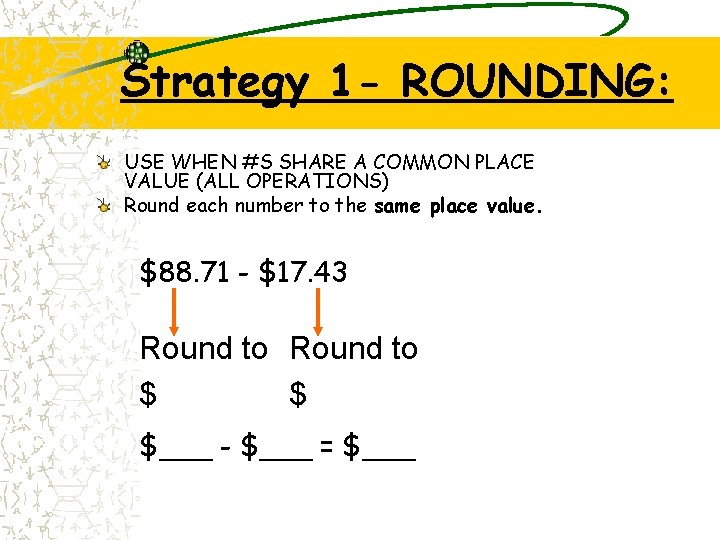
Strategy 1 - ROUNDING: USE WHEN #S SHARE A COMMON PLACE VALUE (ALL OPERATIONS) Round each number to the same place value. $88. 71 - $17. 43 Round to $ $ $___ - $___ = $___
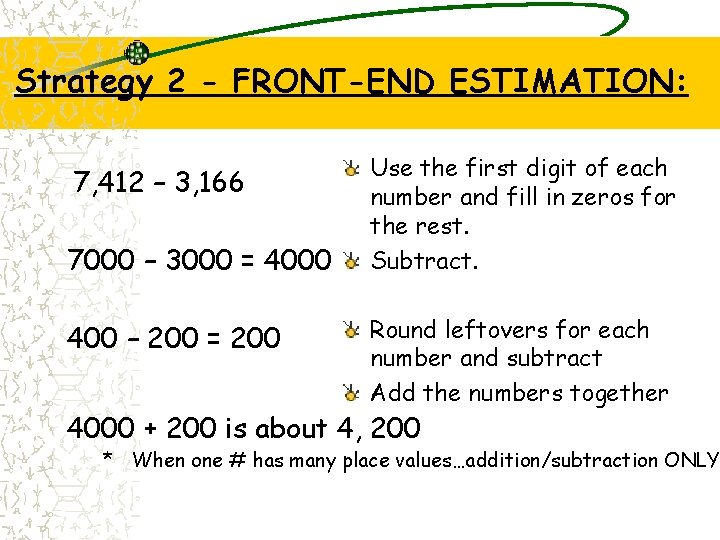
Strategy 2 - FRONT-END ESTIMATION: 7, 412 – 3, 166 7000 – 3000 = 4000 400 – 200 = 200 Use the first digit of each number and fill in zeros for the rest. Subtract. Round leftovers for each number and subtract Add the numbers together 4000 + 200 is about 4, 200 * When one # has many place values…addition/subtraction ONLY
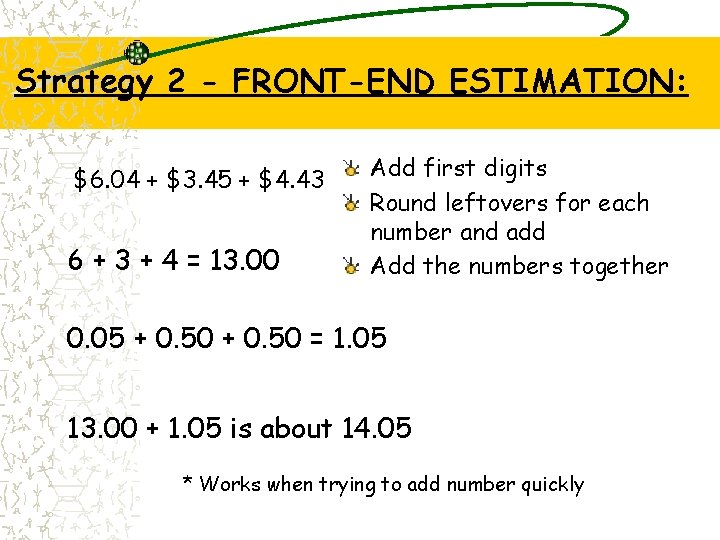
Strategy 2 - FRONT-END ESTIMATION: $6. 04 + $3. 45 + $4. 43 6 + 3 + 4 = 13. 00 Add first digits Round leftovers for each number and add Add the numbers together 0. 05 + 0. 50 = 1. 05 13. 00 + 1. 05 is about 14. 05 * Works when trying to add number quickly
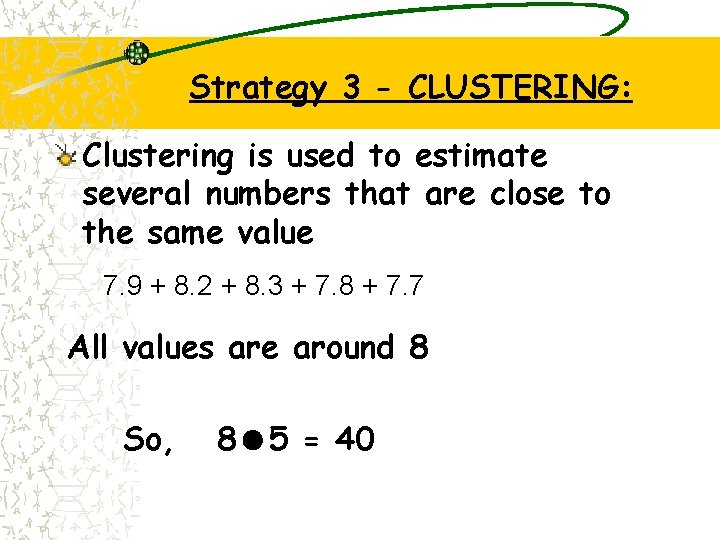
Strategy 3 - CLUSTERING: Clustering is used to estimate several numbers that are close to the same value 7. 9 + 8. 2 + 8. 3 + 7. 8 + 7. 7 All values are around 8 So, 8 5 = 40
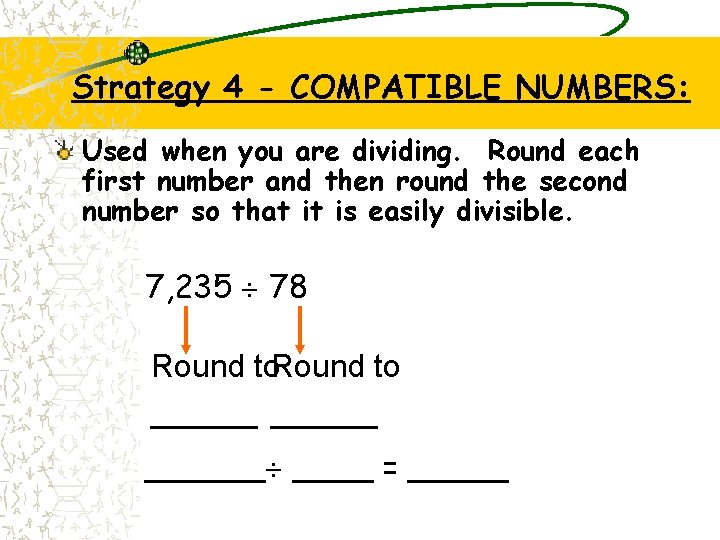
Strategy 4 - COMPATIBLE NUMBERS: Used when you are dividing. Round each first number and then round the second number so that it is easily divisible. 7, 235 78 Round to ______ = _____
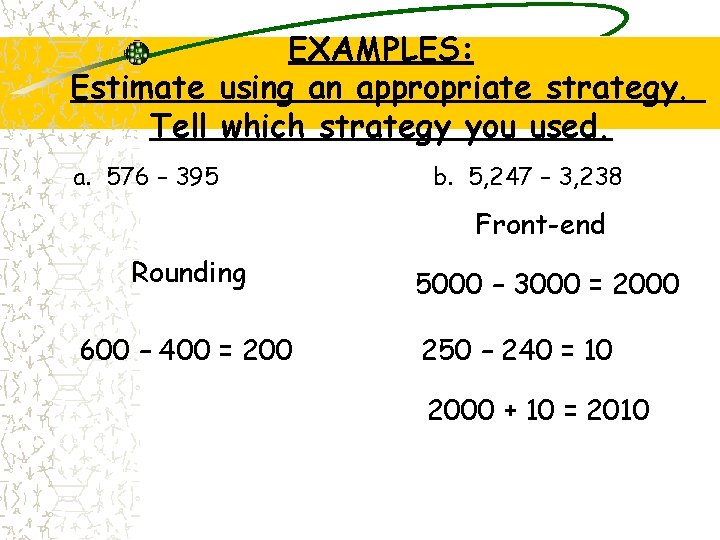
EXAMPLES: Estimate using an appropriate strategy. Tell which strategy you used. a. 576 – 395 b. 5, 247 – 3, 238 Front-end Rounding 600 – 400 = 200 5000 – 3000 = 2000 250 – 240 = 10 2000 + 10 = 2010
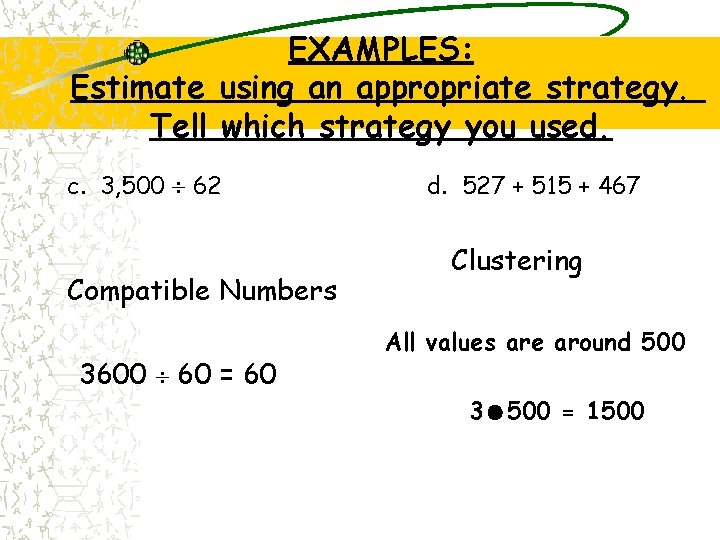
EXAMPLES: Estimate using an appropriate strategy. Tell which strategy you used. c. 3, 500 62 Compatible Numbers 3600 60 = 60 d. 527 + 515 + 467 Clustering All values are around 500 3 500 = 1500
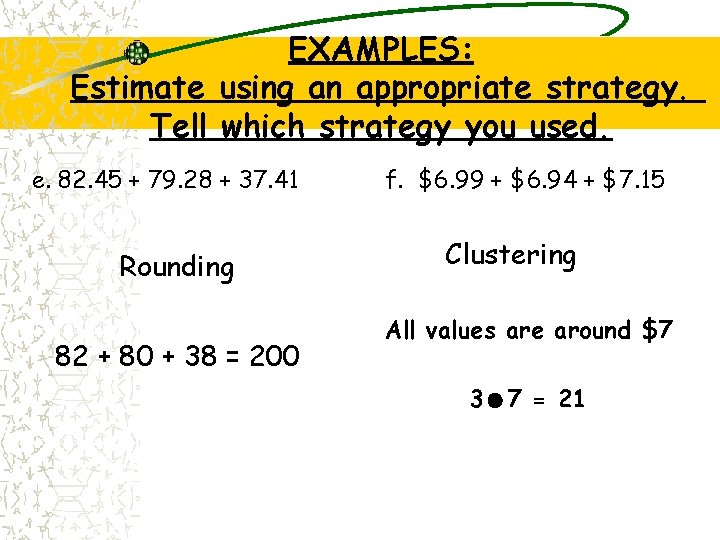
EXAMPLES: Estimate using an appropriate strategy. Tell which strategy you used. e. 82. 45 + 79. 28 + 37. 41 Rounding 82 + 80 + 38 = 200 f. $6. 99 + $6. 94 + $7. 15 Clustering All values are around $7 3 7 = 21
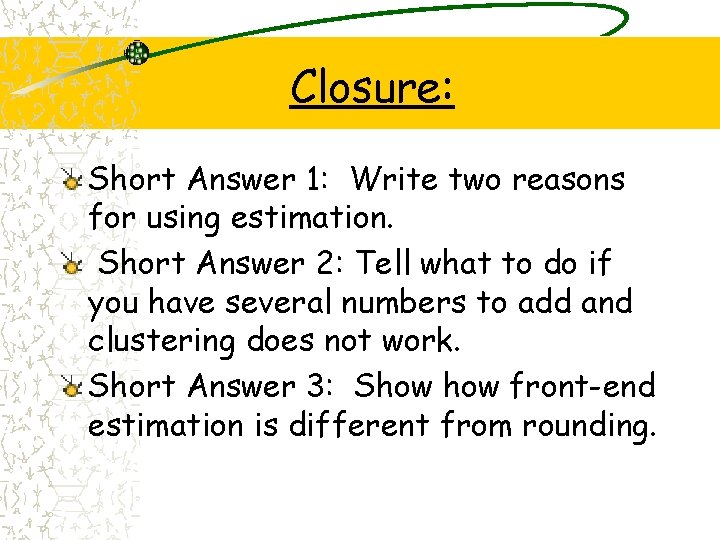
Closure: Short Answer 1: Write two reasons for using estimation. Short Answer 2: Tell what to do if you have several numbers to add and clustering does not work. Short Answer 3: Show front-end estimation is different from rounding.
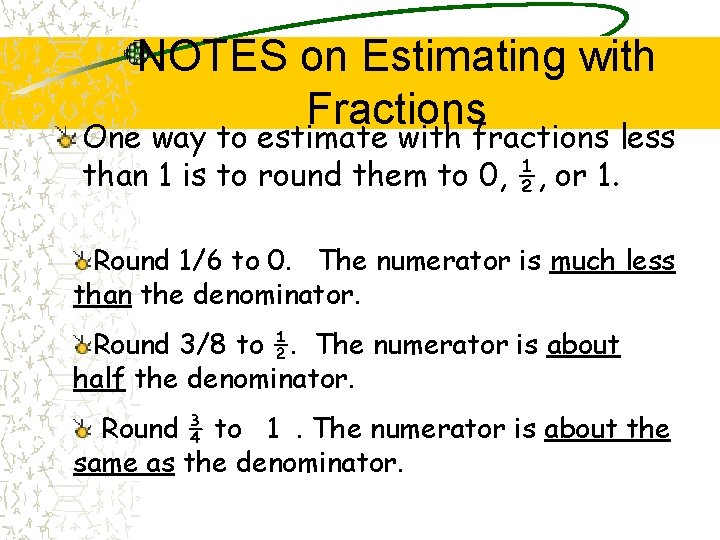
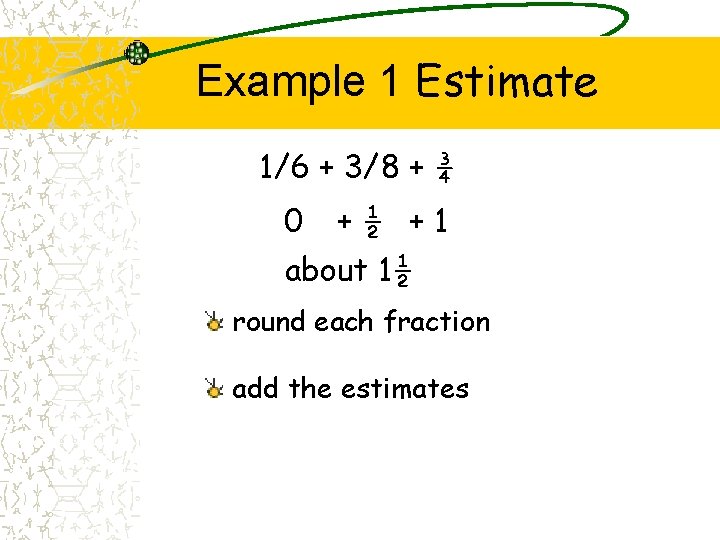
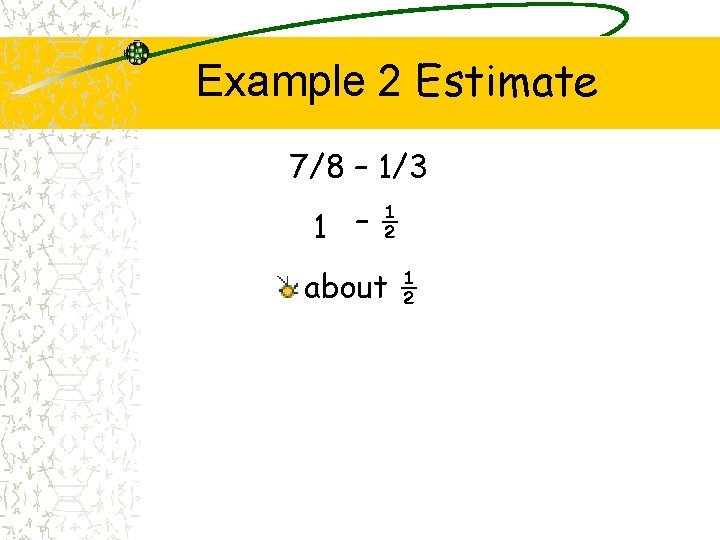
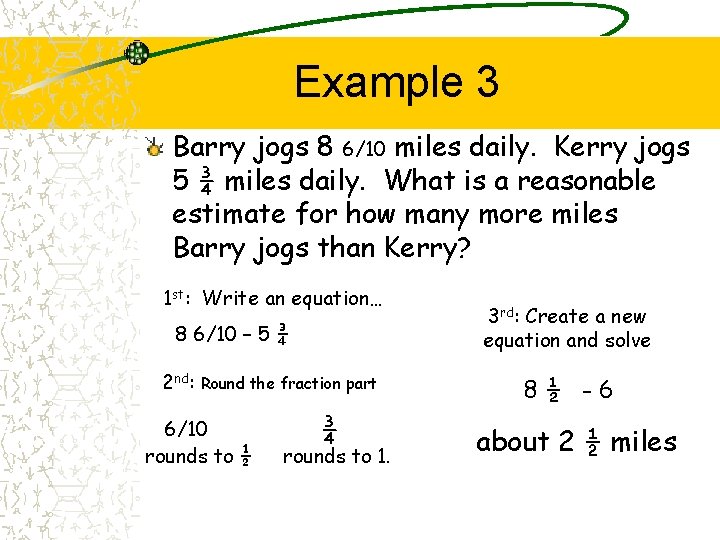
NOTES on Estimating with Fractions One way to estimate with fractions less than 1 is to round them to 0, ½, or 1. Round 1/6 to 0. The numerator is much less than the denominator. Round 3/8 to ½. The numerator is about half the denominator. Round ¾ to 1. The numerator is about the same as the denominator.
Example 1 Estimate 1/6 + 3/8 + ¾ 0 +½ +1 about 1½ round each fraction add the estimates
Example 2 Estimate 7/8 – 1/3 1 –½ about ½
Example 3 Barry jogs 8 6/10 miles daily. Kerry jogs 5 ¾ miles daily. What is a reasonable estimate for how many more miles Barry jogs than Kerry? 1 st: Write an equation… 8 6/10 – 5 ¾ 2 nd: Round the fraction part 6/10 rounds to ½ ¾ rounds to 1. 3 rd: Create a new equation and solve 8½ -6 about 2 ½ miles