
ESTIMATION OF TIME SINCE DEATH DR KISHOR KUMAR
- Slides: 24
ESTIMATION OF TIME SINCE DEATH DR KISHOR KUMAR BADIADKA
ESTIMATION OF TIME SINCE DEATH The signs of death or changes after death or the methods of estimating time since death may traditionally be studied under the following heads.
IMMEDIATE SIGNS OF DEATH Insensibility & absence of EEG rhythm Cessation of respiration Cessation of circulation : - An flat ECG for continuous period of five minutes is accepted as an evidence of death.
EARLY CHANGES AFTER DEATH Facial pallor & changes in the skin Primary flaccidity of the muscle. Changes in the eye. Algor mortis. Livor mortis Rigor mortis Certain biochemical determination in blood body fluids.
LATE CHANGES AFTER DEATH Putrefaction/Decomposition Mummification Adipocere formation Possible timings of postmortem interval by entomology.
EARLY CHANGES AFTER DEATH Facial pallor & changes in the skin Due to stoppage of circulation after death, blood drains out of the small vessels to big ones& there by face usually appears pale.
EARLY CHANGES AFTER DEATH Primary flaccidity of the muscle Muscle lose their tonicity & became flaccid, loose & lax. The jaw drops, limbs fall flat & limp, thorax collapse, the sphincter relax & there may be involuntary passage of urine & faces
EARLY CHANGES AFTER DEATH Changes in the eye Loss of corneal or conjunctival reflex Opacity of the cornea: - Cornea loses its glistening appearance, becomes dull & opaque. Sclera exposed, a film of cell-debris, mucus & dust settles steadily on each side of the cornea within few hours, becoming reddish-brown & then occasionally almost black, to which the name ‘taches Noorie De la Sclerotique. Flaccidity of the eyeball State of the pupils
EARLY CHANGES AFTER DEATH Changes in the eye Changes in the retinal blood vessels: Ophthalmoscopic examination of retina provides one of the earliest signs of death. After death, the blood stream in the retinal vessels becomes segmented as the loss of blood pressure causes the blood stream to break up into segments. This condition of ‘trucking’ is considered a valuable sign of death.
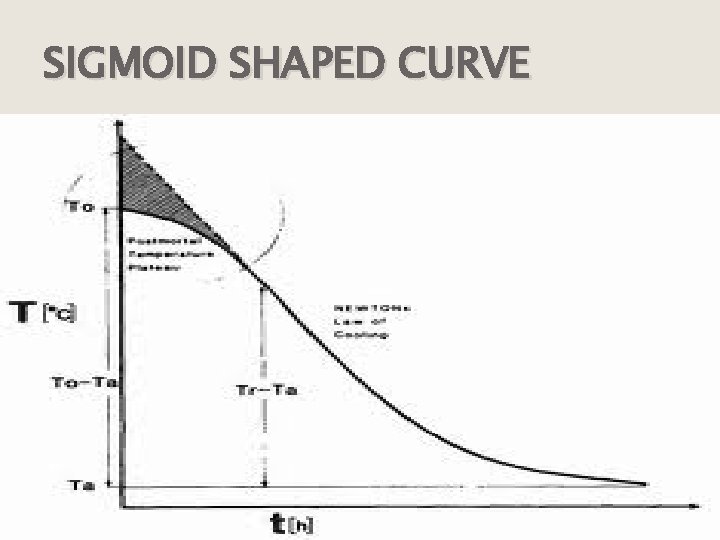
EARLY CHANGES AFTER DEATH ALGOR MORTIS POSTMORTEM COOLING. When the life ends, after a short interval, the body starts losing heat. The temperature of a healthy at rest is about 98. 40 (37 c).
EARLY CHANGES AFTER DEATH ALGOR MORTIS Formula may be used t estimate roughly, time since death: Approximately number of hour since death = Normal body temperature - Rectal temperature Rate of temperature. Fall per hour.
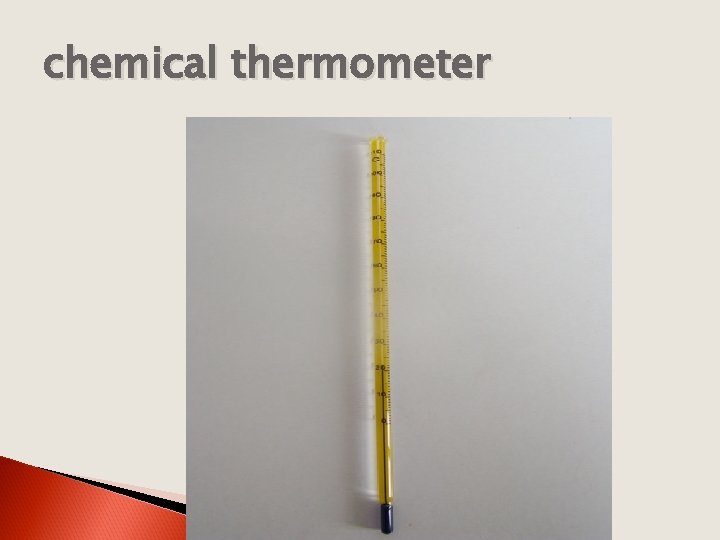
EARLY CHANGES AFTER DEATH ALGOR MORTIS For recording the temperature of the dead bodies, the traditional method of measuring postmortem temperature is by inserting a mercury thermometer ( chemical thermometer)with graduation from 0 to 50 degree centigrade.
EARLY CHANGES AFTER DEATH ALGOR MORTIS Ø Ø Ø Factors Influencing the cooling of the body Temperature- Difference between the body and the surrounding. Clothing's & coverings Body- Built ( The size factor) Air currents & Humidity Postmortem Caloricity: Is rise of body temperature after death instead of cooling of the body. Although the process of postmortem glycogenolysis, which occurs in all dead bodies soon after death, It can produce up to 140 calories which can rise the body temperature by about 2 degree Centigrade
chemical thermometer
SIGMOID SHAPED CURVE
LIVER MORTIS ( POSTMORTEM HYPOSTASIS) It means ‘passive congestion of an organ or part’. With the cessation of circulation at the time of death. This passive pooling of blood in to the dependent areas of the body, imparting purplish or reddish – purple discolouration to those areas, is known as postmortem hypostasis.
The distribution of hypostasis depends upon the posture of body after death. In case of hanging In case of drowning The areas which prevent pooling of blood as they are pressed against the surface of the ground. This areas are known as ‘areas of contact flattening’.
THE COLOUR OF THE HYPOSTASIS § § The usual is reddish purple. Cherry – pink or cherry- red in poisoning by carbon monoxide or hydrocyanic acid Chocolate or coffee- brown in poisoning by potassium chlorate, potassium bichromate or nitrobenzene, aniline etc. Dark brown in in poisoning by phosphorus. A refrigerated dead body may show bright pink patches probably due to re-tension of oxyhaemoglobin in the tissues.
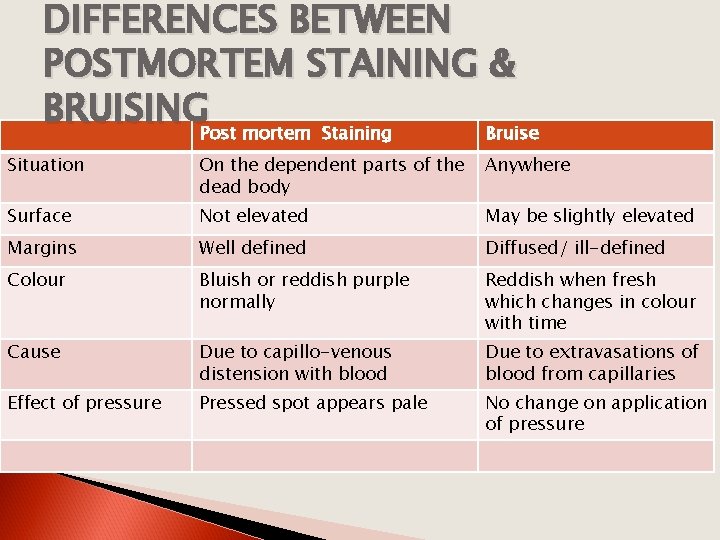
DIFFERENCES BETWEEN POSTMORTEM STAINING & BRUISING Post mortem Staining Bruise Situation On the dependent parts of the dead body Anywhere Surface Not elevated May be slightly elevated Margins Well defined Diffused/ ill-defined Colour Bluish or reddish purple normally Reddish when fresh which changes in colour with time Cause Due to capillo-venous distension with blood Due to extravasations of blood from capillaries Effect of pressure Pressed spot appears pale No change on application of pressure
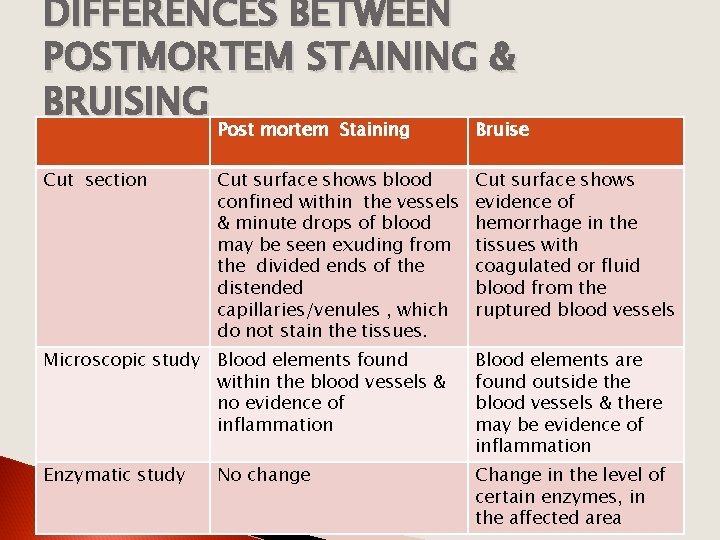
DIFFERENCES BETWEEN POSTMORTEM STAINING & BRUISING Cut section Post mortem Staining Bruise Cut surface shows blood confined within the vessels & minute drops of blood may be seen exuding from the divided ends of the distended capillaries/venules , which do not stain the tissues. Cut surface shows evidence of hemorrhage in the tissues with coagulated or fluid blood from the ruptured blood vessels Microscopic study Blood elements found within the blood vessels & no evidence of inflammation Blood elements are found outside the blood vessels & there may be evidence of inflammation Enzymatic study Change in the level of certain enzymes, in the affected area No change
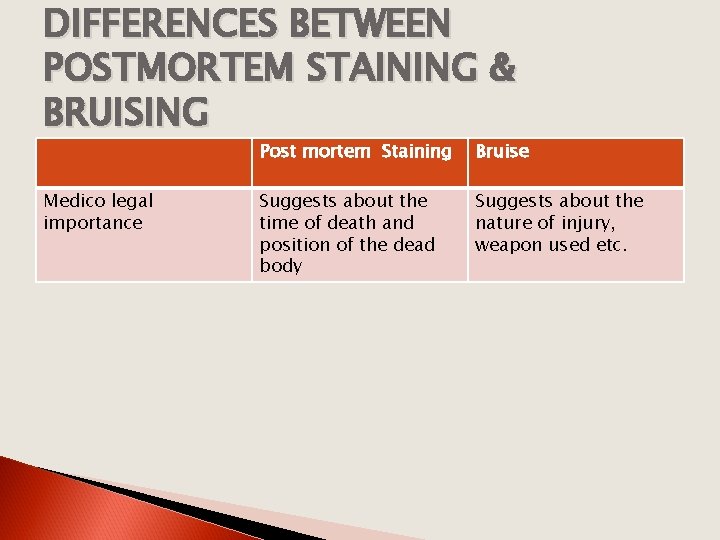
DIFFERENCES BETWEEN POSTMORTEM STAINING & BRUISING Medico legal importance Post mortem Staining Bruise Suggests about the time of death and position of the dead body Suggests about the nature of injury, weapon used etc.
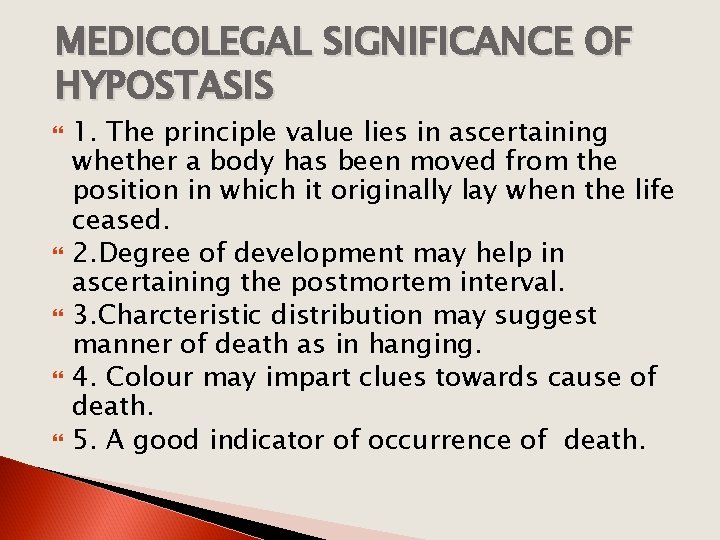
MEDICOLEGAL SIGNIFICANCE OF HYPOSTASIS 1. The principle value lies in ascertaining whether a body has been moved from the position in which it originally lay when the life ceased. 2. Degree of development may help in ascertaining the postmortem interval. 3. Charcteristic distribution may suggest manner of death as in hanging. 4. Colour may impart clues towards cause of death. 5. A good indicator of occurrence of death.