
Estimation of Late Reporting Corrections for Health Indicator

- Slides: 13
Estimation of Late Reporting Corrections for Health Indicator Surveillance Howard Burkom 1, Ph. D Yevgeniy Elbert 2, MSc LTC Julie Pavlin 2, MD MPH Christina Polyak 2, MPH 1 The Johns Hopkins University Applied Physics Laboratory 2 Walter Reed Army Institute for Research Global Emerging Infections Surveillance & Response System San Francisco, CA November 17, 2003 American Public Health Assoc. 131 st Annual Meeting 3. 03. 5. 1~PPT
ESSENCE: An Electronic Surveillance System for the Early Notification of Community-based Epidemics l l l Earlier detection of aberrant clinical patterns at the community level to jump-start response Rapid epidemiology-based targeting of limited response assets (e. g. , personnel and drugs) Communication to reduce the spread of panic and civil unrest 3. 03. 5. 2~PPT
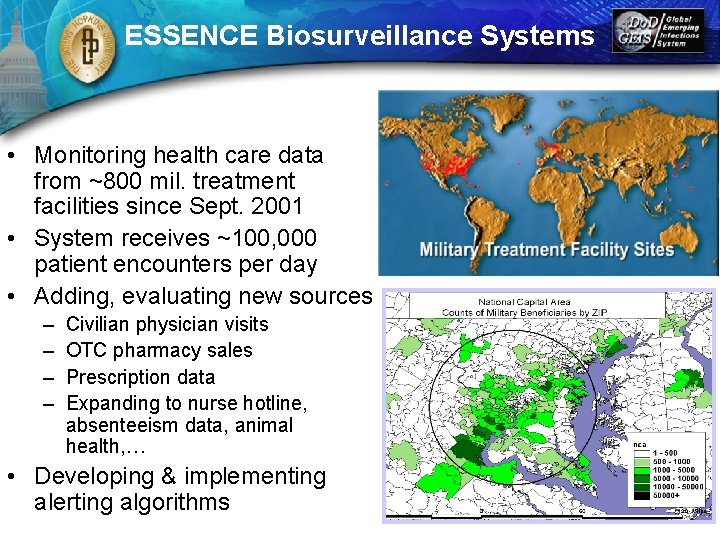
ESSENCE Biosurveillance Systems • Monitoring health care data from ~800 mil. treatment facilities since Sept. 2001 • System receives ~100, 000 patient encounters per day • Adding, evaluating new sources – – Civilian physician visits OTC pharmacy sales Prescription data Expanding to nurse hotline, absenteeism data, animal health, … • Developing & implementing alerting algorithms 3. 03. 5. 3~PPT
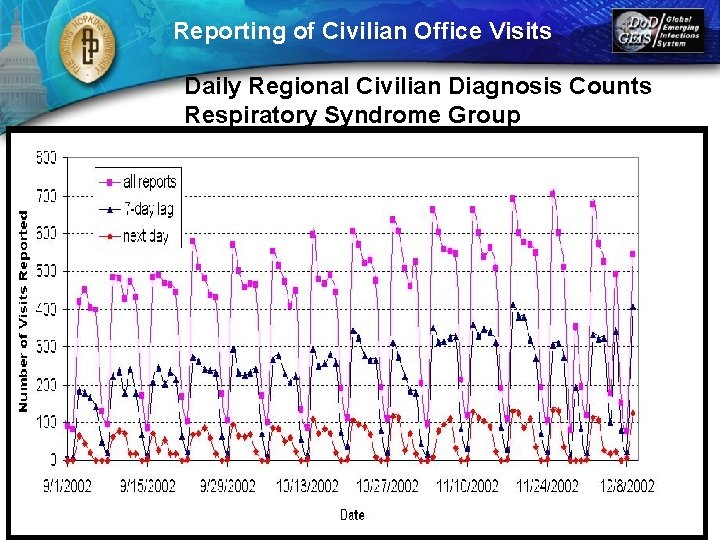
Using Lagged Data Counts for Biosurveillance • ESSENCE II data => hypothesis that earlier stages of an outbreak may be more detectable in office visit (OV) data than in emergency department data – Depends on existence, duration of typical prodrome for underlying disease – How to exploit this for earlier alerting? • BUT, our electronic OV data is reported variably late, depending on individual providers • QUESTION: How can a timely source of data with a reporting lag be used for biosurveillance? 3. 03. 5. 4~PPT
Reporting of Civilian Office Visits Daily Regional Civilian Diagnosis Counts Respiratory Syndrome Group 3. 03. 5. 5~PPT
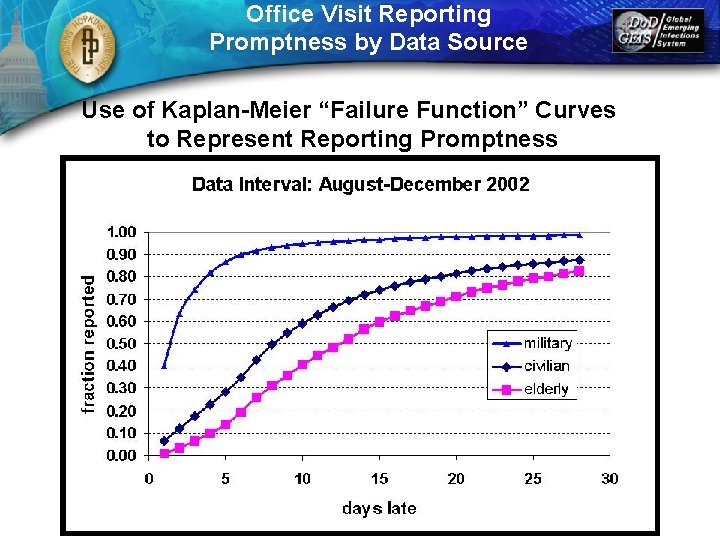
Office Visit Reporting Promptness by Data Source Use of Kaplan-Meier “Failure Function” Curves to Represent Reporting Promptness 3. 03. 5. 6~PPT
Using Lagged Data for Biosurveillance Approaches • Two steps: estimate actual counts, apply algorithm – use recent promptness functions by day-of-week, other covariates – apply lateness factors to recent counts Brookmeyer R, Gail MH, AIDS Epidemiology: A Quantitative Approach. New York: Oxford University Press; 1994; Chapter 7 • Use historically early reporting providers as sentinels • Combined approach: use regression on counts with date and lag as predictors to determine whether recent reported data are anomalous Zeger, SL, See, L-C, Diggle, PJ, “Statistical Methods for Monitoring the AIDS Epidemic”, Statistics in Medicine 8 (1999) • Linear regression using number of providers reporting each day 3. 03. 5. 7~PPT
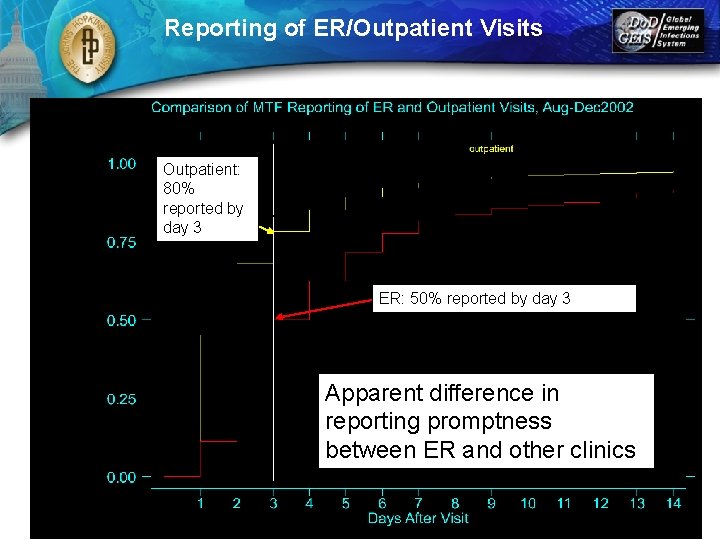
Reporting of ER/Outpatient Visits Outpatient: 80% reported by day 3 ER: 50% reported by day 3 Apparent difference in reporting promptness between ER and other clinics 3. 03. 5. 8~PPT
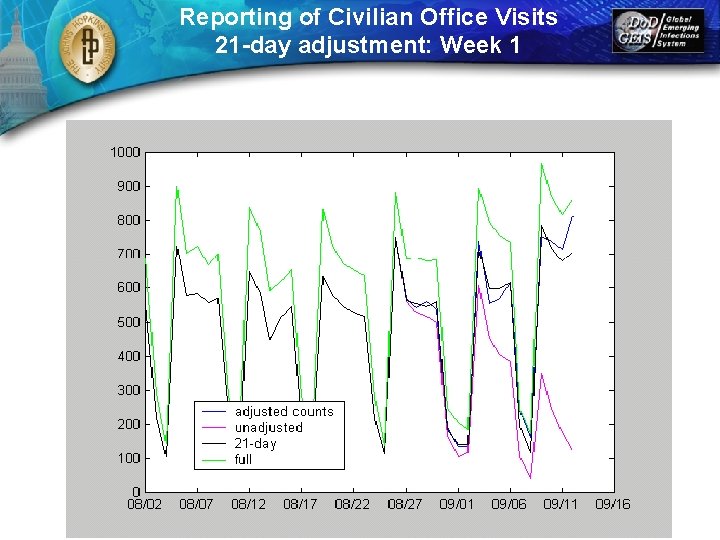
Reporting of Civilian Office Visits 21 -day adjustment: Week 1 3. 03. 5. 9~PPT
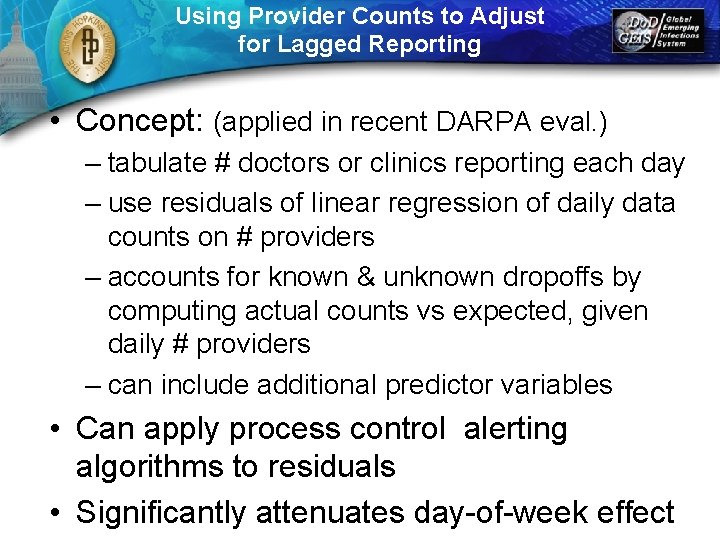
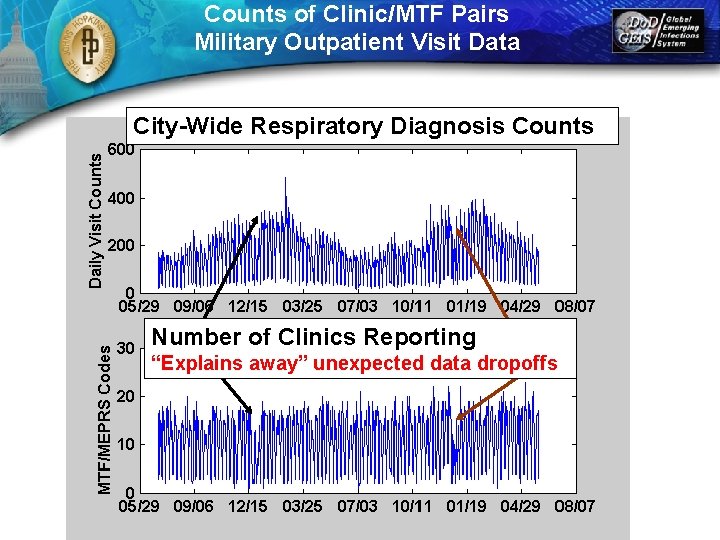
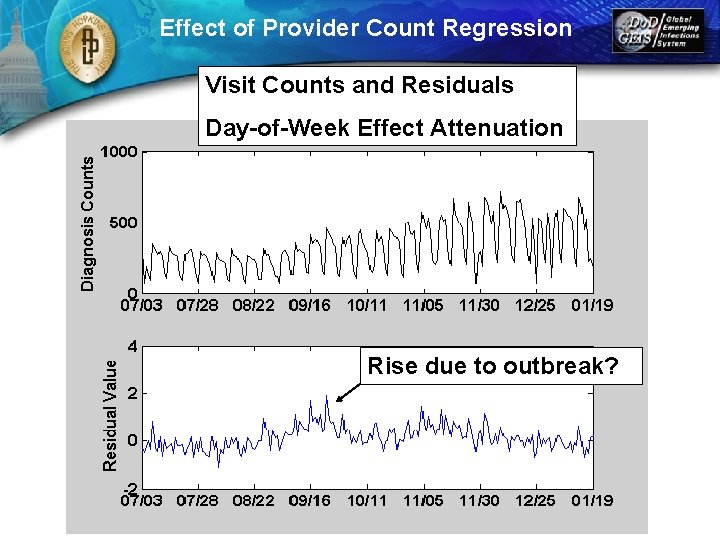
Using Provider Counts to Adjust for Lagged Reporting • Concept: (applied in recent DARPA eval. ) – tabulate # doctors or clinics reporting each day – use residuals of linear regression of daily data counts on # providers – accounts for known & unknown dropoffs by computing actual counts vs expected, given daily # providers – can include additional predictor variables • Can apply process control alerting algorithms to residuals • Significantly attenuates day-of-week effect 3. 03. 5. 10~PPT
Counts of Clinic/MTF Pairs Military Outpatient Visit Data City-Wide Respiratory Diagnosis Counts Number of Clinics Reporting “Explains away” unexpected data dropoffs 3. 03. 5. 11~PPT
Effect of Provider Count Regression Visit Counts and Residuals Day-of-Week Effect Attenuation Rise due to outbreak? 3. 03. 5. 12~PPT
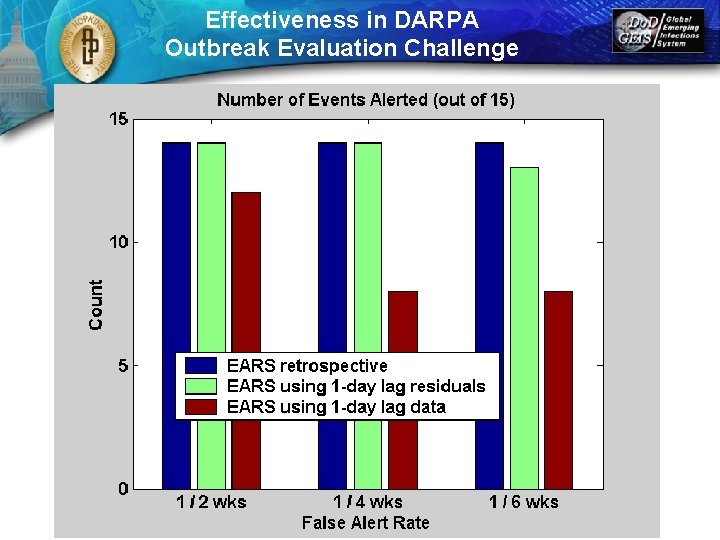
Effectiveness in DARPA Outbreak Evaluation Challenge 3. 03. 5. 13~PPT