
Estimation of Drying Time in spray drying Process

- Slides: 7
Estimation of Drying Time in spray drying Process Food Engineering (DTE - 321) Dr. J. Badshah University Professor – cum - Chief Scientist Dairy Engineering Department Sanjay Gandhi Institute of Dairy Science & Technology, Jagdeopath, Patna (Bihar Animal Sciences University, Patna)
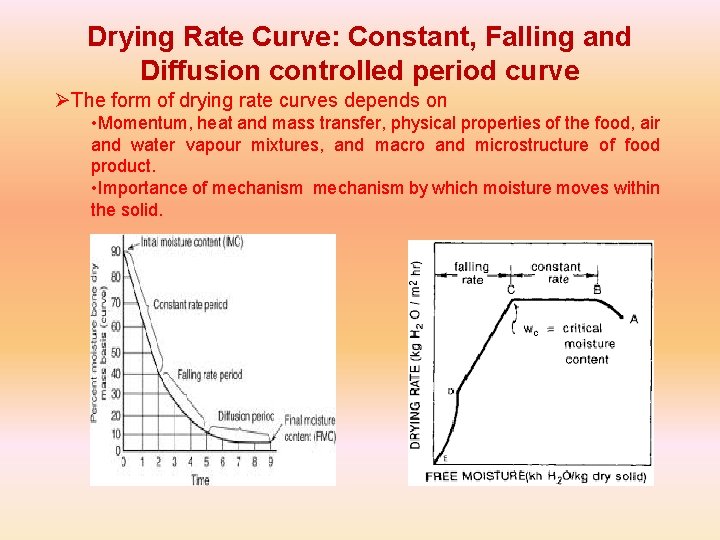
Drying Rate Curve: Constant, Falling and Diffusion controlled period curve ØThe form of drying rate curves depends on • Momentum, heat and mass transfer, physical properties of the food, air and water vapour mixtures, and macro and microstructure of food product. • Importance of mechanism by which moisture moves within the solid.
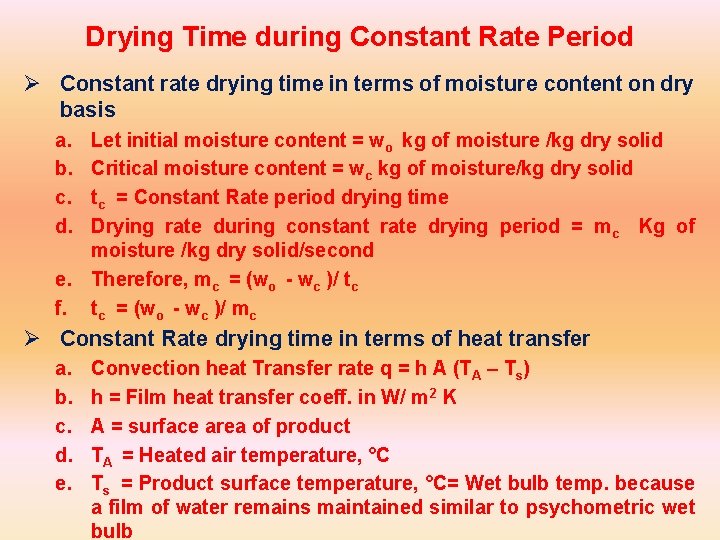
Drying Time during Constant Rate Period Ø Constant rate drying time in terms of moisture content on dry basis a. b. c. d. Let initial moisture content = wo kg of moisture /kg dry solid Critical moisture content = wc kg of moisture/kg dry solid tc = Constant Rate period drying time Drying rate during constant rate drying period = mc Kg of moisture /kg dry solid/second e. Therefore, mc = (wo - wc )/ tc f. tc = (wo - wc )/ mc Ø Constant Rate drying time in terms of heat transfer a. b. c. d. e. Convection heat Transfer rate q = h A (TA – Ts) h = Film heat transfer coeff. in W/ m 2 K A = surface area of product TA = Heated air temperature, °C Ts = Product surface temperature, °C= Wet bulb temp. because a film of water remains maintained similar to psychometric wet bulb
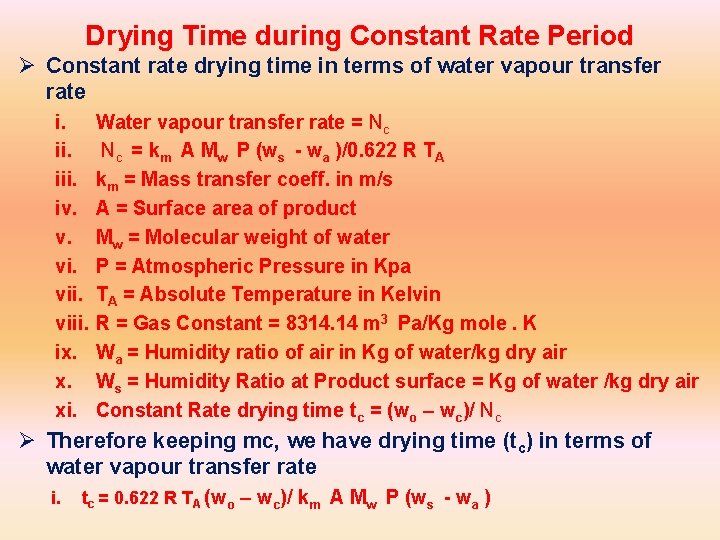
Drying Time during Constant Rate Period Ø Constant rate drying time in terms of water vapour transfer rate i. iii. iv. v. viii. ix. x. xi. Water vapour transfer rate = Nc Nc = km A Mw P (ws - wa )/0. 622 R TA km = Mass transfer coeff. in m/s A = Surface area of product Mw = Molecular weight of water P = Atmospheric Pressure in Kpa TA = Absolute Temperature in Kelvin R = Gas Constant = 8314. 14 m 3 Pa/Kg mole. K Wa = Humidity ratio of air in Kg of water/kg dry air Ws = Humidity Ratio at Product surface = Kg of water /kg dry air Constant Rate drying time tc = (wo – wc)/ Nc Ø Therefore keeping mc, we have drying time (tc) in terms of water vapour transfer rate i. tc = 0. 622 R TA (wo – wc)/ km A Mw P (ws - wa )
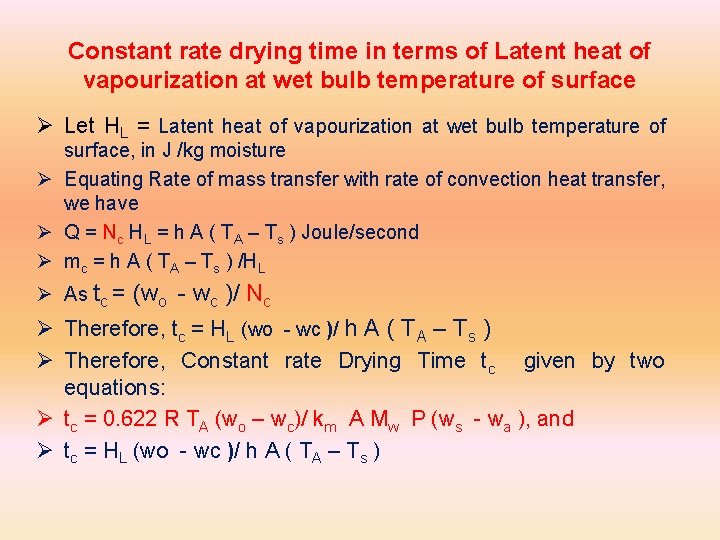
Constant rate drying time in terms of Latent heat of vapourization at wet bulb temperature of surface Ø Let HL = Latent heat of vapourization at wet bulb temperature of surface, in J /kg moisture Ø Equating Rate of mass transfer with rate of convection heat transfer, we have Ø Q = Nc HL = h A ( TA – Ts ) Joule/second Ø mc = h A ( TA – Ts ) /HL Ø As tc = (wo - wc )/ Nc Ø Therefore, tc = HL (wo - wc )/ h A ( TA – Ts ) Ø Therefore, Constant rate Drying Time tc given by two equations: Ø tc = 0. 622 R TA (wo – wc)/ km A Mw P (ws - wa ), and Ø tc = HL (wo - wc )/ h A ( TA – Ts )
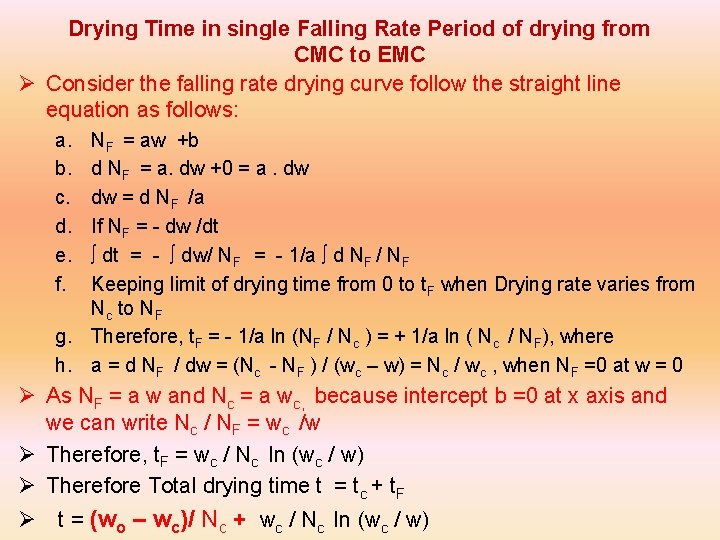
Drying Time in single Falling Rate Period of drying from CMC to EMC Ø Consider the falling rate drying curve follow the straight line equation as follows: a. b. c. d. e. f. NF = aw +b d NF = a. dw +0 = a. dw dw = d NF /a If NF = - dw /dt ∫ dt = - ∫ dw/ NF = - 1/a ∫ d NF / NF Keeping limit of drying time from 0 to t. F when Drying rate varies from Nc to NF g. Therefore, t. F = - 1/a ln (NF / Nc ) = + 1/a ln ( Nc / NF), where h. a = d NF / dw = (Nc - NF ) / (wc – w) = Nc / wc , when NF =0 at w = 0 Ø As NF = a w and Nc = a wc, because intercept b =0 at x axis and we can write Nc / NF = wc /w Ø Therefore, t. F = wc / Nc ln (wc / w) Ø Therefore Total drying time t = tc + t. F Ø t = (wo – wc)/ Nc + wc / Nc ln (wc / w)