
Estimation of a Normal Process Variance from Measurements

- Slides: 22
Estimation of a Normal Process Variance from Measurements with Large Round-Off Errors Diamanta Benson-Karhi, the Open University of Israel Edna Schechtman, Ben-Gurion University 1 Diamanta Benson-Karhi 22: 17 08/03/2021
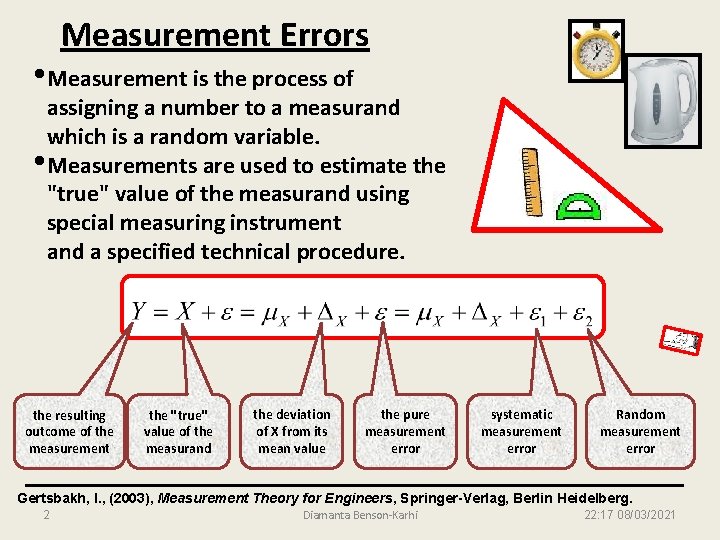
Measurement Errors • Measurement is the process of assigning a number to a measurand which is a random variable. • Measurements are used to estimate the "true" value of the measurand using special measuring instrument and a specified technical procedure. the resulting outcome of the measurement the "true" value of the measurand the deviation of X from its mean value the pure measurement error systematic measurement error Random measurement error Gertsbakh, I. , (2003), Measurement Theory for Engineers, Springer-Verlag, Berlin Heidelberg. 2 Diamanta Benson-Karhi 22: 17 08/03/2021
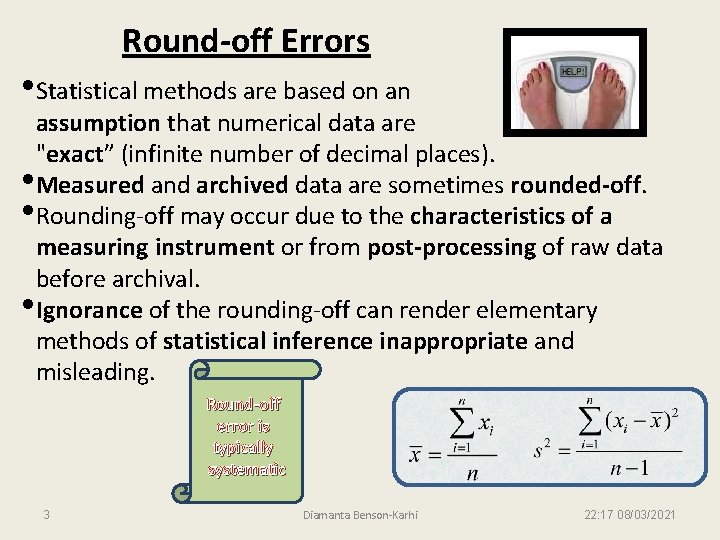
Round-off Errors • Statistical methods are based on an assumption that numerical data are "exact” (infinite number of decimal places). • Measured and archived data are sometimes rounded-off. • Rounding-off may occur due to the characteristics of a measuring instrument or from post-processing of raw data before archival. • Ignorance of the rounding-off can render elementary methods of statistical inference inappropriate and misleading. Round-off error is typically systematic 3 Diamanta Benson-Karhi 22: 17 08/03/2021
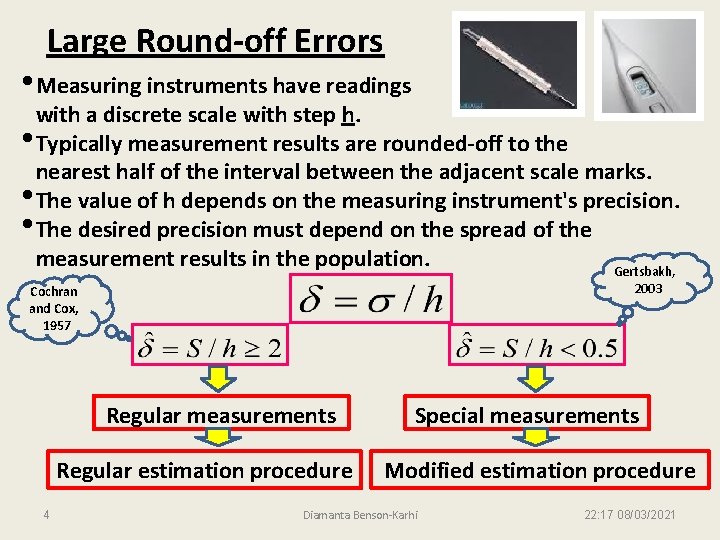
Large Round-off Errors • Measuring instruments have readings with a discrete scale with step h. • Typically measurement results are rounded-off to the nearest half of the interval between the adjacent scale marks. • The value of h depends on the measuring instrument's precision. • The desired precision must depend on the spread of the measurement results in the population. Gertsbakh, 2003 Cochran and Cox, 1957 Regular measurements Regular estimation procedure 4 Special measurements Modified estimation procedure Diamanta Benson-Karhi 22: 17 08/03/2021
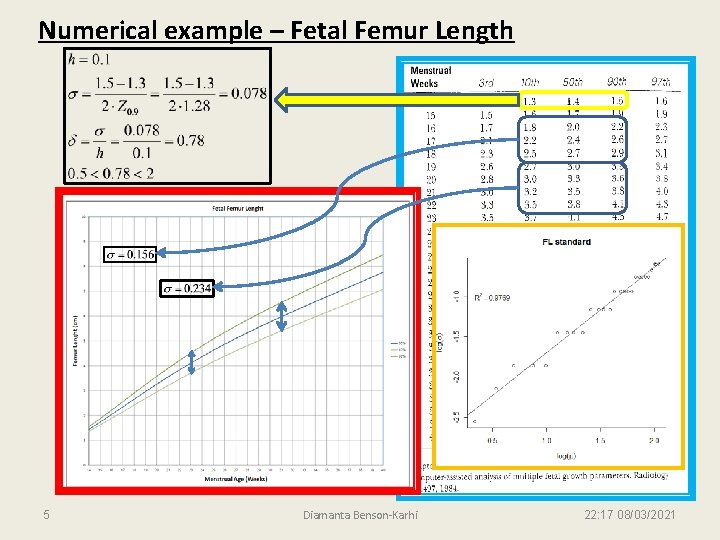
Numerical example – Fetal Femur Length 5 Diamanta Benson-Karhi 22: 17 08/03/2021
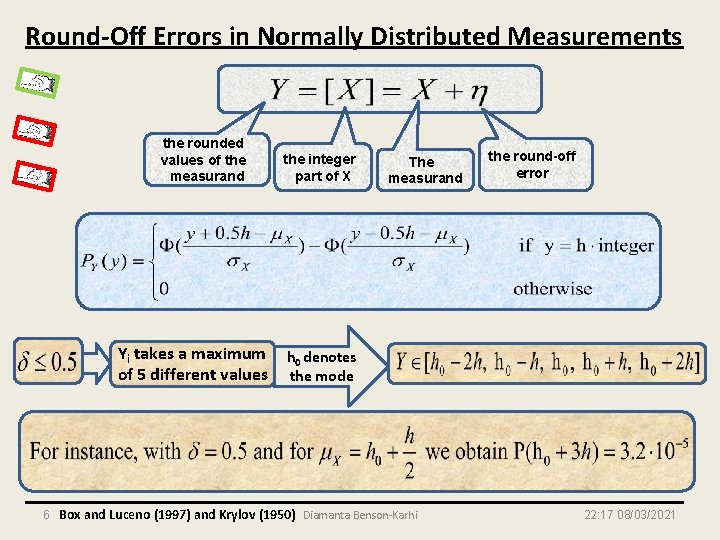
Round-Off Errors in Normally Distributed Measurements the rounded values of the measurand Yi takes a maximum of 5 different values the integer part of X The measurand the round-off error h 0 denotes the mode 6 Box and Luceno (1997) and Krylov (1950) Diamanta Benson-Karhi 22: 17 08/03/2021
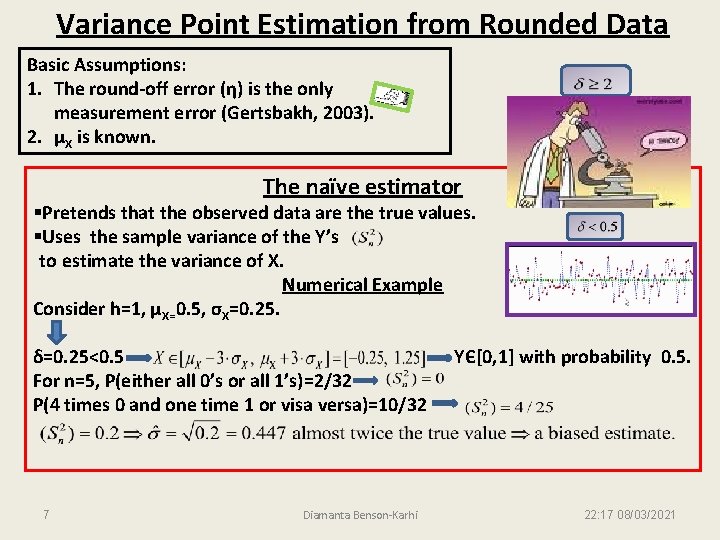
Variance Point Estimation from Rounded Data Basic Assumptions: 1. The round-off error (η) is the only measurement error (Gertsbakh, 2003). 2. μX is known. The naïve estimator §Pretends that the observed data are the true values. §Uses the sample variance of the Y’s to estimate the variance of X. Numerical Example Consider h=1, μX=0. 5, σX=0. 25. δ=0. 25<0. 5 For n=5, P(either all 0’s or all 1’s)=2/32 P(4 times 0 and one time 1 or visa versa)=10/32 7 Diamanta Benson-Karhi YЄ[0, 1] with probability 0. 5. 22: 17 08/03/2021
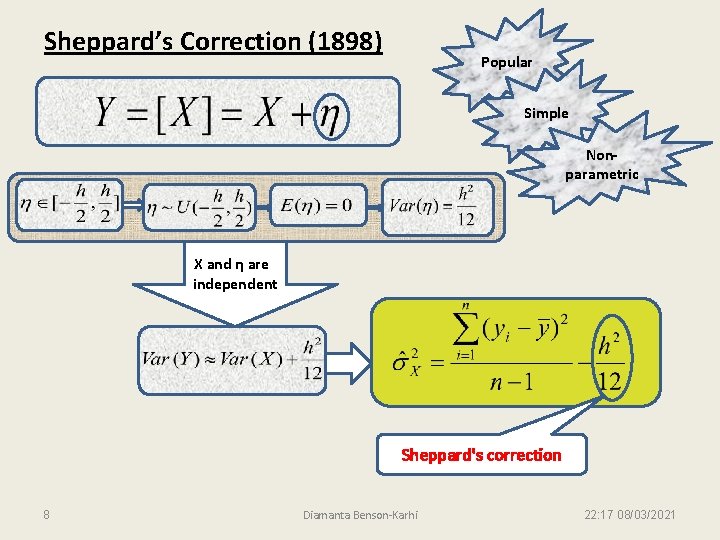
Sheppard’s Correction (1898) Popular Simple Nonparametric X and η are independent Sheppard's correction 8 Diamanta Benson-Karhi 22: 17 08/03/2021
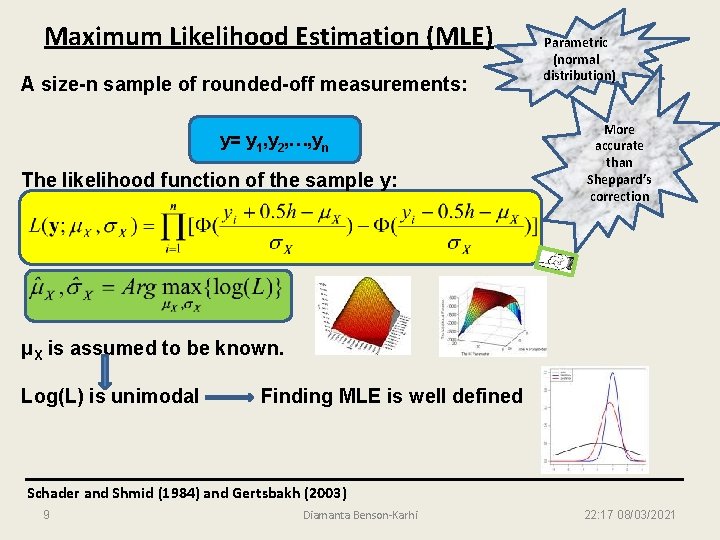
Maximum Likelihood Estimation (MLE) A size-n sample of rounded-off measurements: y= y 1, y 2, …, yn The likelihood function of the sample y: Parametric (normal distribution) More accurate than Sheppard’s correction μX is assumed to be known. Log(L) is unimodal Finding MLE is well defined Schader and Shmid (1984) and Gertsbakh (2003) 9 Diamanta Benson-Karhi 22: 17 08/03/2021
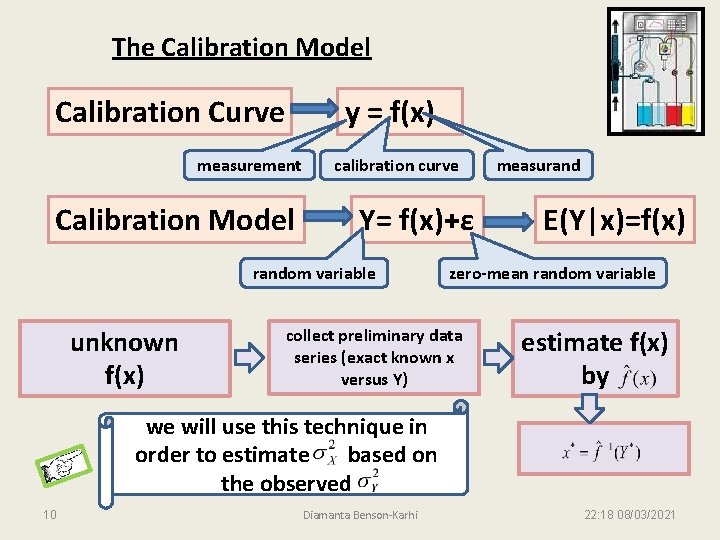
The Calibration Model Calibration Curve y = f(x) measurement Calibration Model calibration curve Y= f(x)+ε random variable unknown f(x) measurand E(Y|x)=f(x) zero-mean random variable collect preliminary data series (exact known x versus Y) estimate f(x) by we will use this technique in order to estimate based on the observed 10 Diamanta Benson-Karhi 22: 18 08/03/2021
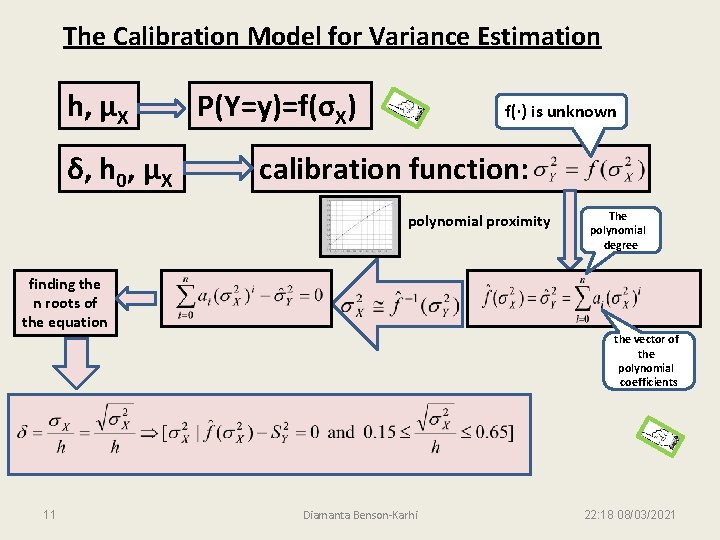
The Calibration Model for Variance Estimation h, μX δ, h 0, μX P(Y=y)=f(σX) f(·) is unknown calibration function: polynomial proximity The polynomial degree finding the n roots of the equation the vector of the polynomial coefficients 11 Diamanta Benson-Karhi 22: 18 08/03/2021
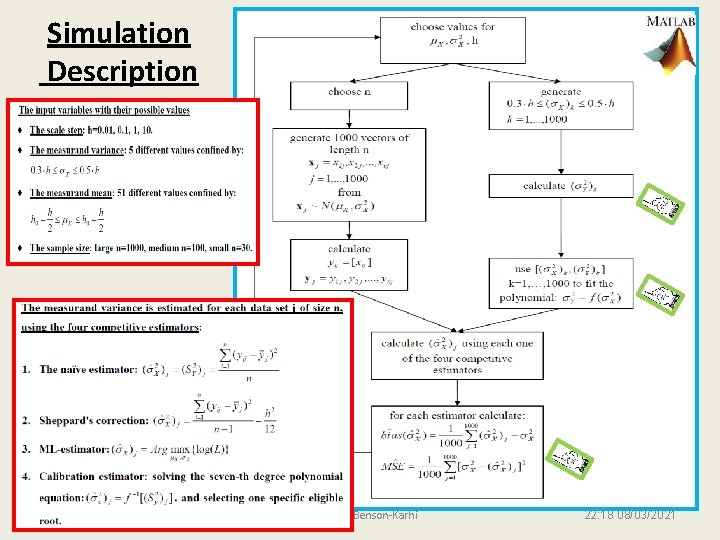
Simulation Description 12 Diamanta Benson-Karhi 22: 18 08/03/2021
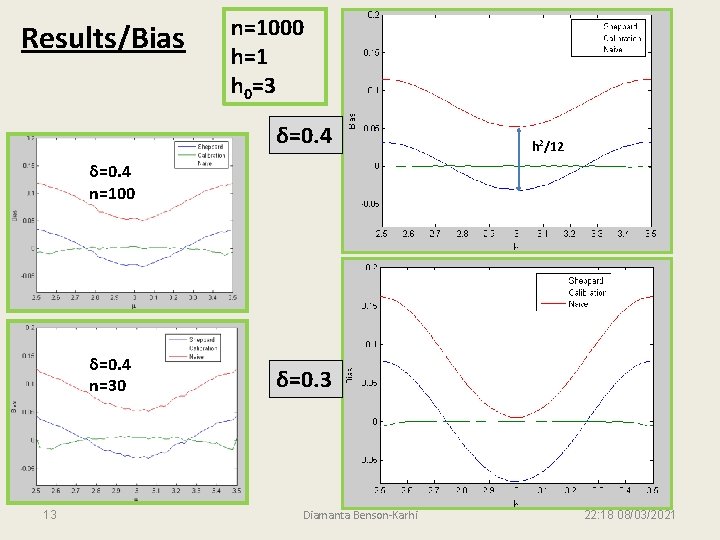
Results/Bias n=1000 h=1 h 0=3 δ=0. 4 h 2/12 δ=0. 4 n=100 δ=0. 4 n=30 13 δ=0. 3 Diamanta Benson-Karhi 22: 18 08/03/2021
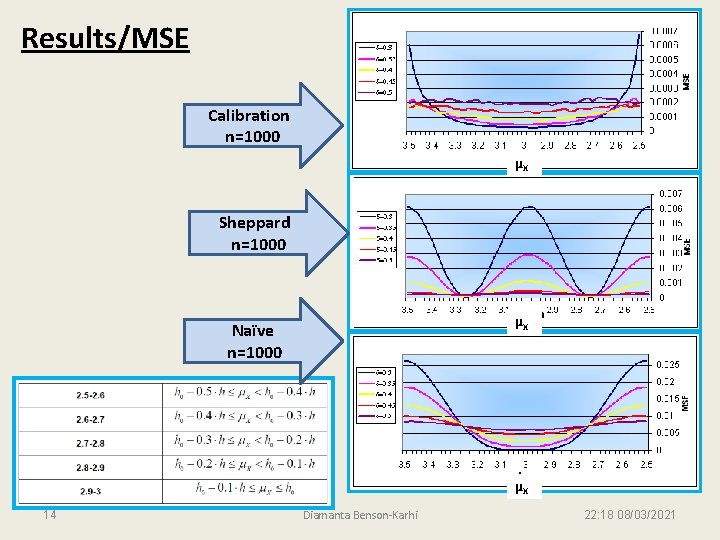
Results/MSE Calibration n=1000 μX Sheppard n=1000 μX Naïve n=1000 μX 14 Diamanta Benson-Karhi 22: 18 08/03/2021
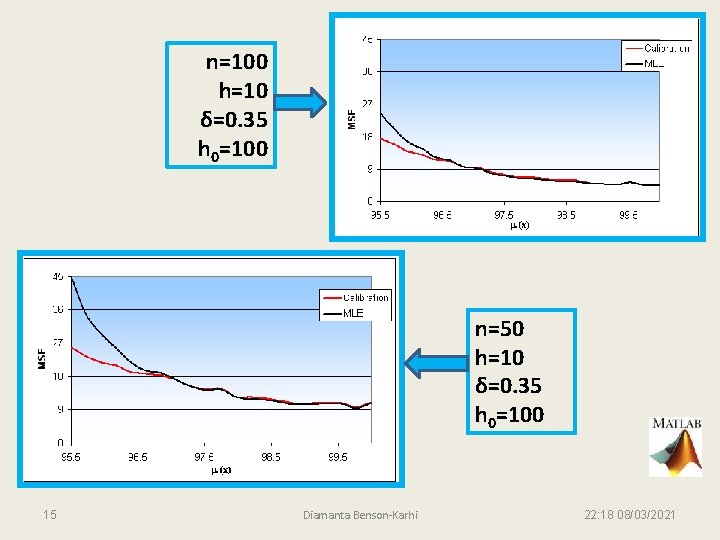
n=100 h=10 δ=0. 35 h 0=100 n=50 h=10 δ=0. 35 h 0=100 15 Diamanta Benson-Karhi 22: 18 08/03/2021
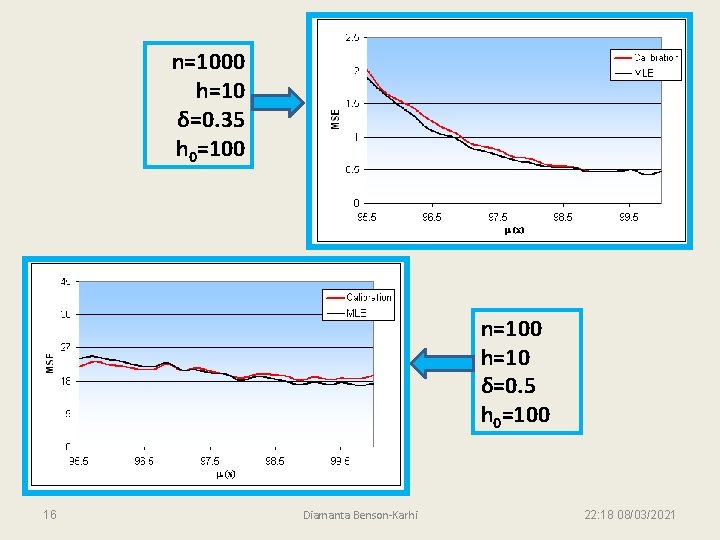
n=1000 h=10 δ=0. 35 h 0=100 n=100 h=10 δ=0. 5 h 0=100 16 Diamanta Benson-Karhi 22: 18 08/03/2021
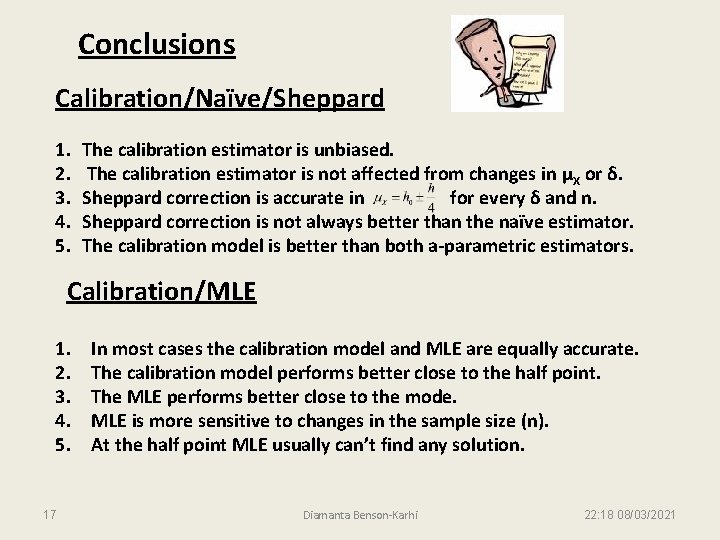
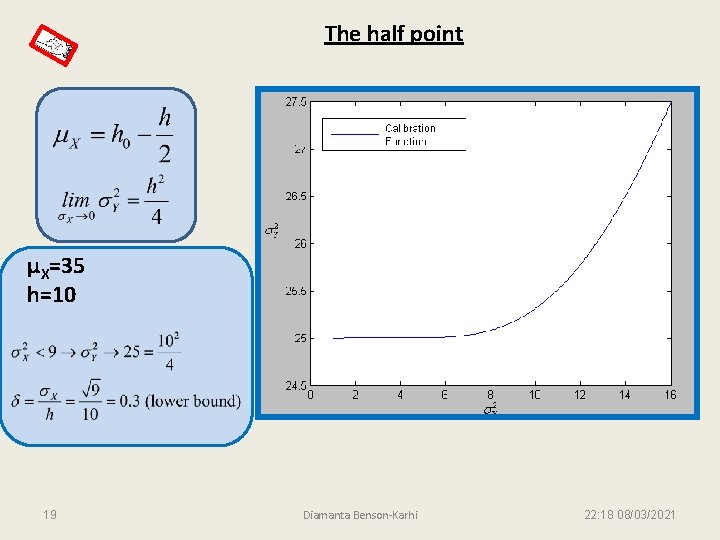
Conclusions Calibration/Naïve/Sheppard 1. 2. 3. 4. 5. The calibration estimator is unbiased. The calibration estimator is not affected from changes in μX or δ. Sheppard correction is accurate in for every δ and n. Sheppard correction is not always better than the naïve estimator. The calibration model is better than both a-parametric estimators. Calibration/MLE 1. 2. 3. 4. 5. 17 In most cases the calibration model and MLE are equally accurate. The calibration model performs better close to the half point. The MLE performs better close to the mode. MLE is more sensitive to changes in the sample size (n). At the half point MLE usually can’t find any solution. Diamanta Benson-Karhi 22: 18 08/03/2021
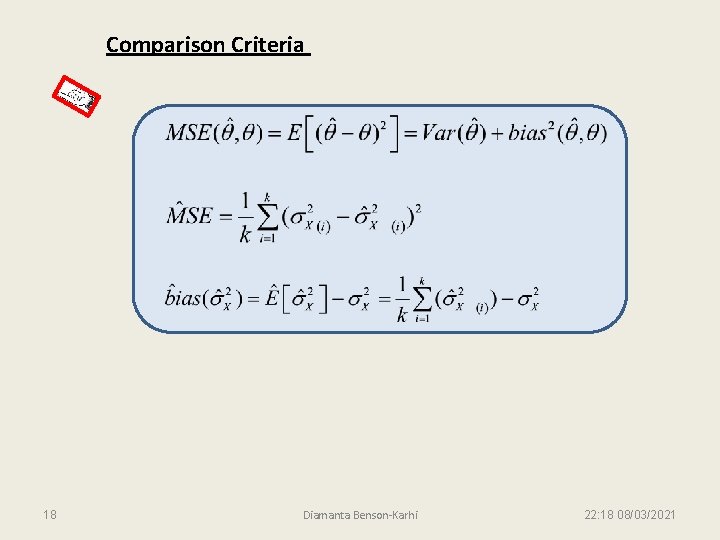
Comparison Criteria 18 Diamanta Benson-Karhi 22: 18 08/03/2021
The half point μX=35 h=10 19 Diamanta Benson-Karhi 22: 18 08/03/2021
20 Diamanta Benson-Karhi 22: 18 08/03/2021
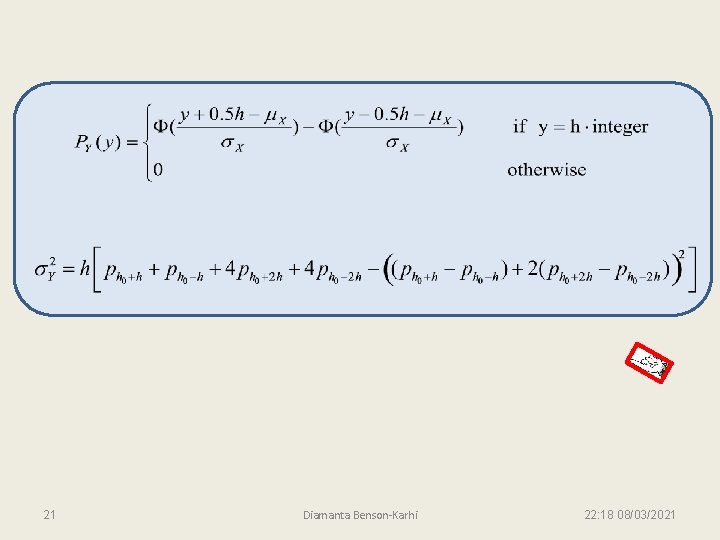
21 Diamanta Benson-Karhi 22: 18 08/03/2021
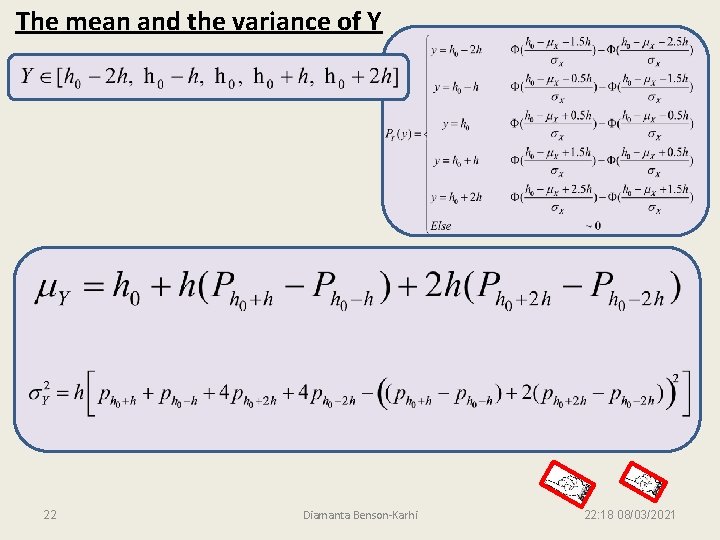
The mean and the variance of Y 22 Diamanta Benson-Karhi 22: 18 08/03/2021