
Estimating with Fractions and Mixed Numbers LESSON 3

Estimating with Fractions and Mixed Numbers LESSON 3 -1 Course 2 Problem of the Day Determine if and where Will and Pedro will meet if they start driving from the same intersection. Pedro travels 2 blocks east, 2 blocks south, 2 blocks east, and 2 blocks north. Will starts traveling 2 blocks north, 4 blocks east, and 2 blocks south. Yes, they will meet 4 blocks east. Lesson Main Lesson 3 -1 Feature
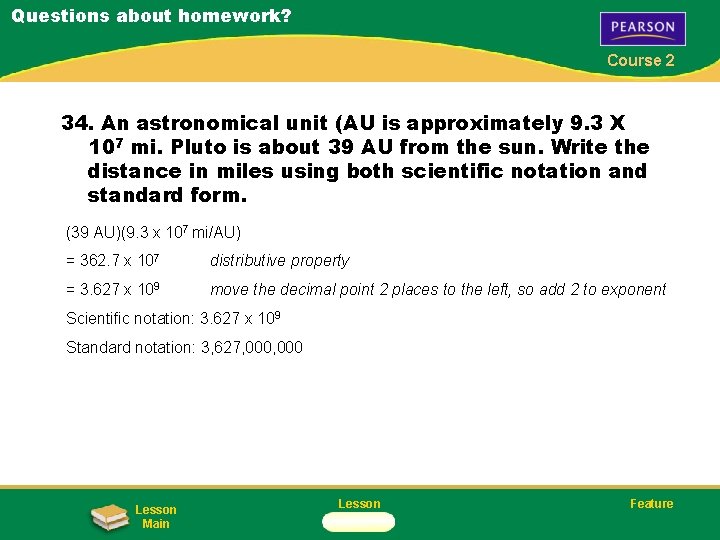
Questions about homework? Course 2 34. An astronomical unit (AU is approximately 9. 3 X 10⁷ mi. Pluto is about 39 AU from the sun. Write the distance in miles using both scientific notation and standard form. (39 AU)(9. 3 x 10⁷ mi/AU) = 362. 7 x 10⁷ distributive property = 3. 627 x 109 move the decimal point 2 places to the left, so add 2 to exponent Scientific notation: 3. 627 x 109 Standard notation: 3, 627, 000 Lesson Main Lesson Feature
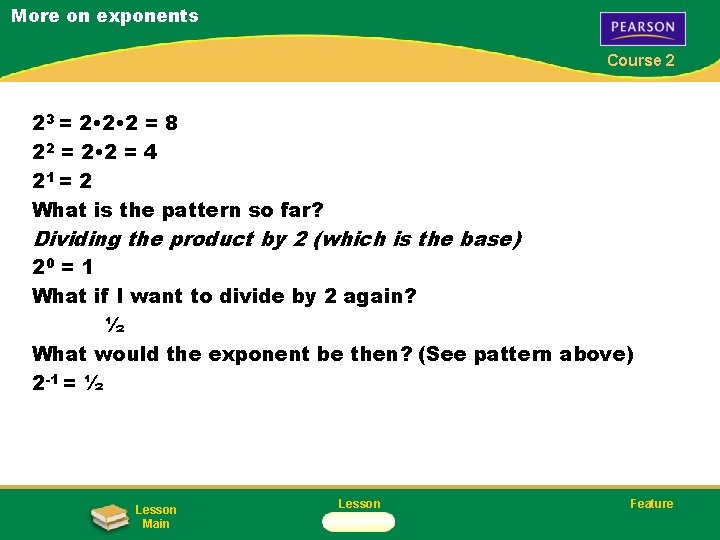
More on exponents Course 2 23 = 2 • 2 = 8 22 = 2 • 2 = 4 21 = 2 What is the pattern so far? Dividing the product by 2 (which is the base) 20 = 1 What if I want to divide by 2 again? ½ What would the exponent be then? (See pattern above) 2 -1 = ½ Lesson Main Lesson Feature
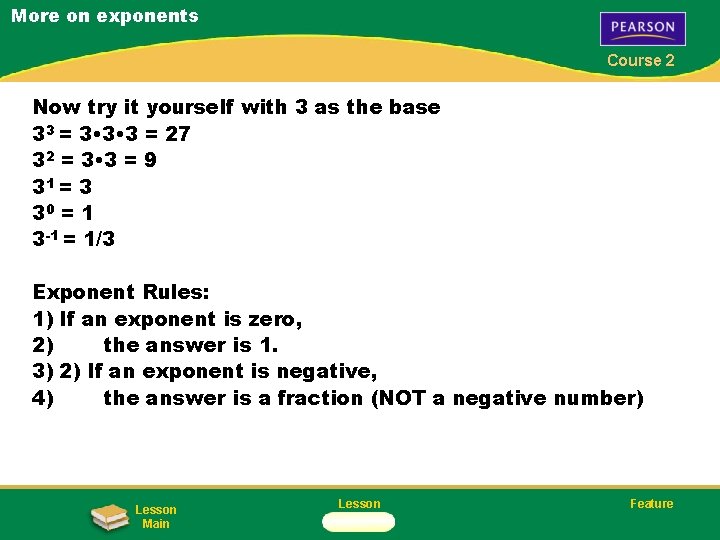
More on exponents Course 2 Now try it yourself with 3 as the base 33 = 3 • 3 = 27 32 = 3 • 3 = 9 31 = 3 30 = 1 3 -1 = 1/3 Exponent Rules: 1) If an exponent is zero, 2) the answer is 1. 3) 2) If an exponent is negative, 4) the answer is a fraction (NOT a negative number) Lesson Main Lesson Feature
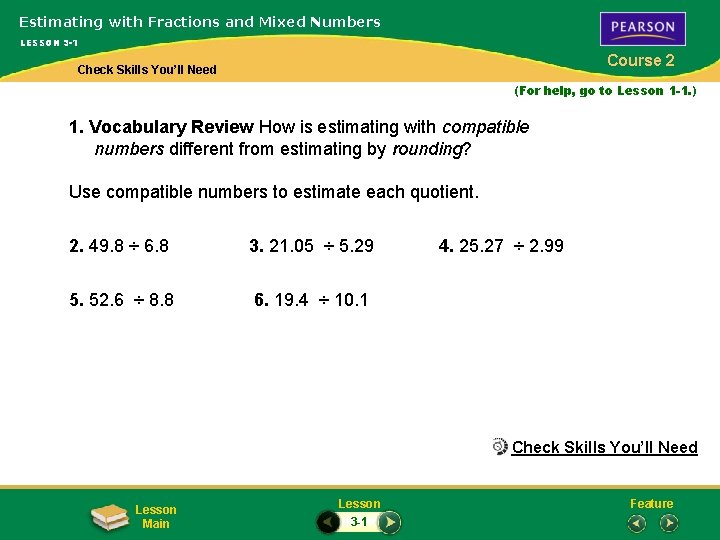
Estimating with Fractions and Mixed Numbers LESSON 3 -1 Course 2 Check Skills You’ll Need (For help, go to Lesson 1 -1. ) 1. Vocabulary Review How is estimating with compatible numbers different from estimating by rounding? Use compatible numbers to estimate each quotient. 2. 49. 8 ÷ 6. 8 3. 21. 05 ÷ 5. 29 5. 52. 6 ÷ 8. 8 6. 19. 4 ÷ 10. 1 4. 25. 27 ÷ 2. 99 Check Skills You’ll Need Lesson Main Lesson 3 -1 Feature
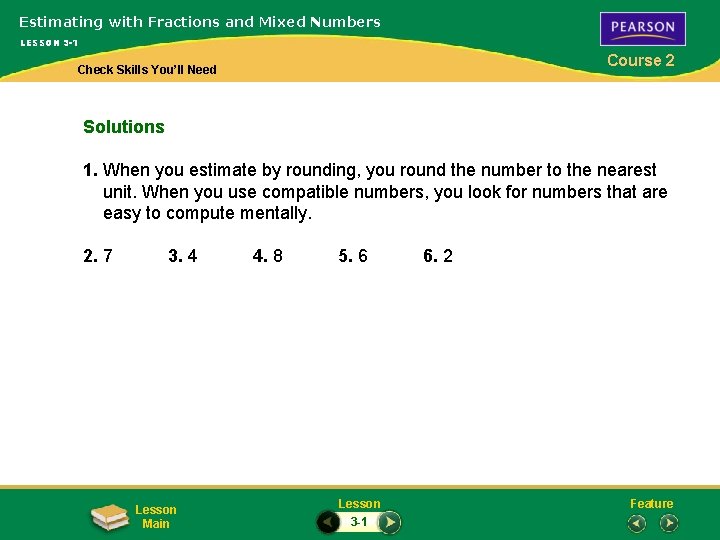
Estimating with Fractions and Mixed Numbers LESSON 3 -1 Course 2 Check Skills You’ll Need Solutions 1. When you estimate by rounding, you round the number to the nearest unit. When you use compatible numbers, you look for numbers that are easy to compute mentally. 2. 7 3. 4 Lesson Main 4. 8 5. 6 Lesson 3 -1 6. 2 Feature
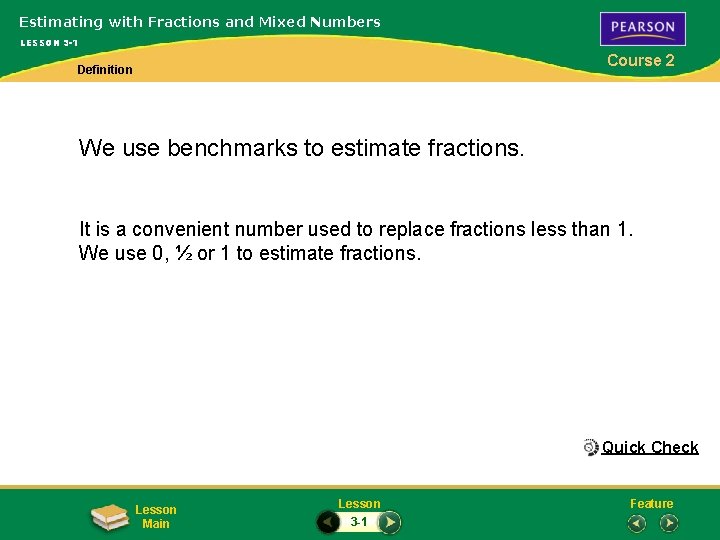
Estimating with Fractions and Mixed Numbers LESSON 3 -1 Course 2 Definition We use benchmarks to estimate fractions. It is a convenient number used to replace fractions less than 1. We use 0, ½ or 1 to estimate fractions. Quick Check Lesson Main Lesson 3 -1 Feature
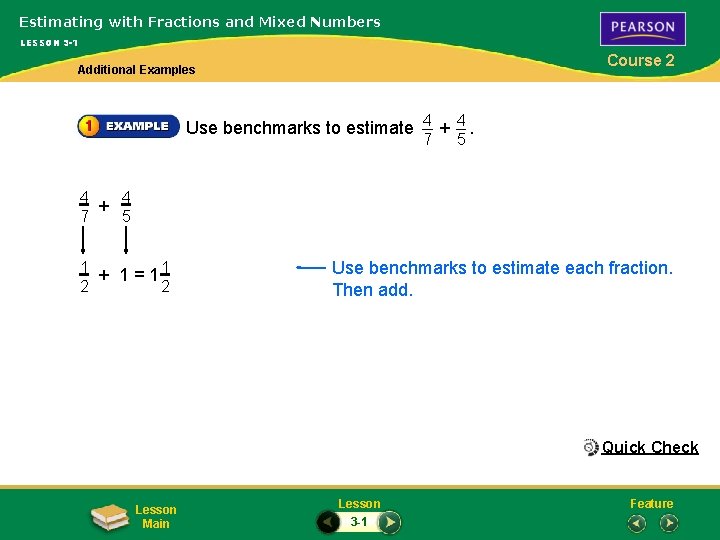
Estimating with Fractions and Mixed Numbers LESSON 3 -1 Course 2 Additional Examples Use benchmarks to estimate 4 + 4. 7 5 4 4 + 7 5 1 + 1 = 11 2 2 Use benchmarks to estimate each fraction. Then add. Quick Check Lesson Main Lesson 3 -1 Feature
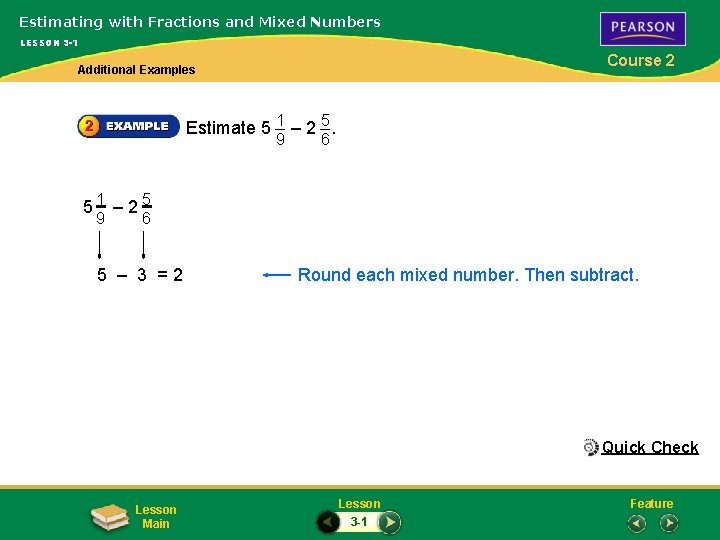
Estimating with Fractions and Mixed Numbers LESSON 3 -1 Course 2 Additional Examples Estimate 5 1 – 2 5. 9 6 51 – 2 5 9 6 5 – 3 =2 Round each mixed number. Then subtract. Quick Check Lesson Main Lesson 3 -1 Feature
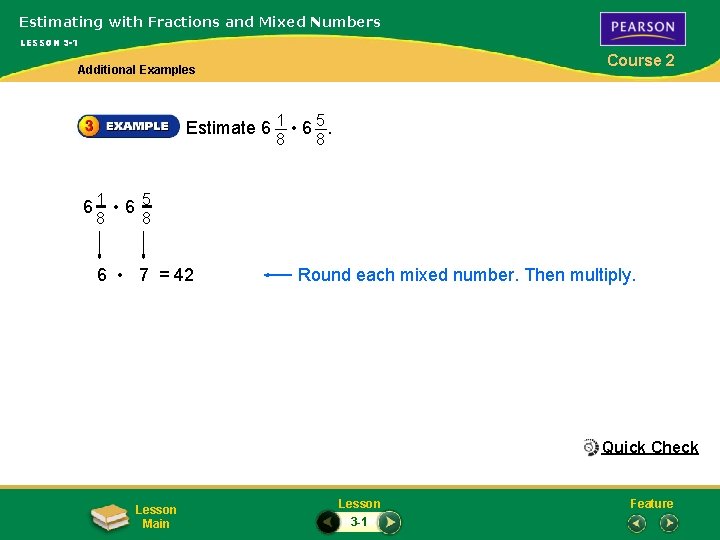
Estimating with Fractions and Mixed Numbers LESSON 3 -1 Course 2 Additional Examples Estimate 6 1 • 6 5. 8 8 61 • 6 5 8 8 6 • 7 = 42 Round each mixed number. Then multiply. Quick Check Lesson Main Lesson 3 -1 Feature
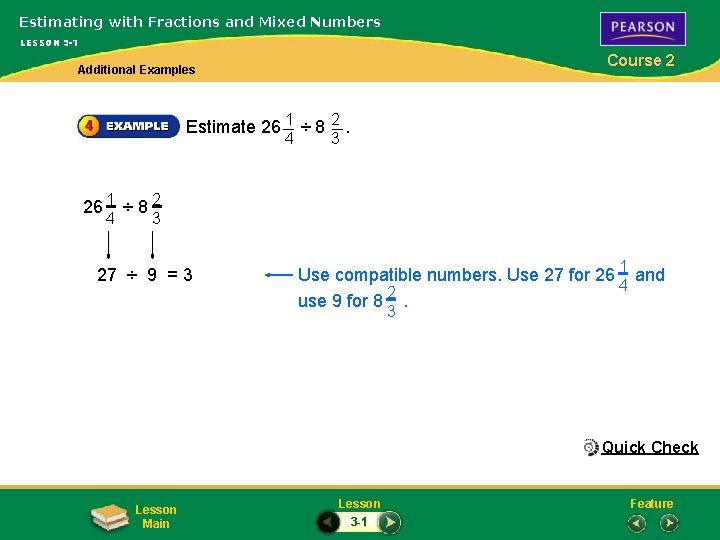
Estimating with Fractions and Mixed Numbers LESSON 3 -1 Course 2 Additional Examples Estimate 26 1 ÷ 8 2. 4 3 26 1 ÷ 8 2 4 3 27 ÷ 9 = 3 1 Use compatible numbers. Use 27 for 26 and 4 2 use 9 for 8. 3 Quick Check Lesson Main Lesson 3 -1 Feature
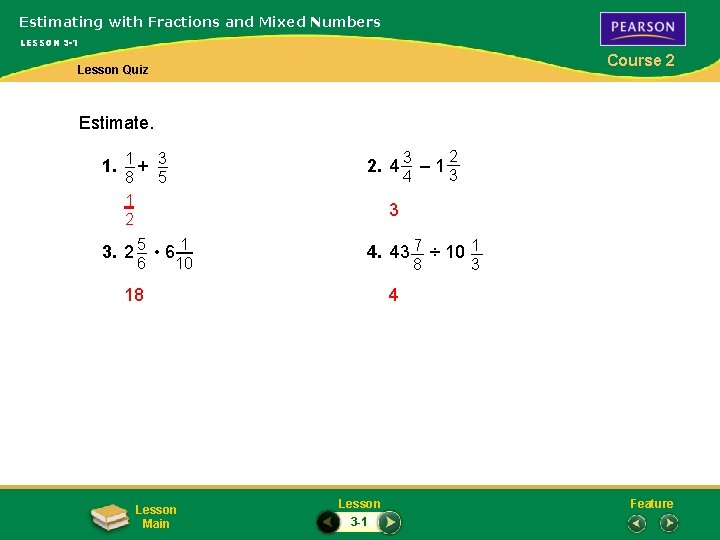
Estimating with Fractions and Mixed Numbers LESSON 3 -1 Course 2 Lesson Quiz Estimate. 2. 4 3 – 1 1. 1 + 3 8 1 2 4 5 2 3 3 3. 2 5 • 6 10 4. 43 7 ÷ 10 1 8 18 Lesson Main 3 4 Lesson 3 -1 Feature
Course 2 Adding and Subtracting Fractions Lesson 3 -2 Lesson Main Lesson Feature
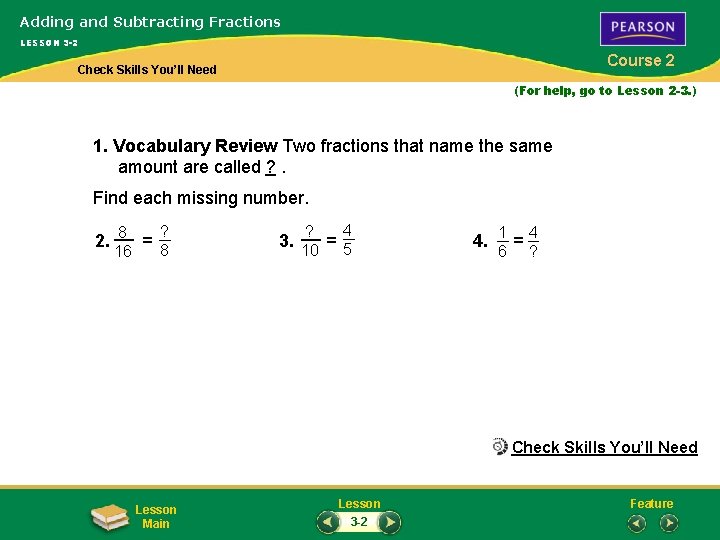
Adding and Subtracting Fractions LESSON 3 -2 Course 2 Check Skills You’ll Need (For help, go to Lesson 2 -3. ) 1. Vocabulary Review Two fractions that name the same amount are called ? . Find each missing number. 2. ? 8 = 8 16 ? 4 3. 10 = 5 4. 1 4 = 6 ? Check Skills You’ll Need Lesson Main Lesson 3 -2 Feature
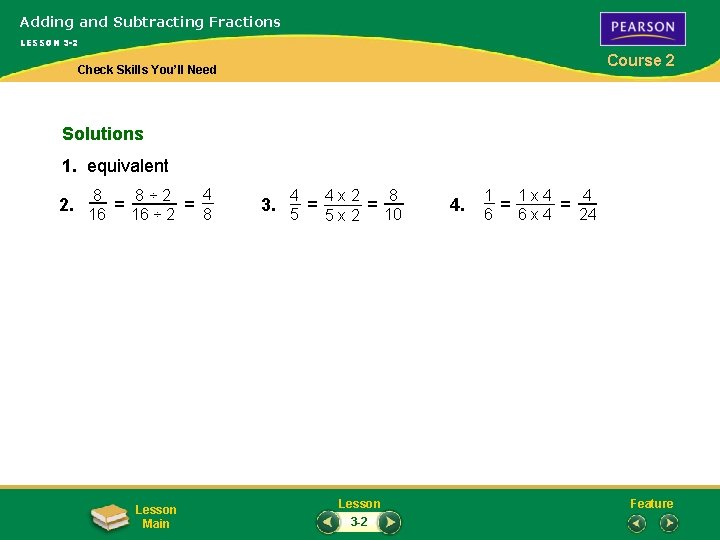
Adding and Subtracting Fractions LESSON 3 -2 Course 2 Check Skills You’ll Need Solutions 1. equivalent 2. 4 8 8÷ 2 = = 8 16 16 ÷ 2 Lesson Main 3. 4 8 4 x 2 = = 5 10 5 x 2 Lesson 3 -2 4. 1 4 1 x 4 = = 6 24 6 x 4 Feature
Course 2 When adding and subtracting fractions, the first step is to check that the denominators of all the addends are the same. Lesson Main Lesson Feature
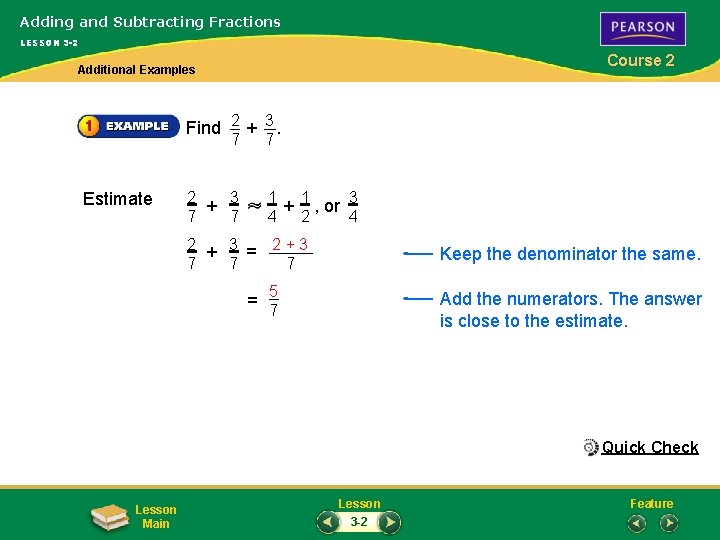
Adding and Subtracting Fractions LESSON 3 -2 Course 2 Additional Examples Find 2 + 3. 7 Estimate 7 2 3 + 7 7 1 1 3 + , or 4 2 + 3 = 2+3 7 7 7 = Keep the denominator the same. 5 7 Add the numerators. The answer is close to the estimate. Quick Check Lesson Main Lesson 3 -2 Feature
Course 2 When adding and subtracting fractions, the first step is to check that the denominators of all the addends are the same. What if the denominators are not the same? (Hint: equivalent fractions) Lesson Main Lesson Feature
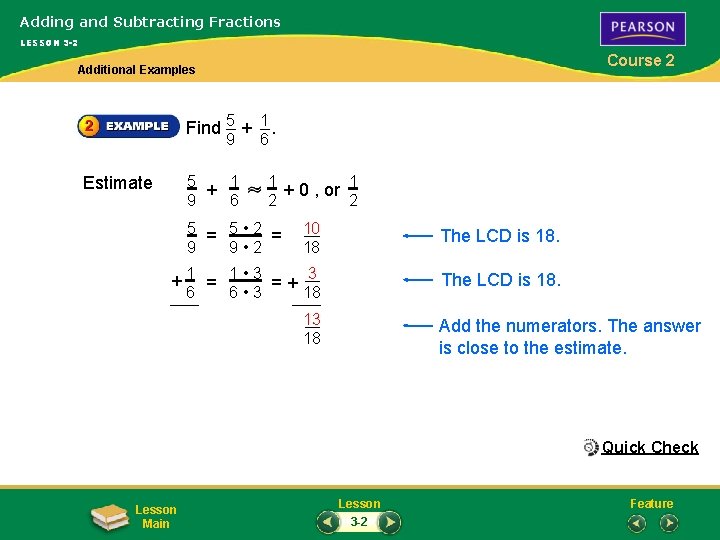
Adding and Subtracting Fractions LESSON 3 -2 Course 2 Additional Examples Find 5 + 1. 9 6 5 1 + 9 6 Estimate 1 1 + 0 , or 2 2 5 = 5 • 2 = 9 9 • 2 10 18 The LCD is 18. +1 = 1 • 3 =+ 3 The LCD is 18. 6 6 • 3 18 13 18 Add the numerators. The answer is close to the estimate. Quick Check Lesson Main Lesson 3 -2 Feature
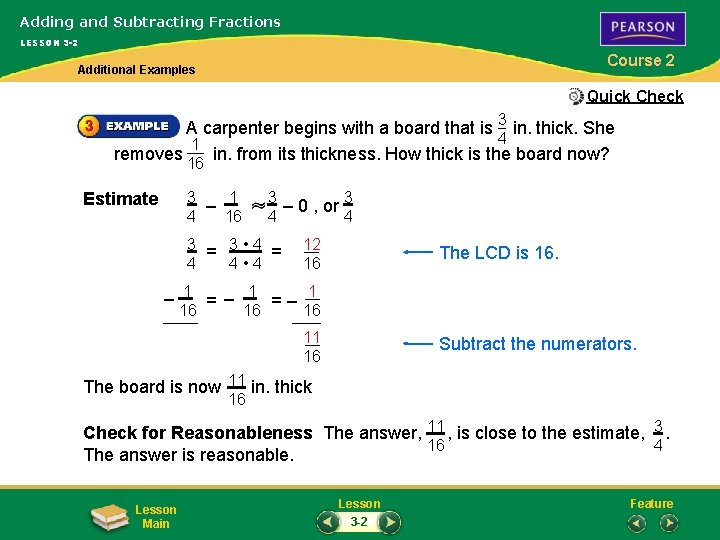
Adding and Subtracting Fractions LESSON 3 -2 Course 2 Additional Examples Quick Check A carpenter begins with a board that is 3 in. thick. She 4 1 removes in. from its thickness. How thick is the board now? 16 3 1 – 4 16 Estimate 3 3 – 0 , or 4 4 3 = 3 • 4 = 4 4 • 4 12 16 The LCD is 16. – 1 =– 1 16 16 16 11 16 Subtract the numerators. The board is now 11 in. thick 16 Check for Reasonableness The answer, 11 , is close to the estimate, 3. 16 4 The answer is reasonable. Lesson Main Lesson 3 -2 Feature
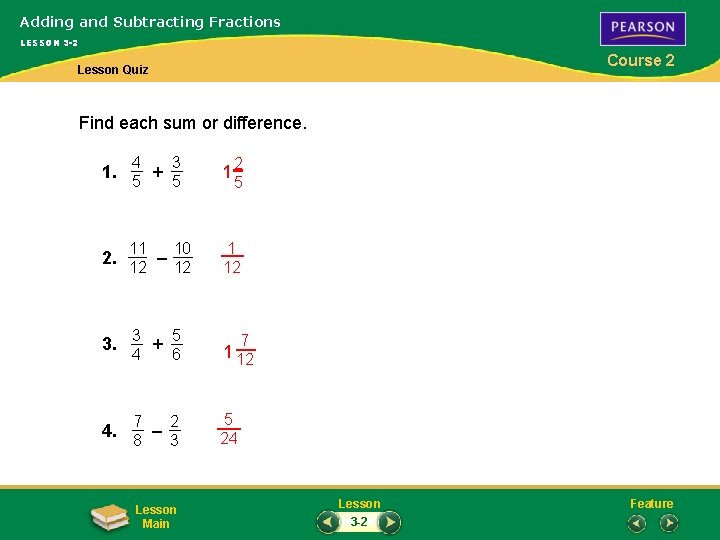
Adding and Subtracting Fractions LESSON 3 -2 Course 2 Lesson Quiz Find each sum or difference. 4 3 1. 5 + 5 1 2 5 2. 11 10 – 12 12 1 12 3. 3 5 + 4 6 1 12 4. 7 2 – 8 3 5 24 Lesson Main 7 Lesson 3 -2 Feature
Course 2 Homework: • Lesson 3 -1: pp. 122 – 123, #s 1, 2, 12 - 44 evens • Lesson 3 -2: pp. 128 -129, #s 26 -46 evens • Get quiz signed (Lesson 2 -1 to 2 -4) Lesson Main Lesson 3 -1 Feature
- Slides: 22