
ESTIMATING THE UNCERTAINTY IN A MULTI RESIDUE METHOD
- Slides: 1
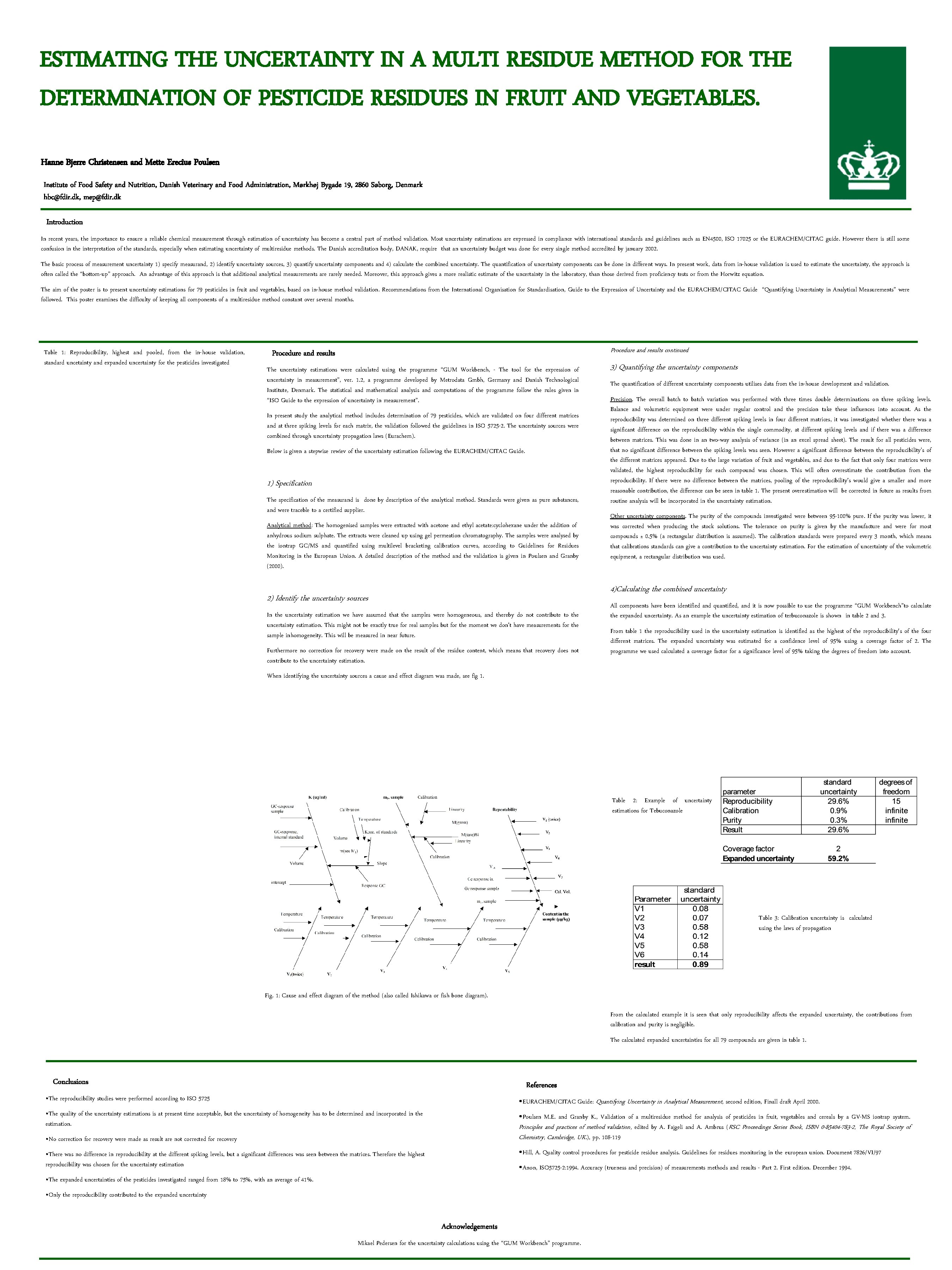
ESTIMATING THE UNCERTAINTY IN A MULTI RESIDUE METHOD FOR THE DETERMINATION OF PESTICIDE RESIDUES IN FRUIT AND VEGETABLES. Hanne Bjerre Christensen and Mette Erecius Poulsen Institute of Food Safety and Nutrition, Danish Veterinary and Food Administration, Mørkhøj Bygade 19, 2860 Søborg, Denmark hbc@fdir. dk, mep@fdir. dk Introduction In recent years, the importance to ensure a reliable chemical measurement through estimation of uncertainty has become a central part of method validation. Most uncertainty estimations are expressed in compliance with international standards and guidelines such as EN 4500, ISO 17025 or the EURACHEM/CITAC guide. However there is still some confusion in the interpretation of the standards, especially when estimating uncertainty of multiresidue methods. The Danish accreditation body, DANAK, require that an uncertainty budget was done for every single method accredited by january 2002. The basic process of measurement uncertainty 1) specify measurand, 2) identify uncertainty sources, 3) quantify uncertainty components and 4) calculate the combined uncertainty. The quantification of uncertainty components can be done in different ways. In present work, data from in-house validation is used to estimate the uncertainty, the approach is often called the “bottom-up” approach. An advantage of this approach is that additional analytical measurements are rarely needed. Moreover, this approach gives a more realistic estimate of the uncertainty in the laboratory, than those derived from proficiency tests or from the Horwitz equation. The aim of the poster is to present uncertainty estimations for 79 pesticides in fruit and vegetables, based on in-house method validation. Recommendations from the International Organisation for Standardisation, Guide to the Expression of Uncertainty and the EURACHEM/CITAC Guide “Quantifying Uncertainty in Analytical Measurements” were followed. This poster examines the difficulty of keeping all components of a multiresidue method constant over several months. Table 1: Reproducibility, highest and pooled, from the in-house validation, standard uncetainty and expanded uncertainty for the pesticides investigated Procedure and results continued Procedure and results The uncertainty estimations were calculated using the programme “GUM Workbench, - The tool for the expression of uncertainty in measurement”, ver. 1. 2, a programme developed by Metrodata Gmbh, Germany and Danish Technological Institute, Denmark. The statistical and mathematical analysis and computations of the programme follow the rules given in “ISO Guide to the expression of uncertainty in measurement”. In present study the analytical method includes determination of 79 pesticides, which are validated on four different matrices and at three spiking levels for each matrix, the validation followed the guidelines in ISO 5725 -2. The uncertainty sources were combined through uncertainty propagation laws (Eurachem). Below is given a stepwise rewiev of the uncertainty estimation following the EURACHEM/CITAC Guide. 1) Specification The specification of the measurand is done by description of the analytical method. Standards were given as pure substances, and were traceble to a certified supplier. Analytical method: The homogenised samples were extracted with acetone and ethyl acetate: cyclohexane under the addition of anhydrous sodium sulphate. The extracts were cleaned up using gel permeation chromatography. The samples were analysed by the iontrap GC/MS and quantified using multilevel bracketing calibration curves, according to Guidelines for Residues Monitoring in the European Union. A detailed description of the method and the validation is given in Poulsen and Granby (2000). 3) Quantifying the uncertainty components The quantification of different uncertainty components utilises data from the in-house development and validation. Precision. The overall batch to batch variation was performed with three times double determinations on three spiking levels. Balance and volumetric equipment were under regular control and the precision take these influences into account. As the reproducibility was determined on three different spiking levels in four different matrices, it was investigated whethere was a significant difference on the reproducibility within the single commodity, at different spiking levels and if there was a difference between matrices. This was done in an two-way analysis of variance (in an excel spread sheet). The result for all pesticides were, that no significant difference between the spiking levels was seen. However a significant difference between the reproducibility’s of the different matrices appeared. Due to the large variation of fruit and vegetables, and due to the fact that only four matrices were validated, the highest reproducibility for each compound was chosen. This will often overestimate the contribution from the reproducibility. If there were no difference between the matrices, pooling of the reproducibility's would give a smaller and more reasonable contribution, the difference can be seen in table 1. The present overestimation will be corrected in future as results from routine analysis will be incorporated in the uncertainty estimation. Other uncertainty components. The purity of the compounds investigated were between 95 -100% pure. If the purity was lower, it was corrected when producing the stock solutions. The tolerance on purity is given by the manufacture and were for most compounds ± 0. 5% (a rectangular distribution is assumed). The calibration standards were prepared every 3 month, which means that calibrations standards can give a contribution to the uncertainty estimation. For the estimation of uncertainty of the volumetric equipment, a rectangular distribution was used. 4)Calculating the combined uncertainty 2) Identify the uncertainty sources In the uncertainty estimation we have assumed that the samples were homogeneous, and thereby do not contribute to the uncertainty estimation. This might not be exactly true for real samples but for the moment we don't have measurements for the sample inhomogeneity. This will be measured in near future. Furthermore no correction for recovery were made on the result of the residue content, which means that recovery does not contribute to the uncertainty estimation. All components have been identified and quantified, and it is now possible to use the programme “GUM Workbench”to calculate the expanded uncertainty. As an example the uncertainty estimation of terbuconazole is shown in table 2 and 3. From table 1 the reproducibility used in the uncertainty estimation is identified as the highest of the reproducibility's of the four different matrices. The expanded uncertainty was estimated for a confidence level of 95% using a coverage factor of 2. The programme we used calculated a coverage factor for a significance level of 95% taking the degrees of freedom into account. When identifying the uncertainty sources a cause and effect diagram was made, see fig 1. Table 2: Example of uncertainty estimations for Tebuconazole Table 3: Calibration uncertainty is calculated using the laws of propagation Fig. 1: Cause and effect diagram of the method (also called Ishikawa or fish bone diagram). From the calculated example it is seen that only reproducibility affects the expanded uncertainty, the contributions from calibration and purity is negligible. The calculated expanded uncertainties for all 79 compounds are given in table 1. Conclusions References • The reproducibility studies were performed according to ISO 5725 • EURACHEM/CITAC Guide: Quantifying Uncertainty in Analytical Measurement, second edition, Finall draft April 2000. • Poulsen M. E. and Granby K. , Validation of a multiresidue method for analysis of pesticides in fruit, vegetables and cereals by a GV-MS iontrap system. • The quality of the uncertainty estimations is at present time acceptable, but the uncertainty of homogeneity has to be determined and incorporated in the estimation. Principles and practices of method validation, edited by A. Fajgeli and A. Ambrus (RSC Proceedings Series Book, ISBN 0 -85404 -783 -2, The Royal Society of Chemistry, Cambridge, UK. ), pp. 108 -119 • No correction for recovery were made as result are not corrected for recovery • Hill, A. Quality control procedures for pesticide residue analysis. Guidelines for residues monitoring in the european union. Document 7826/VI/97 • Anon, ISO 5725 -2: 1994. Accuracy (trueness and precision) of measurements methods and results - Part 2. First edition. December 1994. • There was no difference in reproducibility at the different spiking levels, but a significant differences was seen between the matrices. Therefore the highest reproducibility was chosen for the uncertainty estimation • The expanded uncertainties of the pesticides investigated ranged from 18% to 75%, with an average of 41%. • Only the reproducibility contributed to the expanded uncertainty Acknowledgements Mikael Pedersen for the uncertainty calculations using the “GUM Workbench” programme.