
ESTIMATING THE EFFECT OF HOME COURT ADVANTAGE IN
- Slides: 18
ESTIMATING THE EFFECT OF HOME COURT ADVANTAGE IN THE NBA Jason Kotecki
Introduction • During the 2012 -13 NBA season, the Houston Rockets compiled a record of 45 -37 • The Rockets had a road record of just 16 -25, but they were 29 -12 at home • The Utah Jazz won 30 games at home last year, but they only won 13 on the road • How can this big difference in records be explained? • Home Court Advantage
Home Court Advantage • Home court advantage is “the consistent finding that home teams win over 50% of the games played under a balanced schedule. ” • Each NBA team plays 41 games at home and on the road • They also play each team at least twice, once at home, once on the road
Research Hypothesis • But, how much of a factor does home court advantage have in producing wins? • Logit regression with a dependent variable of wins • I hypothesize that home court advantage exists, and that it can be explained mostly by fan attendance, familiarity with the court, and referee bias
Literature Review • Well-Established in the literature • Carron et al. (2005) • Design a conceptual framework for analyzing home court advantage • Game location factors, critical and psychological behavioral states, and performance outcomes
Game Location Factors • Crowd factors, learning/familiarity factors, travel factors, and rule factors • Schwartz and Barsky (1977) • Compared home advantages between baseball, football, hockey and college basketball • Home advantage is greatest in indoor sports and primarily due to fan support rather than any other factor
Game Location Factors • The literature dealing with crowd factors and attendance is extensive • Forrest et al. (2005); Greer (1983); Nevill (1999); Nevill et al. (1996); Smith (2005) • Salminen (1993) • Fan audiences cheering for the home team is not related to greater home team success • Ashman et al. (2010) and Nutting (2010) • Game Frequency
Critical/Psychological Behavioral States • These deal with how coaches, competitors, and officials affect the outcome of the game • Referee Bias • Carron et al. (2005); Page and Page (2010); Moskowitz and Wertheim (2011)
Performance Outcomes • Statistically based variables • Performance based analysis • Harville and Smith (1994); Cao et al. (2011)
Theory • Stefan Kesenne’s “Economic Theory of Professional Sports” • Win maximizing • Shirking • Katie Stankiewicz (2009) • Players are less likely to shirk in front of their home fans • Referee Bias Theory • Psychological theory that people want to be liked and to be confirmed in their judgments
Data • Basketball-reference. com • Statistics for every NBA team for every year • NBA. com • Attendance for every game • All teams and almost all games* for three season (2008 -11) - 3, 642 game entries
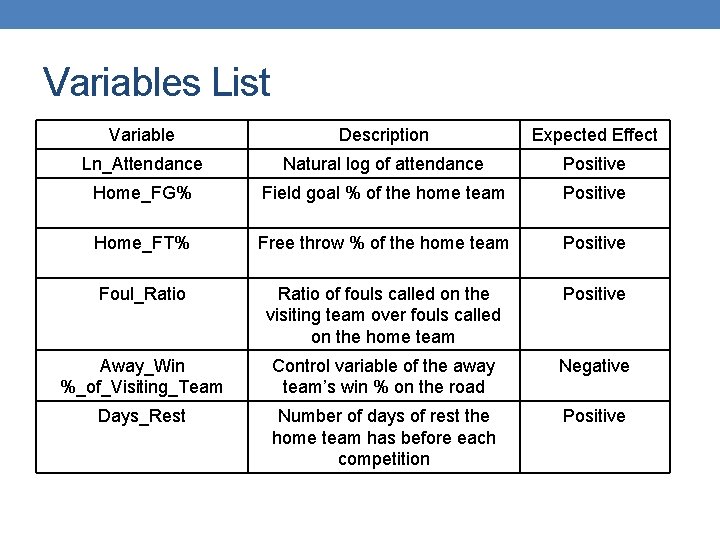
Variables List Variable Description Expected Effect Ln_Attendance Natural log of attendance Positive Home_FG% Field goal % of the home team Positive Home_FT% Free throw % of the home team Positive Foul_Ratio of fouls called on the visiting team over fouls called on the home team Positive Away_Win %_of_Visiting_Team Control variable of the away team’s win % on the road Negative Days_Rest Number of days of rest the home team has before each competition Positive
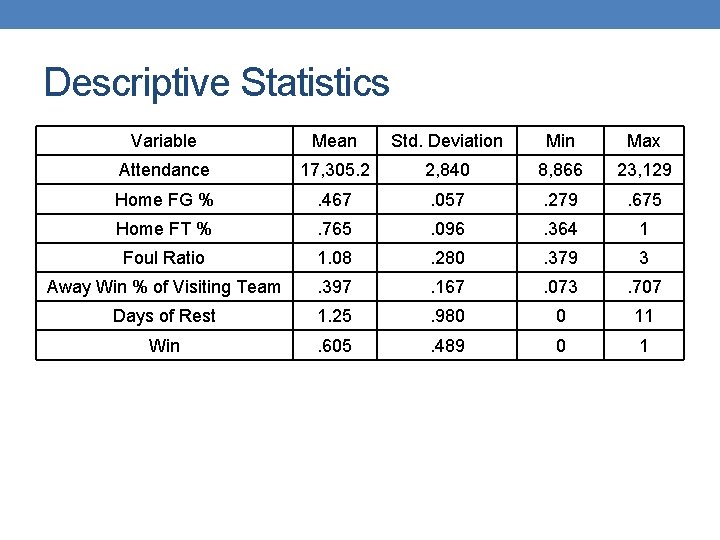
Descriptive Statistics Variable Mean Std. Deviation Min Max Attendance 17, 305. 2 2, 840 8, 866 23, 129 Home FG % . 467 . 057 . 279 . 675 Home FT % . 765 . 096 . 364 1 Foul Ratio 1. 08 . 280 . 379 3 Away Win % of Visiting Team . 397 . 167 . 073 . 707 Days of Rest 1. 25 . 980 0 11 Win . 605 . 489 0 1
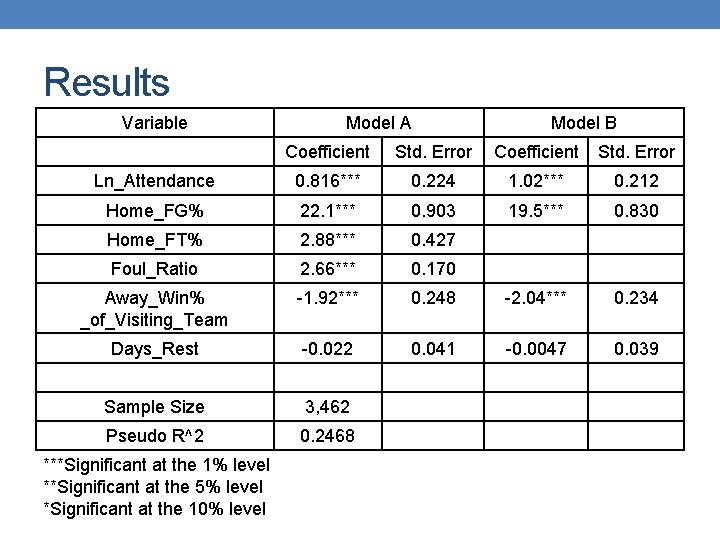
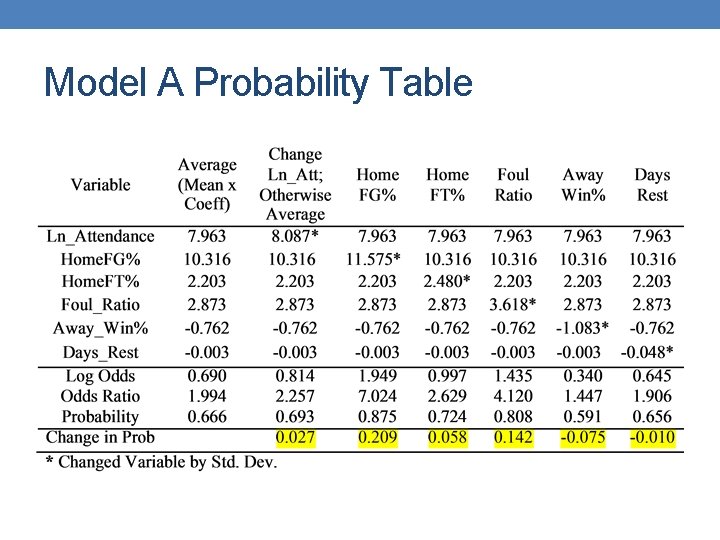
Results Variable Model A Model B Coefficient Std. Error Ln_Attendance 0. 816*** 0. 224 1. 02*** 0. 212 Home_FG% 22. 1*** 0. 903 19. 5*** 0. 830 Home_FT% 2. 88*** 0. 427 Foul_Ratio 2. 66*** 0. 170 Away_Win% _of_Visiting_Team -1. 92*** 0. 248 -2. 04*** 0. 234 Days_Rest -0. 022 0. 041 -0. 0047 0. 039 Sample Size 3, 462 Pseudo R^2 0. 2468 ***Significant at the 1% level **Significant at the 5% level *Significant at the 10% level
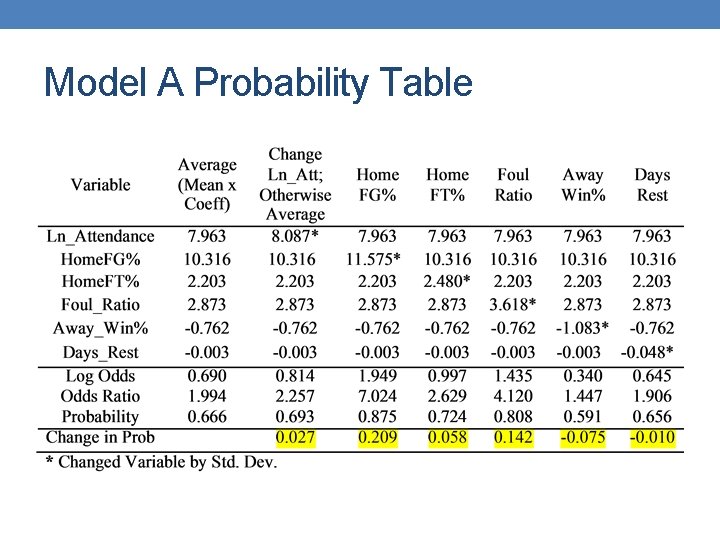
Model A Probability Table
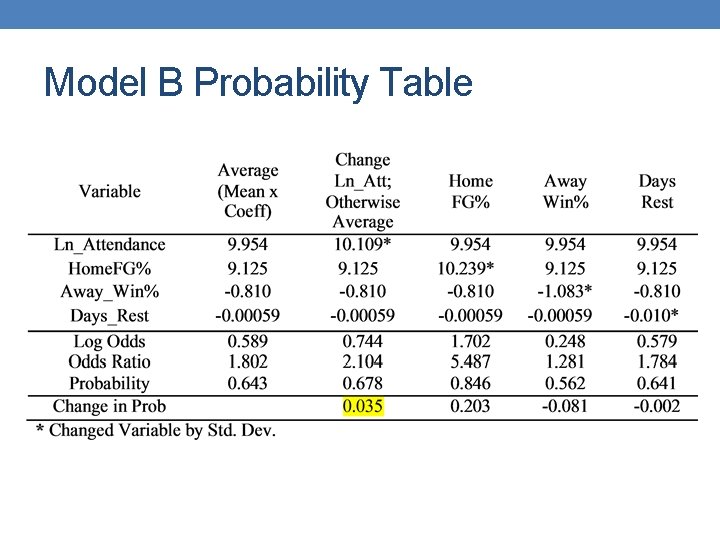
Model B Probability Table
Model A Probability Table
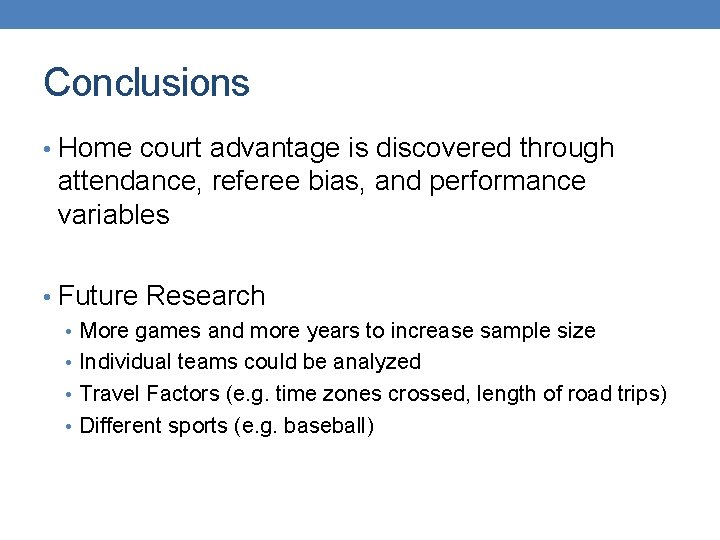
Conclusions • Home court advantage is discovered through attendance, referee bias, and performance variables • Future Research • More games and more years to increase sample size • Individual teams could be analyzed • Travel Factors (e. g. time zones crossed, length of road trips) • Different sports (e. g. baseball)