
Estimating Soil Moisture Using Satellite Observations in Puerto
Estimating Soil Moisture Using Satellite Observations in Puerto Rico By Harold Cruzado Advisor: Dr. Ramón Vásquez University of Puerto Rico - Mayagüez Campus
Contents 1. 2. 3. 4. 5. Introduction Study area characteristics Ground weather stations Instrumentation Algorithm to estimate volumetric soil moisture 6. Preliminary results

Introduction Soil moisture is a key component in the land surface schemes in regional climate models in the tropics. An application of an algorithm for a selected area of Puerto Rico is presented. NOAA satellite observations produce the remote sensing data, which supply the input parameters for the algorithm. Satellite images with one (1) km resolution were used to implement the algorithm using Matlab software.

Characteristics of Selected Region and Vegetation Types Detailed vegetation types information
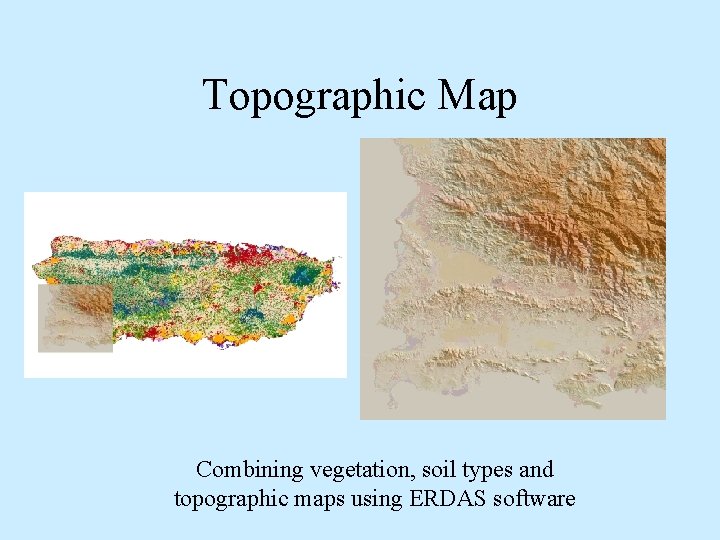
Topographic Map Combining vegetation, soil types and topographic maps using ERDAS software
Soil Types and Profiles The polygon arrays of the soil maps were digitalized, resulting in a complex soil surface. Each of these polygons represents a soil profile, some with more than one soil textural class and others with a single one. The depth of a complete profile is more than 2 meters for all the polygons.
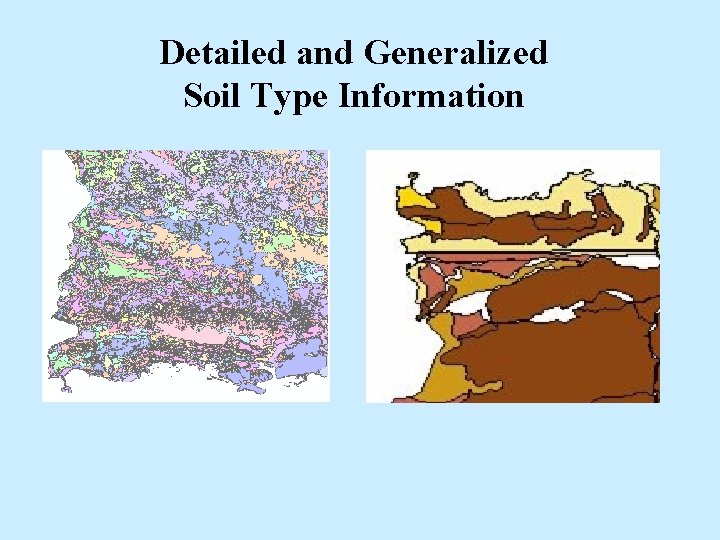
Detailed and Generalized Soil Type Information
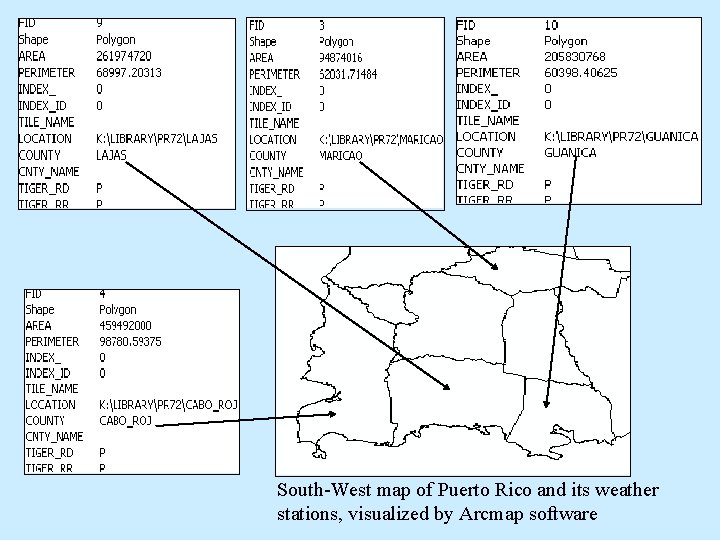
South-West map of Puerto Rico and its weather stations, visualized by Arcmap software
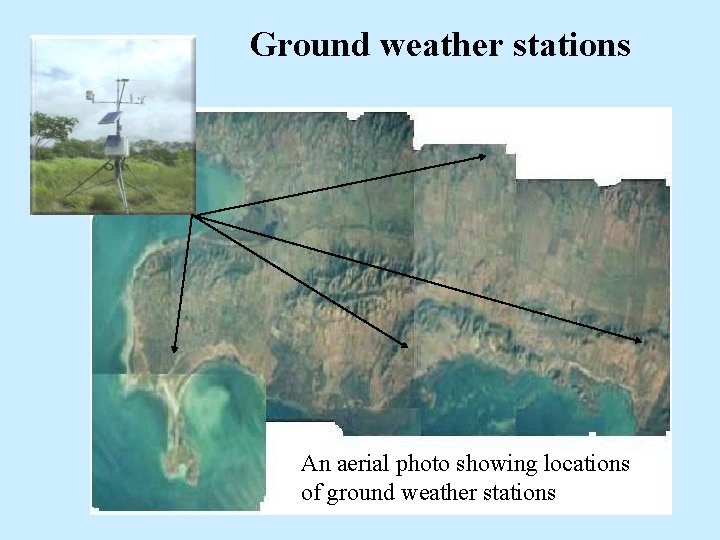
Ground weather stations An aerial photo showing locations of ground weather stations
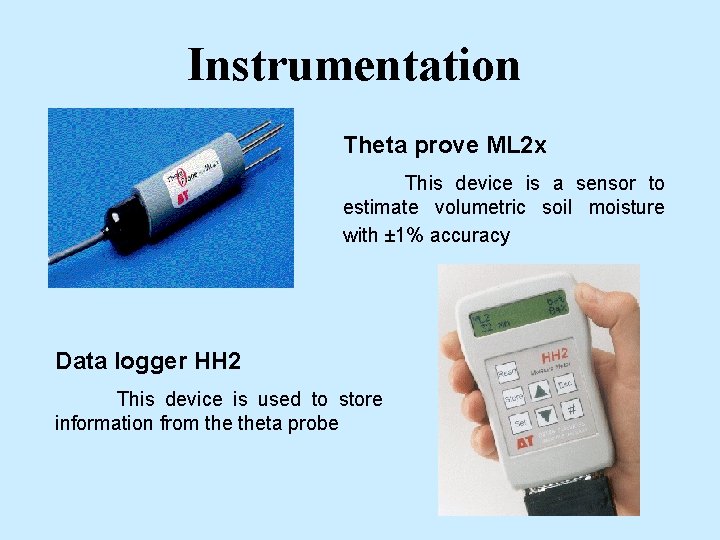
Instrumentation Theta prove ML 2 x This device is a sensor to estimate volumetric soil moisture with ± 1% accuracy Data logger HH 2 This device is used to store information from theta probe
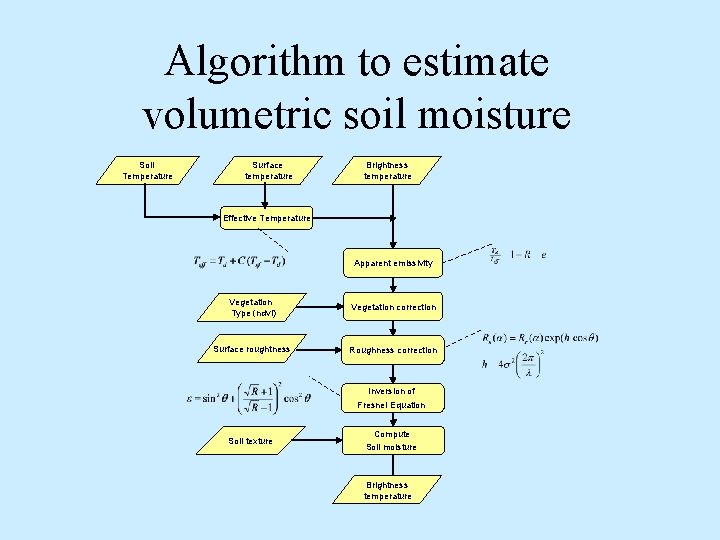
Algorithm to estimate volumetric soil moisture Soil Temperature Surface temperature Brightness temperature Effective Temperature Apparent emissivity Vegetation Type (ndvi) Vegetation correction Surface roughtness Roughness correction Inversion of Fresnel Equation Soil texture Compute Soil moisture Brightness temperature
Brightness Temperature The radiating (or brightness) temperature is the apparent temperature of a blackbody. It can be measured by a remote sensing device such as a radiometer. The possible data sources used are Band 3, 4 or 5 from NOAA satellite or L-band of SAR.
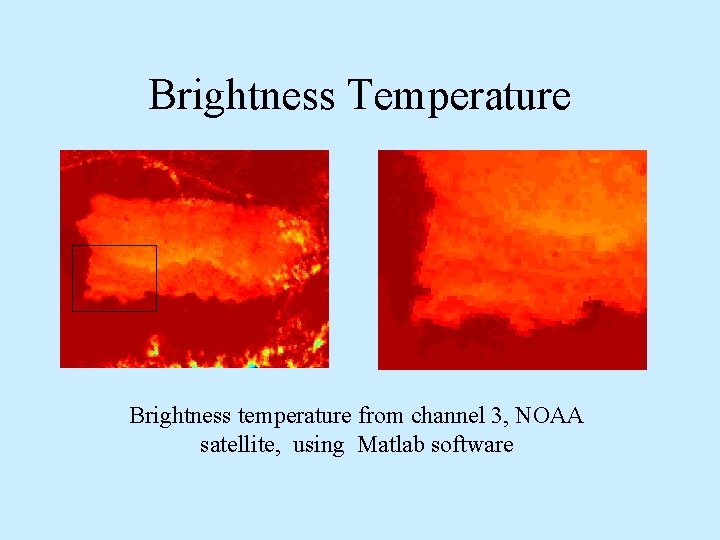
Brightness Temperature Brightness temperature from channel 3, NOAA satellite, using Matlab software
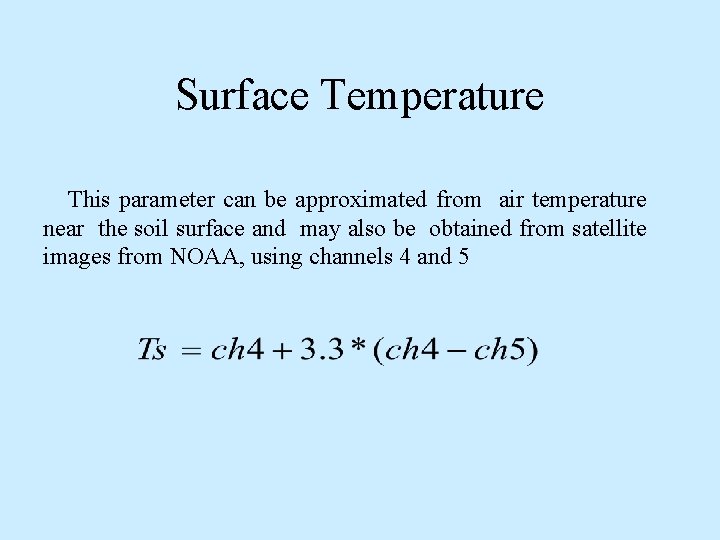
Surface Temperature This parameter can be approximated from air temperature near the soil surface and may also be obtained from satellite images from NOAA, using channels 4 and 5
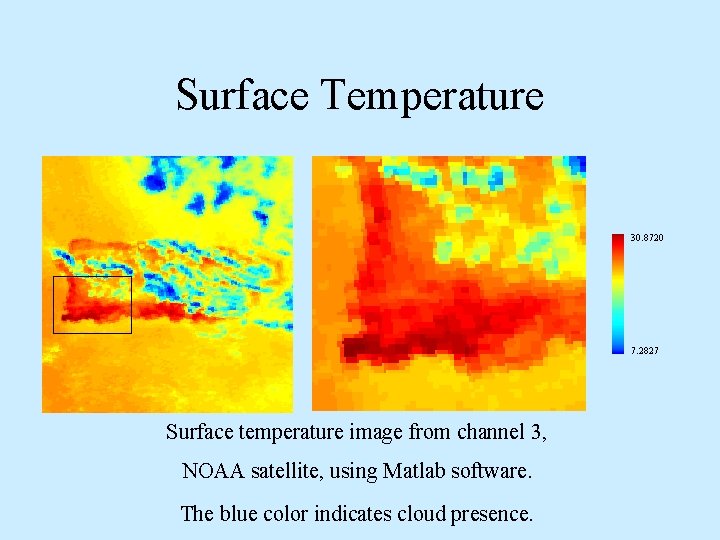
Surface Temperature 30. 8720 7. 2827 Surface temperature image from channel 3, NOAA satellite, using Matlab software. The blue color indicates cloud presence.
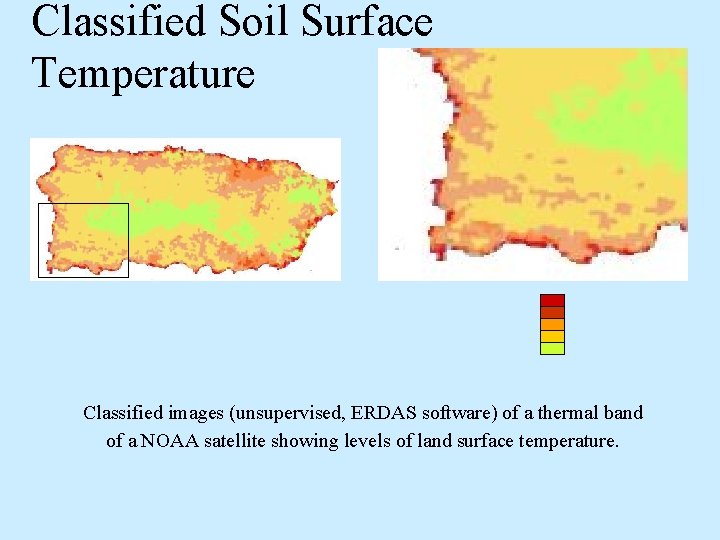
Classified Soil Surface Temperature Classified images (unsupervised, ERDAS software) of a thermal band of a NOAA satellite showing levels of land surface temperature.
Soil Temperature • The algorithm requires soil temperature for 10 to 15 cm of depth. This is provided by experimental stations such as Maricao, Adjuntas, Guanica, and Cabo Rojo in the study area. • Because of insufficient data from the stations other methods need to be considered.
Soil Temperature • Method 1: – Assuming some degrees less than surface temperature – In presence of dense vegetation the surface and deep temperature almost the same. • Method 2: – By training an artificial neural network, whose inputs are the following variables: • Vegetation type • Soil type • Elevation levels • Satellite observations on thermal frequency range The second method is preferred for research.
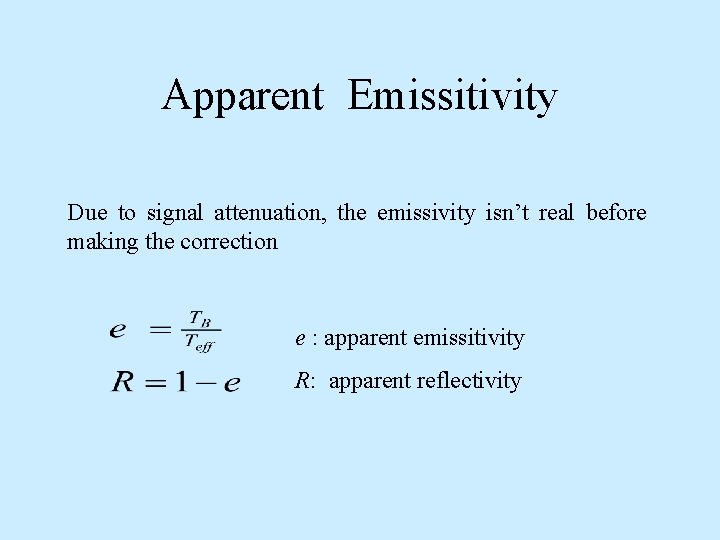
Apparent Emissitivity Due to signal attenuation, the emissivity isn’t real before making the correction e : apparent emissitivity R: apparent reflectivity
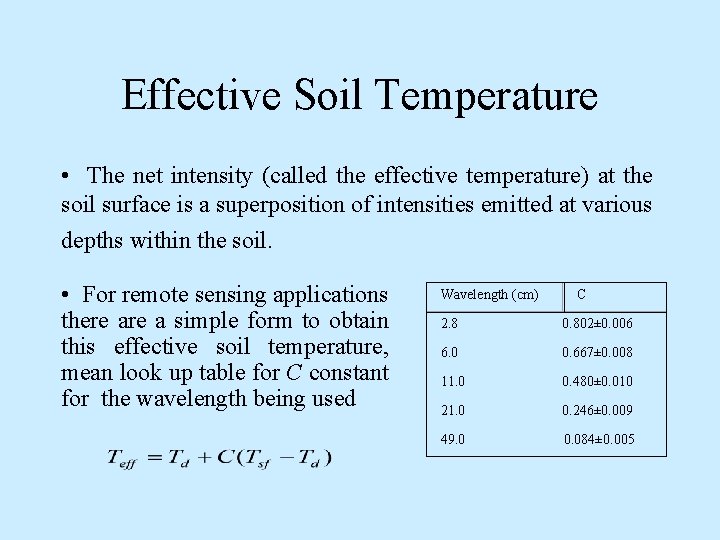
Effective Soil Temperature • The net intensity (called the effective temperature) at the soil surface is a superposition of intensities emitted at various depths within the soil. • For remote sensing applications there a simple form to obtain this effective soil temperature, mean look up table for C constant for the wavelength being used Wavelength (cm) C 2. 8 0. 802± 0. 006 6. 0 0. 667± 0. 008 11. 0 0. 480± 0. 010 21. 0 0. 246± 0. 009 49. 0 0. 084± 0. 005
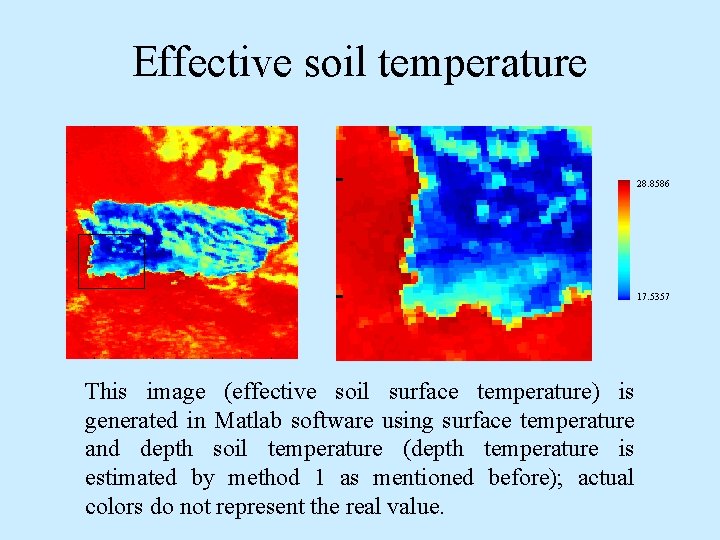
Effective soil temperature 28. 8586 17. 5357 This image (effective soil surface temperature) is generated in Matlab software using surface temperature and depth soil temperature (depth temperature is estimated by method 1 as mentioned before); actual colors do not represent the real value.
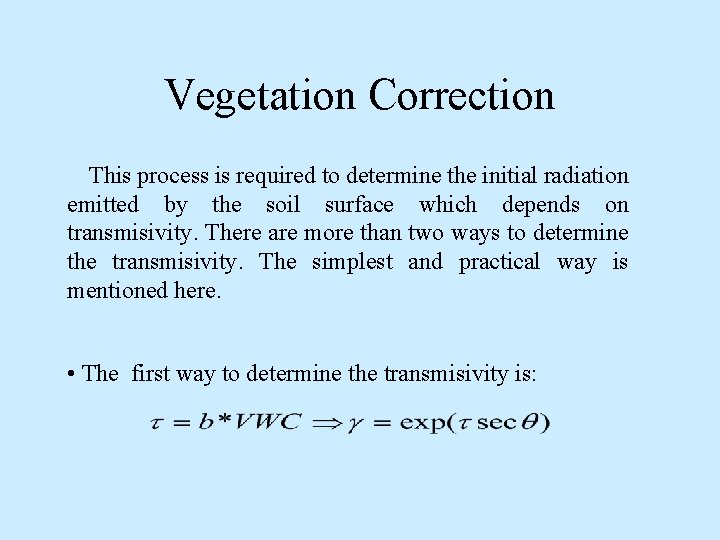
Vegetation Correction This process is required to determine the initial radiation emitted by the soil surface which depends on transmisivity. There are more than two ways to determine the transmisivity. The simplest and practical way is mentioned here. • The first way to determine the transmisivity is:
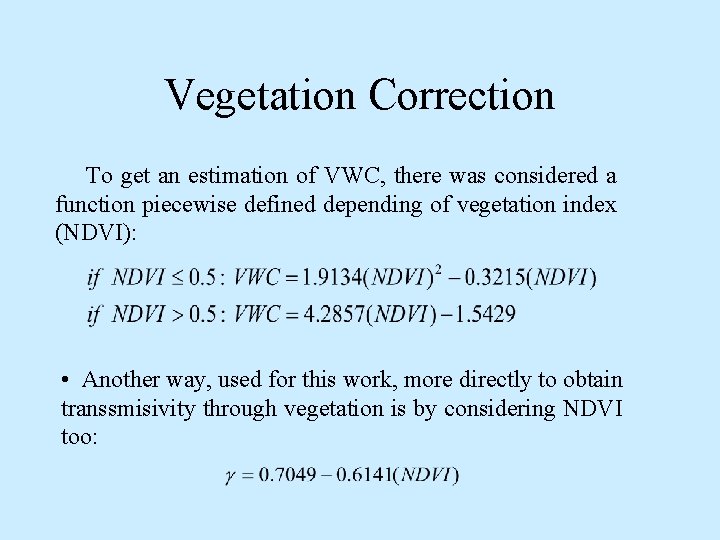
Vegetation Correction To get an estimation of VWC, there was considered a function piecewise defined depending of vegetation index (NDVI): • Another way, used for this work, more directly to obtain transsmisivity through vegetation is by considering NDVI too:
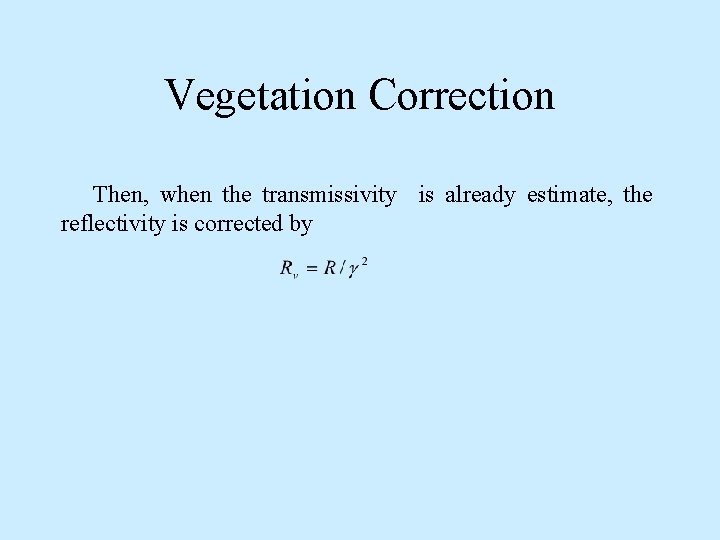
Vegetation Correction Then, when the transmissivity is already estimate, the reflectivity is corrected by
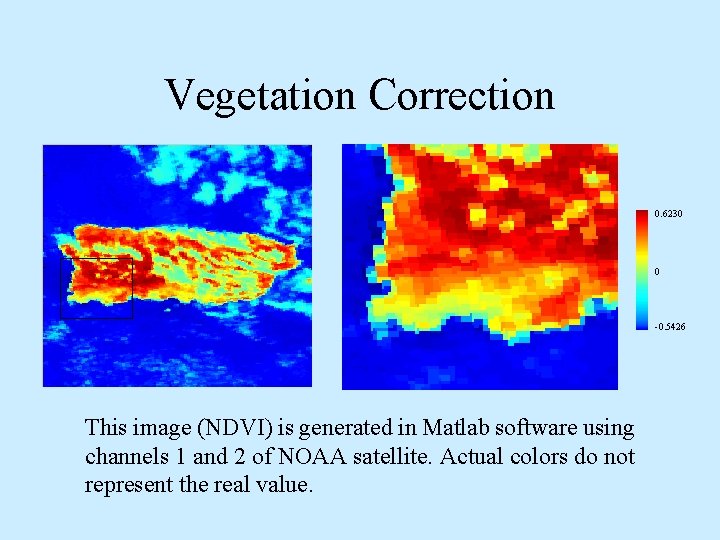
Vegetation Correction 0. 6230 0 -0. 5426 This image (NDVI) is generated in Matlab software using channels 1 and 2 of NOAA satellite. Actual colors do not represent the real value.
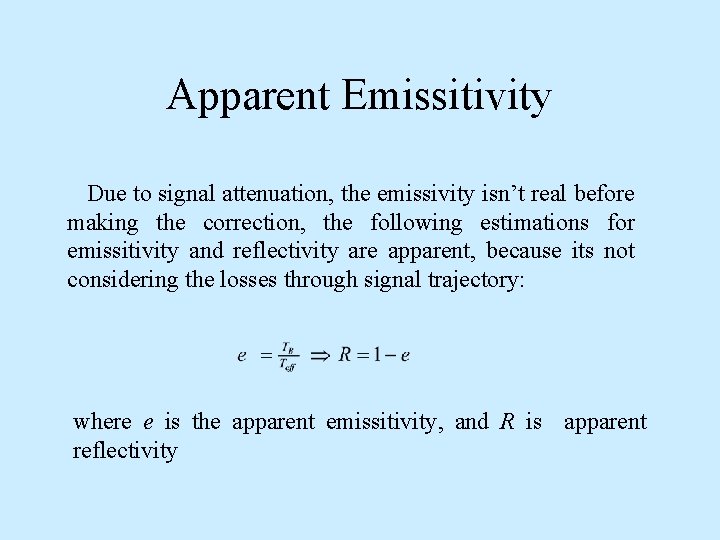
Apparent Emissitivity Due to signal attenuation, the emissivity isn’t real before making the correction, the following estimations for emissitivity and reflectivity are apparent, because its not considering the losses through signal trajectory: where e is the apparent emissitivity, and R is apparent reflectivity
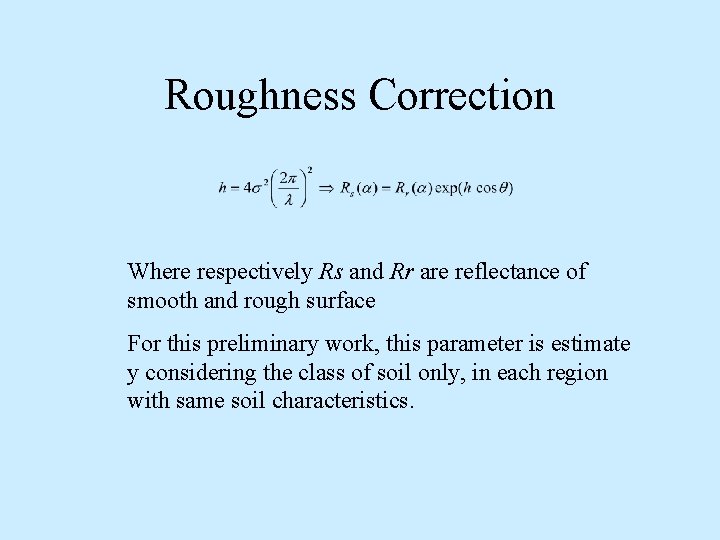
Roughness Correction Where respectively Rs and Rr are reflectance of smooth and rough surface For this preliminary work, this parameter is estimate y considering the class of soil only, in each region with same soil characteristics.
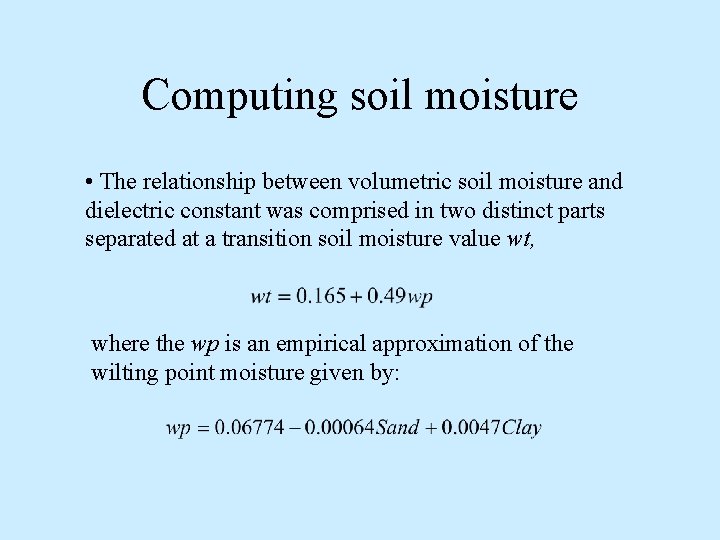
Computing soil moisture • The relationship between volumetric soil moisture and dielectric constant was comprised in two distinct parts separated at a transition soil moisture value wt, where the wp is an empirical approximation of the wilting point moisture given by:
Compute the soil moisture For soil moisture less than wt:
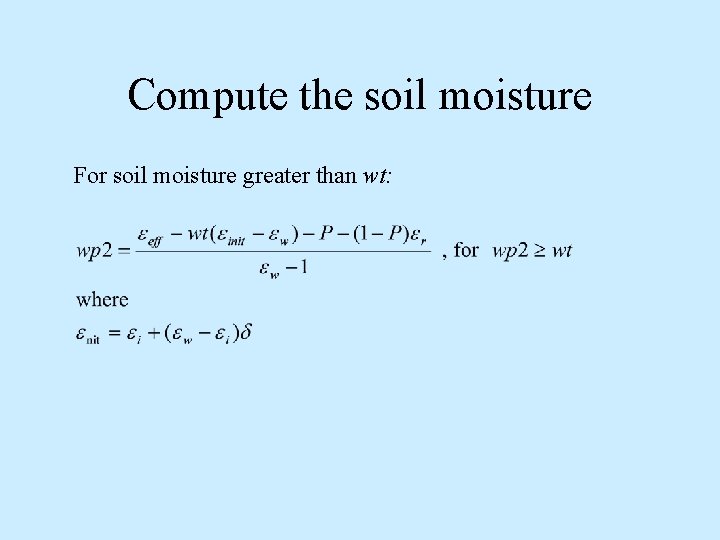
Compute the soil moisture For soil moisture greater than wt:
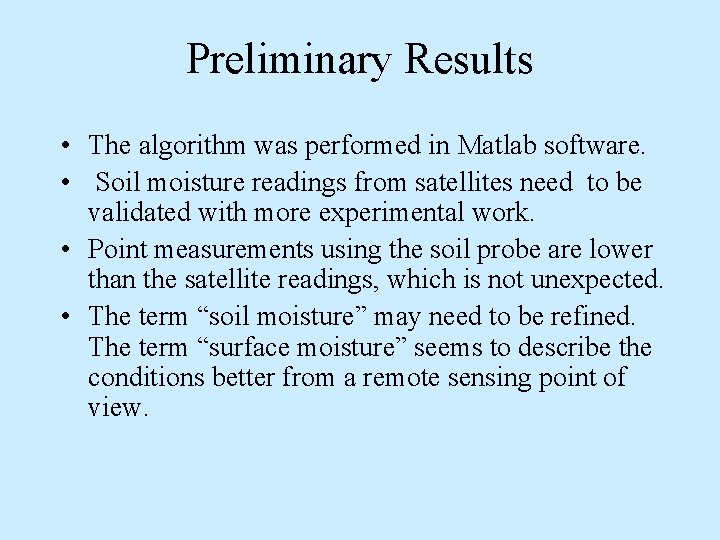
Preliminary Results • The algorithm was performed in Matlab software. • Soil moisture readings from satellites need to be validated with more experimental work. • Point measurements using the soil probe are lower than the satellite readings, which is not unexpected. • The term “soil moisture” may need to be refined. The term “surface moisture” seems to describe the conditions better from a remote sensing point of view.
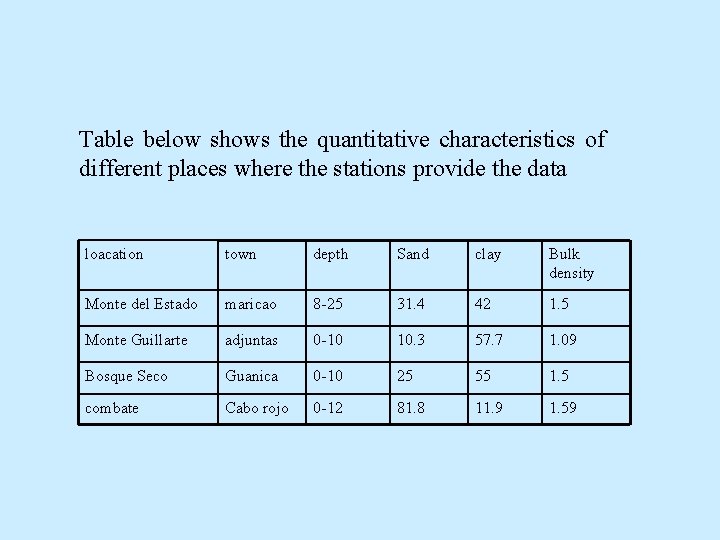
Table below shows the quantitative characteristics of different places where the stations provide the data loacation town depth Sand clay Bulk density Monte del Estado maricao 8 -25 31. 4 42 1. 5 Monte Guillarte adjuntas 0 -10 10. 3 57. 7 1. 09 Bosque Seco Guanica 0 -10 25 55 1. 5 combate Cabo rojo 0 -12 81. 8 11. 9 1. 59
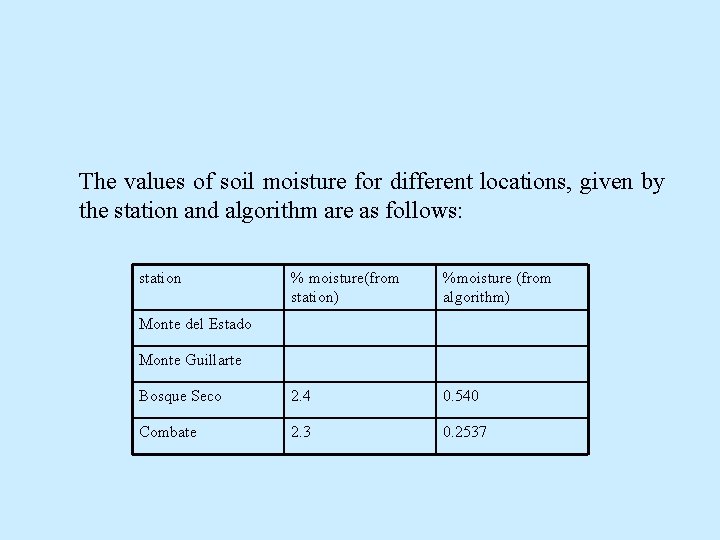
The values of soil moisture for different locations, given by the station and algorithm are as follows: station % moisture(from station) %moisture (from algorithm) Bosque Seco 2. 4 0. 540 Combate 2. 3 0. 2537 Monte del Estado Monte Guillarte
- Slides: 33