
Estimating Simulation Demand Converting Demand Model Forecasts into


- Slides: 13
Estimating Simulation Demand Converting Demand Model Forecasts into Usable Data for Microsimulations Roberto Miquel, AICP June 4, 2019
Acknowledgements § § 2 Ohio Department of Transportation RSG CDM Smith TRB Planning Applications Conference
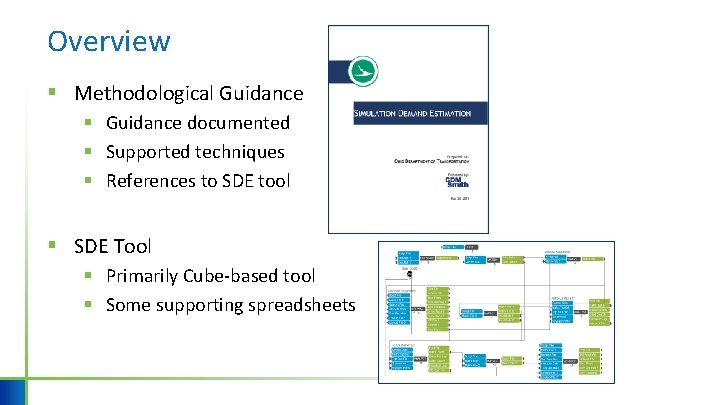
Overview § Methodological Guidance § Guidance documented § Supported techniques § References to SDE tool § SDE Tool § Primarily Cube-based tool § Some supporting spreadsheets
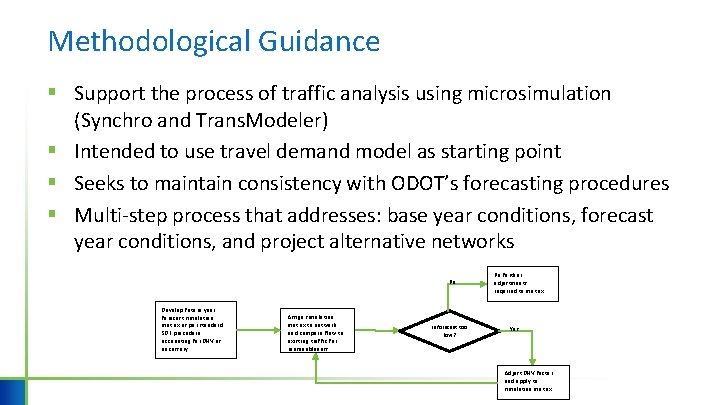
Methodological Guidance § Support the process of traffic analysis using microsimulation (Synchro and Trans. Modeler) § Intended to use travel demand model as starting point § Seeks to maintain consistency with ODOT’s forecasting procedures § Multi-step process that addresses: base year conditions, forecast year conditions, and project alternative networks No Develop future year forecast simulation matrix as per standard SDE procedure accounting for DHV as necessary. Assign simulation matrix to network and compare flow to existing traffic for reasonableness Is forecast too low? No further adjustments required to matrix Yes Adjust DHV factor and apply to simulation matrix
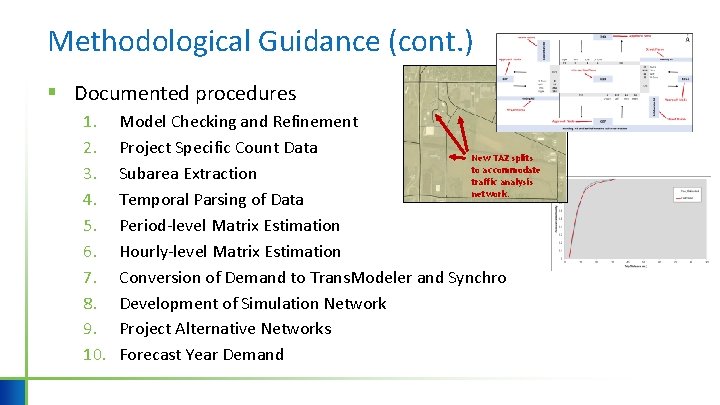
Methodological Guidance (cont. ) § Documented procedures 1. 2. 3. 4. 5. 6. 7. 8. 9. 10. Model Checking and Refinement Project Specific Count Data New TAZ splits to accommodate Subarea Extraction traffic analysis network. Temporal Parsing of Data Period-level Matrix Estimation Hourly-level Matrix Estimation Conversion of Demand to Trans. Modeler and Synchro Development of Simulation Network Project Alternative Networks Forecast Year Demand
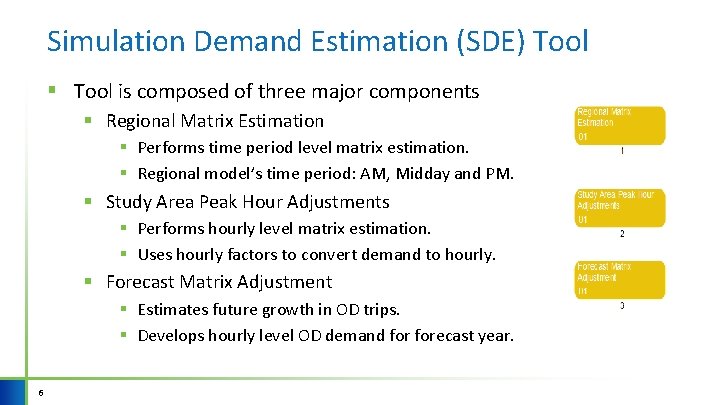
Simulation Demand Estimation (SDE) Tool § Tool is composed of three major components § Regional Matrix Estimation § Performs time period level matrix estimation. § Regional model’s time period: AM, Midday and PM. § Study Area Peak Hour Adjustments § Performs hourly level matrix estimation. § Uses hourly factors to convert demand to hourly. § Forecast Matrix Adjustment § Estimates future growth in OD trips. § Develops hourly level OD demand forecast year. 6
SDE Tool (cont. ) § What it does: § Read ODOT travel demand model data § Extract subarea matrices based on user-defined networks for input to simulations Conducts matrix estimation at the regional / period-level Conducts matrix estimation at the subarea / hourly-level Link counts and turning movement counts Pivots estimated matrices to forecast conditions § § § What it does not do: § Does not automatically create simulation networks § Does not automatically create intersection inputs for simulation § Supplemental spreadsheet tool available 7
Case Studies § Toledo Downtown Traffic Study § Purpose: Evaluate existing, future, and proposed traffic flow for the downtown Toledo transportation plan § 0. 6 square miles of downtown Toledo § 146 intersections (35 with turning movement counts) § Akron Summit 8 § Purpose: Support SR-8 corridor study in Akron with project-level OD matrices § 4. 5 mile corridor § 29 intersections (all major intersections have counts)
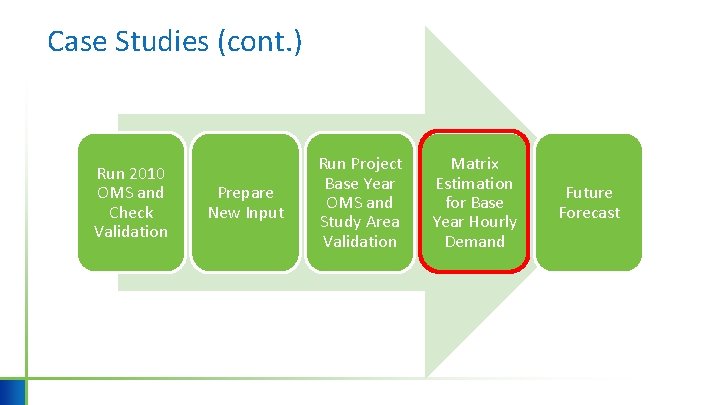
Case Studies (cont. ) Run 2010 OMS and Check Validation Prepare New Input Run Project Base Year OMS and Study Area Validation Matrix Estimation for Base Year Hourly Demand Future Forecast
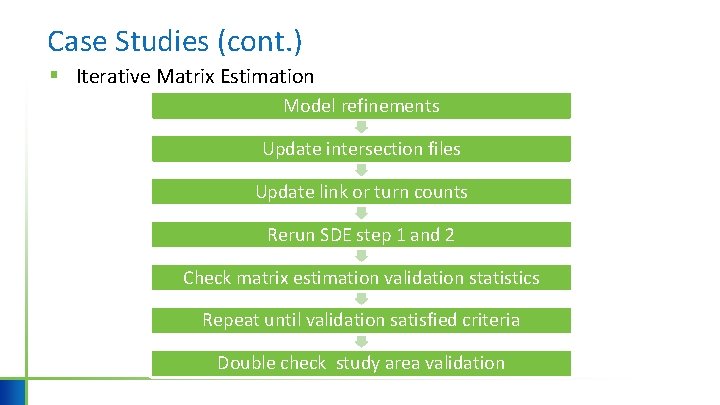
Case Studies (cont. ) § Iterative Matrix Estimation Model refinements Update intersection files Update link or turn counts Rerun SDE step 1 and 2 Check matrix estimation validation statistics Repeat until validation satisfied criteria Double check study area validation
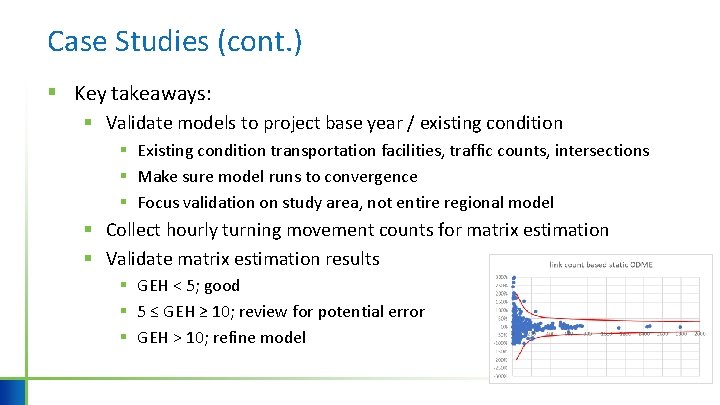
Case Studies (cont. ) § Key takeaways: § Validate models to project base year / existing condition § Existing condition transportation facilities, traffic counts, intersections § Make sure model runs to convergence § Focus validation on study area, not entire regional model § Collect hourly turning movement counts for matrix estimation § Validate matrix estimation results § GEH < 5; good § 5 ≤ GEH ≥ 10; review for potential error § GEH > 10; refine model
Questions/Discussion
Contact Information: Roberto Miquel, AICP CDM Smith 5400 Glenwood Ave. , Raleigh, NC 27612 miquelro@cdmsmith. com 919. 325. 3605 Jason Chen, Ph. D. RSG 55 Railroad Row, White River Junction, VT 05001 Jason. Chen@rsginc. com 802. 359. 6431 Gregory T. Giaimo, P. E. ODOT Office of Statewide Planning and Research 1980 W. Broad Street, MS 3280 Columbus, OH 43223 Greg. Giaimo@dot. ohio. gov 614. 752. 5738 13