
Estimating parameters in inversions for regional carbon fluxes

Estimating parameters in inversions for regional carbon fluxes Nir Y Krakauer 1*, Tapio Schneider 1, James T Randerson 2 1. California Institute of Technology 2. Earth Systems Science, University of California, Irvine * niryk@caltech. edu
Motivation & outline n Inferring carbon fluxes from patterns in atmospheric CO 2 concentrations is an inverse problem n Parameters in the inversion set-up may not be well constrained by prior information, yet the values chosen significantly affect the inferred flux patterns n Here, we explore generalized crossvalidation as a method for choosing values for parameters
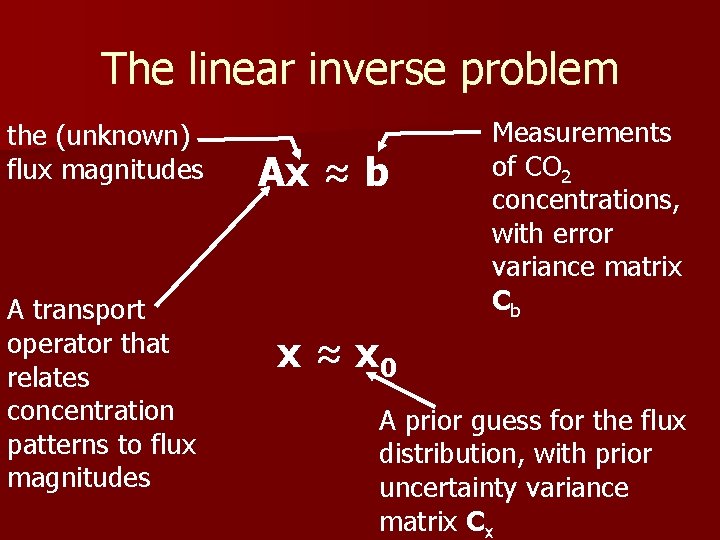
The linear inverse problem the (unknown) flux magnitudes A transport operator that relates concentration patterns to flux magnitudes Ax ≈ b Measurements of CO 2 concentrations, with error variance matrix Cb x ≈ x 0 A prior guess for the flux distribution, with prior uncertainty variance matrix Cx
Ambiguities in parameter choice n Solving the inverse problem requires specifying Cb, Cx, x 0 n Adjustable parameters include: Weight CO 2 measurements equally or differentially? How much weight to give the measurements vs. the prior guesses? n Different parameter values lead to varying results for, e. g. , the land-ocean and America-Eurasia distribution of the missing carbon sink
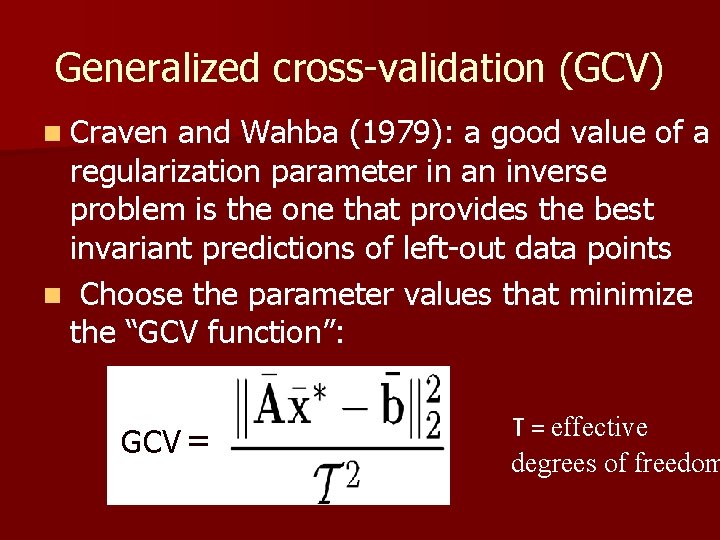
Generalized cross-validation (GCV) n Craven and Wahba (1979): a good value of a regularization parameter in an inverse problem is the one that provides the best invariant predictions of left-out data points n Choose the parameter values that minimize the “GCV function”: GCV = T = effective degrees of freedom
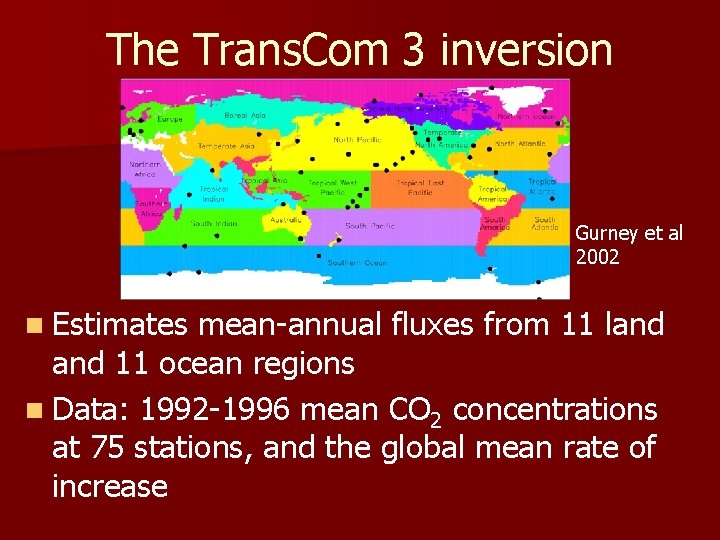
The Trans. Com 3 inversion Gurney et al 2002 n Estimates mean-annual fluxes from 11 land 11 ocean regions n Data: 1992 -1996 mean CO 2 concentrations at 75 stations, and the global mean rate of increase
n λ: Parameters we varied How closely the solution would fit the prior guess x 0 – controls size of the prior-flux variance Cx § higher λ: solution will be closer to x 0 (more regularization) – Trans. Com value: 1 n τ: How much preference to give data from low-variance (oceanic) stations – controls structure of the data variance Cb § 0: all stations weighted equally – Trans. Com value: 1
Results: the GCV function
Results: inferred CO 2 flux (Pg C/ yr)

Results: Ocean
Results: equatorial land
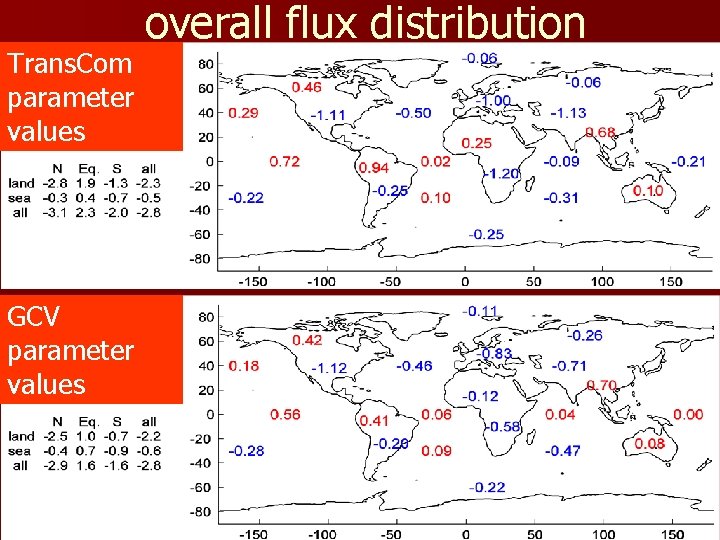
Trans. Com parameter values GCV parameter values overall flux distribution
Conclusion n Parameter choice accounts for part of the variability in CO 2 flux estimates derived from inverse methods n GCV looks promising for empirically choosing parameter values in global-scale CO 2 inversions n GCV-based parameter choice methods should also be of use for smaller-scale (regional and local) studies
- Slides: 13