
Estimating nonmarket values across scale and scope John


- Slides: 18
Estimating non-market values across scale and scope John Rolfe
Participants • Project run by Central Queensland University – John Rolfe, Jill Windle, Xuehong Wang & Galina Ivanova • Collaboration with – Jeff Bennett (ANU) – Riccardo Scarpa (Waikato, NZ) – Kathleen Broderick & Ingrid van Puten (GBRMPA)
Economic valuation • Used to assess how important different issues are to people • Market transactions are easy to value – we look at the monetary tradeoff revealed in markets • Many tradeoffs are harder to value – Environmental issues – Recreation – Social and community tradeoffs
Non-market valuation techniques • Revealed preference techniques – Travel Cost Method used to assess values for recreation • Example – value per recreational fishing trip • Stated preference techniques – Can be used to assess non-use and use values – Give people scenarios with a potential cost and ask them to ‘state’ their tradeoff – Contingent valuation – Choice Modelling
Choice Modelling • Presents people with a series of tradeoffs about issue in question • Tradeoffs described in terms of key attributes • Normally add a cost component as well • Identify if people are willing to pay for additional improvement or protection • Tradeoffs presented in a survey format
The policy needs • Choice Modelling studies are slow and expensive to perform • Often easier to transfer values from other studies • Process known as Benefit Transfer – Prospector approach – Systematic database – Combination of previous studies
How to make Benefit Transfer more accurate • There are four main strategies – Increase the pool of non-market valuation studies – Increase the accuracy and understanding of the conducted studies – Develop better systematic BT case studies – Improve the use of BT tools and databases
Issues with Benefit Transfer • How easy is it to take values that have been estimated in one particular context and transfer them to another application? • Scale issues – do values change according to the amount of an asset involved? – Small patch, large patch, regional area • Scope issues – do values change according to the types of tradeoffs involved? – Forest versus forest + animals + birds • Management issues – do values change according to the types of management actions taken?
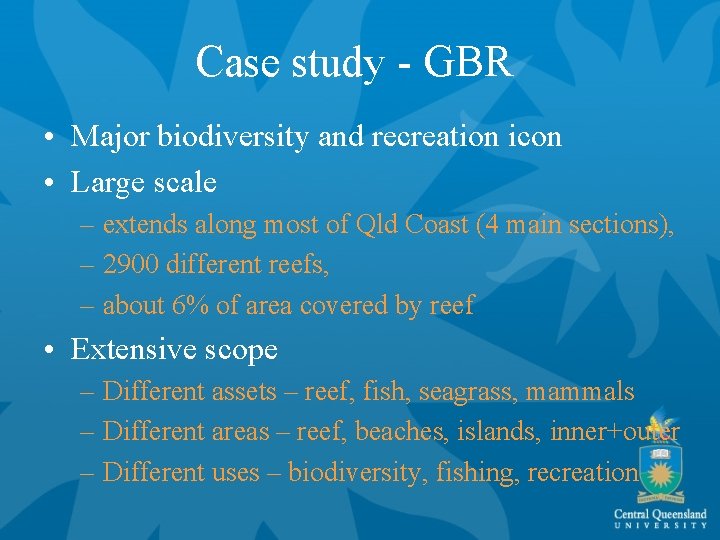
Case study - GBR • Major biodiversity and recreation icon • Large scale – extends along most of Qld Coast (4 main sections), – 2900 different reefs, – about 6% of area covered by reef • Extensive scope – Different assets – reef, fish, seagrass, mammals – Different areas – reef, beaches, islands, inner+outer – Different uses – biodiversity, fishing, recreation
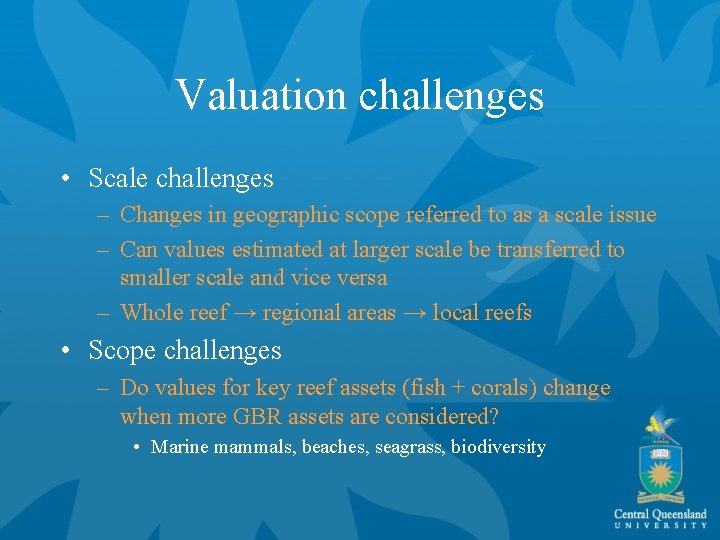
Valuation challenges • Scale challenges – Changes in geographic scope referred to as a scale issue – Can values estimated at larger scale be transferred to smaller scale and vice versa – Whole reef → regional areas → local reefs • Scope challenges – Do values for key reef assets (fish + corals) change when more GBR assets are considered? • Marine mammals, beaches, seagrass, biodiversity
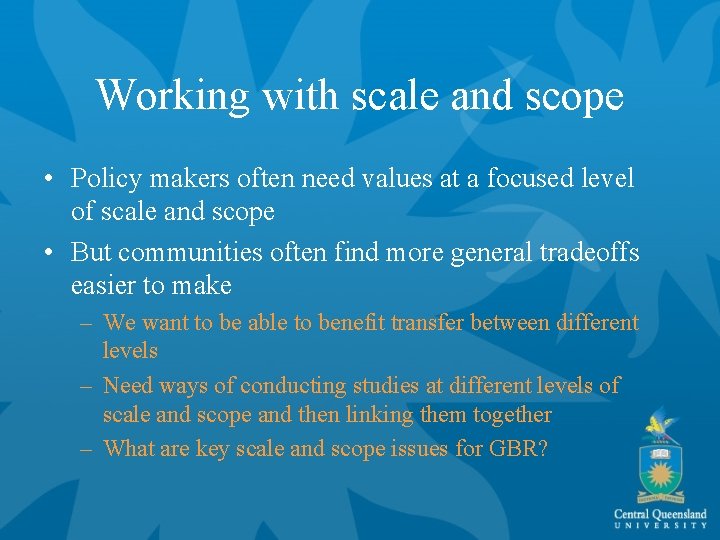
Working with scale and scope • Policy makers often need values at a focused level of scale and scope • But communities often find more general tradeoffs easier to make – We want to be able to benefit transfer between different levels – Need ways of conducting studies at different levels of scale and scope and then linking them together – What are key scale and scope issues for GBR?
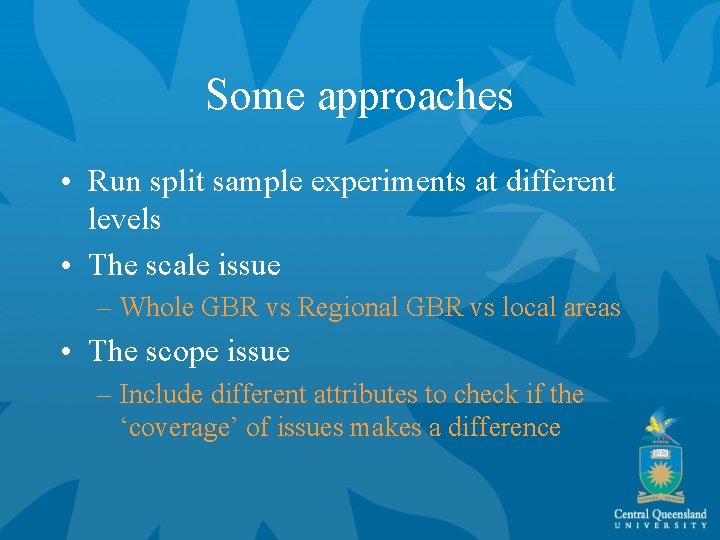
Some approaches • Run split sample experiments at different levels • The scale issue – Whole GBR vs Regional GBR vs local areas • The scope issue – Include different attributes to check if the ‘coverage’ of issues makes a difference
Some other complexities • How values may be sensitive to different levels of uncertainty • How values may be sensitive to different types of management actions • Options to combine the different information in choice sets
Management actions • Four main groups of actions – Improving water quality from agriculture – Restricting fishing (commercial and/or recreational) – Increasing green zones – Climate change mitigation • May be important for policy to identify if preferences are sensitive to actions
Risk and uncertainty • As soon as there are management actions there should also be information about uncertainty – Uncertainty about whether the nominated actions will lead to improvements • Green zones/fishing = low uncertainty • Ag. Water quality = medium uncertainty • Climate change mitigation = very high uncertainty – Challenge of communicating uncertainty
Testing • • Test different formats and survey versions Workshops / focus groups Experimental lab (uncertainty issues) Major survey rounds (different cities)