
Estimating forest structure in tropical forested sites using
- Slides: 1
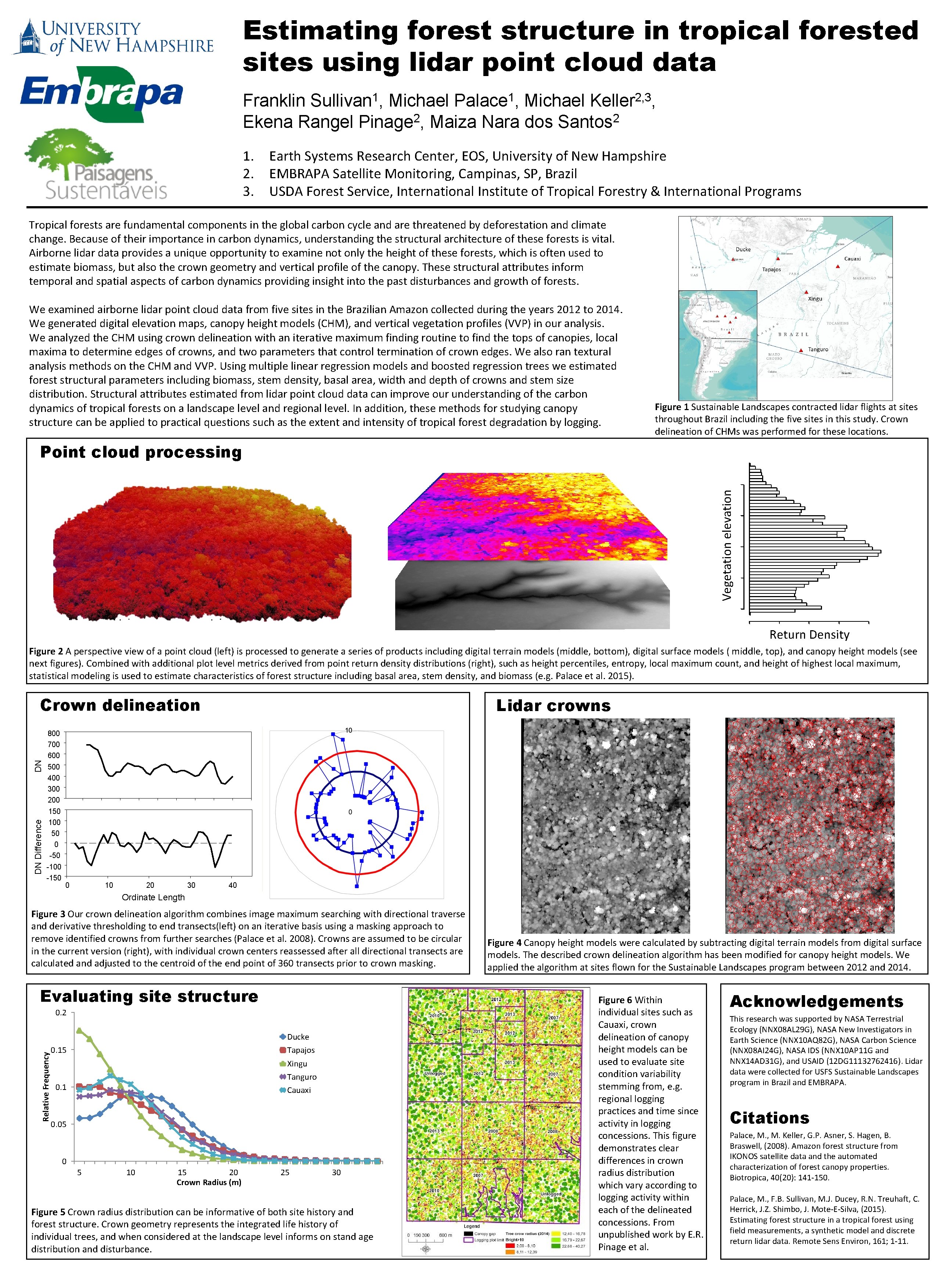
Estimating forest structure in tropical forested sites using lidar point cloud data 1 Sullivan , Franklin Michael Ekena Rangel Pinage 2, Maiza Nara dos Santos 2 1. 2. 3. 1 Palace , 2, 3 Keller , Earth Systems Research Center, EOS, University of New Hampshire EMBRAPA Satellite Monitoring, Campinas, SP, Brazil USDA Forest Service, International Institute of Tropical Forestry & International Programs Tropical forests are fundamental components in the global carbon cycle and are threatened by deforestation and climate change. Because of their importance in carbon dynamics, understanding the structural architecture of these forests is vital. Airborne lidar data provides a unique opportunity to examine not only the height of these forests, which is often used to estimate biomass, but also the crown geometry and vertical profile of the canopy. These structural attributes inform temporal and spatial aspects of carbon dynamics providing insight into the past disturbances and growth of forests. We examined airborne lidar point cloud data from five sites in the Brazilian Amazon collected during the years 2012 to 2014. We generated digital elevation maps, canopy height models (CHM), and vertical vegetation profiles (VVP) in our analysis. We analyzed the CHM using crown delineation with an iterative maximum finding routine to find the tops of canopies, local maxima to determine edges of crowns, and two parameters that control termination of crown edges. We also ran textural analysis methods on the CHM and VVP. Using multiple linear regression models and boosted regression trees we estimated forest structural parameters including biomass, stem density, basal area, width and depth of crowns and stem size distribution. Structural attributes estimated from lidar point cloud data can improve our understanding of the carbon dynamics of tropical forests on a landscape level and regional level. In addition, these methods for studying canopy structure can be applied to practical questions such as the extent and intensity of tropical forest degradation by logging. Figure 1 Sustainable Landscapes contracted lidar flights at sites throughout Brazil including the five sites in this study. Crown delineation of CHMs was performed for these locations. Vegetation elevation Point cloud processing Return Density Figure 2 A perspective view of a point cloud (left) is processed to generate a series of products including digital terrain models (middle, bottom), digital surface models ( middle, top), and canopy height models (see next figures). Combined with additional plot level metrics derived from point return density distributions (right), such as height percentiles, entropy, local maximum count, and height of highest local maximum, statistical modeling is used to estimate characteristics of forest structure including basal area, stem density, and biomass (e. g. Palace et al. 2015). Crown delineation Lidar crowns 800 700 DN 600 500 400 300 200 DN Difference 150 100 50 0 -50 -100 -150 0 10 20 30 40 Ordinate Length Figure 3 Our crown delineation algorithm combines image maximum searching with directional traverse and derivative thresholding to end transects(left) on an iterative basis using a masking approach to remove identified crowns from further searches (Palace et al. 2008). Crowns are assumed to be circular in the current version (right), with individual crown centers reassessed after all directional transects are calculated and adjusted to the centroid of the end point of 360 transects prior to crown masking. Evaluating site structure 0. 2 Relative Frequency Ducke 0. 15 Tapajos Xingu Tanguro 0. 1 Cauaxi 0. 05 0 5 10 15 20 Crown Radius (m) 25 30 Figure 5 Crown radius distribution can be informative of both site history and forest structure. Crown geometry represents the integrated life history of individual trees, and when considered at the landscape level informs on stand age distribution and disturbance. Figure 4 Canopy height models were calculated by subtracting digital terrain models from digital surface models. The described crown delineation algorithm has been modified for canopy height models. We applied the algorithm at sites flown for the Sustainable Landscapes program between 2012 and 2014. Figure 6 Within individual sites such as Cauaxi, crown delineation of canopy height models can be used to evaluate site condition variability stemming from, e. g. regional logging practices and time since activity in logging concessions. This figure demonstrates clear differences in crown radius distribution which vary according to logging activity within each of the delineated concessions. From unpublished work by E. R. Pinage et al. Acknowledgements This research was supported by NASA Terrestrial Ecology (NNX 08 AL 29 G), NASA New Investigators in Earth Science (NNX 10 AQ 82 G), NASA Carbon Science (NNX 08 AI 24 G), NASA IDS (NNX 10 AP 11 G and NNX 14 AD 31 G), and USAID (12 DG 11132762416). Lidar data were collected for USFS Sustainable Landscapes program in Brazil and EMBRAPA. Citations Palace, M. Keller, G. P. Asner, S. Hagen, B. Braswell, (2008). Amazon forest structure from IKONOS satellite data and the automated characterization of forest canopy properties. Biotropica, 40(20): 141 -150. Palace, M. , F. B. Sullivan, M. J. Ducey, R. N. Treuhaft, C. Herrick, J. Z. Shimbo, J. Mote-E-Silva, (2015). Estimating forest structure in a tropical forest using field measurements, a synthetic model and discrete return lidar data. Remote Sens Environ, 161; 1 -11.