
Estimating CTC415 Estimate Types Concept Detailed Definitive Example

- Slides: 29
Estimating CTC-415
Estimate Types • Concept • Detailed • Definitive
Example • You want to buy a car • ROM - $14000 -$16000 or monthly payment • New or Used – Find Car • Detail - what options, which model $15, 595 • Definitive - tags, tax, bank charges $16, 750
Concept or Preliminary • Little data to work with • Rough order of magnitude – Is the project a go? Or too pricey • Time referenced cost indices – Can be based on resources or final product cost – Limited to • How similar is current job to indiced jobs • Factors included in price (land, financing)
Concept • Time referenced cost indices – Can be based on resources or final product cost – Limited to • How similar is current job to indiced jobs • Factors included in price (land, financing)
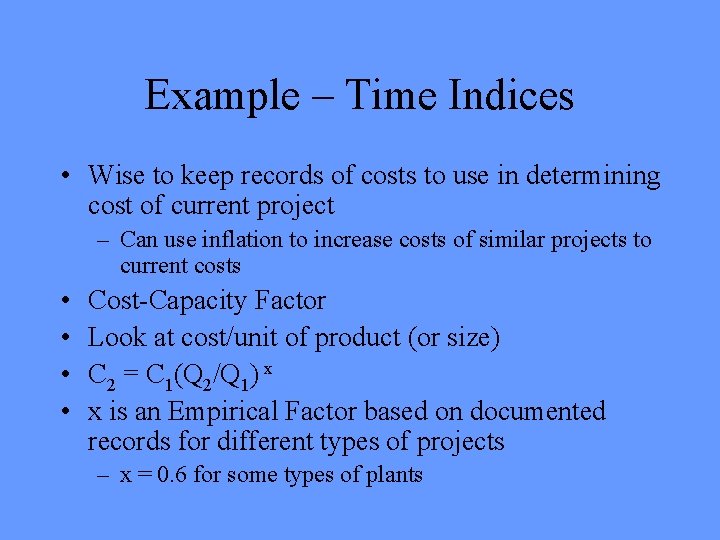
Example – Time Indices • Wise to keep records of costs to use in determining cost of current project – Can use inflation to increase costs of similar projects to current costs • • Cost-Capacity Factor Look at cost/unit of product (or size) C 2 = C 1(Q 2/Q 1) x x is an Empirical Factor based on documented records for different types of projects – x = 0. 6 for some types of plants
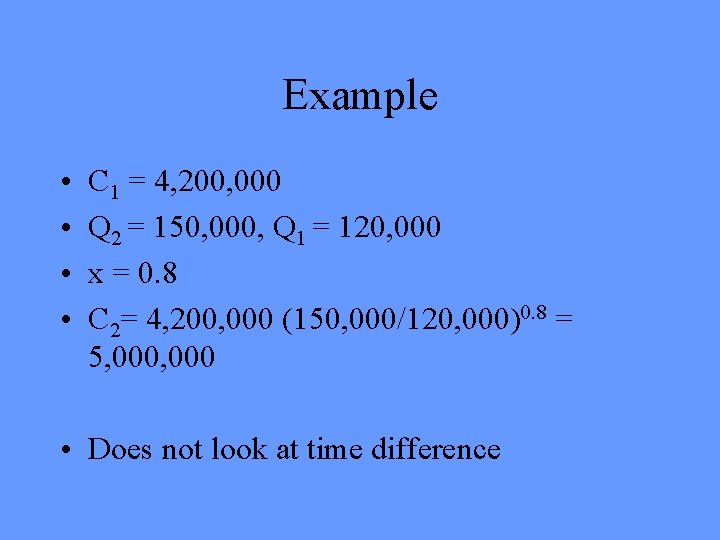
Example • • C 1 = 4, 200, 000 Q 2 = 150, 000, Q 1 = 120, 000 x = 0. 8 C 2= 4, 200, 000 (150, 000/120, 000)0. 8 = 5, 000 • Does not look at time difference
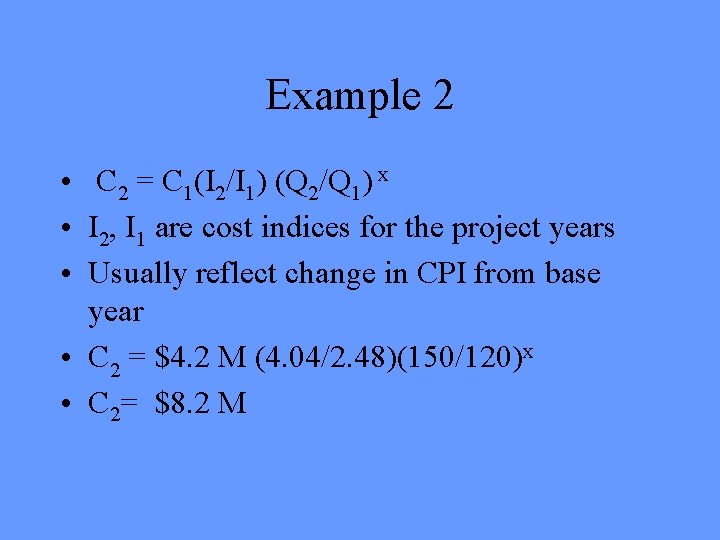
Example 2 • C 2 = C 1(I 2/I 1) (Q 2/Q 1) x • I 2, I 1 are cost indices for the project years • Usually reflect change in CPI from base year • C 2 = $4. 2 M (4. 04/2. 48)(150/120)x • C 2= $8. 2 M
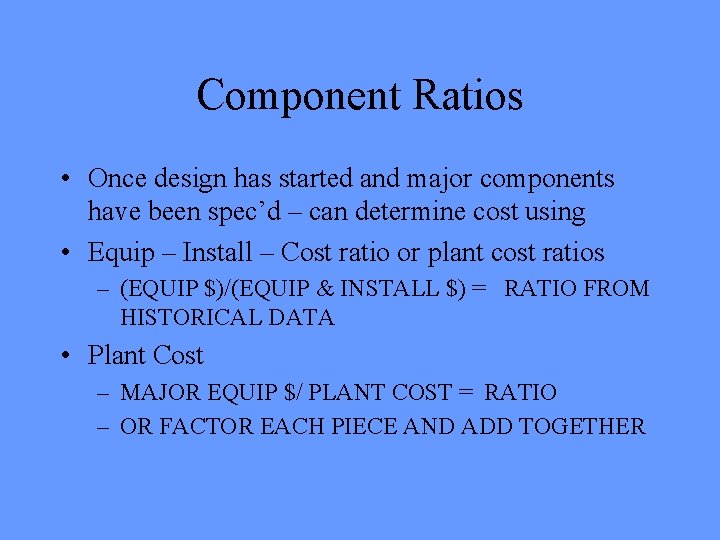
Component Ratios • Once design has started and major components have been spec’d – can determine cost using • Equip – Install – Cost ratio or plant cost ratios – (EQUIP $)/(EQUIP & INSTALL $) = RATIO FROM HISTORICAL DATA • Plant Cost – MAJOR EQUIP $/ PLANT COST = RATIO – OR FACTOR EACH PIECE AND ADD TOGETHER
Parameter Costs Relate costs to a few parameters (SF or bldg) • Usually does not include land or cost of bringing in utilities
Detailed Estimate • After concept design and most of detail work • Requires – Quantity take-offs – Costs/unit • Needs to be done carefully – so that margin of error is low (don’t eat into profits) • Can also find errors
Detailed Estimate • In addition to quantity and prices, • to get total price – Add in indirect cost – Plant and equip – Home-office OH – Profit – Escalation – Contingency
Labor Productivity • • Need to Evaluate Effect of local practices Market competitiveness Weather Completeness of plans and specs Can lead to big differences in final price Union or non-Union?
Fair Cost Estimate • Prepared from bid doc. • Can serve as final check of plans before releasing for bid • Used for – Determining measured job progress – For scheduling and cost control • Done by Engineer/designer to check bids submitted
Contractors’ Bid Estimate • May be less detailed than FCE is • 30 -80% of project often is sub’d • Contractor does not need to detail sub bid unless doing cost and work
Definitive Estimate • More refined and accurate than bid • Estimate gives final project cost with small margin of error • Separate projects into 4 broad categories • 1) Unit price projects • Prices set – quantities vary • May do definite estimate at bid
Definitive Estimate • 2) Traditional projects • • • Lump sum Guaranteed max price, cost and low bid = definitive estimate Definitive estimate done before all drawings are done Has contingency fee Cost + - same as GMP
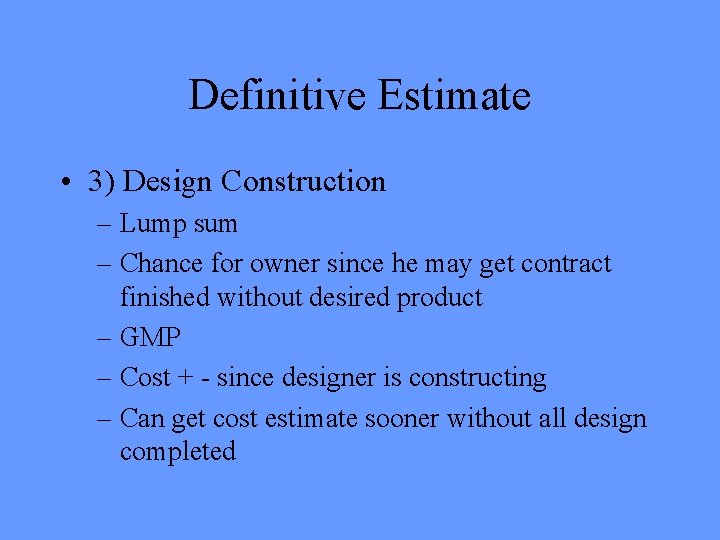
Definitive Estimate • 3) Design Construction – Lump sum – Chance for owner since he may get contract finished without desired product – GMP – Cost + - since designer is constructing – Can get cost estimate sooner without all design completed
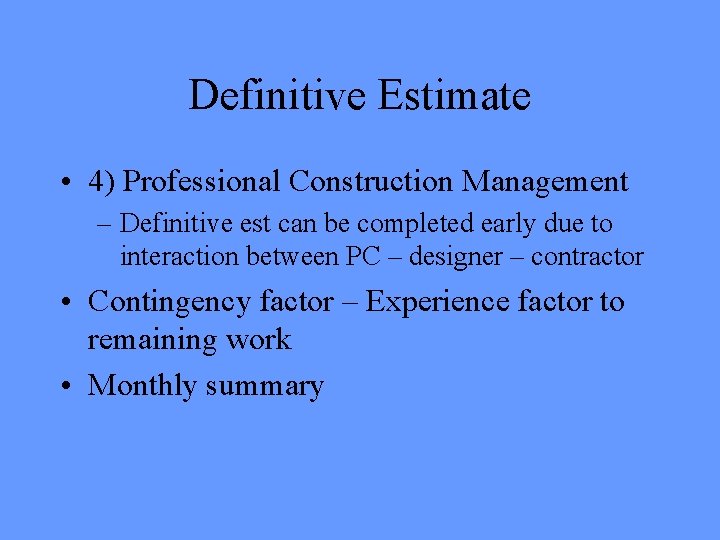
Definitive Estimate • 4) Professional Construction Management – Definitive est can be completed early due to interaction between PC – designer – contractor • Contingency factor – Experience factor to remaining work • Monthly summary
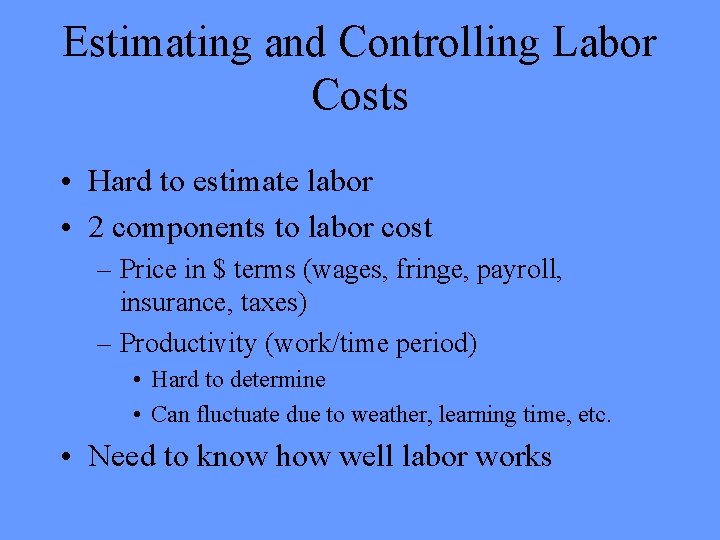
Estimating and Controlling Labor Costs • Hard to estimate labor • 2 components to labor cost – Price in $ terms (wages, fringe, payroll, insurance, taxes) – Productivity (work/time period) • Hard to determine • Can fluctuate due to weather, learning time, etc. • Need to know how well labor works
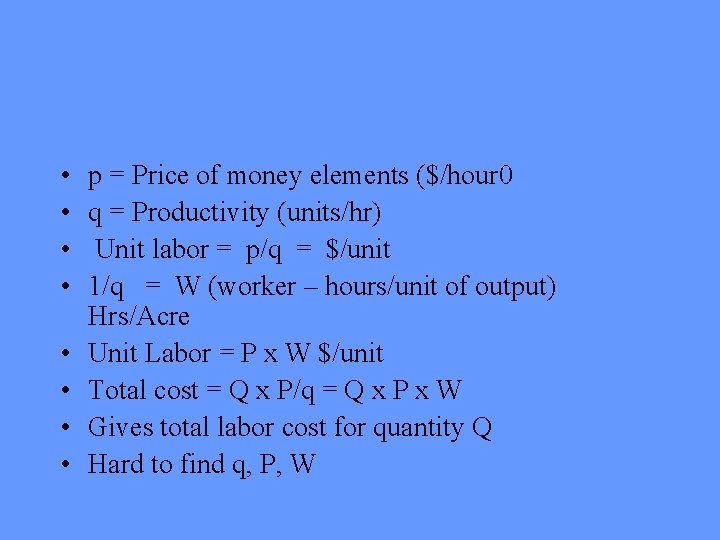
• • p = Price of money elements ($/hour 0 q = Productivity (units/hr) Unit labor = p/q = $/unit 1/q = W (worker – hours/unit of output) Hrs/Acre Unit Labor = P x W $/unit Total cost = Q x P/q = Q x P x W Gives total labor cost for quantity Q Hard to find q, P, W
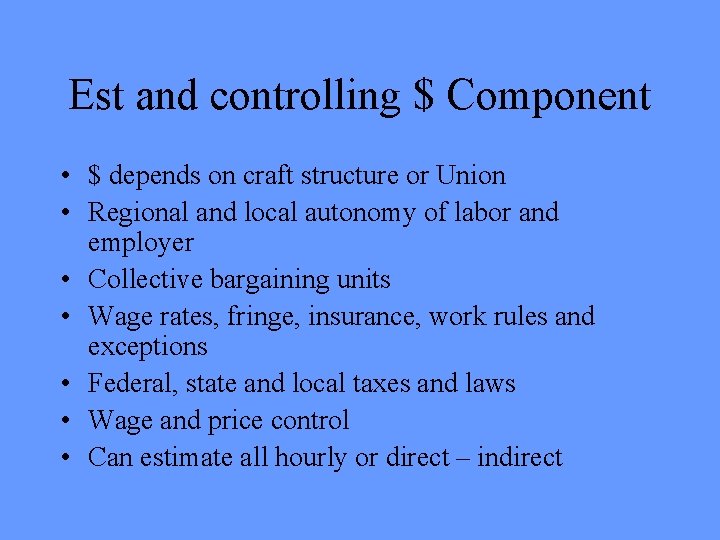
Est and controlling $ Component • $ depends on craft structure or Union • Regional and local autonomy of labor and employer • Collective bargaining units • Wage rates, fringe, insurance, work rules and exceptions • Federal, state and local taxes and laws • Wage and price control • Can estimate all hourly or direct – indirect
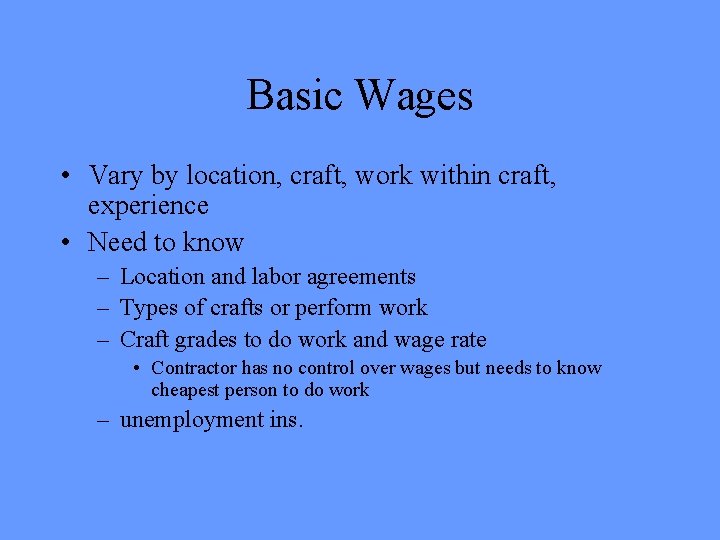
Basic Wages • Vary by location, craft, work within craft, experience • Need to know – Location and labor agreements – Types of crafts or perform work – Craft grades to do work and wage rate • Contractor has no control over wages but needs to know cheapest person to do work – unemployment ins.
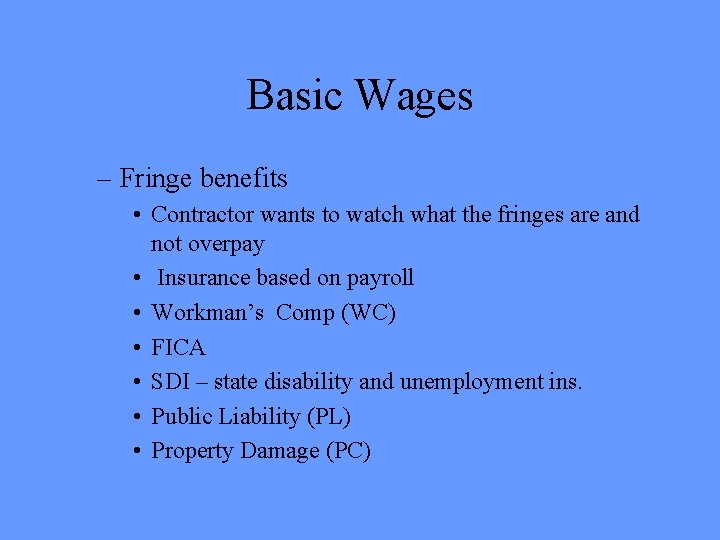
Basic Wages – Fringe benefits • Contractor wants to watch what the fringes are and not overpay • Insurance based on payroll • Workman’s Comp (WC) • FICA • SDI – state disability and unemployment ins. • Public Liability (PL) • Property Damage (PC)
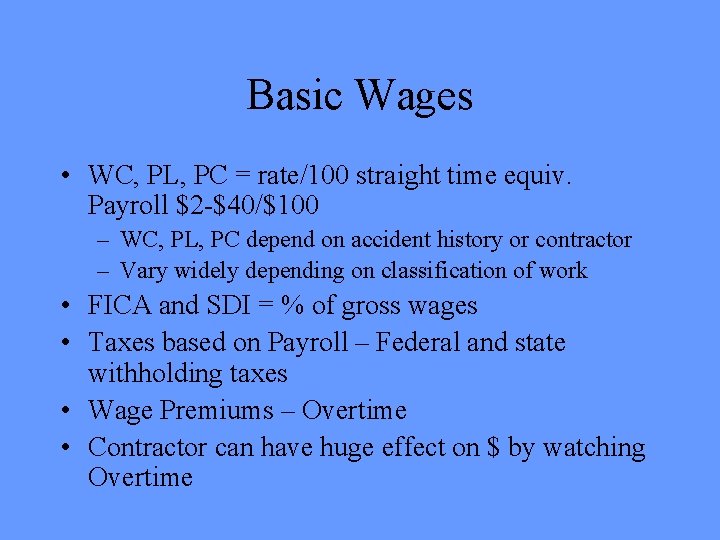
Basic Wages • WC, PL, PC = rate/100 straight time equiv. Payroll $2 -$40/$100 – WC, PL, PC depend on accident history or contractor – Vary widely depending on classification of work • FICA and SDI = % of gross wages • Taxes based on Payroll – Federal and state withholding taxes • Wage Premiums – Overtime • Contractor can have huge effect on $ by watching Overtime
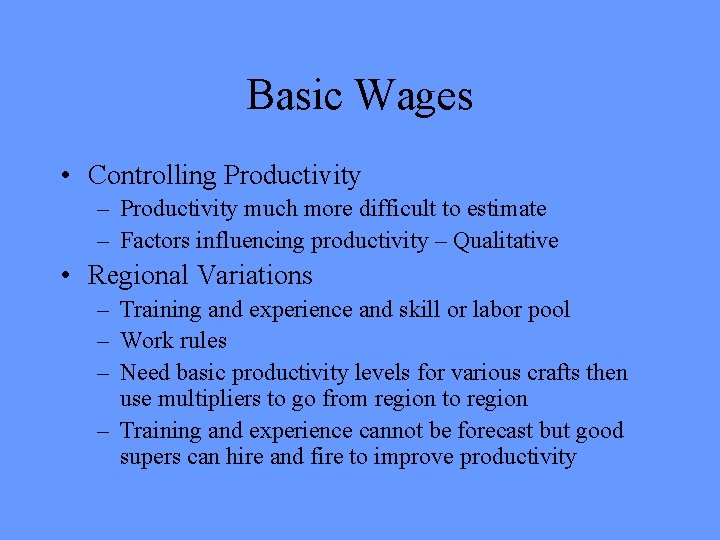
Basic Wages • Controlling Productivity – Productivity much more difficult to estimate – Factors influencing productivity – Qualitative • Regional Variations – Training and experience and skill or labor pool – Work rules – Need basic productivity levels for various crafts then use multipliers to go from region to region – Training and experience cannot be forecast but good supers can hire and fire to improve productivity
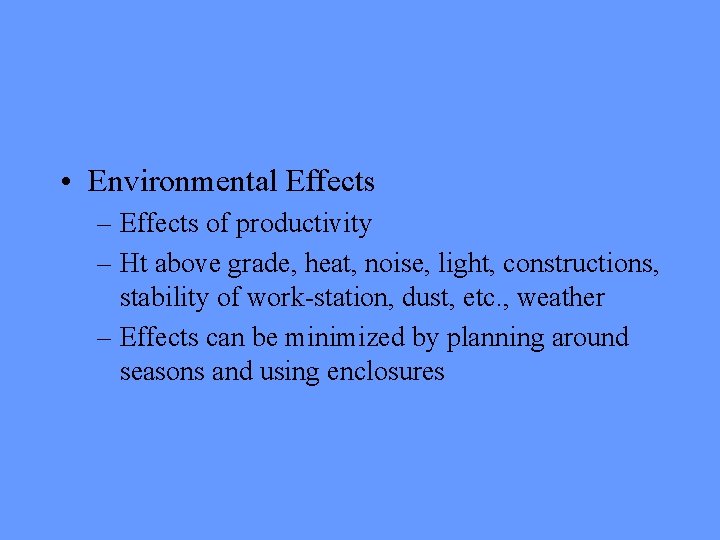
• Environmental Effects – Effects of productivity – Ht above grade, heat, noise, light, constructions, stability of work-station, dust, etc. , weather – Effects can be minimized by planning around seasons and using enclosures
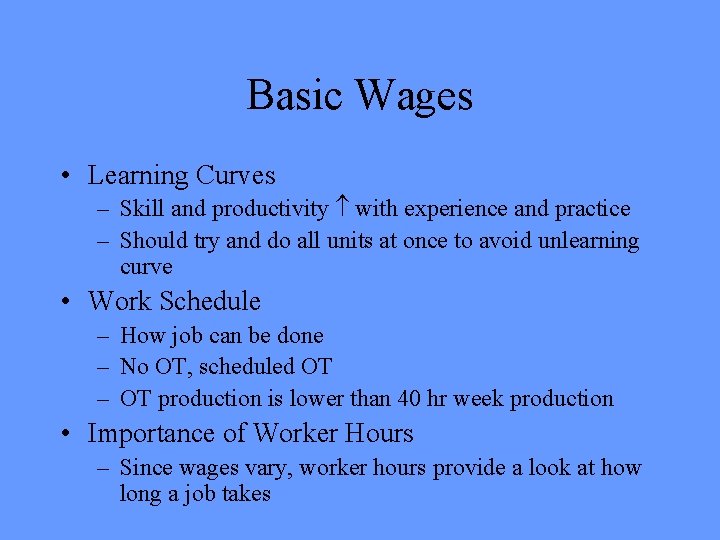
Basic Wages • Learning Curves – Skill and productivity with experience and practice – Should try and do all units at once to avoid unlearning curve • Work Schedule – How job can be done – No OT, scheduled OT – OT production is lower than 40 hr week production • Importance of Worker Hours – Since wages vary, worker hours provide a look at how long a job takes
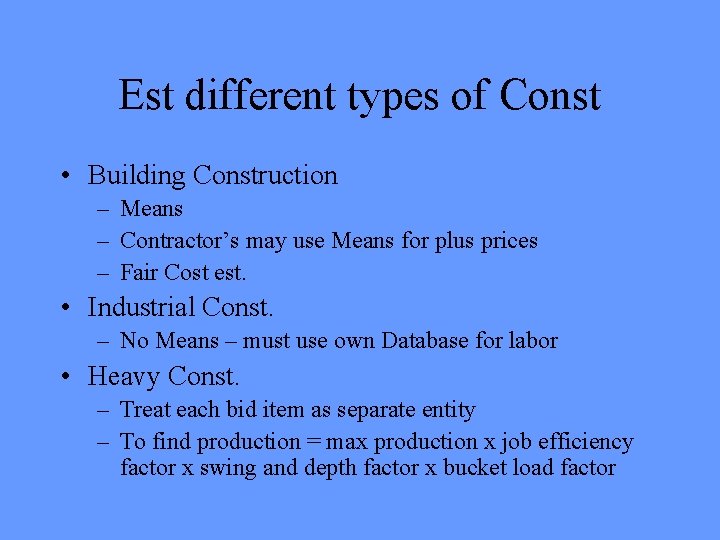
Est different types of Const • Building Construction – Means – Contractor’s may use Means for plus prices – Fair Cost est. • Industrial Const. – No Means – must use own Database for labor • Heavy Const. – Treat each bid item as separate entity – To find production = max production x job efficiency factor x swing and depth factor x bucket load factor