
Estimating a Parameter Lesson 7 1 The Idea
- Slides: 10
Estimating a Parameter Lesson 7. 1 The Idea of a Confidence Interval Statistics and Probability with Applications, 3 rd Edition Starnes & Tabor Bedford Freeman Worth Publishers
The Idea of a Confidence Interval Learning Targets After this lesson, you should be able to: ü Interpret a confidence interval in context. ü Determine the point estimate and margin of error from a confidence interval. ü Use confidence intervals to make decisions. Statistics and Probability with Applications, 3 rd Edition 2
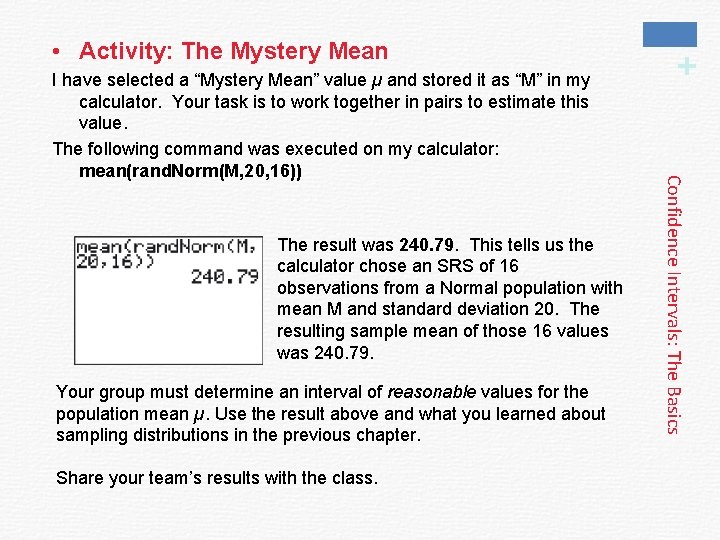
The result was 240. 79. This tells us the calculator chose an SRS of 16 observations from a Normal population with mean M and standard deviation 20. The resulting sample mean of those 16 values was 240. 79. Your group must determine an interval of reasonable values for the population mean µ. Use the result above and what you learned about sampling distributions in the previous chapter. Share your team’s results with the class. Confidence Intervals: The Basics I have selected a “Mystery Mean” value µ and stored it as “M” in my calculator. Your task is to work together in pairs to estimate this value. The following command was executed on my calculator: mean(rand. Norm(M, 20, 16)) + • Activity: The Mystery Mean
The Idea of a Confidence Interval Chapter 7 begins the formal study of statistical inference—using information from a sample to draw conclusions about a population parameter such as p or µ. One of the most common tasks of a statistician is using a sample statistic to estimate the value of a parameter. Confidence Interval A confidence interval gives an interval of plausible values for a parameter. “Plausible” means that we shouldn’t be surprised if any one of the values in the interval is equal to the value of the parameter. We use an interval of plausible values rather than a single-value estimate to increase our confidence that we have a correct value for the parameter. Statistics and Probability with Applications, 3 rd Edition 4
The Idea of a Confidence Interval Confidence intervals are constructed so that we know how much confidence we should have in the interval. The most common confidence level is 95% Confidence Level The confidence level C gives the long-run success rate of confidence intervals calculated with C% confidence. That is, in C% of all possible samples, the interval computed from the sample data will capture the true parameter value. How to Interpret a Confidence Interval To interpret a C% confidence interval for an unknown parameter, say, “We are C% confident that the interval from____to____captures the [parameter in context]. ” Statistics and Probability with Applications, 3 rd Edition 5
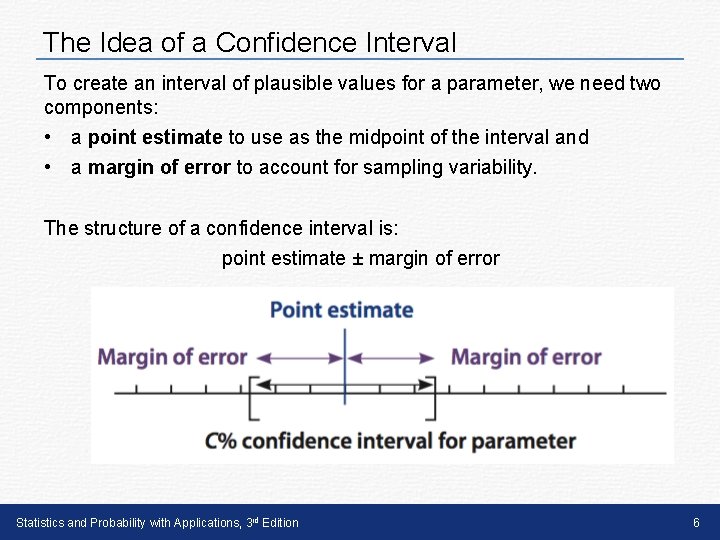
The Idea of a Confidence Interval To create an interval of plausible values for a parameter, we need two components: • a point estimate to use as the midpoint of the interval and • a margin of error to account for sampling variability. The structure of a confidence interval is: point estimate ± margin of error Statistics and Probability with Applications, 3 rd Edition 6
The Idea of a Confidence Interval The point estimate is our best guess for the value of the parameter. Unfortunately, the point estimate is unlikely to be correct because of the variability introduced by random sampling. We include the margin of error to account for this sampling variability. Point Estimate, Margin of Error A point estimate is a single-value estimate of a population parameter. The margin of error of an estimate describes how far, at most, we expect the estimate to vary from the true population value. That is, in a C% confidence interval, the distance between the point estimate and the true parameter value will be less than the margin of error in C% of all samples. Statistics and Probability with Applications, 3 rd Edition 7
LESSON APP 7. 1 Do you approve of the president’s job performance? Polling organizations regularly survey U. S. adults to ask if they approve of the job the president is doing. On the day of the 2014 midterm elections, the 95% confidence interval for the proportion of all U. S. adults that approved of President Obama’s job performance was 0. 39 to 0. 45. 1. Interpret the confidence interval. 2. Calculate the point estimate and margin of error used to create this confidence interval. 3. Is it plausible that on the day of the 2014 midterm elections, a majority of U. S. adults approved of President Obama’s job performance? Explain. Statistics and Probability with Applications, 3 rd Edition 8
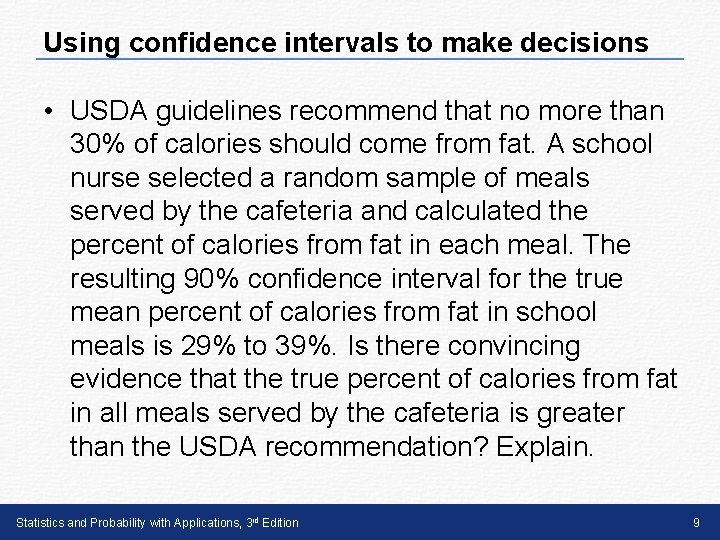
Using confidence intervals to make decisions • USDA guidelines recommend that no more than 30% of calories should come from fat. A school nurse selected a random sample of meals served by the cafeteria and calculated the percent of calories from fat in each meal. The resulting 90% confidence interval for the true mean percent of calories from fat in school meals is 29% to 39%. Is there convincing evidence that the true percent of calories from fat in all meals served by the cafeteria is greater than the USDA recommendation? Explain. Statistics and Probability with Applications, 3 rd Edition 9
The Idea of a Confidence Interval Learning Targets After this lesson, you should be able to: ü Interpret a confidence interval in context. ü Determine the point estimate and margin of error from a confidence interval. ü Use confidence intervals to make decisions. Statistics and Probability with Applications, 3 rd Edition 10