
Estimated Total Annual Cost Calculation Tom Dudley MS

- Slides: 15
Estimated Total Annual Cost Calculation Tom Dudley, MS, RN Division of Website Project Management
Objectives l Review the cost information displayed on the Medicare Prescription Drug Plan Finder. l Review the calculation that is used to determine the “Estimated Total Annual Cost” displayed on the plan finder.
Is the Estimated Total Annual Cost on www. medicare. gov Correct?
Things You Need To Know… 1. 2. You cannot multiply the monthly cost times 12, add the premium, and add the deductible to get the annual cost. The Estimated Total Annual Cost factors in the following: l l l l 3. The actual cost of the drug. The drug cost until the deductible is met. The drug cost during the initial coverage period. The drug cost during the coverage gap. The drug cost during the catastrophic period. The annual premium. The annual deductible. The Estimated Total Annual Cost is Accurate.
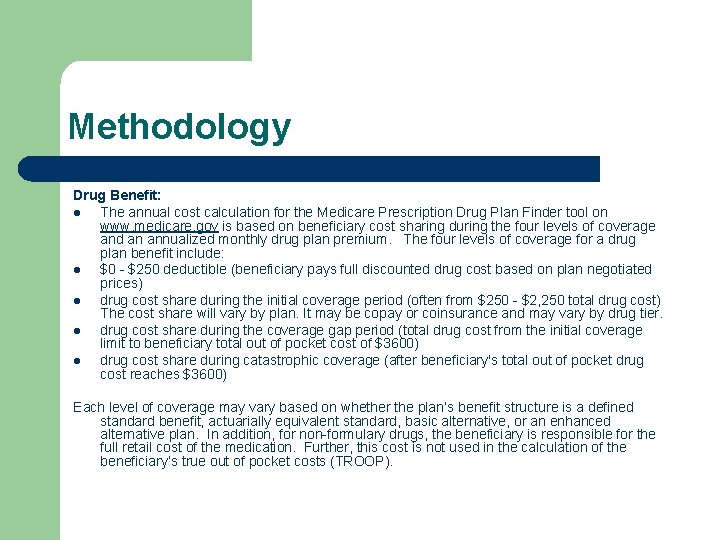
Methodology Drug Benefit: l The annual cost calculation for the Medicare Prescription Drug Plan Finder tool on www. medicare. gov is based on beneficiary cost sharing during the four levels of coverage and an annualized monthly drug plan premium. The four levels of coverage for a drug plan benefit include: l $0 - $250 deductible (beneficiary pays full discounted drug cost based on plan negotiated prices) l drug cost share during the initial coverage period (often from $250 - $2, 250 total drug cost) The cost share will vary by plan. It may be copay or coinsurance and may vary by drug tier. l drug cost share during the coverage gap period (total drug cost from the initial coverage limit to beneficiary total out of pocket cost of $3600) l drug cost share during catastrophic coverage (after beneficiary's total out of pocket drug cost reaches $3600) Each level of coverage may vary based on whether the plan’s benefit structure is a defined standard benefit, actuarially equivalent standard, basic alternative, or an enhanced alternative plan. In addition, for non-formulary drugs, the beneficiary is responsible for the full retail cost of the medication. Further, this cost is not used in the calculation of the beneficiary’s true out of pocket costs (TROOP).
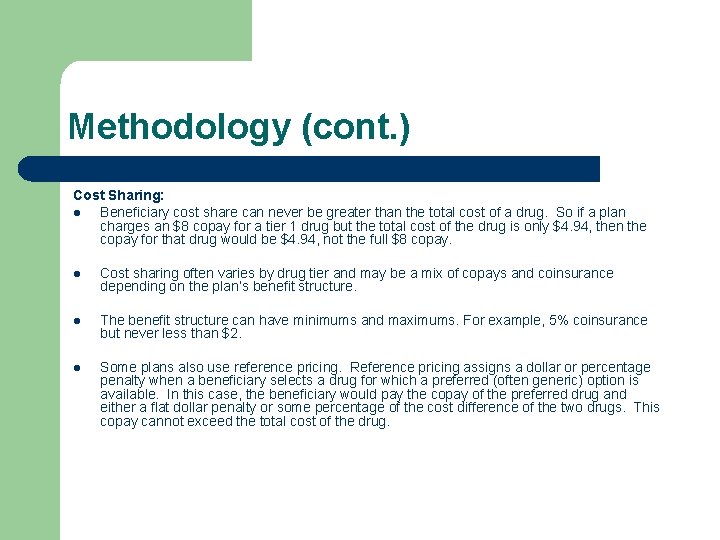
Methodology (cont. ) Cost Sharing: l Beneficiary cost share can never be greater than the total cost of a drug. So if a plan charges an $8 copay for a tier 1 drug but the total cost of the drug is only $4. 94, then the copay for that drug would be $4. 94, not the full $8 copay. l Cost sharing often varies by drug tier and may be a mix of copays and coinsurance depending on the plan’s benefit structure. l The benefit structure can have minimums and maximums. For example, 5% coinsurance but never less than $2. l Some plans also use reference pricing. Reference pricing assigns a dollar or percentage penalty when a beneficiary selects a drug for which a preferred (often generic) option is available. In this case, the beneficiary would pay the copay of the preferred drug and either a flat dollar penalty or some percentage of the cost difference of the two drugs. This copay cannot exceed the total cost of the drug.
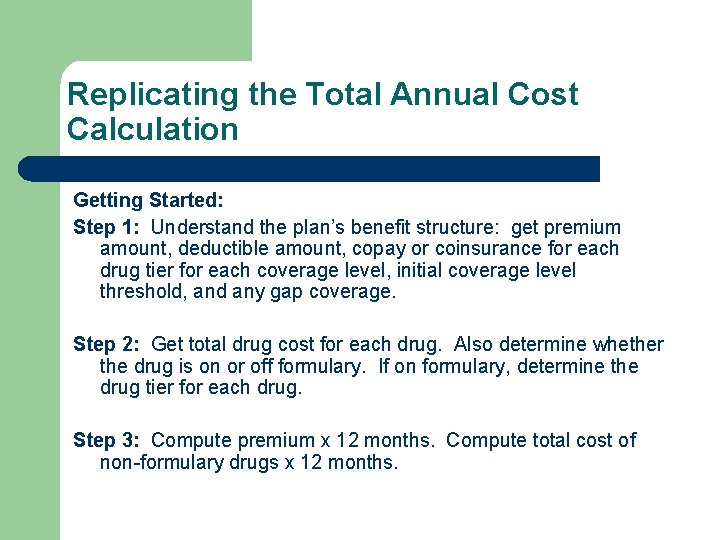
Replicating the Total Annual Cost Calculation Getting Started: Step 1: Understand the plan’s benefit structure: get premium amount, deductible amount, copay or coinsurance for each drug tier for each coverage level, initial coverage level threshold, and any gap coverage. Step 2: Get total drug cost for each drug. Also determine whether the drug is on or off formulary. If on formulary, determine the drug tier for each drug. Step 3: Compute premium x 12 months. Compute total cost of non-formulary drugs x 12 months.
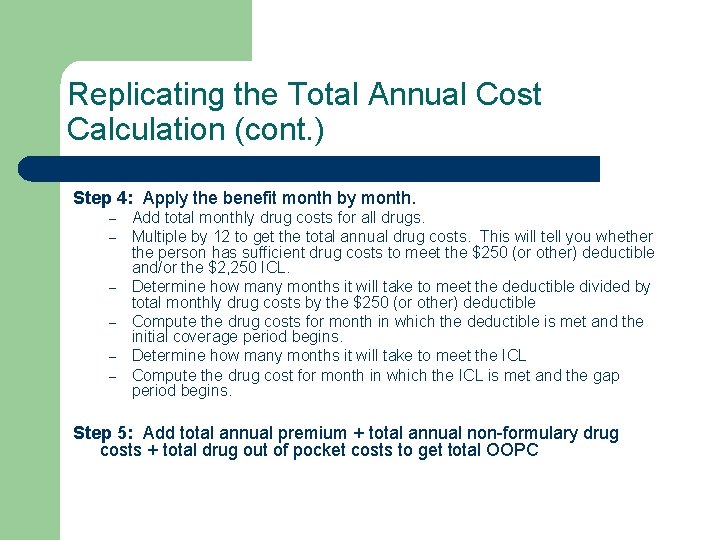
Replicating the Total Annual Cost Calculation (cont. ) Step 4: Apply the benefit month by month. – – – Add total monthly drug costs for all drugs. Multiple by 12 to get the total annual drug costs. This will tell you whether the person has sufficient drug costs to meet the $250 (or other) deductible and/or the $2, 250 ICL. Determine how many months it will take to meet the deductible divided by total monthly drug costs by the $250 (or other) deductible Compute the drug costs for month in which the deductible is met and the initial coverage period begins. Determine how many months it will take to meet the ICL Compute the drug cost for month in which the ICL is met and the gap period begins. Step 5: Add total annual premium + total annual non-formulary drug costs + total drug out of pocket costs to get total OOPC
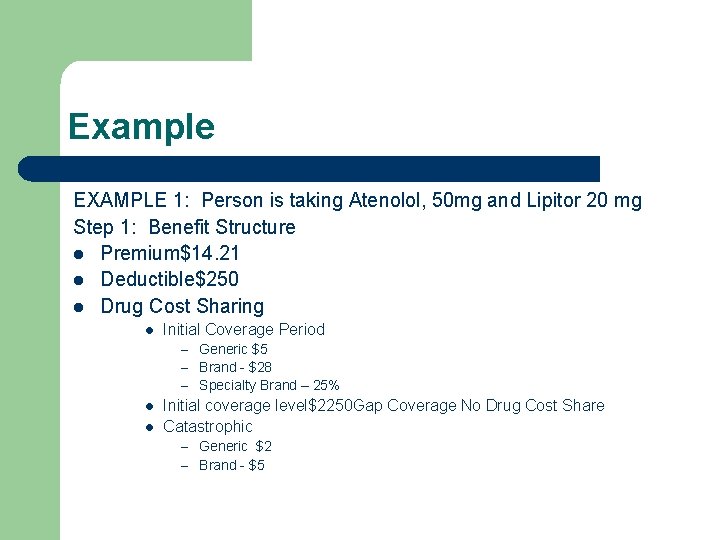
Example EXAMPLE 1: Person is taking Atenolol, 50 mg and Lipitor 20 mg Step 1: Benefit Structure l Premium$14. 21 l Deductible$250 l Drug Cost Sharing l Initial Coverage Period – Generic $5 – Brand - $28 – Specialty Brand – 25% l l Initial coverage level$2250 Gap Coverage No Drug Cost Share Catastrophic – Generic $2 – Brand - $5
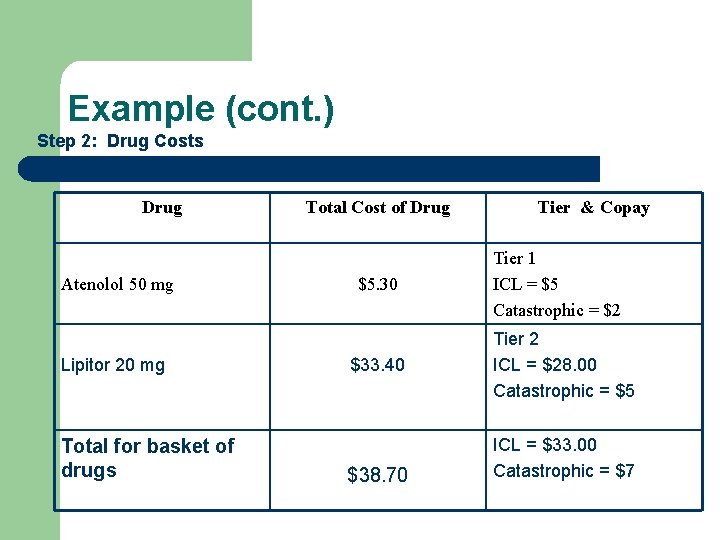
Example (cont. ) Step 2: Drug Costs Drug Atenolol 50 mg Lipitor 20 mg Total for basket of drugs Total Cost of Drug $5. 30 $33. 40 $38. 70 Tier & Copay Tier 1 ICL = $5 Catastrophic = $2 Tier 2 ICL = $28. 00 Catastrophic = $5 ICL = $33. 00 Catastrophic = $7
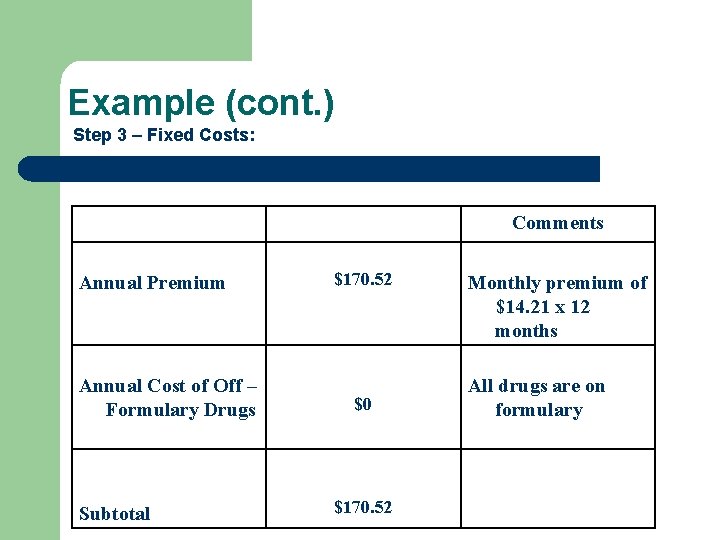
Example (cont. ) Step 3 – Fixed Costs: Comments Annual Premium Annual Cost of Off – Formulary Drugs Subtotal $170. 52 $0 $170. 52 Monthly premium of $14. 21 x 12 months All drugs are on formulary
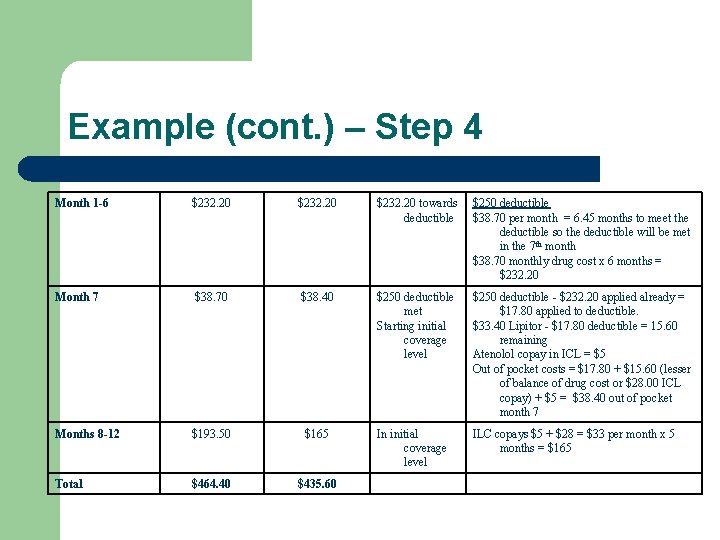
Example (cont. ) – Step 4 Month 1 -6 $232. 20 towards deductible $250 deductible $38. 70 per month = 6. 45 months to meet the deductible so the deductible will be met in the 7 th month $38. 70 monthly drug cost x 6 months = $232. 20 Month 7 $38. 70 $38. 40 $250 deductible met Starting initial coverage level $250 deductible - $232. 20 applied already = $17. 80 applied to deductible. $33. 40 Lipitor - $17. 80 deductible = 15. 60 remaining Atenolol copay in ICL = $5 Out of pocket costs = $17. 80 + $15. 60 (lesser of balance of drug cost or $28. 00 ICL copay) + $5 = $38. 40 out of pocket month 7 Months 8 -12 $193. 50 $165 In initial coverage level ILC copays $5 + $28 = $33 per month x 5 months = $165 Total $464. 40 $435. 60
Example (cont. ) Step 5: $435. 60 (total covered drug out of pocket) + $170. 52 (premium cost) = $606. 12
Questions? ? ?