
ESTIMASI PENJUALAN DATA TIME SERIES DEKOMPOSISI 1 ADDITIVE
- Slides: 5
ESTIMASI PENJUALAN DATA TIME SERIES - DEKOMPOSISI 1. ADDITIVE MODEL 2. MULTIPLICATIVE MODEL
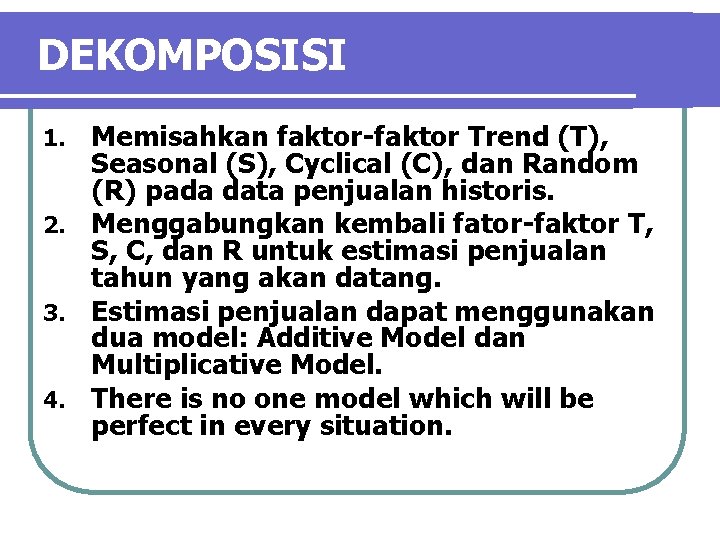
DEKOMPOSISI Memisahkan faktor-faktor Trend (T), Seasonal (S), Cyclical (C), dan Random (R) pada data penjualan historis. 2. Menggabungkan kembali fator-faktor T, S, C, dan R untuk estimasi penjualan tahun yang akan datang. 3. Estimasi penjualan dapat menggunakan dua model: Additive Model dan Multiplicative Model. 4. There is no one model which will be perfect in every situation. 1.
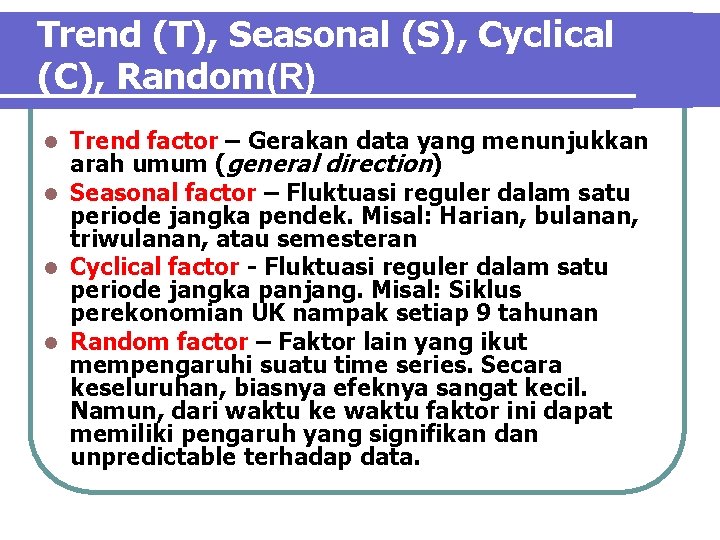
Trend (T), Seasonal (S), Cyclical (C), Random(R) Trend factor – Gerakan data yang menunjukkan arah umum (general direction) l Seasonal factor – Fluktuasi reguler dalam satu periode jangka pendek. Misal: Harian, bulanan, triwulanan, atau semesteran l Cyclical factor - Fluktuasi reguler dalam satu periode jangka panjang. Misal: Siklus perekonomian UK nampak setiap 9 tahunan l Random factor – Faktor lain yang ikut mempengaruhi suatu time series. Secara keseluruhan, biasnya efeknya sangat kecil. Namun, dari waktu ke waktu faktor ini dapat memiliki pengaruh yang signifikan dan unpredictable terhadap data. l
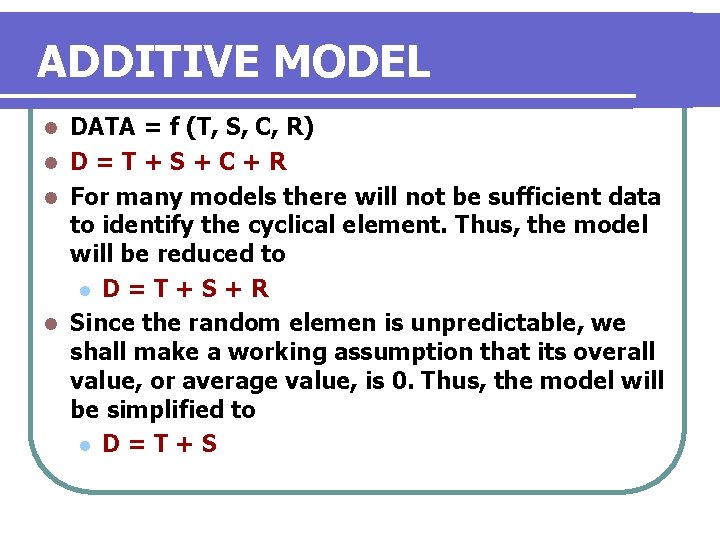
ADDITIVE MODEL DATA = f (T, S, C, R) l D=T+S+C+R l For many models there will not be sufficient data to identify the cyclical element. Thus, the model will be reduced to l D = T + S + R l Since the random elemen is unpredictable, we shall make a working assumption that its overall value, or average value, is 0. Thus, the model will be simplified to l D = T + S l
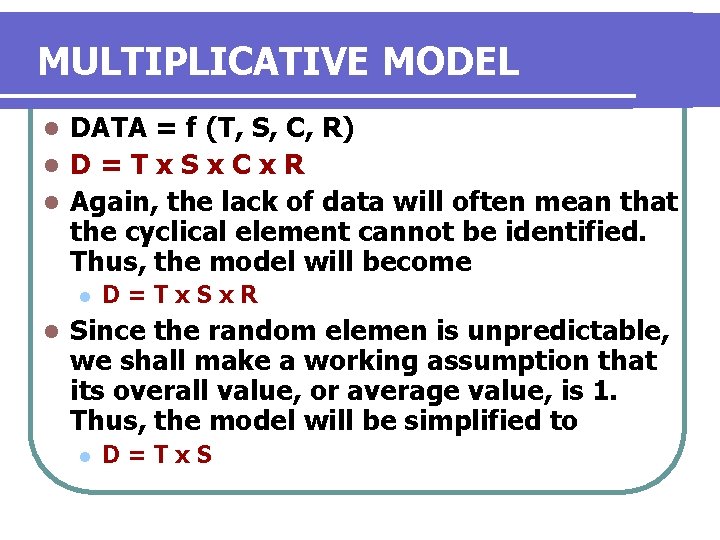
MULTIPLICATIVE MODEL DATA = f (T, S, C, R) l D=Tx. Sx. Cx. R l Again, the lack of data will often mean that the cyclical element cannot be identified. Thus, the model will become l l l D=Tx. Sx. R Since the random elemen is unpredictable, we shall make a working assumption that its overall value, or average value, is 1. Thus, the model will be simplified to l D=Tx. S