
Esters 26 February 2021 Esters Lesson Objective To

Esters 26 February 2021
Esters Lesson Objective: To know how esters are made from carboxylic acids and alcohols and about the hydrolysis of esters Success criteria • Recognise esters (E) • Name esters (D) • Describe how esters are made from carboxylic acids and alcohols (C) • Explain the hydrolysis reactions of esters in acidic and alkaline solutions (A)
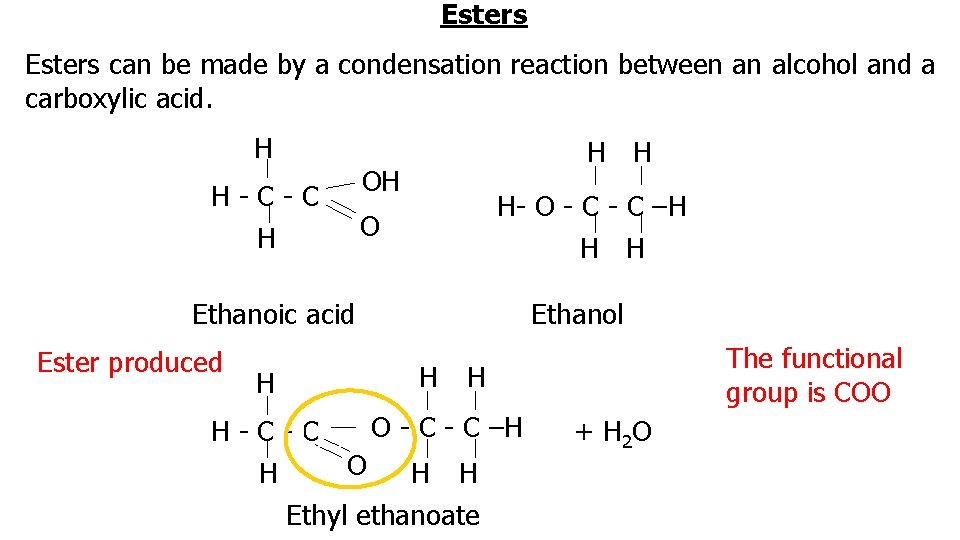
Esters can be made by a condensation reaction between an alcohol and a carboxylic acid. H H H OH H-C-C H- O - C –H H H O H Ethanoic acid Ester produced H H O H The functional group is COO H O - C –H H-C-C H Ethanol H Ethyl ethanoate + H 2 O
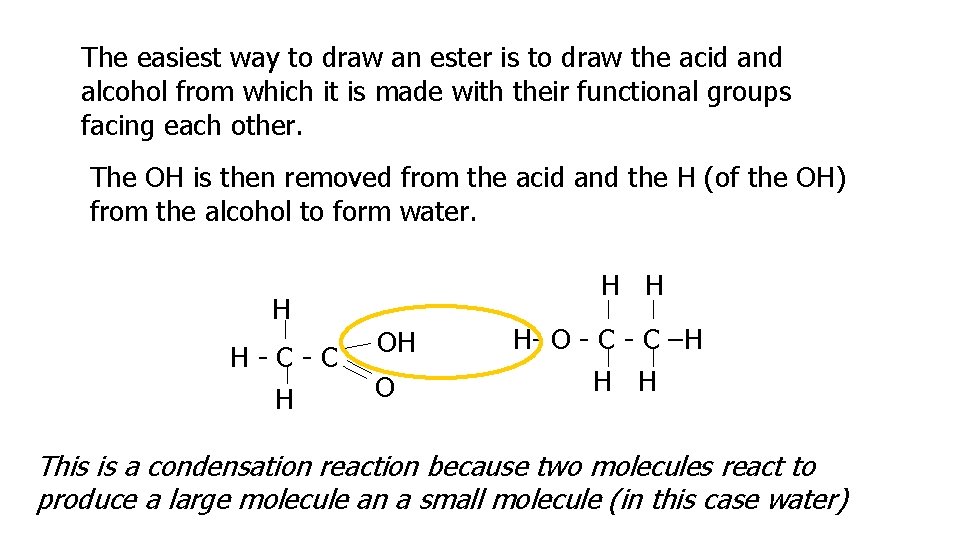
The easiest way to draw an ester is to draw the acid and alcohol from which it is made with their functional groups facing each other. The OH is then removed from the acid and the H (of the OH) from the alcohol to form water. H H-C-C H H H OH O H- O - C –H H H This is a condensation reaction because two molecules react to produce a large molecule an a small molecule (in this case water)
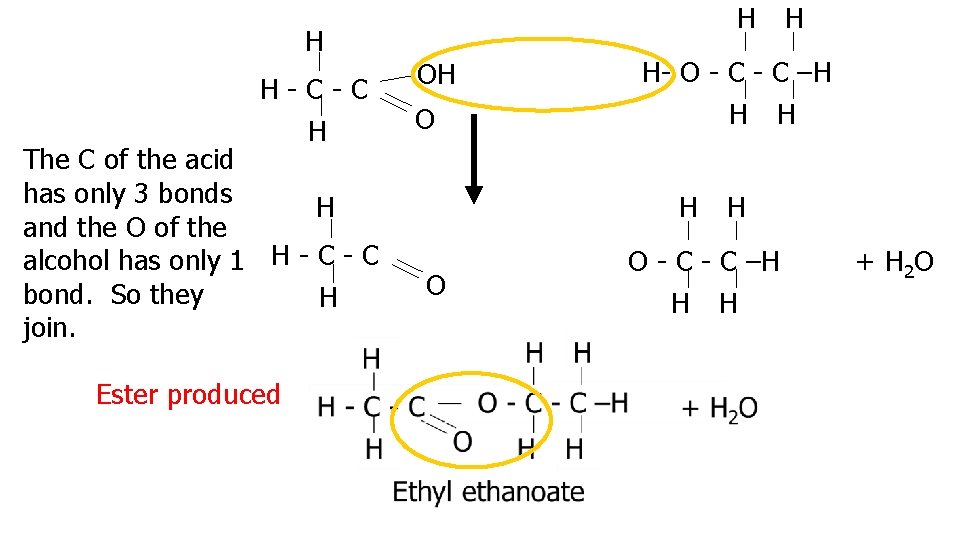
H H-C-C H The C of the acid has only 3 bonds H and the O of the alcohol has only 1 H - C bond. So they H join. Ester produced H OH H- O - C –H H O H H H O - C –H H H + H 2 O
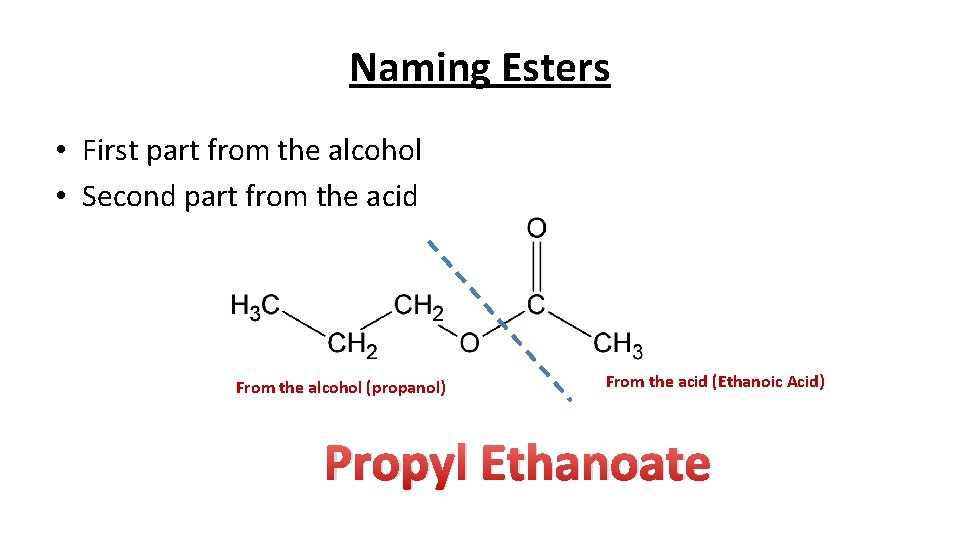
Naming Esters • First part from the alcohol • Second part from the acid From the alcohol (propanol) From the acid (Ethanoic Acid) Propyl Ethanoate
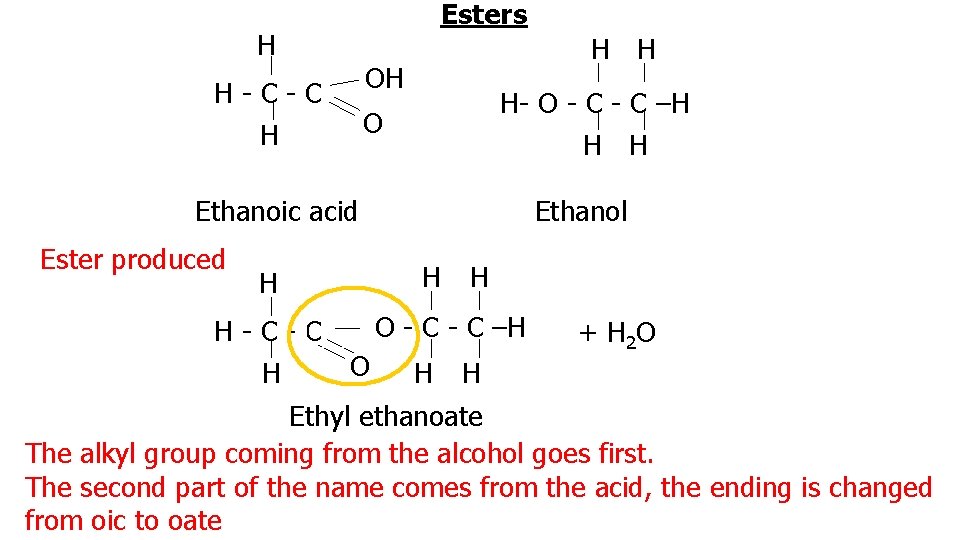
Esters H H H OH H-C-C H- O - C –H H H O H Ethanoic acid Ester produced H H H-C-C H Ethanol H O - C –H O H + H 2 O H Ethyl ethanoate The alkyl group coming from the alcohol goes first. The second part of the name comes from the acid, the ending is changed from oic to oate
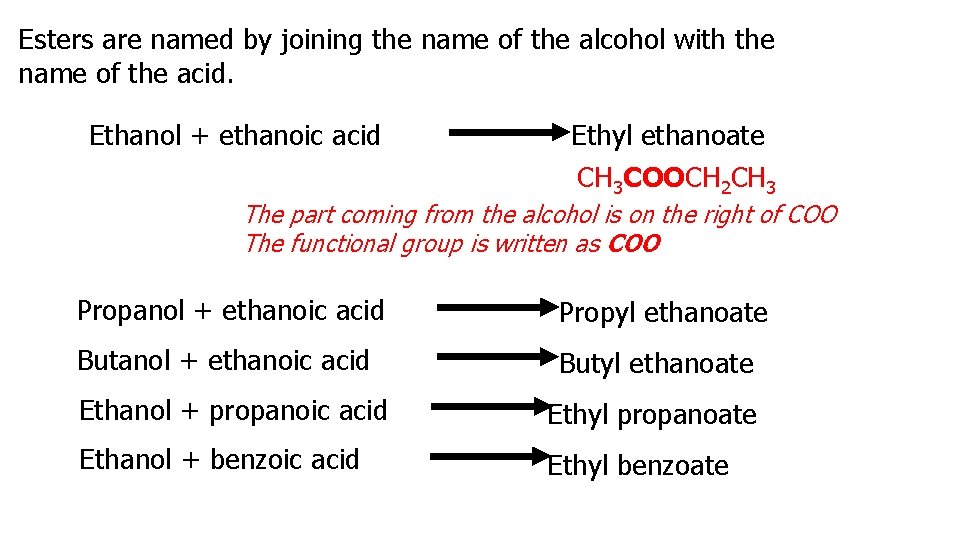
Esters are named by joining the name of the alcohol with the name of the acid. Ethanol + ethanoic acid Ethyl ethanoate CH 3 COOCH 2 CH 3 The part coming from the alcohol is on the right of COO The functional group is written as COO Propanol + ethanoic acid Propyl ethanoate Butanol + ethanoic acid Butyl ethanoate Ethanol + propanoic acid Ethyl propanoate Ethanol + benzoic acid Ethyl benzoate

Naming Esters If either carbon chain is branched you need to name the attached groups too. For an ester you number the carbons starting from the C atoms in the C-O-C bond E. g.

Naming Esters Example with benzene ring
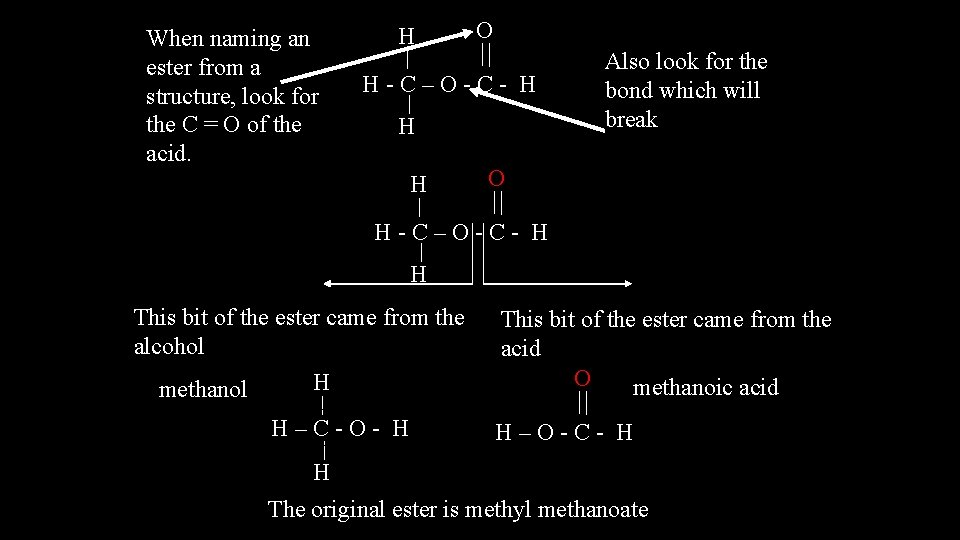
When naming an ester from a structure, look for the C = O of the acid. H O H-C–O-C- H H H Also look for the bond which will break O H-C–O-C- H H This bit of the ester came from the alcohol methanol H H–C-O- H This bit of the ester came from the acid O methanoic acid H–O-C- H H The original ester is methyl methanoate
Esters Lesson Objective: To know how esters are made from carboxylic acids and alcohols and about the hydrolysis of esters Success criteria • Recognise esters (E) • Name esters (D) • Describe how esters are made from carboxylic acids and alcohols (C) • Explain the hydrolysis reactions of esters in acidic and alkaline solutions (A)
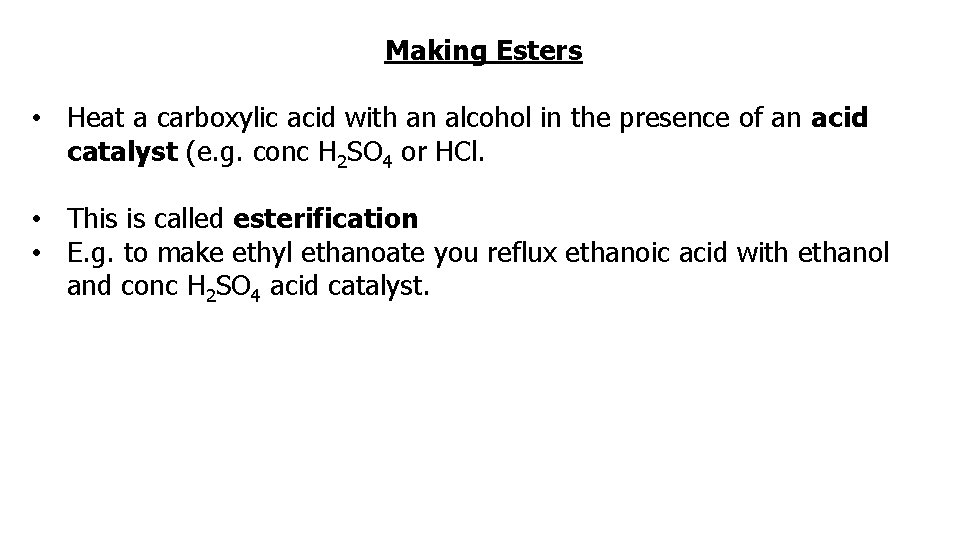
Making Esters • Heat a carboxylic acid with an alcohol in the presence of an acid catalyst (e. g. conc H 2 SO 4 or HCl. • This is called esterification • E. g. to make ethyl ethanoate you reflux ethanoic acid with ethanol and conc H 2 SO 4 acid catalyst.
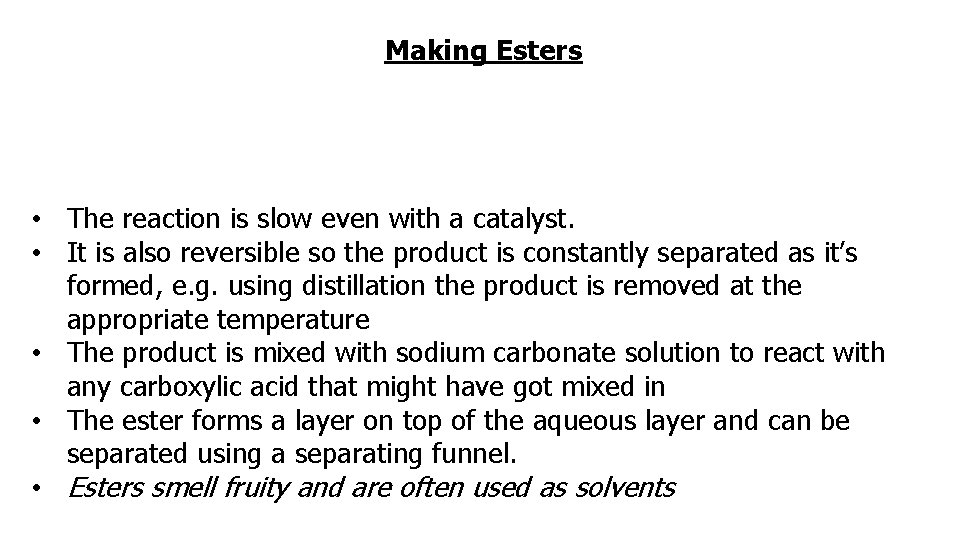
Making Esters • The reaction is slow even with a catalyst. • It is also reversible so the product is constantly separated as it’s formed, e. g. using distillation the product is removed at the appropriate temperature • The product is mixed with sodium carbonate solution to react with any carboxylic acid that might have got mixed in • The ester forms a layer on top of the aqueous layer and can be separated using a separating funnel. • Esters smell fruity and are often used as solvents
Esters Lesson Objective: To know how esters are made from carboxylic acids and alcohols and about the hydrolysis of esters Success criteria • Recognise esters (E) • Name esters (D) • Describe how esters are made from carboxylic acids and alcohols (C) • Explain the hydrolysis reactions of esters in acidic and alkaline solutions (A)
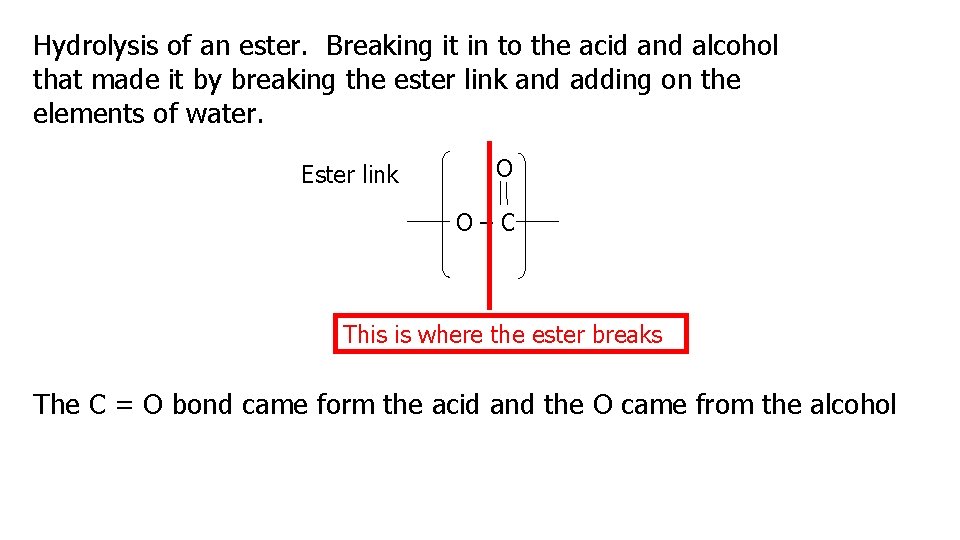
Hydrolysis of an ester. Breaking it in to the acid and alcohol that made it by breaking the ester link and adding on the elements of water. Ester link O O–C This is where the ester breaks The C = O bond came form the acid and the O came from the alcohol
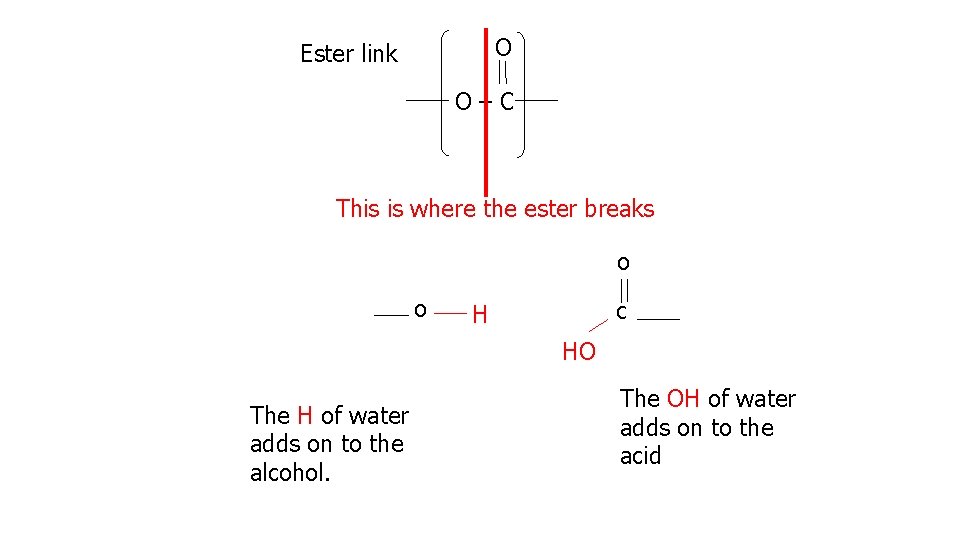
O Ester link O–C This is where the ester breaks O O H C HO The H of water adds on to the alcohol. The OH of water adds on to the acid
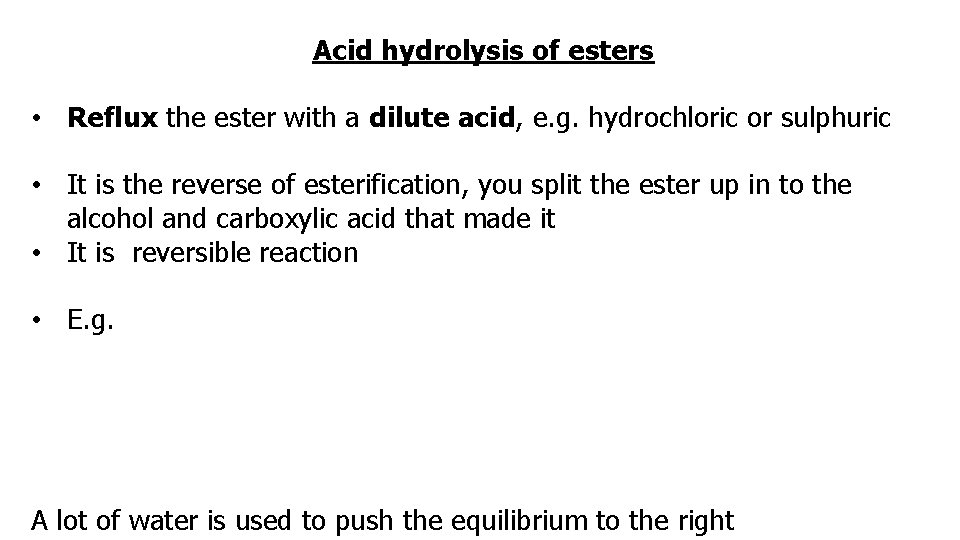
Acid hydrolysis of esters • Reflux the ester with a dilute acid, e. g. hydrochloric or sulphuric • It is the reverse of esterification, you split the ester up in to the alcohol and carboxylic acid that made it • It is reversible reaction • E. g. A lot of water is used to push the equilibrium to the right
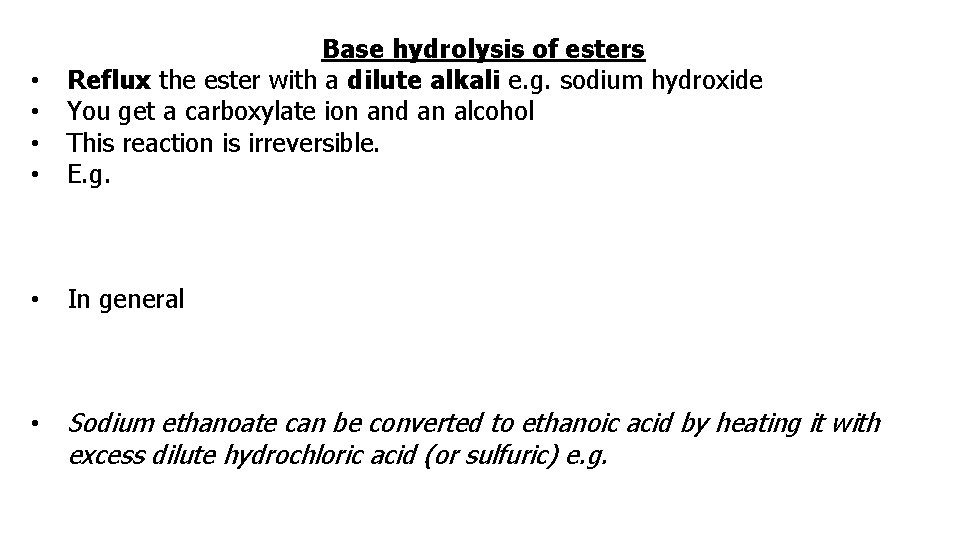
• • Base hydrolysis of esters Reflux the ester with a dilute alkali e. g. sodium hydroxide You get a carboxylate ion and an alcohol This reaction is irreversible. E. g. • In general • Sodium ethanoate can be converted to ethanoic acid by heating it with excess dilute hydrochloric acid (or sulfuric) e. g.
Esters Lesson Objective: To know how esters are made from carboxylic acids and alcohols and about the hydrolysis of esters Success criteria • Recognise esters (E) • Name esters (D) • Describe how esters are made from carboxylic acids and alcohols (C) • Explain the hydrolysis reactions of esters in acidic and alkaline solutions (A)
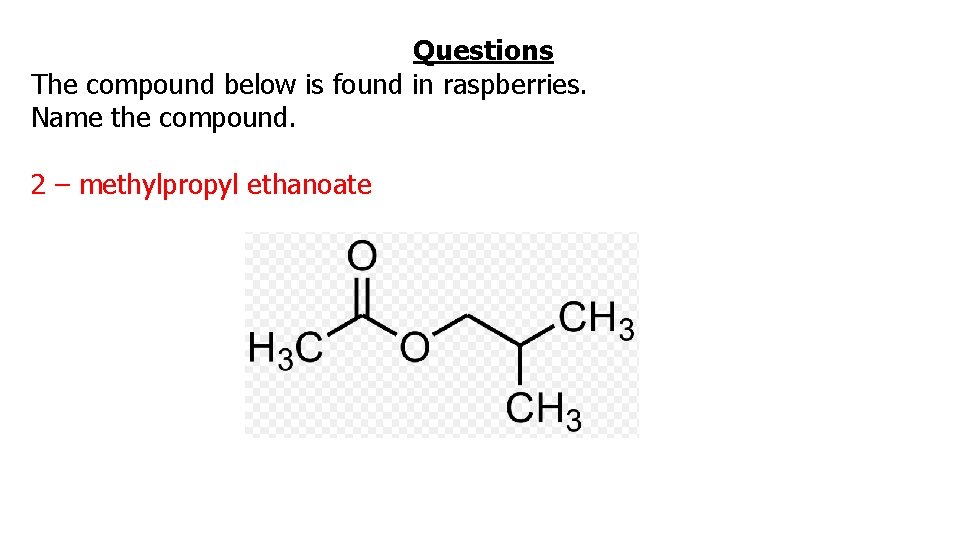
Questions The compound below is found in raspberries. Name the compound. 2 – methylpropyl ethanoate
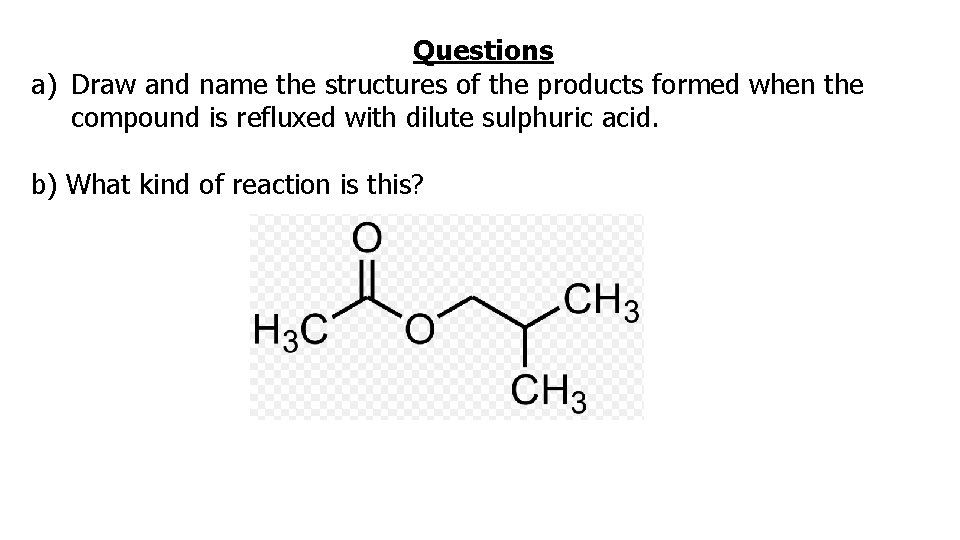
Questions a) Draw and name the structures of the products formed when the compound is refluxed with dilute sulphuric acid. b) What kind of reaction is this?
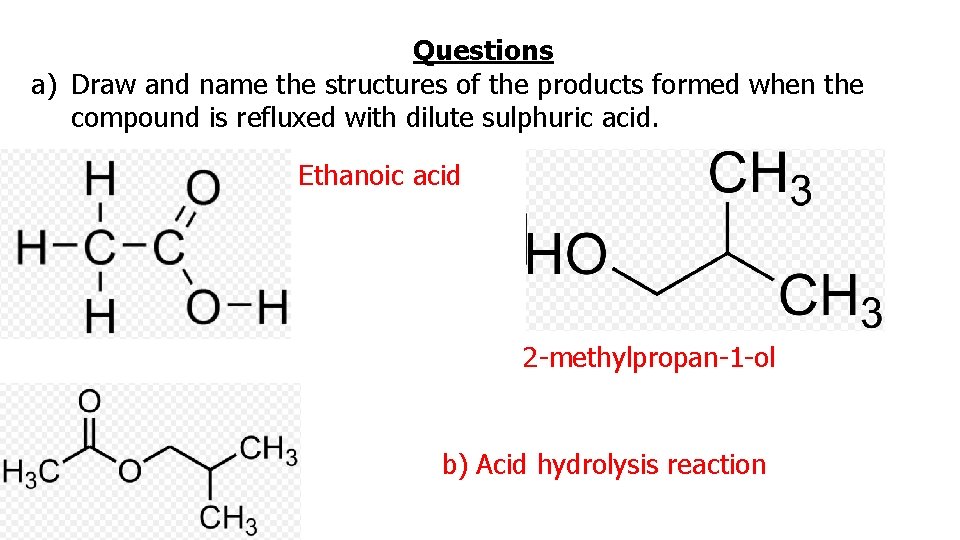
Questions a) Draw and name the structures of the products formed when the compound is refluxed with dilute sulphuric acid. Ethanoic acid 2 -methylpropan-1 -ol b) Acid hydrolysis reaction
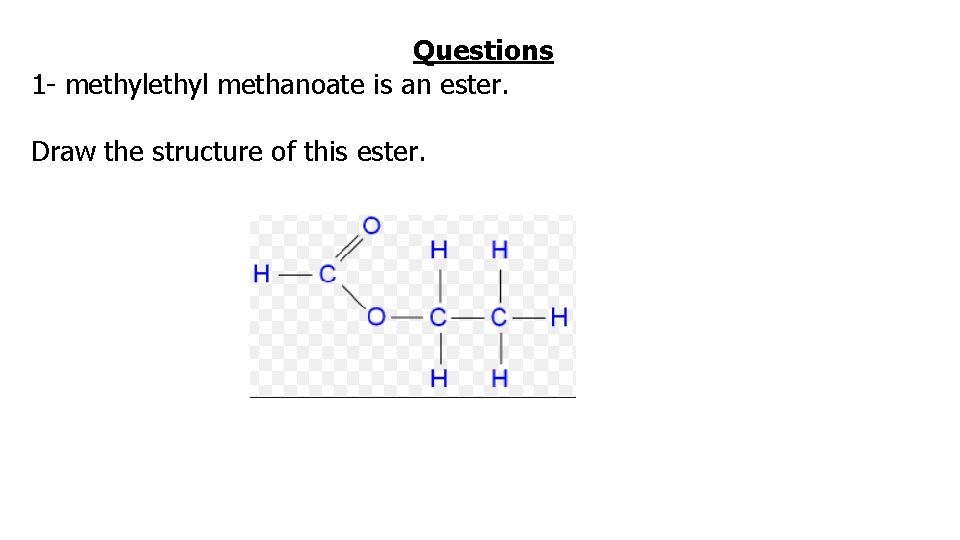
Questions 1 - methyl methanoate is an ester. Draw the structure of this ester.
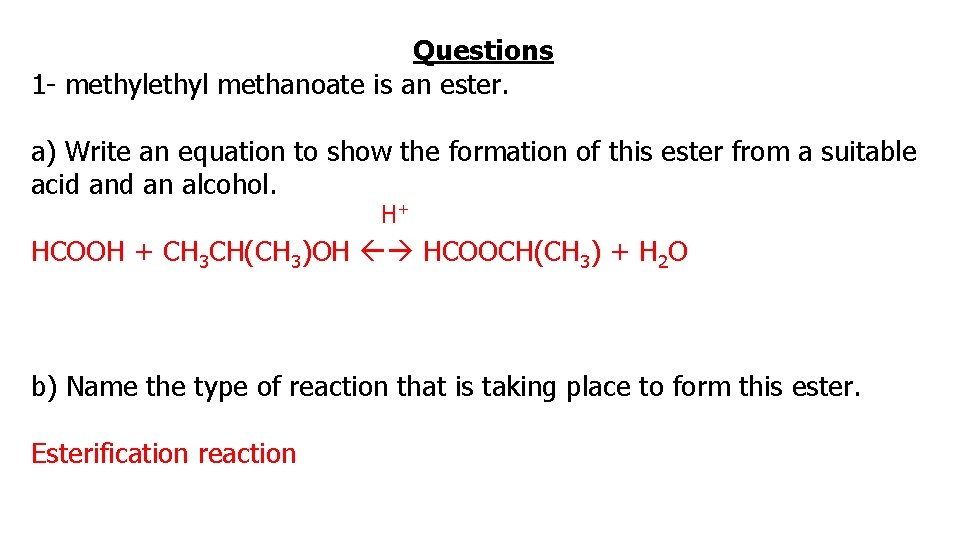
Questions 1 - methyl methanoate is an ester. a) Write an equation to show the formation of this ester from a suitable acid an alcohol. H+ HCOOH + CH 3 CH(CH 3)OH HCOOCH(CH 3) + H 2 O b) Name the type of reaction that is taking place to form this ester. Esterification reaction
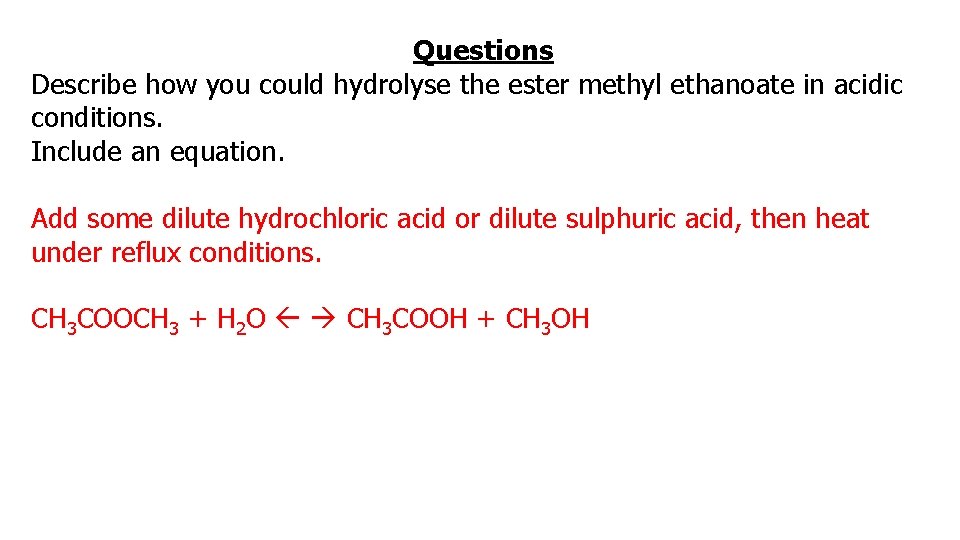
Questions Describe how you could hydrolyse the ester methyl ethanoate in acidic conditions. Include an equation. Add some dilute hydrochloric acid or dilute sulphuric acid, then heat under reflux conditions. CH 3 COOCH 3 + H 2 O CH 3 COOH + CH 3 OH
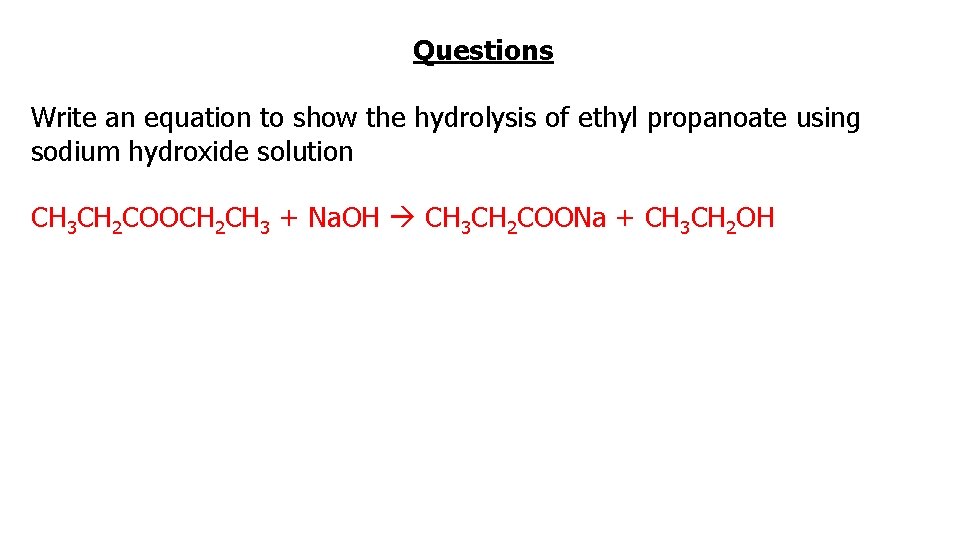
Questions Write an equation to show the hydrolysis of ethyl propanoate using sodium hydroxide solution CH 3 CH 2 COOCH 2 CH 3 + Na. OH CH 3 CH 2 COONa + CH 3 CH 2 OH
Esters Lesson Objective: To know how esters are made from carboxylic acids and alcohols and about the hydrolysis of esters Success criteria • Recognise esters (E) • Name esters (D) • Describe how esters are made from carboxylic acids and alcohols (C) • Explain the hydrolysis reactions of esters in acidic and alkaline solutions (A)
- Slides: 28