
Estate Planning Basics An Overview of the Estate
Estate Planning Basics An Overview of the Estate Planning Process
What Is an Estate Plan? An estate plan is a map This map reflects the way you want your personal and financial affairs to be handled in case of incapacity or death

Who Needs an Estate Plan? Chances are, you do Not just for the wealthy Without an estate plan, you can’t control what happens to your property if you die or become incapacitated An estate plan makes your wishes clear and helps avoid family disputes Proper estate planning can preserve assets and provide for loved ones Especially needed if: Your spouse isn’t comfortable with financial matters You have minor children Your net worth exceeds the federal transfer tax exclusion amount ($11, 580, 000 in 2020) or, if less, your state’s exemption amount You own property in more than one state Financial privacy is a concern You own a business
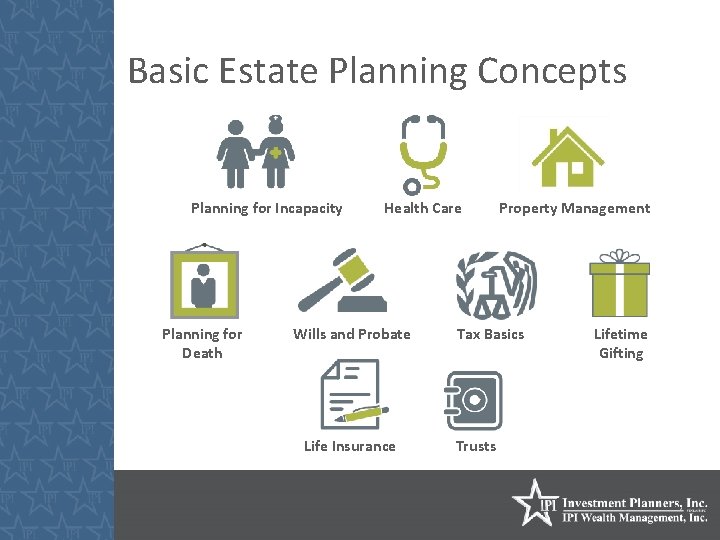
Basic Estate Planning Concepts Planning for Incapacity Planning for Death Health Care Wills and Probate Life Insurance Property Management Tax Basics Trusts Lifetime Gifting

Planning for Incapacity can strike anyone at any time Failing to plan means a court would have to appoint a guardian Lack of planning increases the burden on your guardian Your guardian’s decisions might not be what you would want
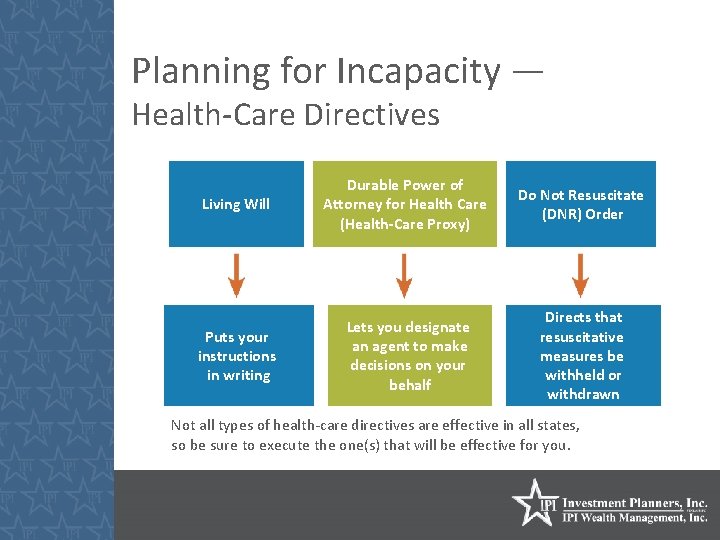
Planning for Incapacity — Health-Care Directives Living Will Durable Power of Attorney for Health Care (Health-Care Proxy) Do Not Resuscitate (DNR) Order Puts your instructions in writing Lets you designate an agent to make decisions on your behalf Directs that resuscitative measures be withheld or withdrawn Not all types of health-care directives are effective in all states, so be sure to execute the one(s) that will be effective for you.
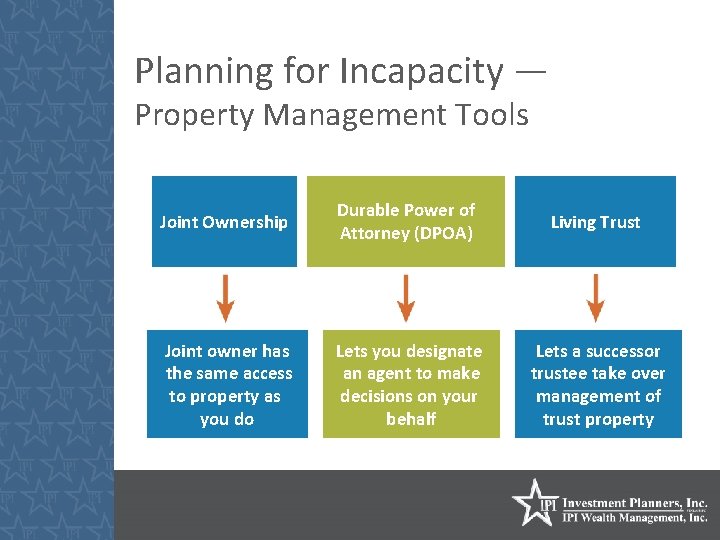
Planning for Incapacity — Property Management Tools Joint Ownership Durable Power of Attorney (DPOA) Living Trust Joint owner has the same access to property as you do Lets you designate an agent to make decisions on your behalf Lets a successor trustee take over management of trust property

What Happens If You Die Without an Estate Plan? Some property passes automatically to a joint owner or to a designated beneficiary (e. g. , IRAs, retirement plans, life insurance, trusts) All other property generally passes according to state intestacy laws
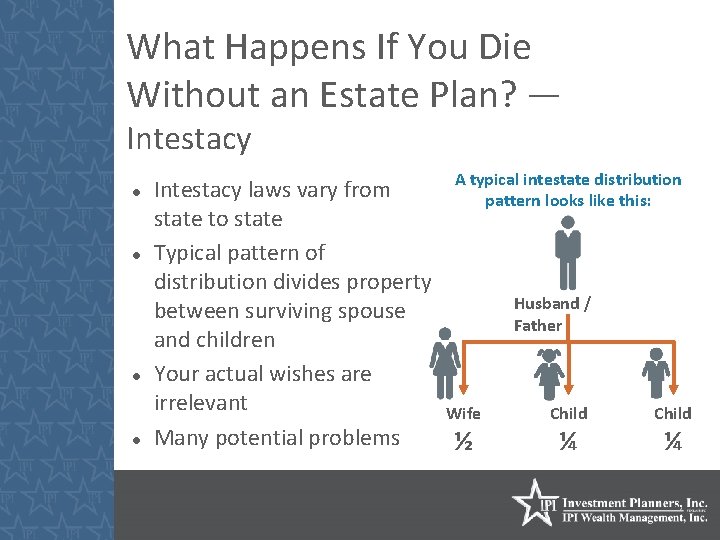
What Happens If You Die Without an Estate Plan? — Intestacy A typical intestate distribution Intestacy laws vary from pattern looks like this: state to state Typical pattern of distribution divides property Husband / between surviving spouse Father and children Your actual wishes are irrelevant Wife Child Many potential problems ½ ¼ ¼
Wills & Probate A will is the cornerstone of an estate plan Directs how your property will be distributed Names executor and guardian for minor children Can accomplish other estate planning goals (e. g. , minimizing taxes) Written, signed by you, and witnessed
Wills & Probate — The Probate Process Most wills must be probated Will is filed with probate court Executor collects assets, pays debts, files tax returns, and distributes property to heirs Typically, process lasts several months to a year
Wills & Probate — Probate Pros & Cons Pros Time and costs are typically modest Court supervision Protection against creditors Cons Can be time consuming for complex estates Title transfer delays Fees Ancillary probate Public record
Wills & Probate — Avoiding Probate Can you avoid probate? Yes, an estate plan can be designed to control which assets pass through probate, or to avoid probate. Own property jointly with rights of survivorship Complete beneficiary designation forms for property such as IRAs, retirement plans, and life insurance Use trusts Make lifetime gifts
Tax Basics Transfer taxes include: Federal gift tax — imposed on transfers you make during your life Federal estate tax — imposed on transfers made upon your death Federal generation-skipping transfer (GST) tax — imposed on transfers to individuals who are more than one generation below you (e. g. , grandchildren) both during your life and upon your death Transfer taxes imposed on the state level tend to affect smaller estates.
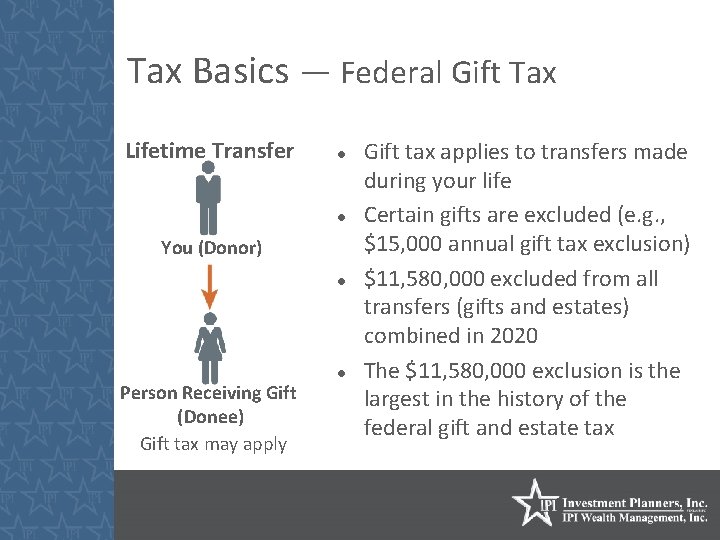
Tax Basics — Federal Gift Tax Lifetime Transfer You (Donor) Person Receiving Gift (Donee) Gift tax may apply Gift tax applies to transfers made during your life Certain gifts are excluded (e. g. , $15, 000 annual gift tax exclusion) $11, 580, 000 excluded from all transfers (gifts and estates) combined in 2020 The $11, 580, 000 exclusion is the largest in the history of the federal gift and estate tax
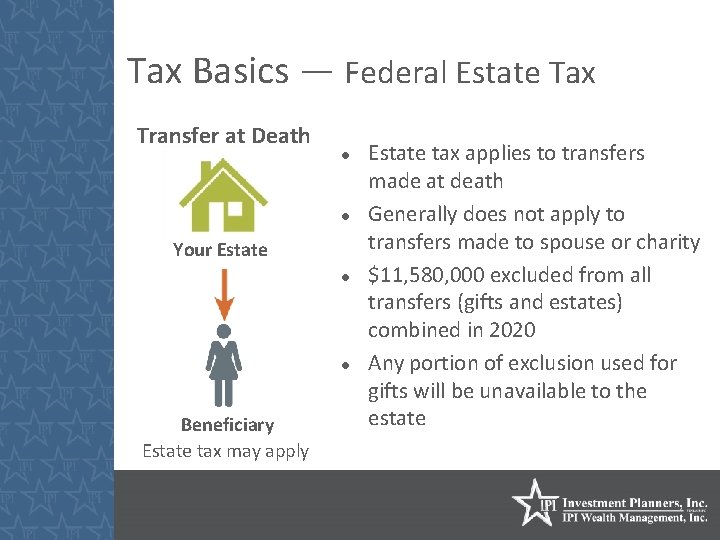
Tax Basics — Federal Estate Tax Transfer at Death Your Estate Beneficiary Estate tax may apply Estate tax applies to transfers made at death Generally does not apply to transfers made to spouse or charity $11, 580, 000 excluded from all transfers (gifts and estates) combined in 2020 Any portion of exclusion used for gifts will be unavailable to the estate
Tax Basics — Federal Estate Tax New feature important for married couples Exclusion is “portable” — unused portion left by deceased spouse can be transferred to surviving spouse $23, 160, 000 can be left to beneficiaries tax free (in 2020)
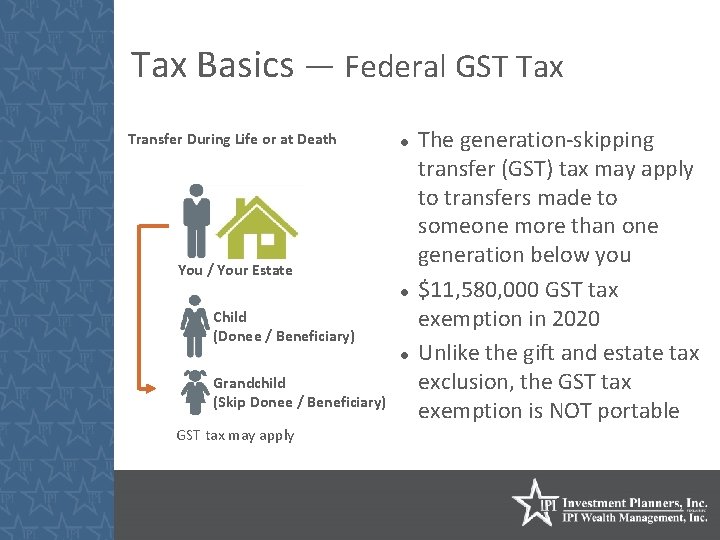
Tax Basics — Federal GST Tax Transfer During Life or at Death You / Your Estate Child (Donee / Beneficiary) Grandchild (Skip Donee / Beneficiary) GST tax may apply The generation-skipping transfer (GST) tax may apply to transfers made to someone more than one generation below you $11, 580, 000 GST tax exemption in 2020 Unlike the gift and estate tax exclusion, the GST tax exemption is NOT portable
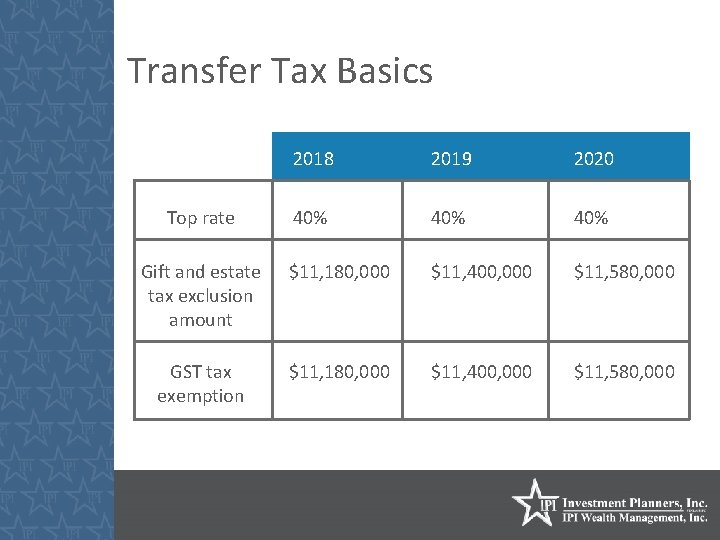
Transfer Tax Basics 2018 2019 2020 40% 40% Gift and estate tax exclusion amount $11, 180, 000 $11, 400, 000 $11, 580, 000 GST tax exemption $11, 180, 000 $11, 400, 000 $11, 580, 000 Top rate
Lifetime Gifting Lets you see the recipient enjoying your gift Lets you minimize transfer taxes by taking advantage of the $15, 000 annual gift tax exclusion and other tax deductions Removes future appreciation of property from your taxable estate No “step-up” in basis — your basis in the property carries over instead
Lifetime Gifting — Transfers Excluded from Gift Tax You can give $15, 000 to as many individuals as you want federal gift tax free ($30, 000 if you and your spouse make the gift together) If you’re contributing to a Section 529 plan, you can give $75, 000 ($150, 000 with spouse) gift tax free No gift tax on amounts paid directly to a school for an individual’s tuition No gift tax on amounts paid directly to a medical care provider for an individual’s medical care
Trusts Versatile estate planning tool Can protect against incapacity, avoid probate, minimize taxes Allow professional management of assets Provide safeguards for minor children, elderly parents, other beneficiaries Can protect assets from future creditors Control over property
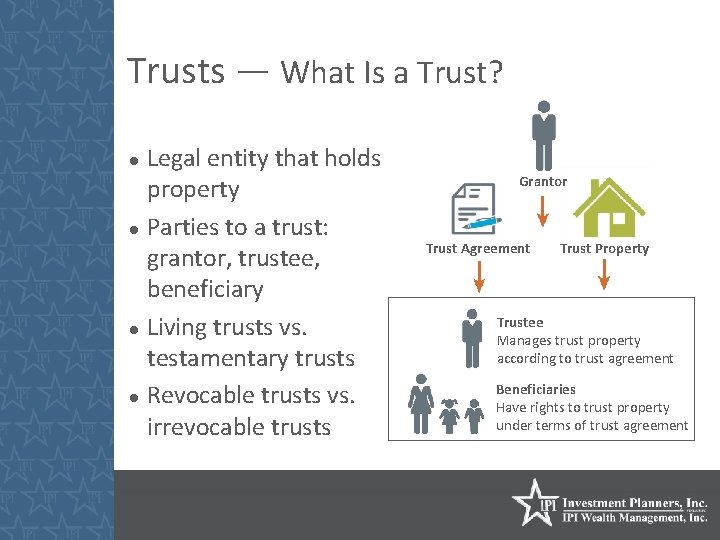
Trusts — What Is a Trust? Legal entity that holds property Parties to a trust: grantor, trustee, beneficiary Living trusts vs. testamentary trusts Revocable trusts vs. irrevocable trusts Grantor Trust Agreement Trust Property Trustee Manages trust property according to trust agreement Beneficiaries Have rights to trust property under terms of trust agreement

Life Insurance Can provide instant estate Can provide needed estate liquidity Life insurance proceeds are included in your estate for federal estate tax purposes unless your estate plan addresses this issue Key issue is ownership of policy
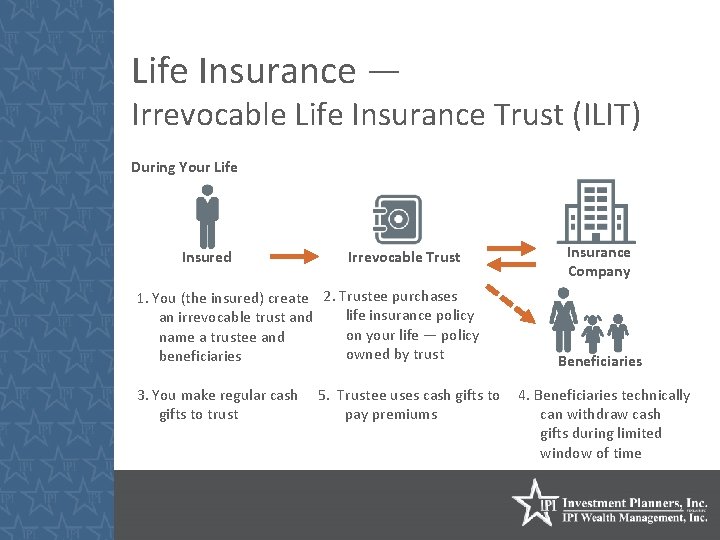
Life Insurance — Irrevocable Life Insurance Trust (ILIT) During Your Life Insured Irrevocable Trust 1. You (the insured) create 2. Trustee purchases life insurance policy an irrevocable trust and on your life — policy name a trustee and owned by trust beneficiaries 3. You make regular cash gifts to trust 5. Trustee uses cash gifts to pay premiums Insurance Company Beneficiaries 4. Beneficiaries technically can withdraw cash gifts during limited window of time
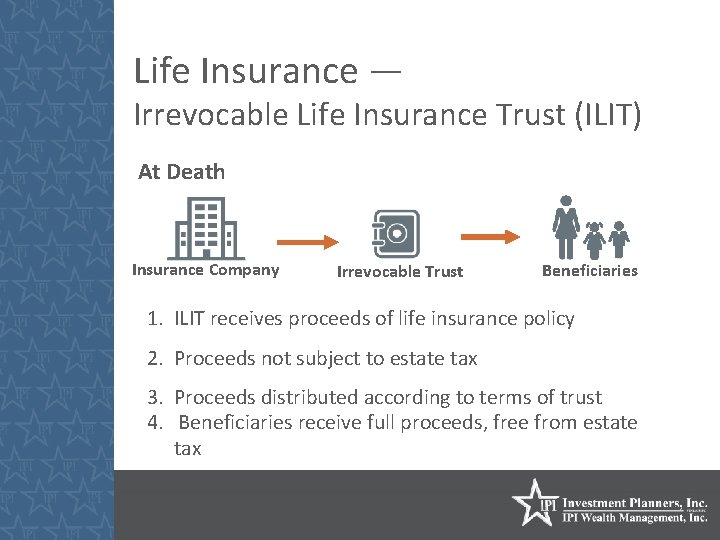
Life Insurance — Irrevocable Life Insurance Trust (ILIT) At Death Insurance Company Irrevocable Trust Beneficiaries 1. ILIT receives proceeds of life insurance policy 2. Proceeds not subject to estate tax 3. Proceeds distributed according to terms of trust 4. Beneficiaries receive full proceeds, free from estate tax
Conclusion Have you implemented a plan for incapacity (health and property)? Do you have a valid will? Are transfer taxes a planning concern for you? Does your overall estate plan reflect your current wishes and circumstances?

Thank You
Disclaimer IMPORTANT DISCLOSURES Broadridge Investor Communication Solutions, Inc. does not provide investment, tax, or legal advice. The information presented here is not specific to any individual's personal circumstances. To the extent that this material concerns tax matters, it is not intended or written to be used, and cannot be used, by a taxpayer for the purpose of avoiding penalties that may be imposed by law. Each taxpayer should seek independent advice from a tax professional based on his or her individual circumstances. These materials are provided for general information and educational purposes based upon publicly available information from sources believed to be reliable—we cannot assure the accuracy or completeness of these materials. The information in these materials may change at any time and without notice. Securities and investment advice offered through Investment Planners, Inc. (Member FINRA/SIPC) and IPI Wealth Management, Inc. , 226 W. Eldorado Street, Decatur, IL 62522. 217 -425 -6340.
- Slides: 29