
Establishment and Characterization of an Acute Myeloid Leukemia
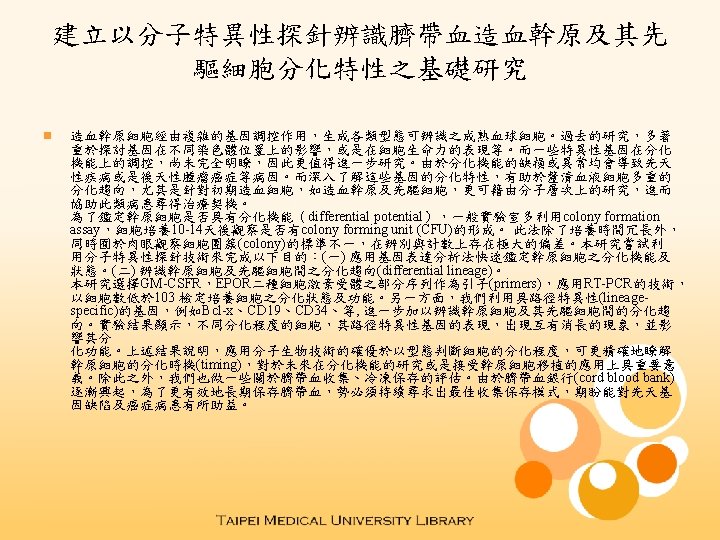
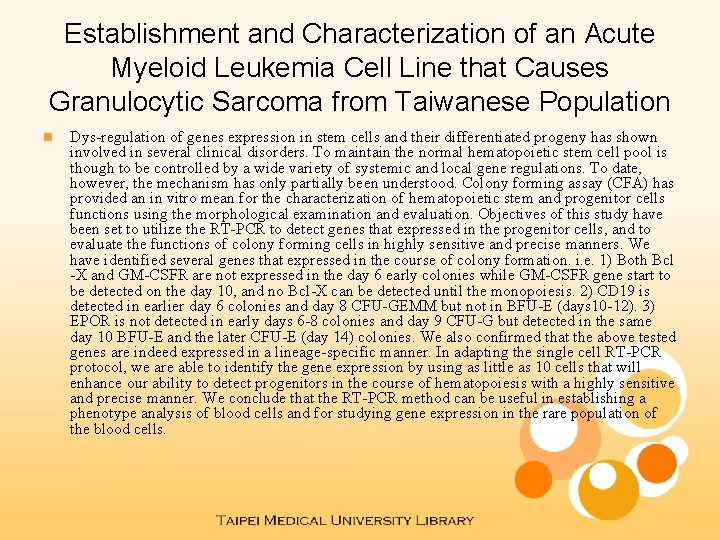
Establishment and Characterization of an Acute Myeloid Leukemia Cell Line that Causes Granulocytic Sarcoma from Taiwanese Population n Dys-regulation of genes expression in stem cells and their differentiated progeny has shown involved in several clinical disorders. To maintain the normal hematopoietic stem cell pool is though to be controlled by a wide variety of systemic and local gene regulations. To date, however, the mechanism has only partially been understood. Colony forming assay (CFA) has provided an in vitro mean for the characterization of hematopoietic stem and progenitor cells functions using the morphological examination and evaluation. Objectives of this study have been set to utilize the RT-PCR to detect genes that expressed in the progenitor cells, and to evaluate the functions of colony forming cells in highly sensitive and precise manners. We have identified several genes that expressed in the course of colony formation. i. e. 1) Both Bcl -X and GM-CSFR are not expressed in the day 6 early colonies while GM-CSFR gene start to be detected on the day 10, and no Bcl-X can be detected until the monopoiesis. 2) CD 19 is detected in earlier day 6 colonies and day 8 CFU-GEMM but not in BFU-E (days 10 -12). 3) EPOR is not detected in early days 6 -8 colonies and day 9 CFU-G but detected in the same day 10 BFU-E and the later CFU-E (day 14) colonies. We also confirmed that the above tested genes are indeed expressed in a lineage-specific manner. In adapting the single cell RT-PCR protocol, we are able to identify the gene expression by using as little as 10 cells that will enhance our ability to detect progenitors in the course of hematopoiesis with a highly sensitive and precise manner. We conclude that the RT-PCR method can be useful in establishing a phenotype analysis of blood cells and for studying gene expression in the rare population of the blood cells.
- Slides: 2