
Establishing Validation Acceptance Criteria on the Observed Mean
Establishing Validation Acceptance Criteria on the Observed Mean and Standard Deviation for 2 -Sided Dissolution Specifications Using Bayesian Methodology and Simulation Thomas Parks, Eli Lilly & Co Adam Rauk, Inventive Health Company Confidential © 2014 Eli Lilly and Company
Outline • Background on USP dissolution test <711> • Defining the problem • Specifications on an extended release product • Statistically supporting criteria for validation • Approaches • ASTM E 2709, “Standard Practice for Demonstrating Capability to Comply with a Lot Acceptance Procedure” (the “Bergum method) • Cu. DAL (Content Uniformity and Dissolution Acceptance Limits) is validated software for calculating one-sided limits • Bayesian approach using conjugate priors • • Distributions/Model Simulation Results References 2/28/2021 © 2014 Eli Lilly and Company 2
Background on USP <711> Dissolution Test • Purpose • To provide in vitro drug release information • Uses • Quality control including batch-to-batch variability • Surrogate for in vivo testing through In Vitro/In Vivo Correlations (IVIVC) • International Conference on Harmonisation (ICH) • The USP General Chapter <711> Dissolution test is harmonized with Europe and Japan 2/28/2021 © 2014 Eli Lilly and Company 3
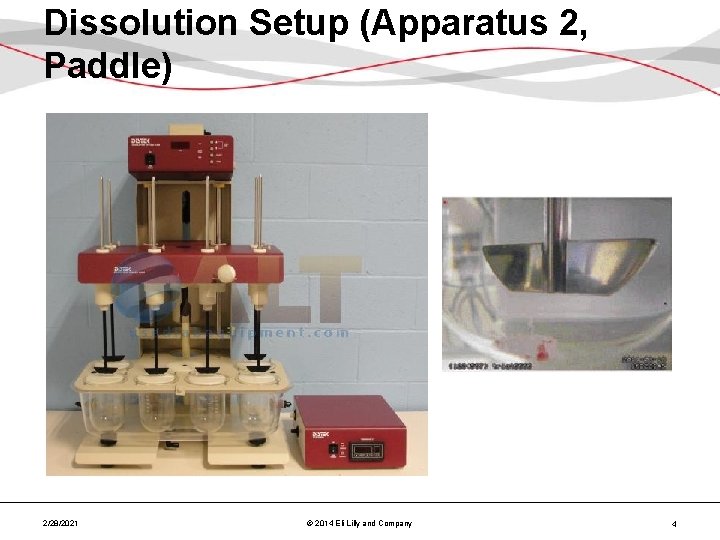
Dissolution Setup (Apparatus 2, Paddle) 2/28/2021 © 2014 Eli Lilly and Company 4
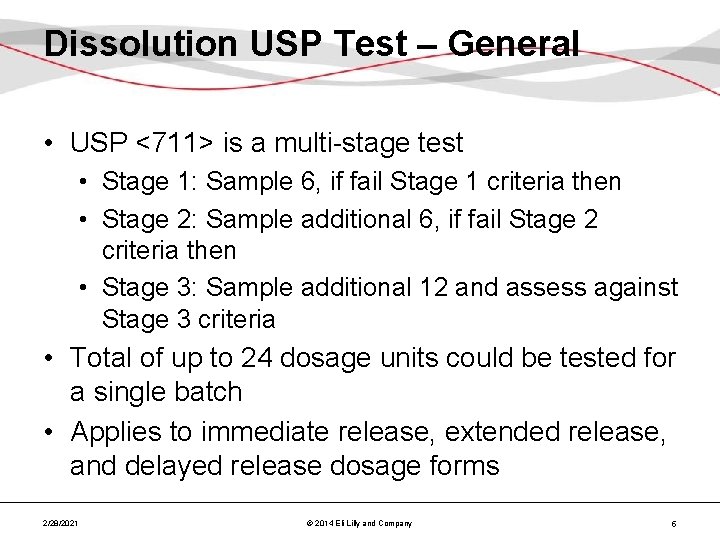
Dissolution USP Test – General • USP <711> is a multi-stage test • Stage 1: Sample 6, if fail Stage 1 criteria then • Stage 2: Sample additional 6, if fail Stage 2 criteria then • Stage 3: Sample additional 12 and assess against Stage 3 criteria • Total of up to 24 dosage units could be tested for a single batch • Applies to immediate release, extended release, and delayed release dosage forms 2/28/2021 © 2014 Eli Lilly and Company 5
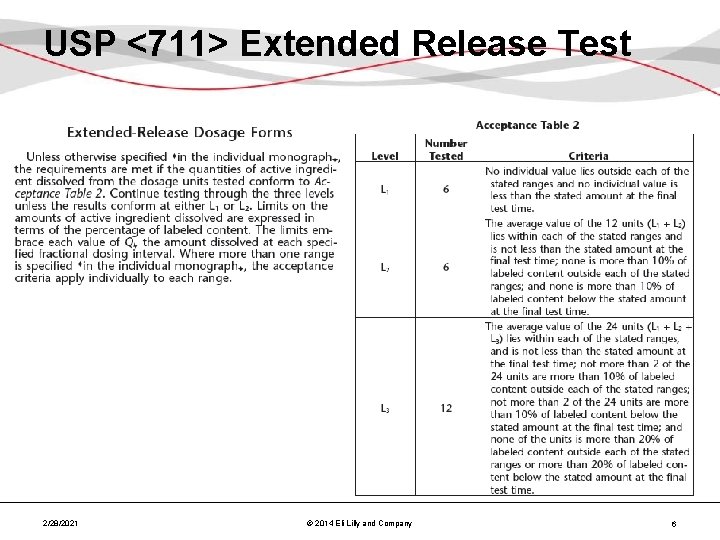
USP <711> Extended Release Test 2/28/2021 © 2014 Eli Lilly and Company 6
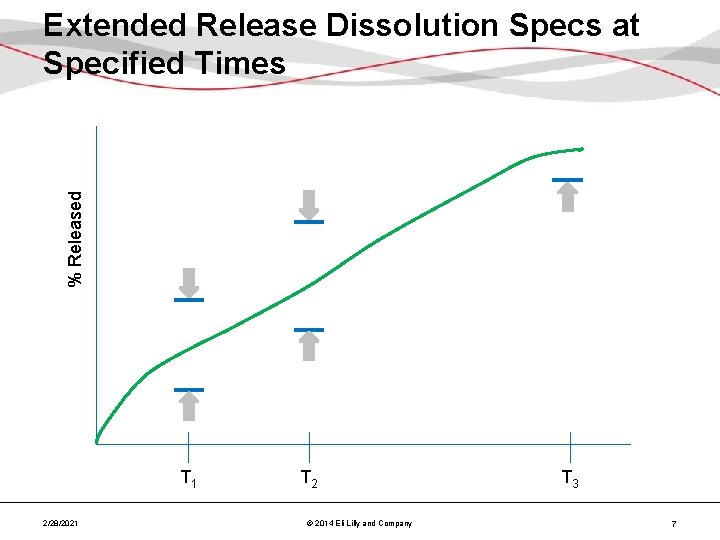
% Released Extended Release Dissolution Specs at Specified Times T 1 2/28/2021 T 2 © 2014 Eli Lilly and Company T 3 7
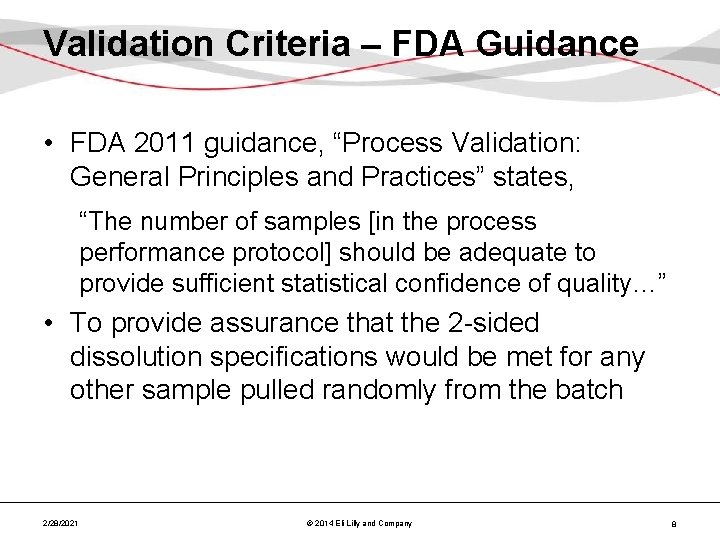
Validation Criteria – FDA Guidance • FDA 2011 guidance, “Process Validation: General Principles and Practices” states, “The number of samples [in the process performance protocol] should be adequate to provide sufficient statistical confidence of quality…” • To provide assurance that the 2 -sided dissolution specifications would be met for any other sample pulled randomly from the batch 2/28/2021 © 2014 Eli Lilly and Company 8
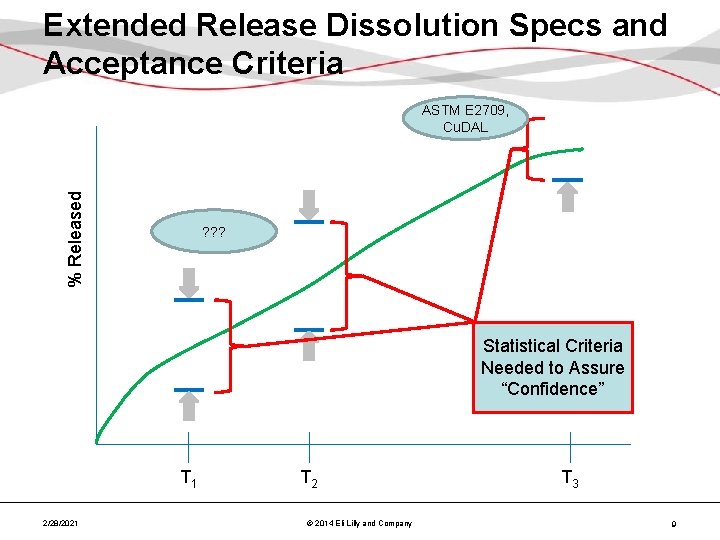
Extended Release Dissolution Specs and Acceptance Criteria % Released ASTM E 2709, Cu. DAL ? ? ? Statistical Criteria Needed to Assure “Confidence” T 1 2/28/2021 T 2 © 2014 Eli Lilly and Company T 3 9
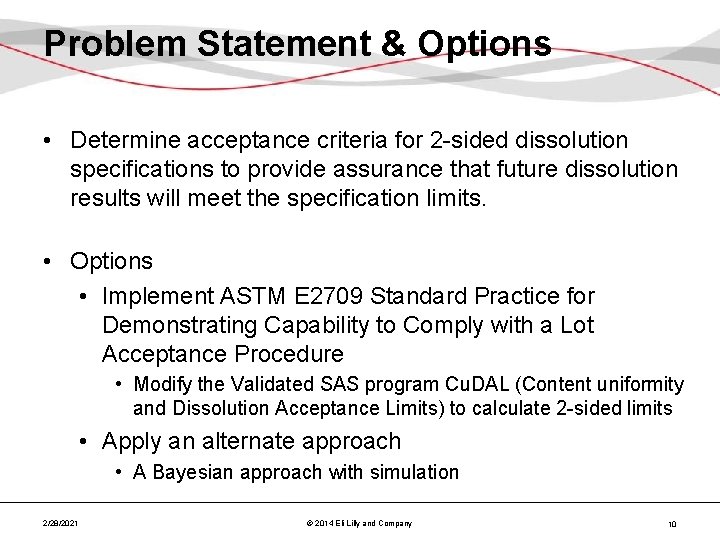
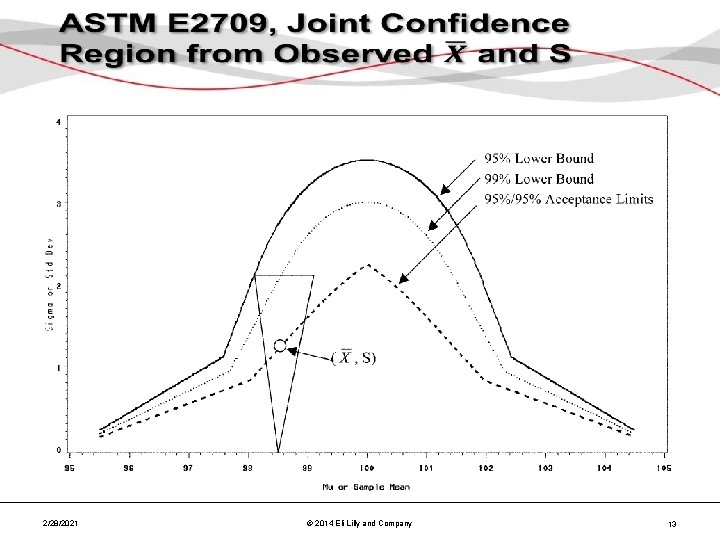
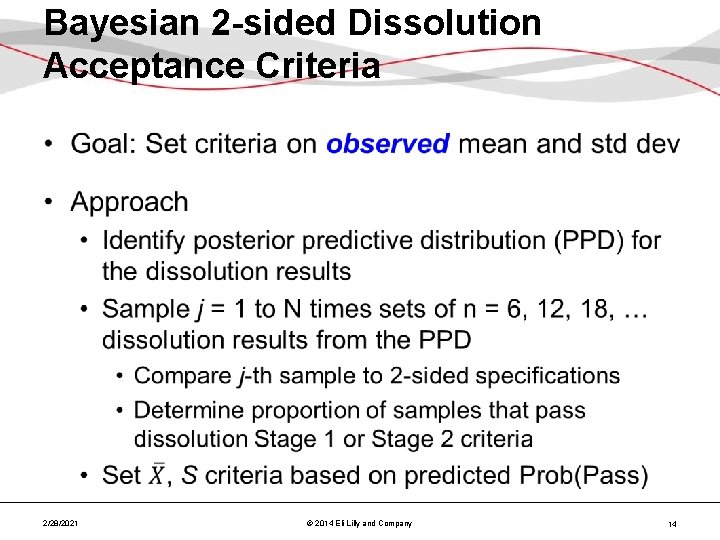
Problem Statement & Options • Determine acceptance criteria for 2 -sided dissolution specifications to provide assurance that future dissolution results will meet the specification limits. • Options • Implement ASTM E 2709 Standard Practice for Demonstrating Capability to Comply with a Lot Acceptance Procedure • Modify the Validated SAS program Cu. DAL (Content uniformity and Dissolution Acceptance Limits) to calculate 2 -sided limits • Apply an alternate approach • A Bayesian approach with simulation 2/28/2021 © 2014 Eli Lilly and Company 10
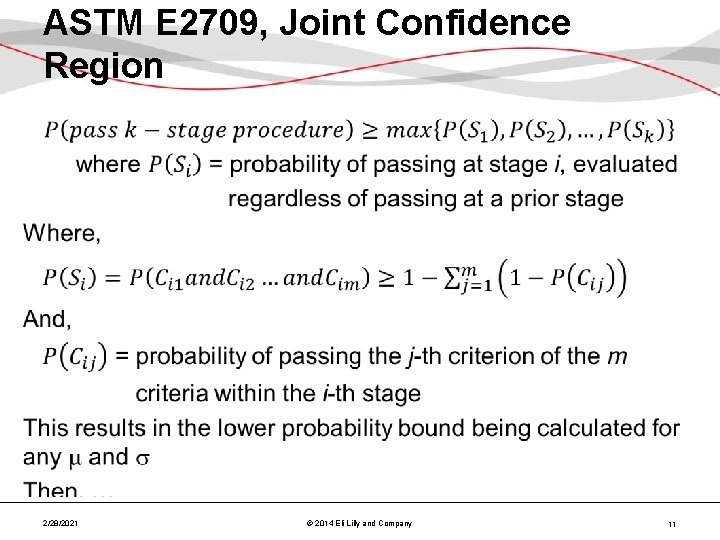
ASTM E 2709, Joint Confidence Region • 2/28/2021 © 2014 Eli Lilly and Company 11
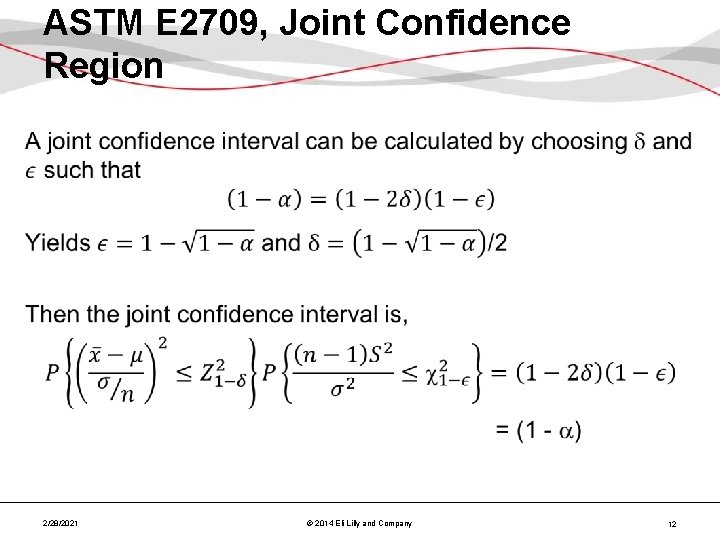
ASTM E 2709, Joint Confidence Region • 2/28/2021 © 2014 Eli Lilly and Company 12
2/28/2021 © 2014 Eli Lilly and Company 13
Bayesian 2 -sided Dissolution Acceptance Criteria • 2/28/2021 © 2014 Eli Lilly and Company 14
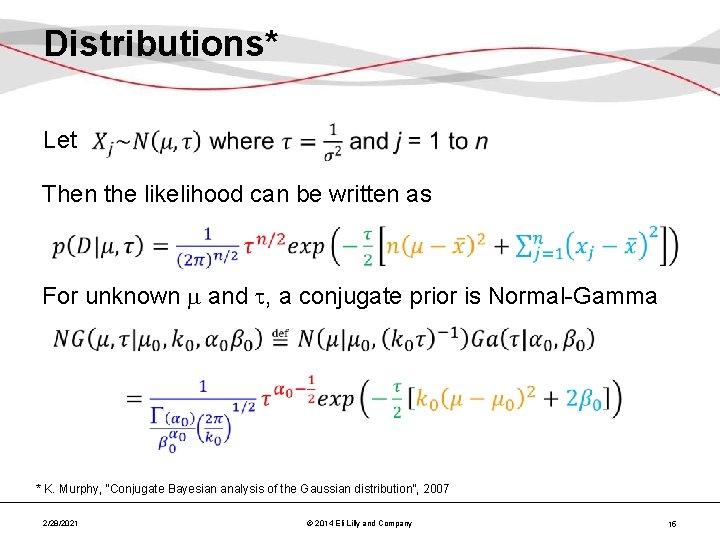
Distributions* Let Then the likelihood can be written as For unknown and , a conjugate prior is Normal-Gamma * K. Murphy, “Conjugate Bayesian analysis of the Gaussian distribution”, 2007 2/28/2021 © 2014 Eli Lilly and Company 15
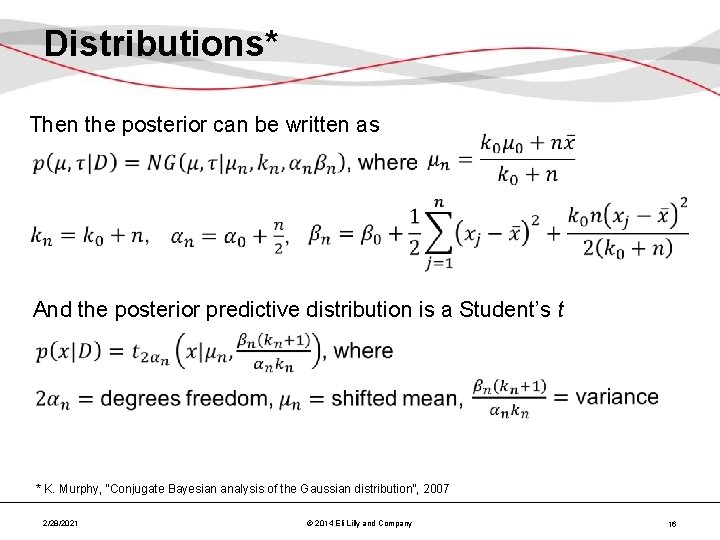
Distributions* Then the posterior can be written as And the posterior predictive distribution is a Student’s t * K. Murphy, “Conjugate Bayesian analysis of the Gaussian distribution”, 2007 2/28/2021 © 2014 Eli Lilly and Company 16
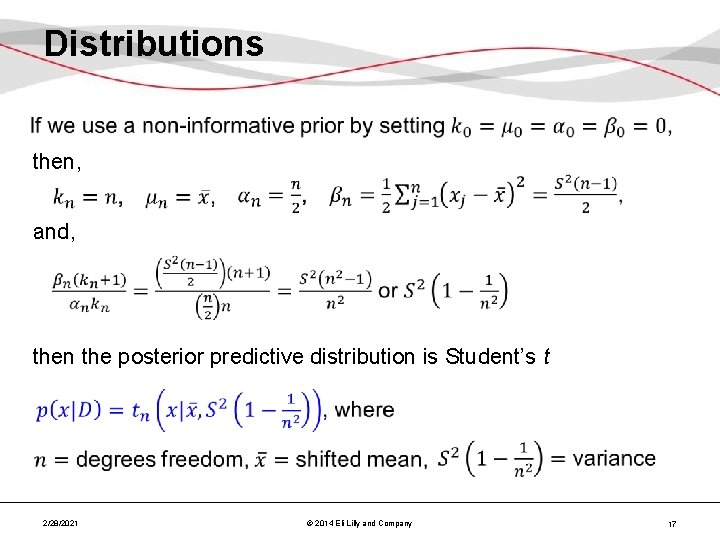
Distributions then, and, then the posterior predictive distribution is Student’s t 2/28/2021 © 2014 Eli Lilly and Company 17
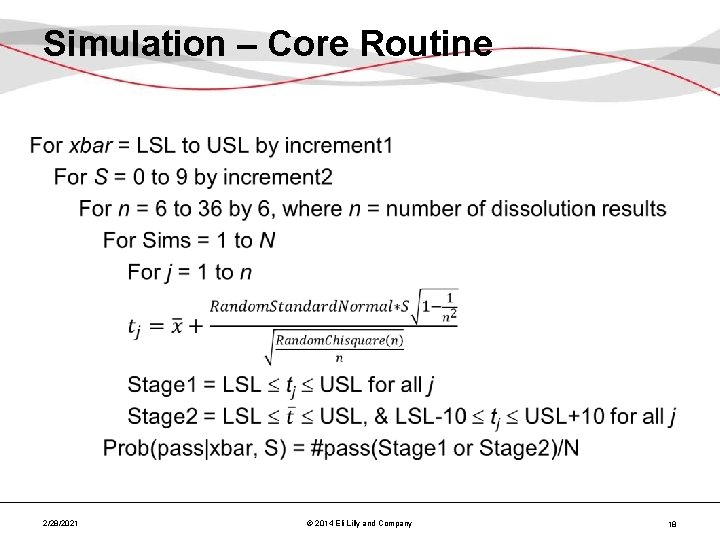
Simulation – Core Routine • 2/28/2021 © 2014 Eli Lilly and Company 18
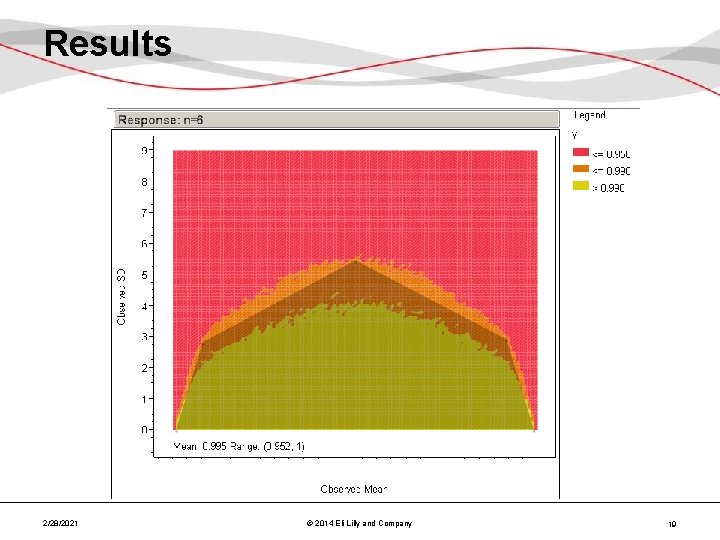
Results 2/28/2021 © 2014 Eli Lilly and Company 19
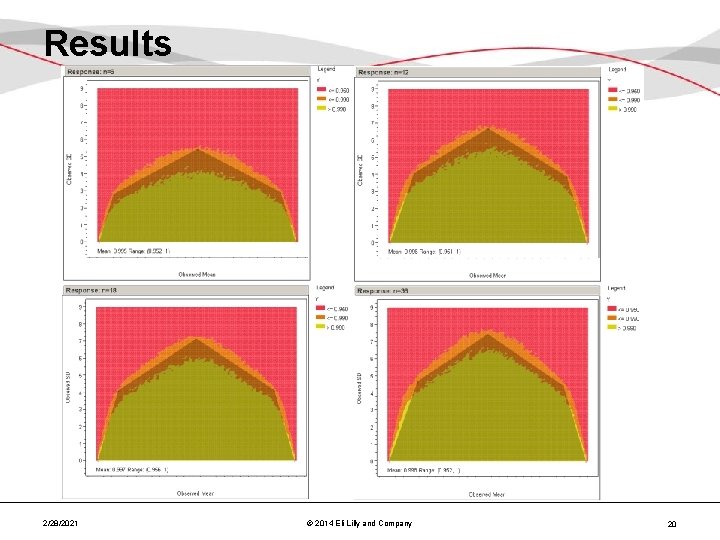
Results 2/28/2021 © 2014 Eli Lilly and Company 20
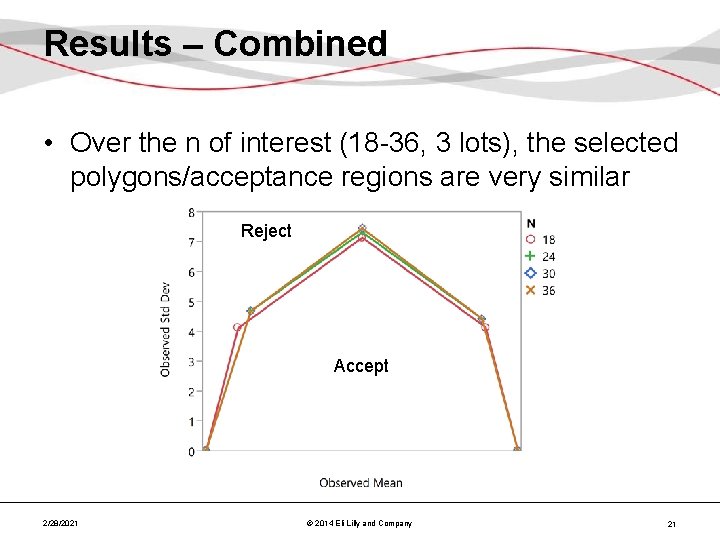
Results – Combined • Over the n of interest (18 -36, 3 lots), the selected polygons/acceptance regions are very similar Reject Accept 2/28/2021 © 2014 Eli Lilly and Company 21
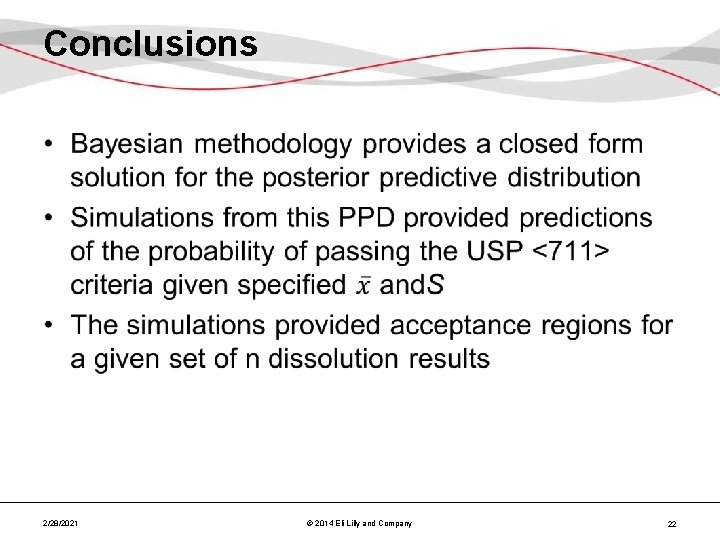
Conclusions • 2/28/2021 © 2014 Eli Lilly and Company 22
Comments and Questions 2/28/2021 © 2014 Eli Lilly and Company 23
References http: //en. wikipedia. org/wiki/Conjugate_prior K. Murphy, “Conjugate Bayesian Analysis of the Gaussian Distribution”, 2007 United States Pharmacopeia general chapter <711> ASTM E 2709, “ M. Evans, et. al. , “Statistical Distributions” 2 nd ed. , 1993 N. Johnson, et. al. , “Continuous Univariate Distributions” vol 2, 2 nd ed. , 1995 2/28/2021 © 2014 Eli Lilly and Company 24
- Slides: 24