
Establishing the Ovarian Cycle During childhood ovaries grow
Establishing the Ovarian Cycle • During childhood, – ovaries grow – secrete small amounts of _ – inhibit the hypothalamic release of Gn. RH • As puberty nears, – Gn. RH is released – • These events continue until an adult cyclic pattern is achieved and menarche occurs
Hormonal Interactions During the Ovarian Cycle • Day 1 – Gn. RH from _______________ stimulates the release of ___________________ from anterior pituitary • Over the next several days, FSH and LH _ • As the follicle matures, it begins to produce and release estrogen • Rising estrogen levels: –
Hormonal Interactions During the Ovarian Cycle • Estrogen levels increase • high estrogen levels have a ___________________, causing a sudden surge of _
Hormonal Interactions During the Ovarian Cycle • The LH spike stimulates the primary oocyte to complete meiosis I, and the secondary oocyte continues on to metaphase II • Day 14 –
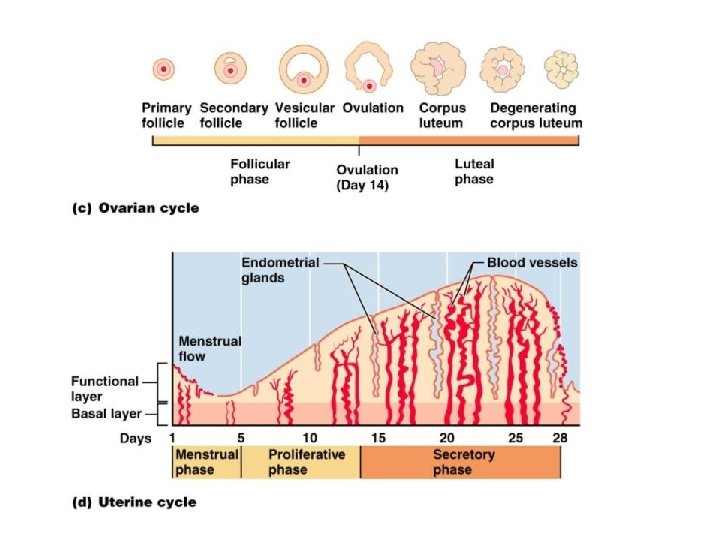
Hormonal Interactions & the Ovarian Cycle • LH transforms the ruptured follicle into a _ – produces inhibin, progesterone, and estrogen • These hormones shut off ___________________ release and declining LH ends luteal activity • Days 26 -28 – decline of the ovarian hormones – Ends the blockade of FSH and LH – The cycle starts anew
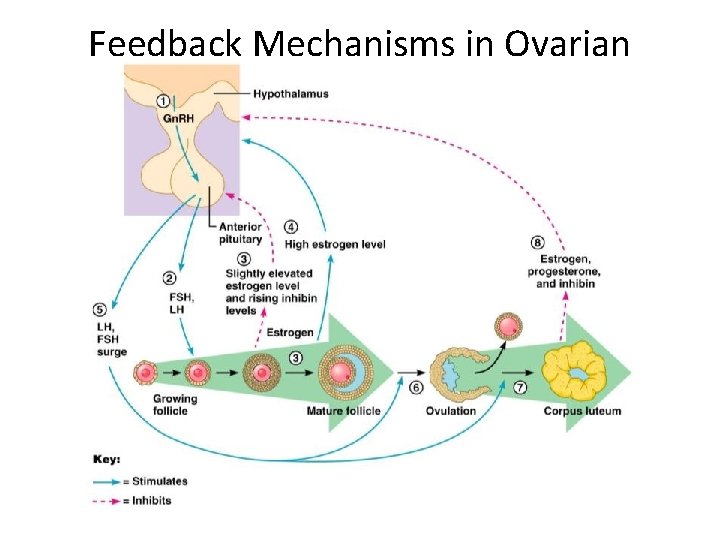
Feedback Mechanisms in Ovarian Function
Uterine (Menstrual) Cycle • Series of cyclic changes that the uterine endometrium goes through each month in response to ovarian hormones in the blood • – _________________________– uterus sheds all but the deepest part of the endometrium • Days 6 -14: – _________________________ (preovulatory) phase – endometrium rebuilds itself • Days 15 -28: – _________________________ (postovulatory) phase – endometrium prepares for implantation of the embryo
Menses • If fertilization does _________ occur – – deprives the endometrium of hormonal support • _____________________ spasms and endometrial cells begin to die as blood flow is interupted • The functional layer begins to _ • Spiral arteries constrict one final time then suddenly relax and open wide • The rush of blood fragments weakened capillary beds and _
Extrauterine Effects of Estrogens and Progesterone • Estrogen levels _ • Promote oogenesis and follicle growth in the ovary • Exert _________________ on the female reproductive tract – Uterine tubes, uterus, and vagina grow larger and become functional – Uterine tubes and uterus exhibit _ – Vaginal mucosa thickens and _
Estrogen-Induced Secondary Sex Characteristics • Growth of the _ • Increased deposition of ___________________, especially in the hips and breasts • Widening and lightening of the pelvis • Growth of _
Female Sexual response • _________________ nerve impulses cause arteries of erectile tissues to dilate – Blood flow _ – erectile tissues swell – Vagina begins to _
Female Sexual Response • parasympathetic impulses stimulate – ____________________ to secrete ________________ into the vestibule. • serves to moisten and lubricate the tissues, • • prevent irritation of tissues and _
Female orgasm • The culmination of stimulation is _ • the ______________________________________________ resulting in an increased friction. • Orgasm initiates a series of reflexes in which the – muscles of the perineum – walls of the uterus and fallopian tubes _ • The contractions help to _______________________ towards the uterine tubes.
Female Sexual Response • Females do not have a __________________ after orgasm and can experience multiple orgasms in a single sexual experience • Orgasm is _______________ for conception
Sexually Transmitted Diseases: Gonorrhea • Bacterial infection caused by Neisseria gonorrhoeae, • spread by contact with _ • Signs and symptoms – In males • ______________________, discharge of pus from the penis – In females • • abdominal discomfort, vaginal discharge, abnormal uterine bleeding – Often mild symptoms are _____________________ or vaginosis
STD: Gonorrhea – Left untreated, can result in • pelvic inflammatory disease in women – May damage fallopian tubes and result in ectopic pregnancies or infertility • • According to the CDC: – In the United States, the highest reported rates of infection are among _
STD: Gonorrhea • Prevention – Abstinence – – _____________________ reduces transmission • Treatment: – antibiotics, but resistant strains are becoming more prevalent
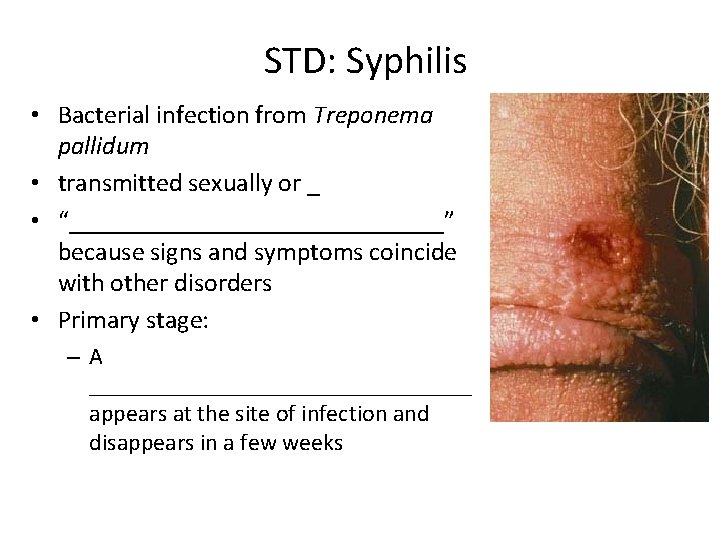
STD: Syphilis • Bacterial infection from Treponema pallidum • transmitted sexually or _ • “_______________” because signs and symptoms coincide with other disorders • Primary stage: –A ________________ appears at the site of infection and disappears in a few weeks
s. TD: Syphilis • time between infection and the start of the first symptom – from __________________ (average 21 days). – The chancre is usually ______________________, and painless. – It appears at the spot where syphilis entered the body. – The chancre ____________________, and it ________________________. However, if adequate treatment is not administered, the infection progresses to the secondary stage.
STD: Syphilis • _____________________ shows signs of pink skin rash, fever, and joint pain – Other symptoms include swollen lymph glands, sore throat, patchy hair loss, headaches, weight loss, muscle aches, and fatigue. – • A _______________ period follows, which may progress to tertiary syphilis characterized by gummas (lesions of the CNS, blood vessels, bones, and skin) – difficulty coordinating muscle movements, paralysis, numbness, gradual blindness, and dementia. • Treatment:
STD: Chlamydia • Most common STD in the U. S. • Bacteria: Chlamydia trachomatis • Symptoms include – – penile and vaginal discharges; – abdominal, rectal, or testicular pain; – – irregular menses • Can cause _______________________ and urinary tract infections in men, and sterility in women • “______________________" disease because about three quarters of infected women and about half of infected men have no symptoms • Prevention: abstinence, latex condoms reduce risk • Treatment is with tetracycline
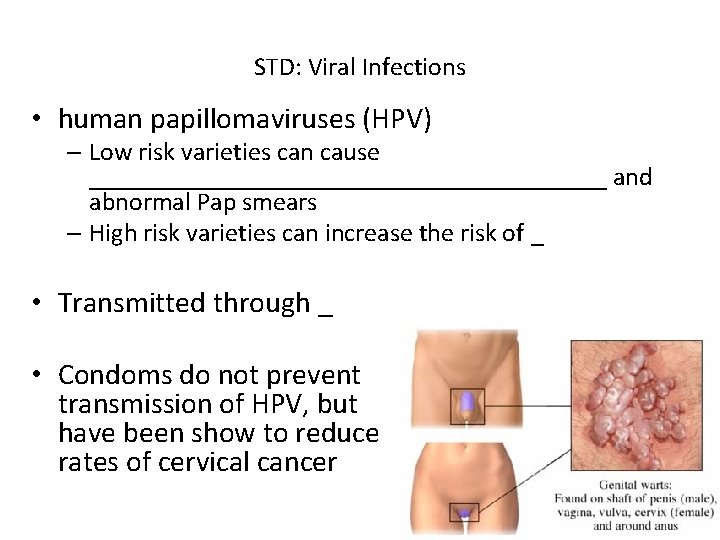
STD: Viral Infections • human papillomaviruses (HPV) – Low risk varieties can cause ____________________ and abnormal Pap smears – High risk varieties can increase the risk of _ • Transmitted through _ • Condoms do not prevent transmission of HPV, but have been show to reduce rates of cervical cancer
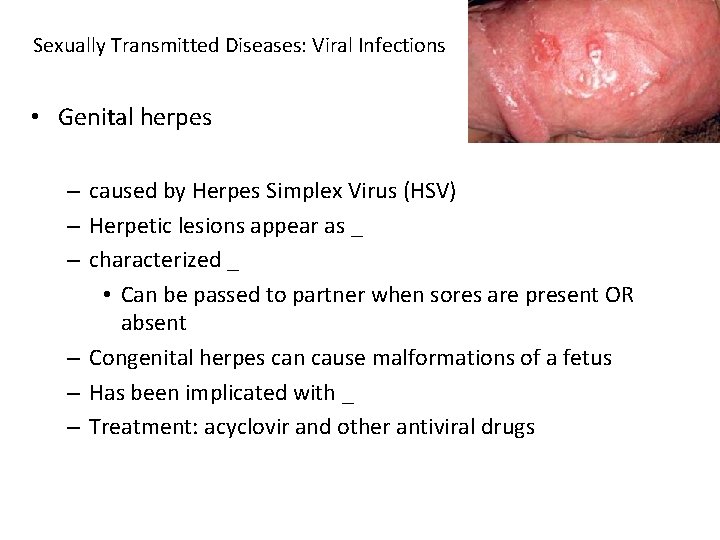
Sexually Transmitted Diseases: Viral Infections • Genital herpes – caused by Herpes Simplex Virus (HSV) – Herpetic lesions appear as _ – characterized _ • Can be passed to partner when sores are present OR absent – Congenital herpes can cause malformations of a fetus – Has been implicated with _ – Treatment: acyclovir and other antiviral drugs
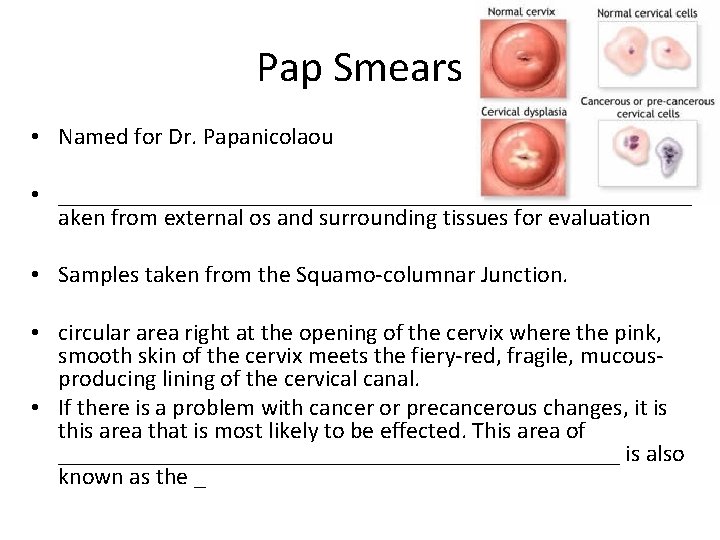
Pap Smears • Named for Dr. Papanicolaou • ___________________________t aken from external os and surrounding tissues for evaluation • Samples taken from the Squamo-columnar Junction. • circular area right at the opening of the cervix where the pink, smooth skin of the cervix meets the fiery-red, fragile, mucousproducing lining of the cervical canal. • If there is a problem with cancer or precancerous changes, it is this area that is most likely to be effected. This area of ________________________ is also known as the _
Pelvic Inflammatory Disease • General term for infection of _ – Often stemming from sexually transmitted diseases • • – Can damage uterus, fallopian tubes, and ovaries resulting in ____________________, abscesses, and chronic pain
Pelvic Inflammatory Disease • Risk factors – – – • alters vaginal environment and allows bacteria to thrive • Forces bacteria through cervical canal • Symptoms: most commonly include _. – fever, unusual vaginal discharge that may have a foul odor, – painful intercourse, painful urination, irregular menstrual bleeding, and pain in the right upper abdomen (rare).
Endometriosis • Endometrial tissue normally found within the uterus is located within the pelvic cavity, commonly on ovaries – Fallopian tubes, uterine ligaments, intestines, bladder, vagina, cervix • Sympoms: • • pain during or after sexual activity • Infertility • • Other symptoms may include fatigue; painful bowel movements with periods; ____________________; diarrhea and/or constipation and other intestinal upset with some periods. • Some women with endometriosis have no symptoms. Infertility affects about 30 -40% of women with endometriosis and is a common result with progression of the disease.
PMS: pre Menstrual syndrome • symptoms usually _ • Symptoms usually stop when menstruation begins, or shortly thereafter. • exact cause of PMS has not been identified • estimated to affect up _______________ during their childbearing years • Symptoms: – headache, ankle swelling, back ache, abdominal cramps, abdominal pain, breast tenderness, weight gain, cold sores, acne flare-ups, nausea, constipation/diarrhea, food cravings, irritable, clumsy
Dysmenorrhea • • Begins a day or so before menstruation and ends when the bleeding stops • May be related to _ • Primary dysmenorrhea: – occurs in “healthy” women. – not related to any specific problems with the uterus or other pelvic organs. • Secondary dysmenorrhea: – caused by ____________________ or structural abnormality either within or outside the uterus
Genetic Sex Determination • Genetic sex is determined by the sex chromosomes each gamete contains • There are two types of sex chromosomes_ • Females have two X chromosomes; males have one X and one Y • Hence, all eggs have an X chromosome; half the sperm have an X, and the other half a Y • A single gene on the Y chromosome, the _____________, initiates testes development and determines maleness
Development of External Genitalia: Male • Under the influence of testosterone • _________________ enlarges forming the penis • __________________ elongates and closes completely • Urethral folds give rise to the _ • __________________ swellings develop into the scrotum

Development of External Genitalia: Female • In the _ • Genital tubercle gives rise to the _ • The ________________ as the vestibule • The urethral folds become _ • The labioscrotal swellings _
Descent of the Gonads • About 2 months before birth and stimulated by testosterone, the _____________________ and enter the scrotum • – fibrous cord that extends from the testes to the scrotum • Spermatic cord – blood vessels, nerves, and fascial layers that help suspend the testes • Ovaries also descend, but are ________________________ at the pelvic brim
Development Aspects: Puberty • Reproductive organs grow to adult size and become functional • Secondary sex characteristics appear • Characteristics of puberty – Males • _____________________ and scrotum, appearance of axillary and facial hair, _ – Females • enlarging of the breasts, __________________ , and dependable ovulation
Menopause • Ovulation and menses _ • Without sufficient _____________ , reproductive organs and breasts atrophy – – Skin blood vessels undergo intense vasodilation (hot flashes occur) – Gradual thinning of the skin and bone loss • Males have no equivalent to menopause
From Egg to Embryo • Pregnancy – events that occur from _ • – the developing offspring • – from the last menstrual period until birth
From Egg to Embryo • Preembryo – conceptus from _ • Embryo – conceptus during the _ • Fetus – conceptus from the _
Accomplishing Fertilization • The oocyte is viable for _ • Sperm is viable _ • For fertilization to occur, coitus must occur no more than: – Three days before ovulation – 24 hours after ovulation • Fertilization – when a sperm fuses with an egg to _
Sperm Transport and Capacitation • Fates of ejaculated sperm: – Leak out of the vagina immediately after deposition – – Fail to make it through the cervix – Dispersed in the uterine cavity or destroyed by _ – Reach the uterine tubes • Sperm must undergo ________________ before they can penetrate the oocyte
Acrosomal Reaction and Sperm Penetration • An ovulated oocyte is encapsulated by: – The _ – Extracellular matrix • Sperm binds to the zona pellucida and undergoes the _ – ___________________ are released near the oocyte – Hundreds of acrosomes release their enzymes _
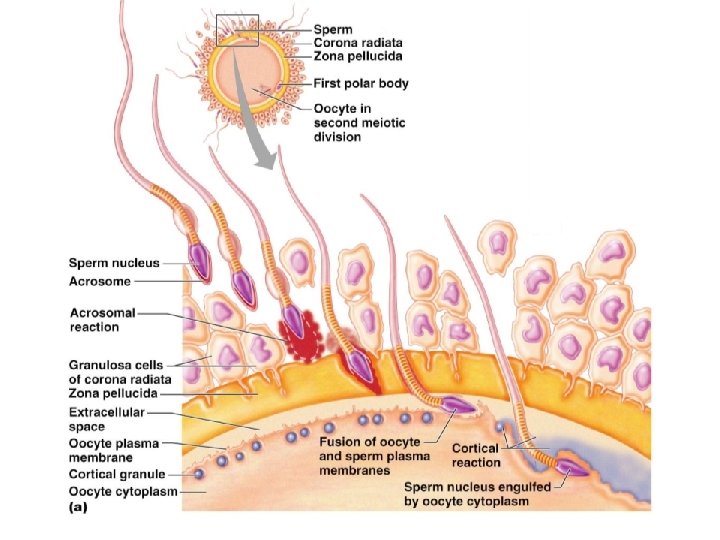
Completion of Meiosis II and Fertilization • Upon entry of sperm, the secondary oocyte: – – Casts out the second polar body • The ovum nucleus swells, and the two nuclei approach each other • When fully swollen, the two nuclei are called _ • Fertilization – when the _
Preembryonic Development • The first cleavage produces _ • – the 16 or more cell stage (72 hours old) • By the fourth or fifth day the preembryo consists of 100 or so cells (blastocyst)
Preembryonic Development • • a fluid-filled hollow sphere composed of: – A single layer of _ – An _ • Trophoblasts take part in _ • The inner cell mass becomes the _
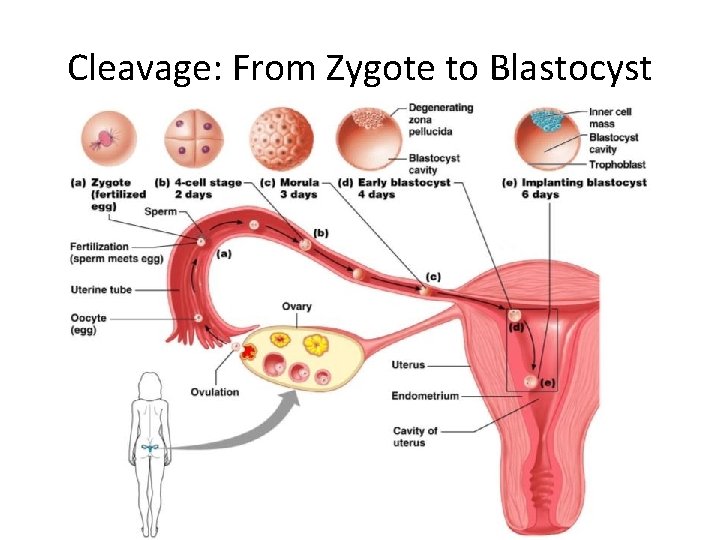
Cleavage: From Zygote to Blastocyst
Implantation • Begins ___________________ when the trophoblasts adhere to a properly prepared endometrium • The trophoblasts then proliferate and form _ – Cytotrophoblast • cells of the inner layer that retain their cell boundaries – Syncytiotrophoblast • cells in the outer layer that lose their plasma membranes _
Implantation • The implanted blastocyst is covered over by endometrial cells • Implantation is completed by the _
Implantation • Viability of the corpus luteum is maintained by human chorionic gonadotropin (________) secreted by the _ • h. CG prompts the corpus luteum to continue to secrete progesterone and estrogen • Chorion – developed from trophoblasts after implantation, continues this hormonal stimulus • Between the second and third month, the placenta: – Assumes the role of progesterone and estrogen production – Is providing _
Placentation • Formation of the placenta from: – – ___________________ endometrial tissues • The placenta is fully formed and functional by the _
Placentation • Embryonic placental barriers include: – The _ – The endothelium of embryonic capillaries • The _______________ also secretes other hormones – human placental lactogen, human chorionic thyrotropin, and relaxin
Embryonic Membranes • Amnion – Provides a ___________________ that protects the embryo – Helps maintain _ – Amniotic fluid comes from maternal blood, and later, fetal urine
Embryonic Membranes • – Forms part of the _ – Produces earliest _____________ and vessels – Is the source of primordial germ cells
Embryonic Membranes • – a small outpocketing at the caudal end of the yolk sac – Structural base for the _ – Becomes part of the _ • – helps form the _ – Encloses the embryonic body and all other membranes
- Slides: 54