
Establishing Telework for Success November 2011 Welcome Presenters
Establishing Telework for Success November 2011

Welcome Presenters: • Ryan Hendricks, HR Consultant • Kate Mc. Grath, HR Consultant 2
Agenda 1. Telework Terms 2. Clarifying Expectations 3. Accessibility 4. Track Results 5. Telework Agreement 3
Section 1 Telework Terms

Telework • Telework Any arrangement in which an employee performs officially assigned duties at an alternative worksite either on a regular and recurring, or on an ad hoc basis (not including while on official travel) • Telework Enhancement Act of 2010: “A work flexibility arrangement under which an employee performs the duties and responsibilities of such employee’s position, and other authorized activities, from an approved worksite other than the location from with the employee otherwise work” 5
Why Telework • Leverage talent • Decrease travel and mandatory relocation • Improve work-life balance and job satisfaction • Decrease operating costs • Decrease turnover and increase commitment • Increase performance 6
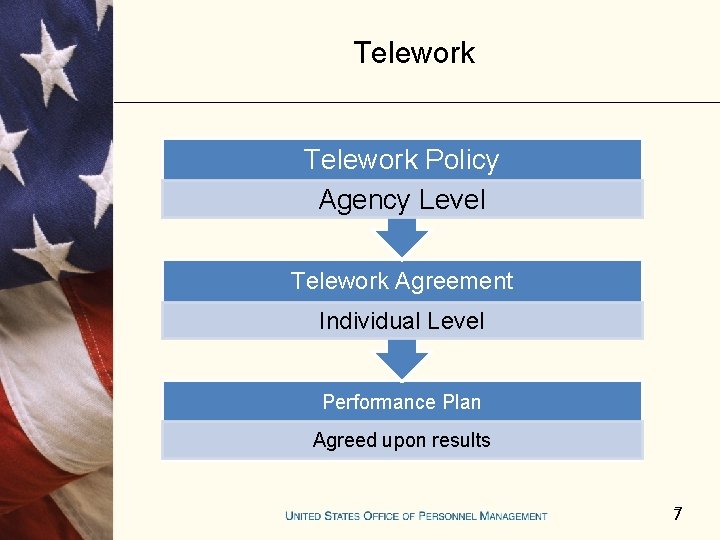
Telework Policy Agency Level Telework Agreement Individual Level Performance Plan Agreed upon results 7
Telework Terms • Telework Policy- establishes the framework for telework at the office or agency level • Telework Agreement- establishes the framework at the individual level 8
Telework Request Types of Teleworkers • Full-Time– An employee who works exclusively from an alternate worksite • Nonregular or Episodic– work performed at an alternate work station without a regular schedule. Example, time to complete discrete portions of projects or work assignments • Regular - work is performed on a regularly scheduled basis for a period of several months or longer • Unscheduled– Employees work at their alternate worksite on days not originally scheduled for telework due to severe weather conditions or other situations that require the implementation Continuity of Operations (COOP) 9
Telework Request Other Flexibilities • Substitute– Switching telework days, teleworking on a day they are not scheduled to telework instead of their regular, scheduled telework day • Compressed Work Schedule – Enables employees to have work schedules that help the employee balance work/life responsibilities. (e. g. , 9 longer days on, 1 day off within a two week pay period) • Flexi-time- Variations of the traditional fixed work schedule that permit employees to vary their arrival and departure times within the parameters set forth in the CBA • Hoteling - Offices and/or cubicles set aside for the shared use of employees who spend the majority of their time teleworking 10
Telework Location Terms • Alternate worksite - A specific area at a telework center or within an employee’s residence or at another approved location other than the official duty station • Telecenter - Office space, located to reduce commuting, that is available for teleworkers’ use • Official duty station - The current work location specified in the employee’s Official Personnel Folder. Teleworking does not change the official duty station, unless an employee becomes a full-time teleworker in which their alternative worksite will become the official duty station 11

Telework • Participation in telework is: • A voluntary condition of employment or; • Required under Continuity-Of-Operations Planning (COOP) in times of severe weather or emergency • Each telework employee should collaboratively create a telework agreement with his/her direct supervisor • Establish the telework agreement and performance management process to: • Clearly lay out parameters • Agree upon a communication strategy • Include results-focused measurable standards 12

Ensure Success 1 • Clarifying Expectations 2 • Accessibility 3 • Tracking Results

Section 2 Clarify Expectations
Application Process Basic Eligibility • The work does not require, on a daily basis, direct handling of secure materials or on-site activity that cannot be handled remotely or at an alternative worksite • Fully Successful • No disciplinary action within the last year • No official discipline for being absent without permission for more than 5 days in any calendar year • Has never been officially disciplined for violating subpart G of the Standards of Ethical Conduct Eligibility does not mean automatic approval 15
Application Process • Other Eligibility Considerations • If applicable, the employee must have dependent care arrangements in place, (e. g. , child care, elder care, etc. ) • The employee must have experience within their current position to be considered for telework, unless otherwise approved by supervisor • What is the business case for telework? Telework is not an entitlement. It is at the manager’s discretion. 16
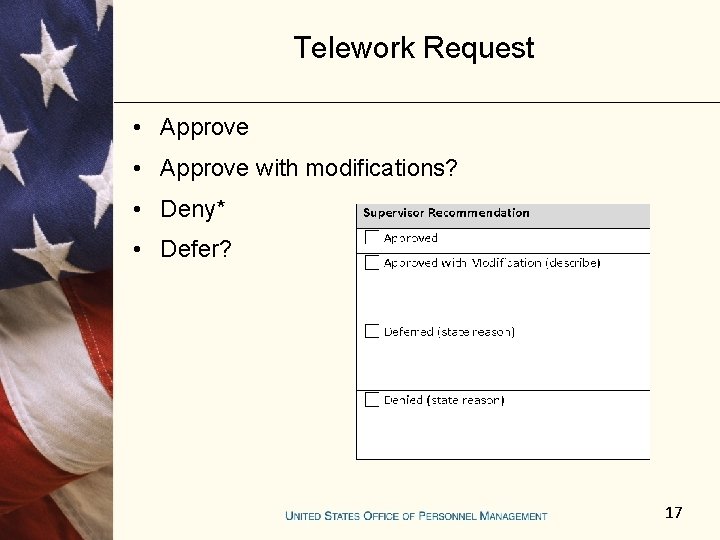
Telework Request • Approve with modifications? • Deny* • Defer? 17

Section 3 Accessibility
Accessibility Once an employee has been approved for telework, the employee and supervisor meet to discuss: • The Communication Strategy • Scheduling Goal: no surprises! 19
Accessibility The Communication Strategy • Office/Telework schedule • Frequency of communication • Transparency of accessibility • Method of communication • Equipment to send deliverables 20
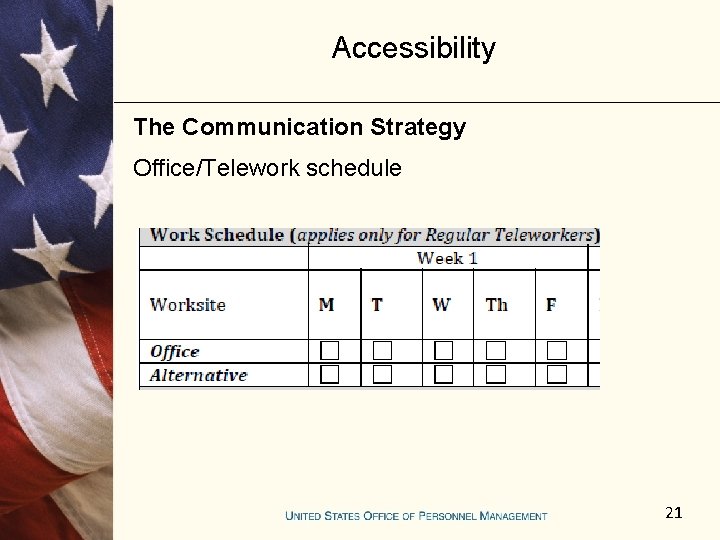
Accessibility The Communication Strategy Office/Telework schedule 21
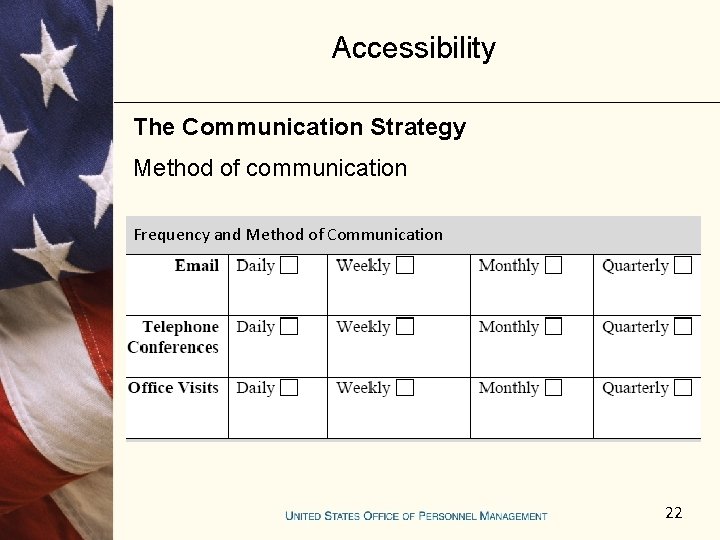
Accessibility The Communication Strategy Method of communication Frequency and Method of Communication 22
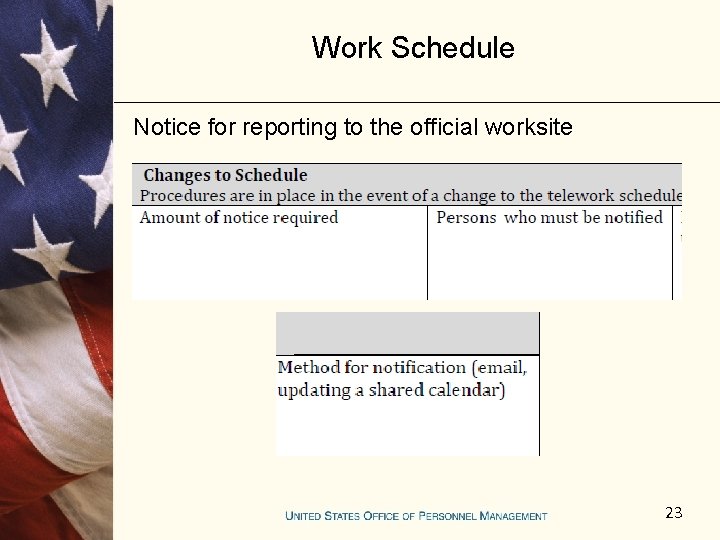
Work Schedule Notice for reporting to the official worksite 23
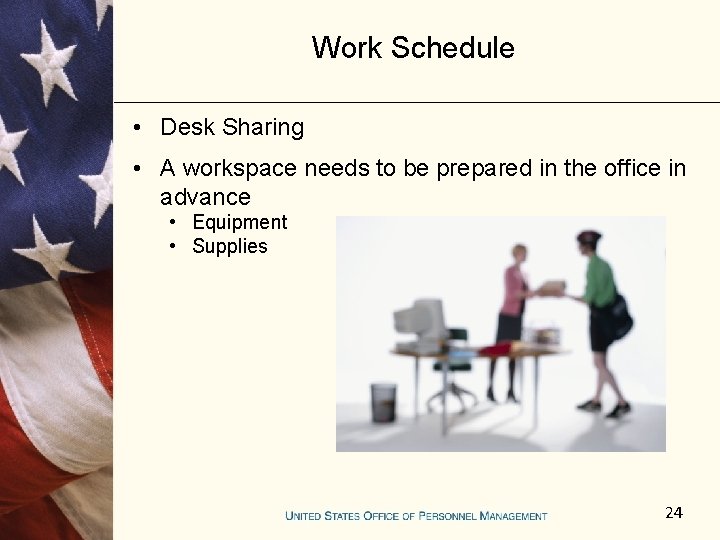
Work Schedule • Desk Sharing • A workspace needs to be prepared in the office in advance • Equipment • Supplies 24

Section 4 Track Results

Track Results How will the manger know the work is being accomplished? • Focus on the results or final product, not the tasks and duties • Discuss performance expectations • Clarify what it means to meet, not meet, and exceed standards 26
Track Results • Shift from managing by sight to managing by results • Time spent teleworking must be accounted for and reported in the same manner as at the traditional worksite • Ensure employees are available for requisite meetings and conference calls • Deadlines for deliverables are agreed upon and met • Identify tasks that must be completed in the office 27
The Performance Plan • A plan based solely on competencies or behaviors, no matter how soundly developed, is insufficient in the absence of one or more measurable performance objectives • It is also much more difficult for a supervisor to manage remote workers based on competencies • You can’t depend on sight of employees • Must look at the work 28
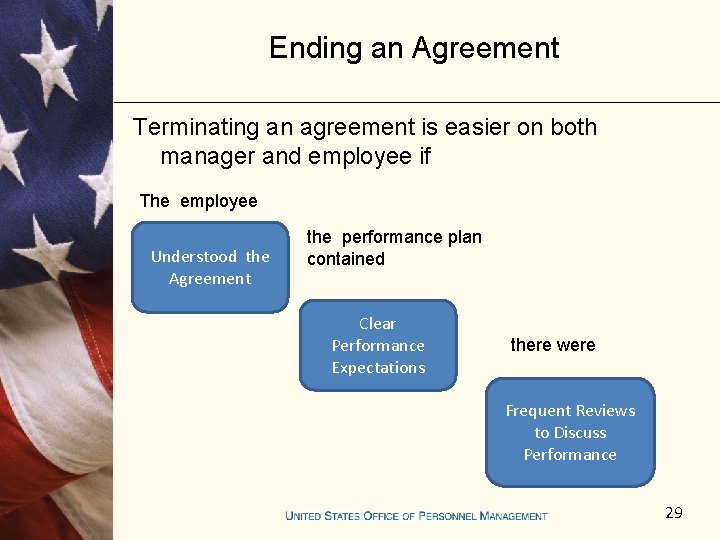
Ending an Agreement Terminating an agreement is easier on both manager and employee if The employee Understood the Agreement the performance plan contained Clear Performance Expectations there were Frequent Reviews to Discuss Performance 29
Process • Notice: • From the employee or the supervisor • Depends on the circumstance • Appeal • Opportunity for reapplication 30
Sections 1 -4 Summary Key Take-Aways • The key to managing in a telework environment is managing by results • Establish and communicate performance expectations • Consult with the employee when writing the telework agreement • Reassess the agreement 31

Section 5 Telework Agreement
Background Telework Enhancement Act of 2010 Requirements Include: 1. 2. 3. 4. 5. Establish a policy authorizing eligible employees to telework Determine the eligibility of all employees and notify employees of their eligibility status Develop written telework agreements for all teleworkers Provide an interactive telework training program to all eligible employees prior to the signing of the telework agreement Designate a telework managing official, who must be a senior official with direct access to the agency head 33
Telework Agreement Sections • Expectations of Roles and Responsibilities • Telework Readiness and Safety • Equipment and Technology Support • Security • Work Schedule • Communication Strategy • Telework Deferral, Denial, and Termination 34
Expectations of Roles and Responsibilities • Official Duty Station • Injury Compensation • Alternative Worksite • Work Assignments • Official Duties • Work Reporting • Time and Attendance • Performance • Overtime • Disclosure • Alternative workplace costs • Standards of Conduct • COOP • Collective Bargaining Unit • Mileage Savings 35
Telework Readiness and Safety • Employees must certify that they are ready to perform their duties at an alternate worksite Example: All necessary equipment, files, dependent care arrangements, and appropriate work space available (can be verified by supervisor). • Employees must certify the safety of their alternate worksite Example: All electrical equipment is free from hazards that would cause physical harm; aisles, doorways, and corners are free from obstructions; and noise, temperature, ventilation, and lighting are at adequate levels to maintain performance. Tip: Create a checklist(s) to certify telework readiness and safety. 36
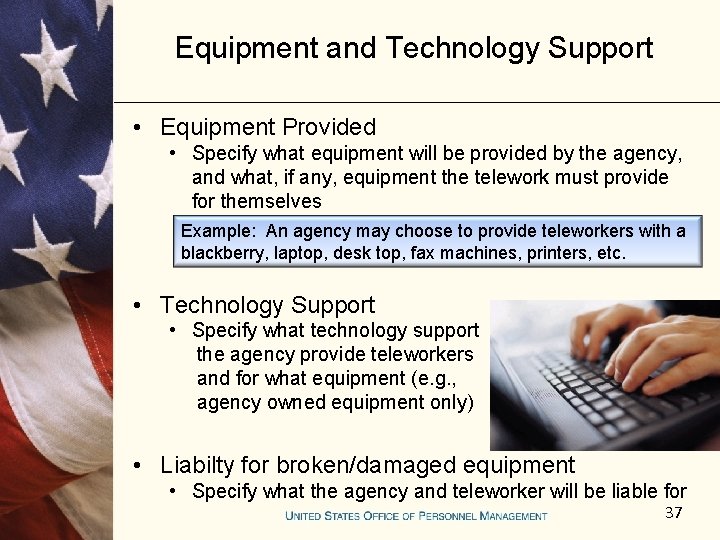
Equipment and Technology Support • Equipment Provided • Specify what equipment will be provided by the agency, and what, if any, equipment the telework must provide for themselves Example: An agency may choose to provide teleworkers with a blackberry, laptop, desk top, fax machines, printers, etc. • Technology Support • Specify what technology support the agency provide teleworkers and for what equipment (e. g. , agency owned equipment only) • Liabilty for broken/damaged equipment • Specify what the agency and teleworker will be liable for 37
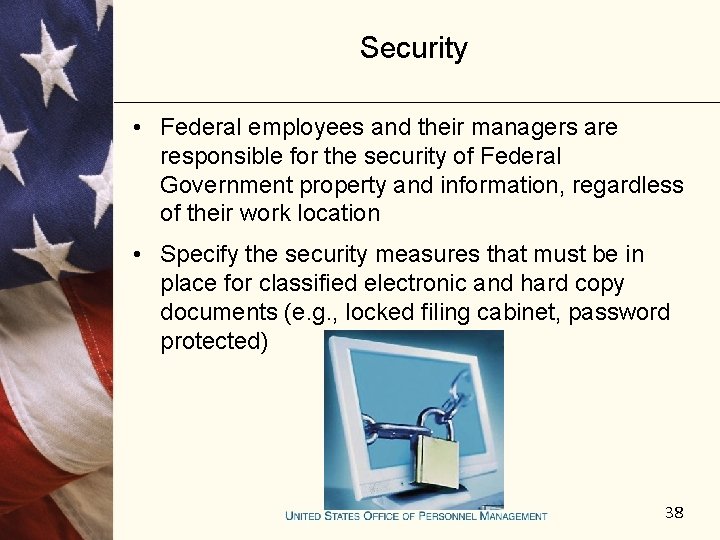
Security • Federal employees and their managers are responsible for the security of Federal Government property and information, regardless of their work location • Specify the security measures that must be in place for classified electronic and hard copy documents (e. g. , locked filing cabinet, password protected) 38
Work Schedule Type of Telework (Check all that apply): Full Time Regular Episodic Unscheduled • Core Hours • What is required by the telework policy or supervisor? • Example: Employees must work between 9 am and 2 pm • Substitute Days • Is it allowed by the policy and supervisor? • If so, does the supervisor need to be notified? How much notice is necessary? • Compressed schedule • Is it allowed by the policy and supervisor? • Example: Work 9 longer days with 1 day off within a 2 week period 39
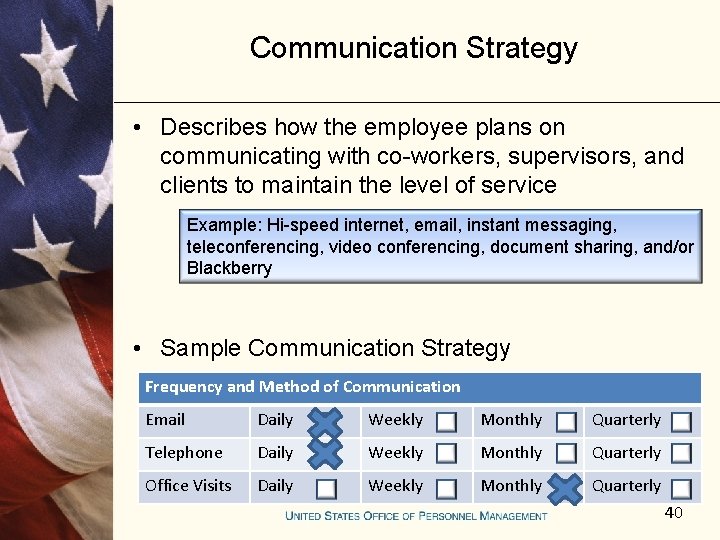
Communication Strategy • Describes how the employee plans on communicating with co-workers, supervisors, and clients to maintain the level of service Example: Hi-speed internet, email, instant messaging, teleconferencing, video conferencing, document sharing, and/or Blackberry • Sample Communication Strategy Frequency and Method of Communication Email Daily Weekly Monthly Quarterly Telephone Daily Weekly Monthly Quarterly Office Visits Daily Weekly Monthly Quarterly 40
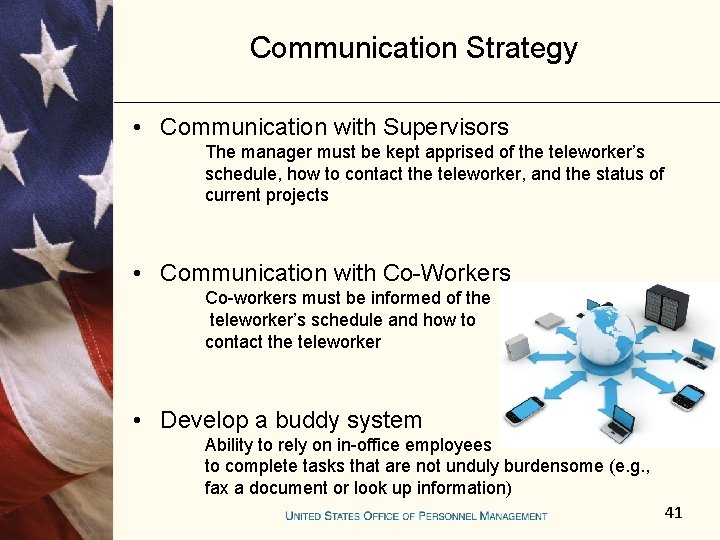
Communication Strategy • Communication with Supervisors The manager must be kept apprised of the teleworker’s schedule, how to contact the teleworker, and the status of current projects • Communication with Co-Workers Co-workers must be informed of the teleworker’s schedule and how to contact the teleworker • Develop a buddy system Ability to rely on in-office employees to complete tasks that are not unduly burdensome (e. g. , fax a document or look up information) 41
Telework Deferral, Denial, and Termination • Telework is not an employee right • Include a clause stating that deferrals, denials, and terminations will be based upon business needs, performance, and conduct • Include a statement about the teleworker’s right to terminate the telework agreement • Specify notification requirements Example: Supervisor must notify employee of a deferral or denial within two weeks. Supervisor must notify teleworker of a termination 10 days before they must return to the office. 42
Section 5 Summary Key Take-Aways • Communication at the beginning of the telework cycle is crucial • Explicitly state all expectations in the telework agreement • Telework is not an employee right • Review all supervisor and employee expectations with each new/renewed telework agreement 43

This Presentation Was Developed By: For more information on OPM’s Performance Management Solutions, contact Ryan Hendricks (Ryan. Hendricks@opm. gov) or Kate Mc. Grath (Kate. Mc. Grath@opm. gov) 44
- Slides: 44