
Establishing Qualifications Frameworks as international tools for recognising
Establishing Qualifications Frameworks as international tools for recognising lifelong learning Where we are now? Mr. Arjen Deij, European Training Foundation 1
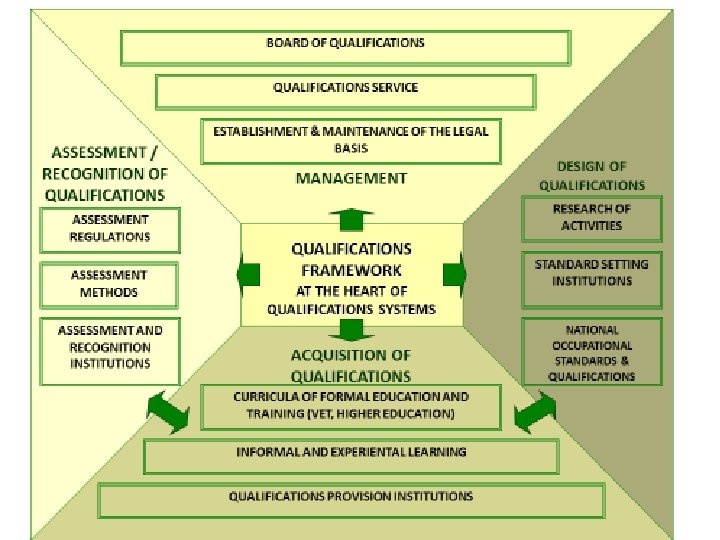
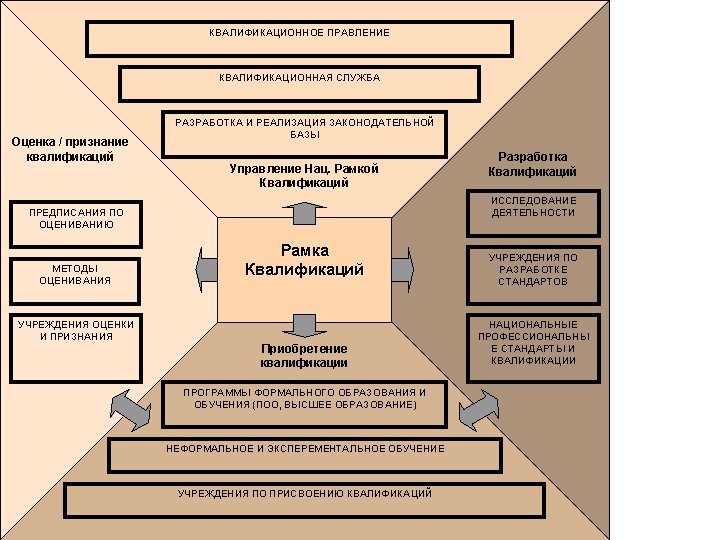
Some key international concepts Relevant Qualifications How to determine what types of skills or competencies should be acquired?
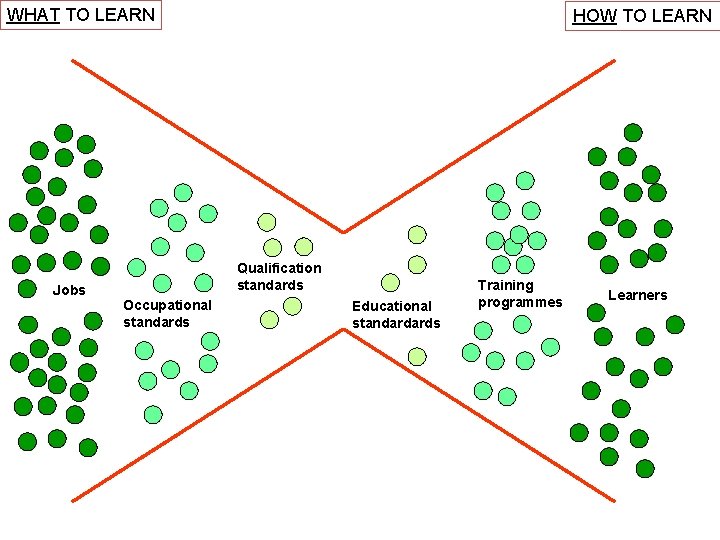
WHAT TO LEARN Jobs HOW TO LEARN Qualification standards Occupational standards Educational standardards Training programmes Learners
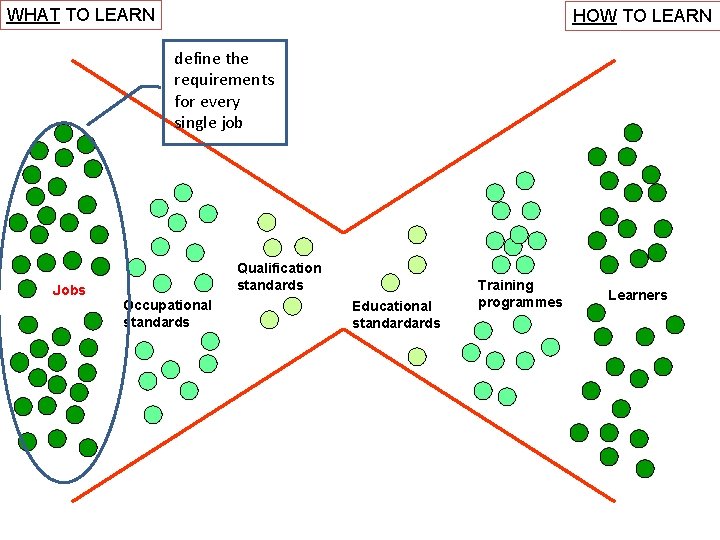
WHAT TO LEARN HOW TO LEARN define the requirements for every single job Jobs Qualification standards Occupational standards Educational standardards Training programmes Learners
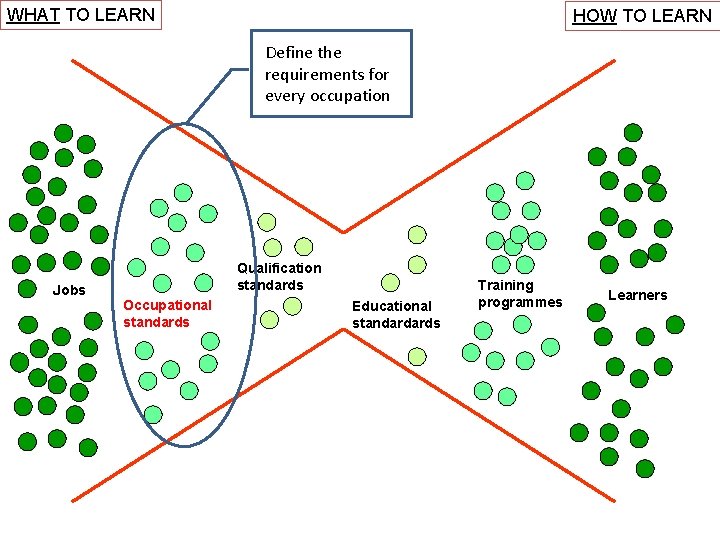
WHAT TO LEARN HOW TO LEARN Define the requirements for every occupation Jobs Qualification standards Occupational standards Educational standardards Training programmes Learners
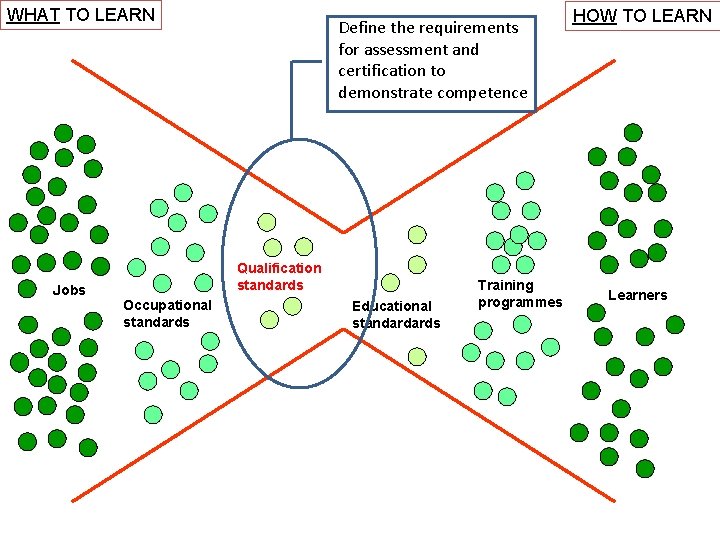
WHAT TO LEARN Jobs Define the requirements for assessment and certification to demonstrate competence Qualification standards Occupational standards Educational standardards Training programmes HOW TO LEARN Learners
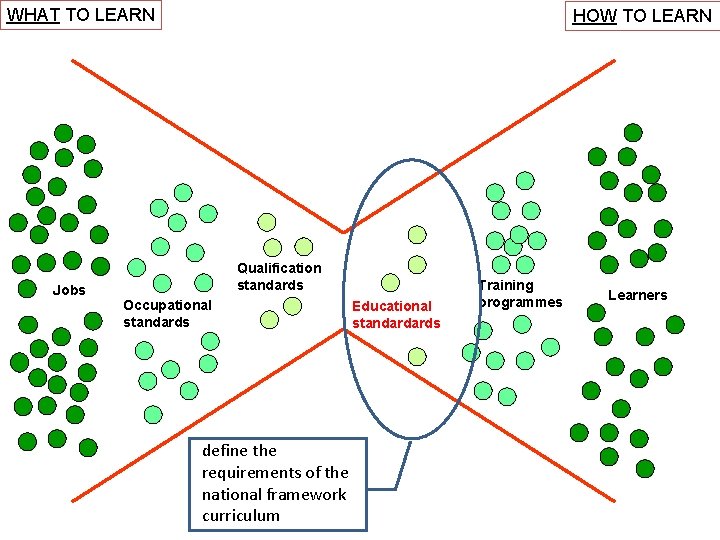
WHAT TO LEARN Jobs HOW TO LEARN Qualification standards Occupational standards define the requirements of the national framework curriculum Educational standardards Training programmes Learners
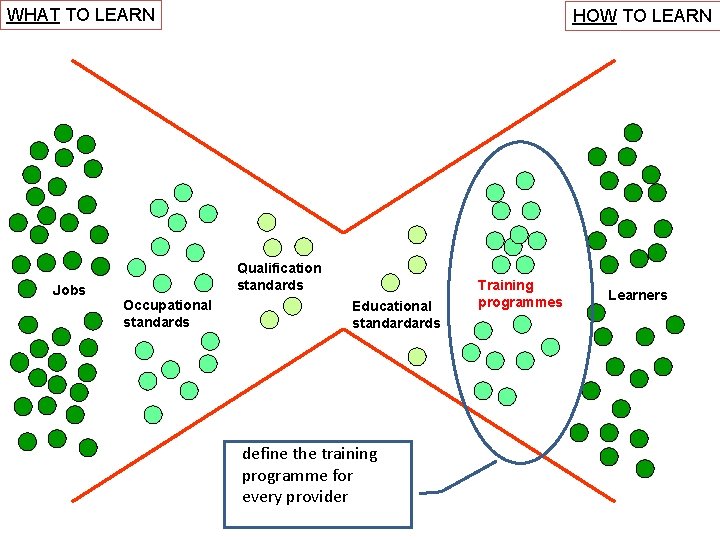
WHAT TO LEARN Jobs HOW TO LEARN Qualification standards Occupational standards Educational standardards define the training programme for every provider Training programmes Learners
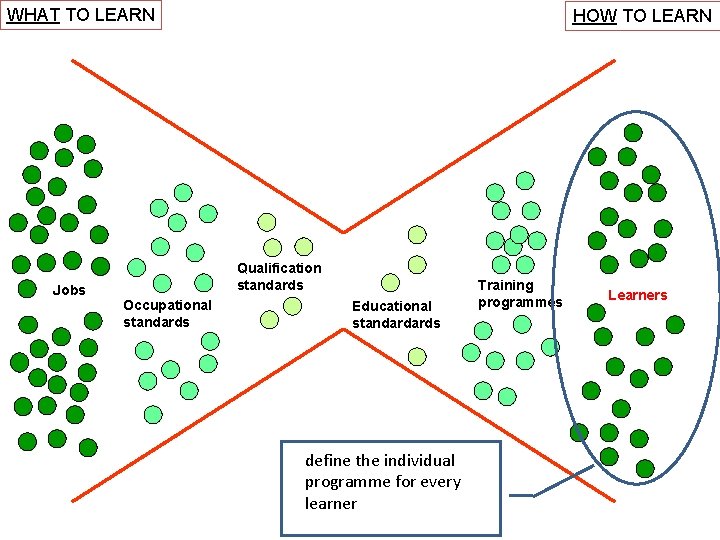
WHAT TO LEARN Jobs HOW TO LEARN Qualification standards Occupational standards Educational standardards define the individual programme for every learner Training programmes Learners
What do we mean with qualifications and qualification standards?
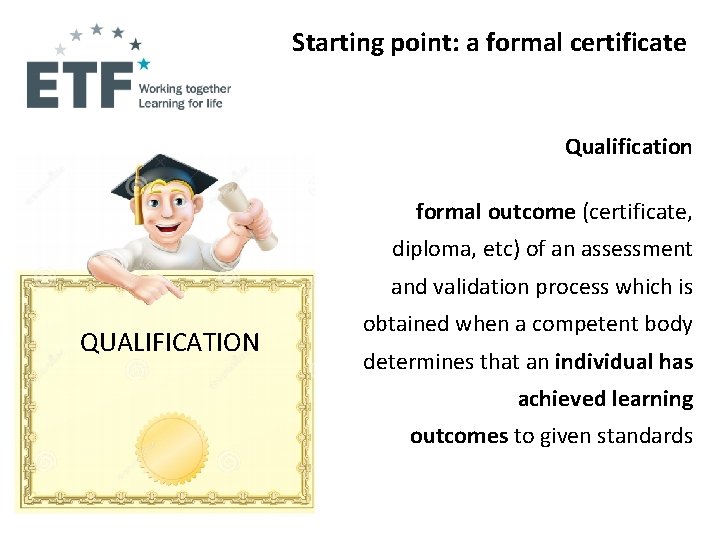
Starting point: a formal certificate Qualification formal outcome (certificate, diploma, etc) of an assessment and validation process which is QUALIFICATION obtained when a competent body determines that an individual has achieved learning outcomes to given standards
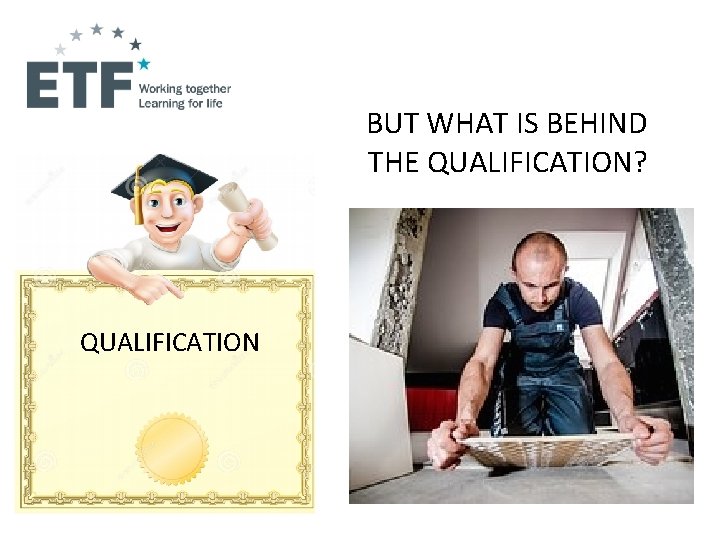
BUT WHAT IS BEHIND THE QUALIFICATION? QUALIFICATION
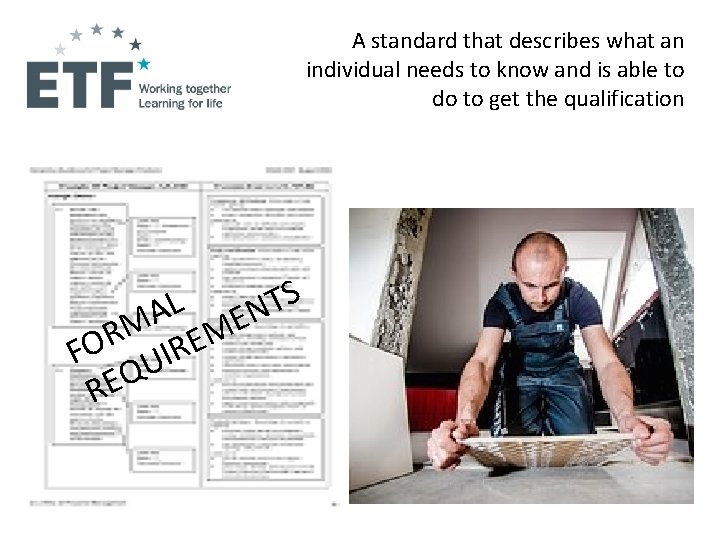
A standard that describes what an individual needs to know and is able to do to get the qualification S T L N A E M M R E O R F I U Q RE
USING LEARNING OUTCOMES «statements of what a learner knows, understands and is able to do on completion of a learning process defined in terms of knowledge, skills and competence» . (Source European Qualifications Framework, 2008) A shift from input parameters (duration, type of education, location, program, institution, etc. ) to the results that can be demonstrated an alternative way to define and develop education, training and qualifications.
Example Compare the following statements: – – – – I know EXCEL. I use EXCEL every day. I took a course in EXCEL. I have a certificate of ECDL (European Computer Driving License). I know how to work in EXCEL. I am able to perform simple mathematical operations in EXCEL. I'm able to do a regression analysis using a computer program. All these statements provide information about my knowledge, skills & competencies But only two are learning outcomes
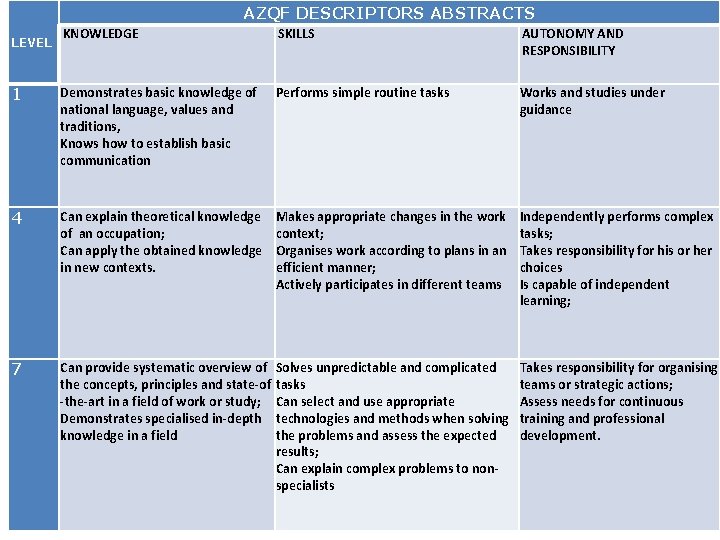
AZQF DESCRIPTORS ABSTRACTS KNOWLEDGE SKILLS AUTONOMY AND RESPONSIBILITY 1 Demonstrates basic knowledge of national language, values and traditions, Knows how to establish basic communication Performs simple routine tasks Works and studies under guidance 4 Can explain theoretical knowledge of an occupation; Can apply the obtained knowledge in new contexts. Makes appropriate changes in the work context; Organises work according to plans in an efficient manner; Actively participates in different teams Independently performs complex tasks; Takes responsibility for his or her choices Is capable of independent learning; 7 Can provide systematic overview of the concepts, principles and state-of -the-art in a field of work or study; Demonstrates specialised in-depth knowledge in a field Solves unpredictable and complicated tasks Can select and use appropriate technologies and methods when solving the problems and assess the expected results; Can explain complex problems to nonspecialists Takes responsibility for organising teams or strategic actions; Assess needs for continuous training and professional development. LEVEL
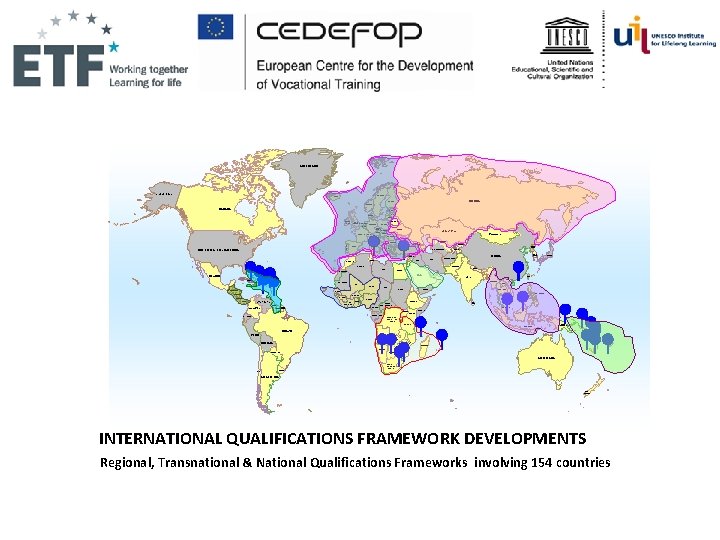
GREENLAND ALASKA (USA) SWEDEN ICELAND RUSSIA FINLAND NORWAY CANADA ESTONIA LATVIA DENMARK LITHUANIA REPULIC OF IRELAND UNITED KINGDOM NETHERLANDS BELARUS GERMANY POLAND BELGIUM CZECH REPUBLIC UKRAINE KAZAKHSTAN SLOVAKIA AUSTRIA FRANCE SWITZ. MONGOLIA HUNGARY ROMANIA ITALY UZBEKISTAN PORTUGAL BULGARIA UNITED STATES of AMERICA GEORGIA KYRGYZSTAN SPAIN NORTH KOREA GREECE TURKEY TURKMENISTAN SYRIA SOUTH KOREA CHINA JAPAN IRAQ TUNISIA MOROCCO TAHKISTAN AFGHANISTAN PAKISTAN ALGERIA NEPAL LIBYA EGYPT WESTERN SAHARA SAUDI ARABIA MEXICO UAE OMAN TAIWAN INDIA MYANMAR CUBA MAURITANIA VIETNAM LAOS MALI NIGER CHAD SUDAN GUATEMALA HONDURAS NICARAGUA THAILAND YEMEN SENEGAL PHILIPPINES CAMBODIA BURKINA GUINEA NIGERIA COSTA RICA ETHIOPIA GHANA VENEZUELA PANAMA LIBERIA GUYANA FRENCH SURINAMEGUIANA COLOMBIA COTE D’IVOIRE SRI LANKA CENTRAL AFRICAN REPUBLIC CAMEROON MALAYSIA SOMALIA UGANDA KENYA GABON CONGO ECUADOR DEMOCRATIC REPUBLIC OF CONGO TANZANIA PAPUA NEW GUINEA INDONESIA BRAZIL PERU ANGOLA UE ZAMBIA O MADAGASCAR M ZIMBABWE ZA M BIQ BOLIVIA NAMIBIA PARAGUAY BOTSWANA AUSTRALIA REPUBLIC OF SOUTH AFRICA CHILE URUGUAY ARGENTINA NEW ZEALAND INTERNATIONAL QUALIFICATIONS FRAMEWORK DEVELOPMENTS Regional, Transnational & National Qualifications Frameworks involving 154 countries
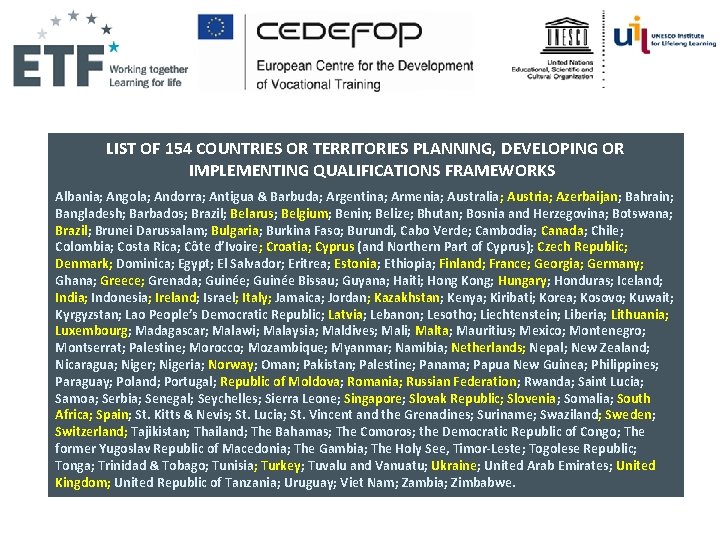
LIST OF 154 COUNTRIES OR TERRITORIES PLANNING, DEVELOPING OR IMPLEMENTING QUALIFICATIONS FRAMEWORKS Albania; Angola; Andorra; Antigua & Barbuda; Argentina; Armenia; Australia; Austria; Azerbaijan; Bahrain; Bangladesh; Barbados; Brazil; Belarus; Belgium; Benin; Belize; Bhutan; Bosnia and Herzegovina; Botswana; Brazil; Brunei Darussalam; Bulgaria; Burkina Faso; Burundi, Cabo Verde; Cambodia; Canada; Chile; Colombia; Costa Rica; Côte d’Ivoire; Croatia; Cyprus (and Northern Part of Cyprus); Czech Republic; Denmark; Dominica; Egypt; El Salvador; Eritrea; Estonia; Ethiopia; Finland; France; Georgia; Germany; Ghana; Greece; Grenada; Guinée Bissau; Guyana; Haiti; Hong Kong; Hungary; Honduras; Iceland; India; Indonesia; Ireland; Israel; Italy; Jamaica; Jordan; Kazakhstan; Kenya; Kiribati; Korea; Kosovo; Kuwait; Kyrgyzstan; Lao People’s Democratic Republic; Latvia; Lebanon; Lesotho; Liechtenstein; Liberia; Lithuania; Luxembourg; Madagascar; Malawi; Malaysia; Maldives; Mali; Malta; Mauritius; Mexico; Montenegro; Montserrat; Palestine; Morocco; Mozambique; Myanmar; Namibia; Netherlands; Nepal; New Zealand; Nicaragua; Nigeria; Norway; Oman; Pakistan; Palestine; Panama; Papua New Guinea; Philippines; Paraguay; Poland; Portugal; Republic of Moldova; Romania; Russian Federation; Rwanda; Saint Lucia; Samoa; Serbia; Senegal; Seychelles; Sierra Leone; Singapore; Slovak Republic; Slovenia; Somalia; South Africa; Spain; St. Kitts & Nevis; St. Lucia; St. Vincent and the Grenadines; Suriname; Swaziland; Sweden; Switzerland; Tajikistan; Thailand; The Bahamas; The Comoros; the Democratic Republic of Congo; The former Yugoslav Republic of Macedonia; The Gambia; The Holy See, Timor-Leste; Togolese Republic; Tonga; Trinidad & Tobago; Tunisia; Turkey; Tuvalu and Vanuatu; Ukraine; United Arab Emirates; United Kingdom; United Republic of Tanzania; Uruguay; Viet Nam; Zambia; Zimbabwe.
GLOBAL INVENTORY 2015 FINDINGS • Learning outcomes are central to implementation of qualification frameworks. • As national qualifications frameworks become operational, their impact on education, training and employment policies and institutions increases • Regional qualifications frameworks, like the EQF, can play a key role in inspiring QF developments and promoting international cooperation. • NQFs help to identify strengths and weaknesses of existing qualifications systems and point to the need for new qualifications.
GLOBAL INVENTORY 2015 FINDINGS • The implementation of NQFs inspire and trigger • new legislation, for example linked to lifelong learning • new institutional solutions, for example in quality assurance • new forms of stakeholder involvement, for example by involving the labour market in qualifications design and review • Qualifications frameworks facilitate international cooperation,
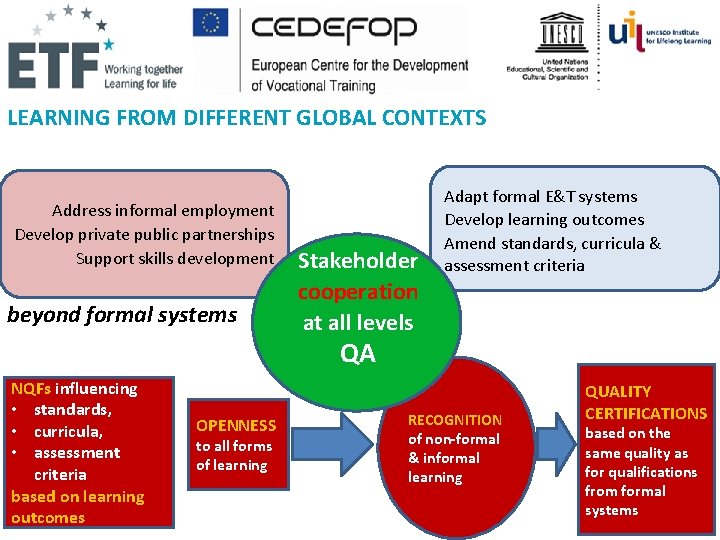
LEARNING FROM DIFFERENT GLOBAL CONTEXTS Address informal employment Develop private public partnerships Support skills development Facilitating recognition beyond formal systems Stakeholder cooperation at all levels Adapt formal E&T systems Develop learning outcomes Amend standards, curricula & assessment criteria QA NQFs influencing • standards, • curricula, • assessment criteria based on learning outcomes OPENNESS to all forms of learning RECOGNITION of non-formal & informal learning QUALITY CERTIFICATIONS based on the same quality as for qualifications from formal systems
- Slides: 23