
Establishing Organizational Information Requirements l In order to
Establishing Organizational Information Requirements l In order to develop an effective information systems plan, the organization must have a clear understanding of both its long- and short-term information requirements. l Two principal methodologies for establishing the essential information requirements of the organization as a whole are: Enterprise analysis or business systems planning l Critical success factors (CSFs) or strategic analysis l
Enterprise Analysis (Business Systems Planning) l Stating that the firm’s information requirements can only be understood by looking at the entire organization in terms of organizational units, functions, processes, and data elements l Taking a large sample of managers and ask them: l l l how they use information; where they get the information; what their environments are like; what their objectives are; how they make decisions; and what their data needs are l Then, aggregating the results of this large survey into subunits, functions, processes, and data matrices l Finally, organizing data elements into logical application groups (groups of data elements that support related sets of organizational processes)
Enterprise Analysis (Business Systems Planning) l The weaknesses of enterprise analysis are that: l it produces a very large amount of data that is expensive to collect and difficult to analyze. l most of the interviews are conducted with senior or middle managers, but there is little effort to collect information from clerical workers and supervisory managers. l the interviewing questions frequently focus not on management’s critical objectives and where information is needed but rather on what existing information is used. l the result is a tendency to automate whatever exists even though sometimes entirely new approaches to how business is conducted are needed, and these needs are not addressed.
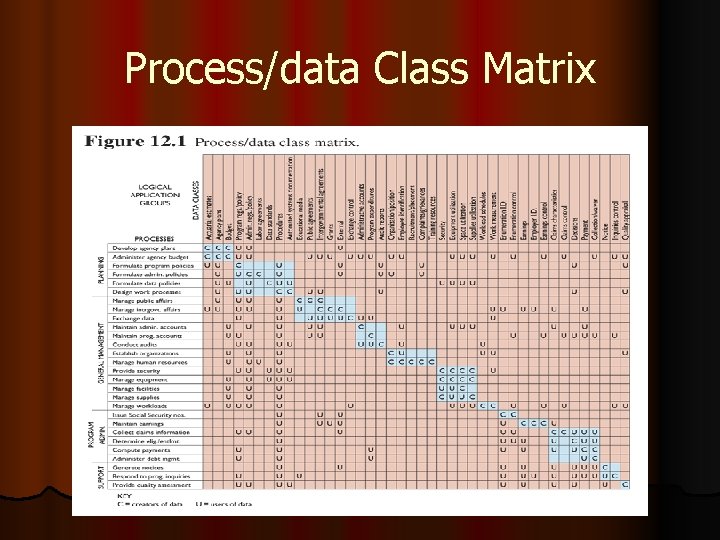
Process/data Class Matrix
Critical Success Factors (Strategic Analysis) l Stating that an organization’s information requirements are determined by a small number of critical success factors (CSFs) of managers (or objectives that managers can easily identify and on which information systems can focus) l Being shaped by the industry, the firm, the manager, and the broader environment l Personally interviewing with a number of top managers for several times to identify their goals and the resulting CSFs l Then, aggregating these personal CSFs to develop a picture of the firm’s CSFs l Finally, building systems to deliver information on these CSFs
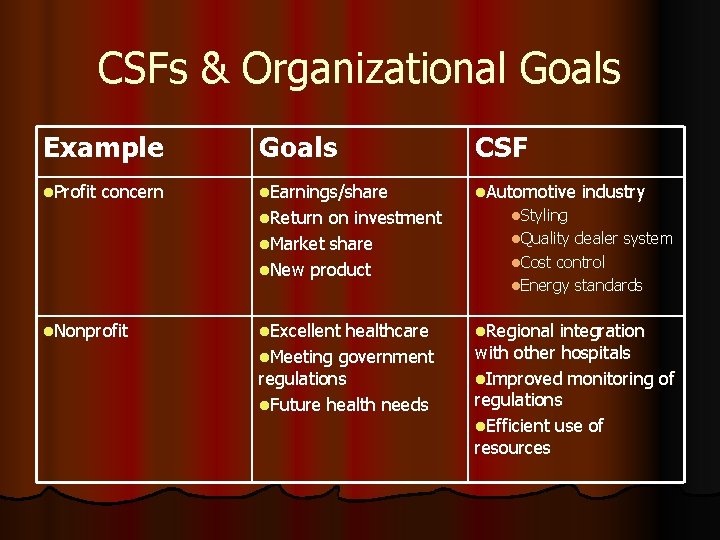
CSFs & Organizational Goals Example Goals CSF l. Profit l. Earnings/share l. Automotive concern l. Return on investment l. Market share l. New product l. Nonprofit l. Excellent healthcare l. Meeting government regulations l. Future health needs industry l. Styling l. Quality dealer system l. Cost control l. Energy standards l. Regional integration with other hospitals l. Improved monitoring of regulations l. Efficient use of resources
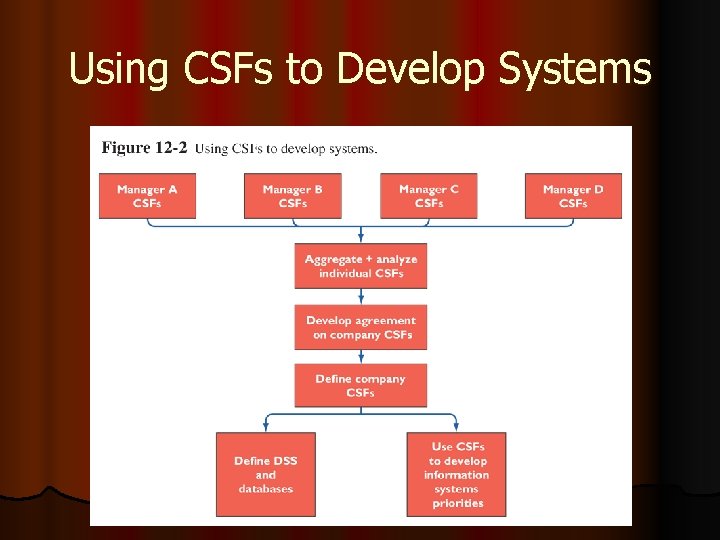
Using CSFs to Develop Systems
Critical Success Factors (Strategic Analysis) l The strengths of the CSF method are that: l it produces a smaller data set to analyze than does enterprise analysis. l only top managers are interviewed, and the questions focus on a small number of CSFs rather than a broad question into what information is used or needed. l it considers the changing environment with which organizations and managers must deal. l because it focuses organizational attention on how information should be handled, it is especially suitable for top management and for the development of DSS and ESS.
Critical Success Factors (Strategic Analysis) l The weaknesses of the CSF method are that: l the aggregation process and the analysis of the data are difficult. l there is often confusion among interviewees and interviewers between individual and organizational CSFs. (What can be critical to a manager may not be important for the organization. ) l it is clearly biased toward top managers because they are the ones interviewed.
- Slides: 9