
Establishing Inclusion Identify and understand the needs of
Establishing Inclusion Identify and understand the needs of the adult learner.
Needs Assessment • Felt Needs • Adult learners know their needs when they come into a course – find out how they feel. • Ask your learners • Allow learners to rank a list of topics or course activities • Allow learners to finish a sentence • Not absolute, but helps you get an idea of your learner’s needs
Normative Needs • Explain the levels of competency required and gain learner trust • Have learners participate in problem solving activities
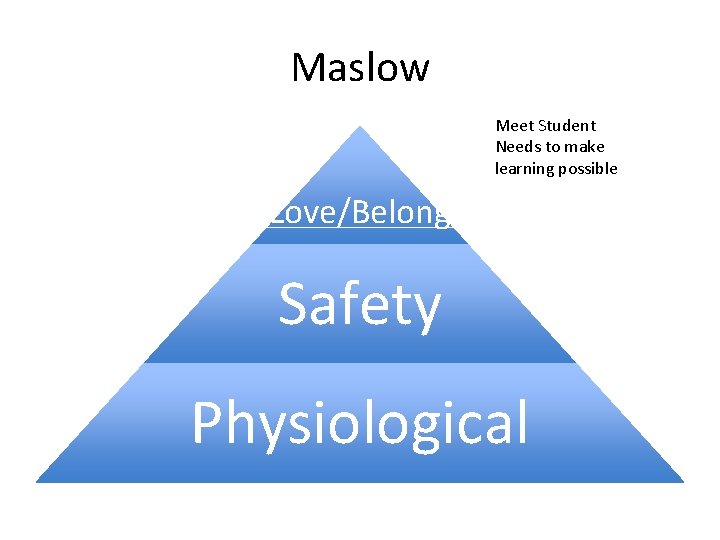
Maslow Meet Student Needs to make learning possible Love/Belong Safety Physiological

Meeting Learner Needs • Adult learners need an orderly learning environment where they do not fear failure • Relate tasks to to familiar concepts • Create a visual to help students understand • Help them feel accepted and respected • Allow them to learn and demonstrate new skills • Challenge them to improve or progress
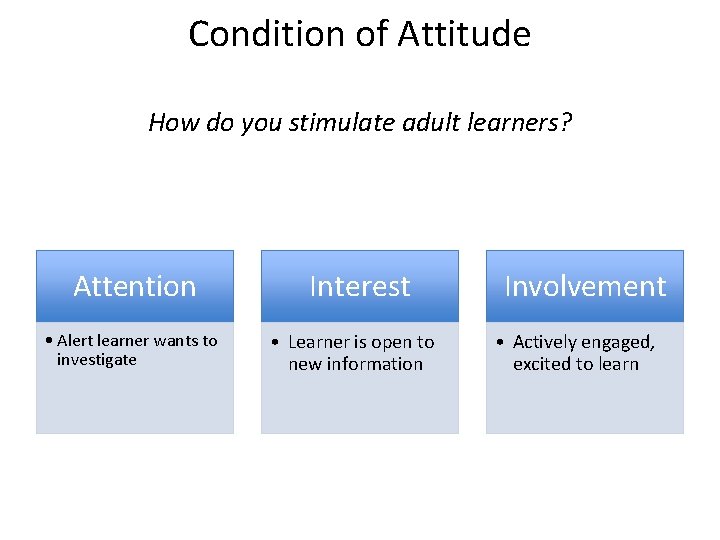
Condition of Attitude How do you stimulate adult learners? Attention • Alert learner wants to investigate Interest • Learner is open to new information Involvement • Actively engaged, excited to learn
• One – be creative with your instruction, what appeals to one learner may not be interesting to another one in the same class. Learning will increase if learners enjoy what they are doing. • Two – Adult learners have a choice to learn and are motivated when they are trying to reach a goal. Having a choice of what to learn when possible can make the learning experience more inviting. • Three- Adult learners need more chances to respond such as being able to tell about a concept, demonstrate a skill or answering a question.
• Four – Learners try harder when they know they will be evaluated. Be sure students know what concepts they will be evaluated on, and how their progress will be measured. Call attention to important concepts in class and provide supplemental materials to help them learn. • Five – Make sure your presentation style varies including movement, differences in tone and pitch, paying careful attention to your voice quality and pauses and eye contact. You can also change your communication channel by including different types of learning activities and interactivity in your lectures.

• Six – Frame your instructional sessions with a beginning and end to let students know when they should be paying attention to our activities. Ask questions call on students, talk up your activities to create interest and help students tie the learning activity to the concept they are learning in the class. Review and clarify the activity to close • Seven- Give breaks or provide something to diminish fatigue. Don’t go by the clock to know when you should break, give breaks when the students need one.
• • Eight – Relate activities to adult interests. As we mature, our focus changes from starting our adult life to having children, getting a job, creating a stable and productive life for our family to settling down and preparing for the senior years. Relating your learning activities to these stages will help adult learners stay connected. • Nine – Help learners understand why they need to learn and what advantages they will gain from learning. • Ten – Use humor to relax and engage your learners when possible. • Eleven- Make them feel something – use stories, films, or anything to evoke parapathic feelings and get learners to feel emotions
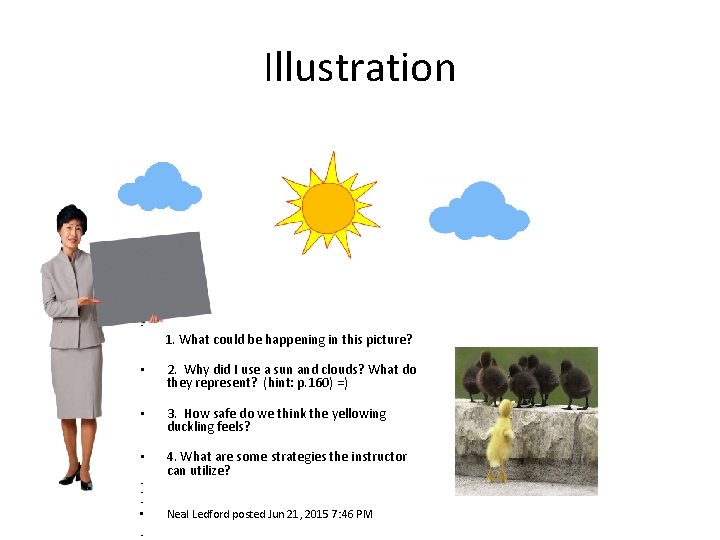
Illustration • 1. What could be happening in this picture? • 2. Why did I use a sun and clouds? What do they represent? (hint: p. 160) =) • 3. How safe do we think the yellowing duckling feels? • 4. What are some strategies the instructor can utilize? • • • Neal Ledford posted Jun 21, 2015 7: 46 PM
- Slides: 11