
Establishing correlation of footprints with body weight Forensic
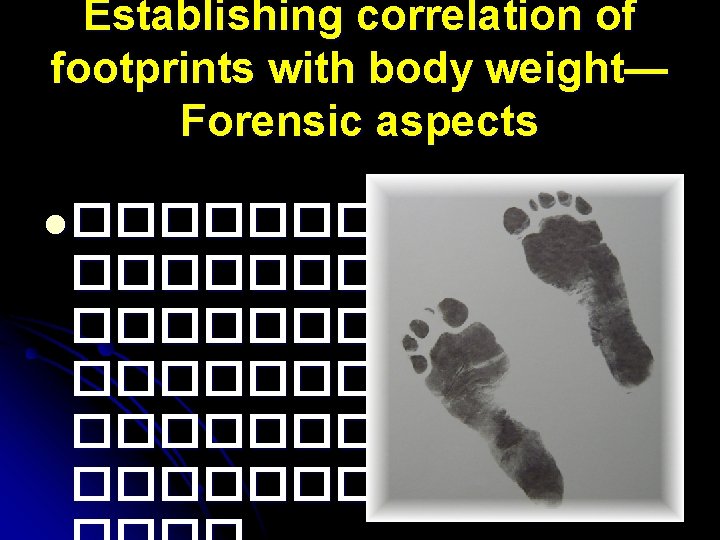
Establishing correlation of footprints with body weight— Forensic aspects l ����������� �����������
Introduction Human foot impression has a considerable value in forensic science especially in a country like India where people prefer to walk barefoot due to religious, climatic and socio-economic reasons. Footprints are usually encountered at crime sites in India. If carefully examined, footprints can be collected from almost every kind of crime scene. They can be utilized as a kind of evidence for estimation of body size (stature, body weight, etc. ), individualistic characteristics and foot morphology of the criminals.
Objective The present study explores the correlation of body weight with footprints by subjecting 50 individuals to additional weights ranging from 5 kg to 20 kg. The study further explores the effect of additional weight on the dimensions of the footprints. The study also attempts to estimate body weight from footprint dimensions by regression analysis.
Meterials and methods The subjects for the present study comprise 50 adult male Gujjars (age: 18– 30 years)
Body weight of each subject was measured on a spring loaded weighing machine and the results were recorded to the nearest 0. 1 kg. l The left and right footprints of the subject with his normal weight were recorded. Then, the footprints were taken when the subject had additional 5 kg weight in his hands and had 20 kg weight in his hands, separately. l
l The differences between the measurements of the normal weight footprints and the footprints taken with additional weight of 5 kg and then of 20 kg, were calculated separately. To see the statistical significance of the mean differences, t-test was employed. l The correlation coefficients between the measurements of these three kinds of footprints and body weight were calculated to see whethere is any difference between the degrees of correlation in these three kinds of footprints.
l Regression analysis was employed to calculate regression formulae for estimation of body weight from various measurements in normal weight footprints and footprints with 20 kg additional weight. l The data were analyzed using Statistical Package for Social Sciences (SPSS) on Widows Professional.
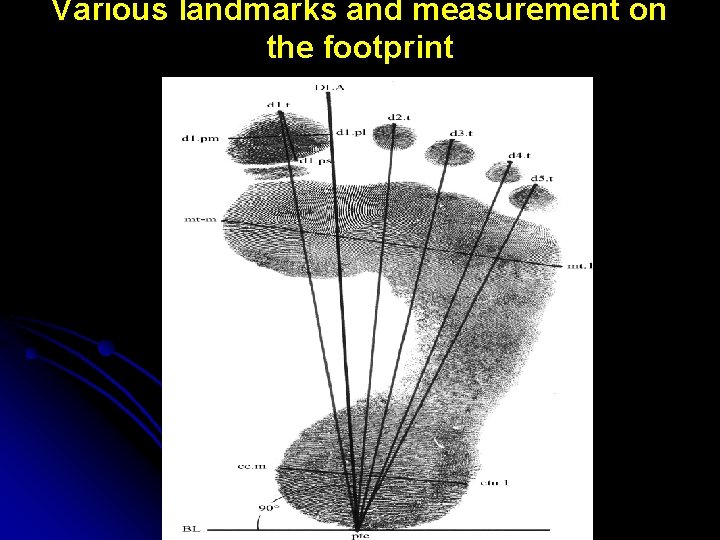
Various landmarks and measurement on the footprint
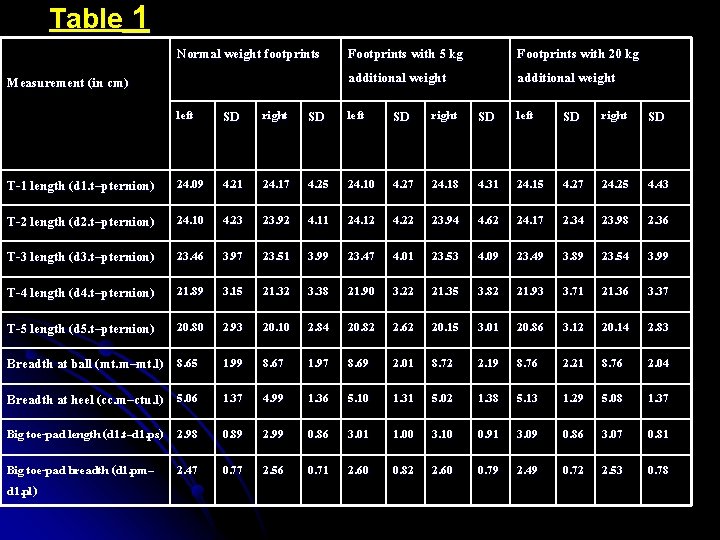
Table 1 Normal weight footprints Measurement (in cm) left SD right SD Footprints with 5 kg additional weight left SD right Footprints with 20 kg additional weight SD left SD right SD T-1 length (d 1. t–pternion) 24. 09 4. 21 24. 17 4. 25 24. 10 4. 27 24. 18 4. 31 24. 15 4. 27 24. 25 4. 43 T-2 length (d 2. t–pternion) 24. 10 4. 23 23. 92 4. 11 24. 12 4. 22 23. 94 4. 62 24. 17 2. 34 23. 98 2. 36 T-3 length (d 3. t–pternion) 23. 46 3. 97 23. 51 3. 99 23. 47 4. 01 23. 53 4. 09 23. 49 3. 89 23. 54 3. 99 T-4 length (d 4. t–pternion) 21. 89 3. 15 21. 32 3. 38 21. 90 3. 22 21. 35 3. 82 21. 93 3. 71 21. 36 3. 37 T-5 length (d 5. t–pternion) 20. 80 2. 93 20. 10 2. 84 20. 82 2. 62 20. 15 3. 01 20. 86 3. 12 20. 14 2. 83 Breadth at ball (mt. m–mt. l) 8. 65 1. 99 8. 67 1. 97 8. 69 2. 01 8. 72 2. 19 8. 76 2. 21 8. 76 2. 04 Breadth at heel (cc. m–ctu. l) 5. 06 1. 37 4. 99 1. 36 5. 10 1. 31 5. 02 1. 38 5. 13 1. 29 5. 08 1. 37 Big toe-pad length (d 1. t–d 1. ps) 2. 98 0. 89 2. 99 0. 86 3. 01 1. 00 3. 10 0. 91 3. 09 0. 86 3. 07 0. 81 Big toe-pad breadth (d 1. pm– d 1. pl) 0. 77 2. 56 0. 71 2. 60 0. 82 2. 60 0. 79 2. 49 0. 72 2. 53 0. 78 2. 47
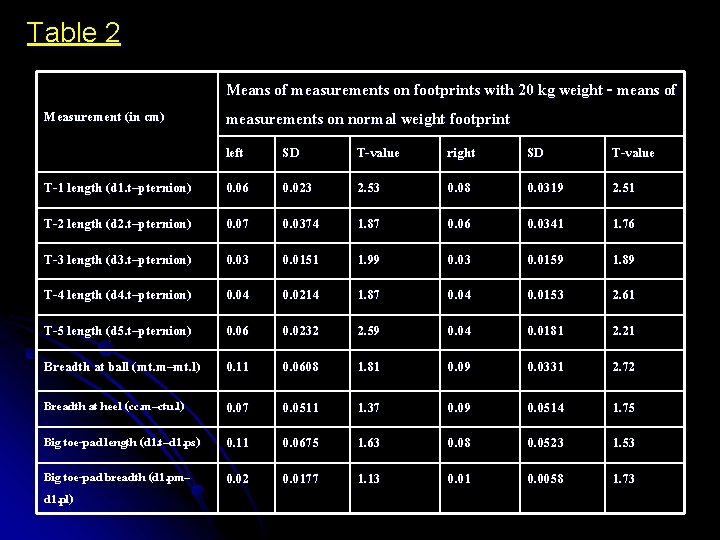
Table 2 Measurement (in cm) Means of measurements on footprints with 20 kg weight - means of measurements on normal weight footprint left SD T-value right SD T-value T-1 length (d 1. t–pternion) 0. 06 0. 023 2. 53 0. 08 0. 0319 2. 51 T-2 length (d 2. t–pternion) 0. 07 0. 0374 1. 87 0. 06 0. 0341 1. 76 T-3 length (d 3. t–pternion) 0. 03 0. 0151 1. 99 0. 03 0. 0159 1. 89 T-4 length (d 4. t–pternion) 0. 04 0. 0214 1. 87 0. 04 0. 0153 2. 61 T-5 length (d 5. t–pternion) 0. 06 0. 0232 2. 59 0. 04 0. 0181 2. 21 Breadth at ball (mt. m–mt. l) 0. 11 0. 0608 1. 81 0. 09 0. 0331 2. 72 Breadth at heel (cc. m–ctu. l) 0. 07 0. 0511 1. 37 0. 09 0. 0514 1. 75 Big toe-pad length (d 1. t–d 1. ps) 0. 11 0. 0675 1. 63 0. 08 0. 0523 1. 53 Big toe-pad breadth (d 1. pm– d 1. pl) 0. 02 0. 0177 1. 13 0. 01 0. 0058 1. 73
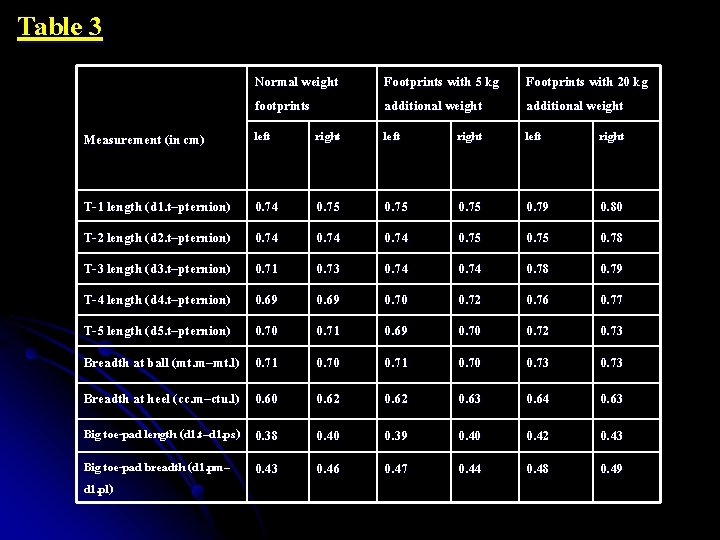
Table 3 Normal weight footprints Footprints with 5 kg additional weight Footprints with 20 kg additional weight Measurement (in cm) left right T-1 length (d 1. t–pternion) 0. 74 0. 75 0. 79 0. 80 T-2 length (d 2. t–pternion) 0. 74 0. 75 0. 78 T-3 length (d 3. t–pternion) 0. 71 0. 73 0. 74 0. 78 0. 79 T-4 length (d 4. t–pternion) 0. 69 0. 70 0. 72 0. 76 0. 77 T-5 length (d 5. t–pternion) 0. 70 0. 71 0. 69 0. 70 0. 72 0. 73 Breadth at ball (mt. m–mt. l) 0. 71 0. 70 0. 73 Breadth at heel (cc. m–ctu. l) 0. 60 0. 62 0. 63 0. 64 0. 63 Big toe-pad length (d 1. t–d 1. ps) 0. 38 0. 40 0. 39 0. 40 0. 42 0. 43 0. 46 0. 47 0. 44 0. 48 0. 49 Big toe-pad breadth (d 1. pm– d 1. pl)
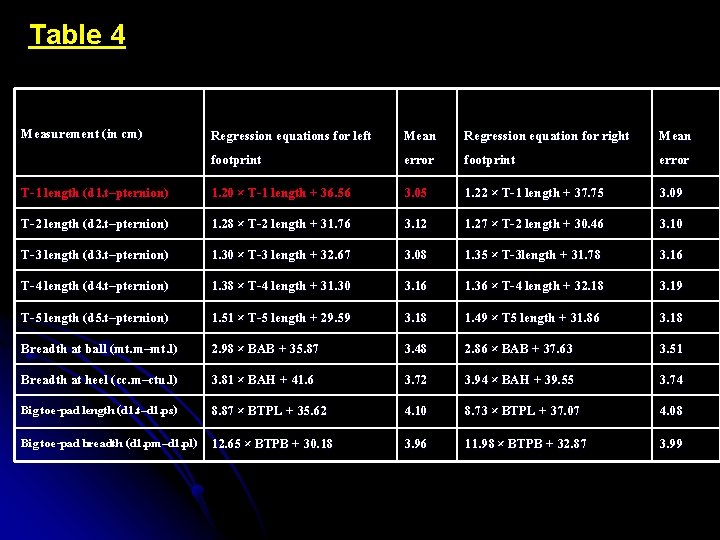
Table 4 Measurement (in cm) Regression equations for left footprint Mean error Regression equation for right footprint Mean error T-1 length (d 1. t–pternion) 1. 20 × T-1 length + 36. 56 3. 05 1. 22 × T-1 length + 37. 75 3. 09 T-2 length (d 2. t–pternion) 1. 28 × T-2 length + 31. 76 3. 12 1. 27 × T-2 length + 30. 46 3. 10 T-3 length (d 3. t–pternion) 1. 30 × T-3 length + 32. 67 3. 08 1. 35 × T-3 length + 31. 78 3. 16 T-4 length (d 4. t–pternion) 1. 38 × T-4 length + 31. 30 3. 16 1. 36 × T-4 length + 32. 18 3. 19 T-5 length (d 5. t–pternion) 1. 51 × T-5 length + 29. 59 3. 18 1. 49 × T 5 length + 31. 86 3. 18 Breadth at ball (mt. m–mt. l) 2. 98 × BAB + 35. 87 3. 48 2. 86 × BAB + 37. 63 3. 51 Breadth at heel (cc. m–ctu. l) 3. 81 × BAH + 41. 6 3. 72 3. 94 × BAH + 39. 55 3. 74 Big toe-pad length (d 1. t–d 1. ps) 8. 87 × BTPL + 35. 62 4. 10 8. 73 × BTPL + 37. 07 4. 08 3. 96 11. 98 × BTPB + 32. 87 3. 99 Big toe-pad breadth (d 1. pm–d 1. pl) 12. 65 × BTPB + 30. 18
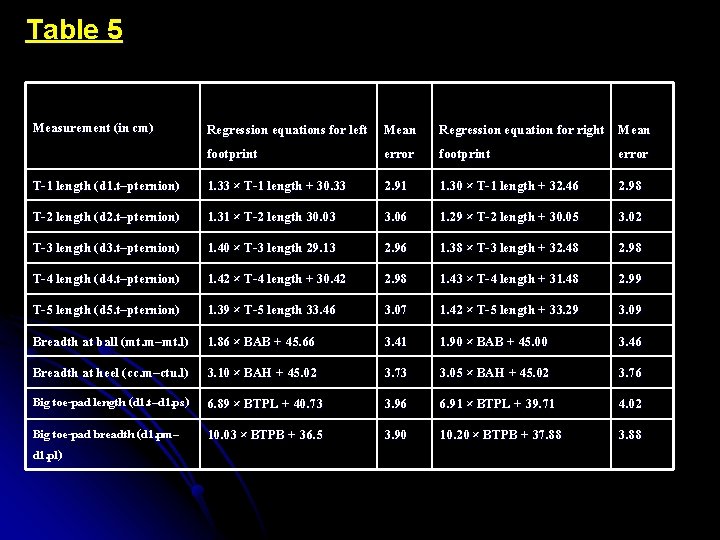
Table 5 Measurement (in cm) Regression equations for left Mean footprint error Regression equation for right Mean footprint error T-1 length (d 1. t–pternion) 1. 33 × T-1 length + 30. 33 2. 91 1. 30 × T-1 length + 32. 46 2. 98 T-2 length (d 2. t–pternion) 1. 31 × T-2 length 30. 03 3. 06 1. 29 × T-2 length + 30. 05 3. 02 T-3 length (d 3. t–pternion) 1. 40 × T-3 length 29. 13 2. 96 1. 38 × T-3 length + 32. 48 2. 98 T-4 length (d 4. t–pternion) 1. 42 × T-4 length + 30. 42 2. 98 1. 43 × T-4 length + 31. 48 2. 99 T-5 length (d 5. t–pternion) 1. 39 × T-5 length 33. 46 3. 07 1. 42 × T-5 length + 33. 29 3. 09 Breadth at ball (mt. m–mt. l) 1. 86 × BAB + 45. 66 3. 41 1. 90 × BAB + 45. 00 3. 46 Breadth at heel (cc. m–ctu. l) 3. 10 × BAH + 45. 02 3. 73 3. 05 × BAH + 45. 02 3. 76 Big toe-pad length (d 1. t–d 1. ps) 6. 89 × BTPL + 40. 73 3. 96 6. 91 × BTPL + 39. 71 4. 02 10. 03 × BTPB + 36. 5 3. 90 10. 20 × BTPB + 37. 88 3. 88 Big toe-pad breadth (d 1. pm– d 1. pl)
Conclusion l l The study concludes that the body weight has a strong and positive correlation with the various measurements of the footprint. It is also observed that when the subjects have additional weight of 20 kg in their hands, some of the footprint dimensions are significantly altered. It is further concluded that estimation of body weight can successfully be estimated from various dimensions of the footprints with defined mean errors.
Conclusion l Reliability of the estimate is little more in case of the footprints when the individuals are subjected to 20 kg weight than the normal weight footprints. The study would be helpful in interpretation and analysis of footprints in criminal cases pertaining to rivalries, homicides, sexual offences especially robberies, thefts, shoplifting, dacoity, etc. where the person is lifting the bags, gunny bags full of some material and leaving the footprints at crime site.
- Slides: 16