
Establishing C 3 the coherence between beam physics
Establishing C 3, the coherence between beam physics requirements, magnet manufacture, and measurements Stephan Russenschuck for the CERN magnet (measurement) -team 02. 12. 2013 1 S. Russenschuck Workshop: Beam Physics meets Magnets, Darmstadt, Dezember 2013 1
Beam Physicists, Magnet Designers, and Measurement Engineers Magnet design chap Mag. measurement guy Wer viel misst, misst Mist Scene from Reservoir Dogs, Q. Tarentino Beam physics bloke S. Russenschuck Workshop: Beam Physics meets Magnets, Darmstadt, Dezember 2013
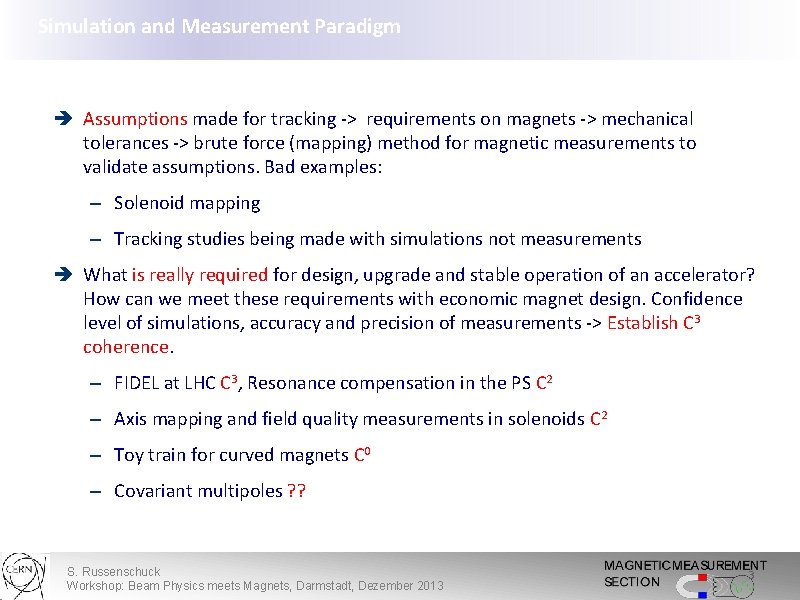
Simulation and Measurement Paradigm è Assumptions made for tracking -> requirements on magnets -> mechanical tolerances -> brute force (mapping) method for magnetic measurements to validate assumptions. Bad examples: – Solenoid mapping – Tracking studies being made with simulations not measurements è What is really required for design, upgrade and stable operation of an accelerator? How can we meet these requirements with economic magnet design. Confidence level of simulations, accuracy and precision of measurements -> Establish C 3 coherence. – FIDEL at LHC C 3, Resonance compensation in the PS C 2 – Axis mapping and field quality measurements in solenoids C 2 – Toy train for curved magnets C 0 – Covariant multipoles ? ? S. Russenschuck Workshop: Beam Physics meets Magnets, Darmstadt, Dezember 2013 3
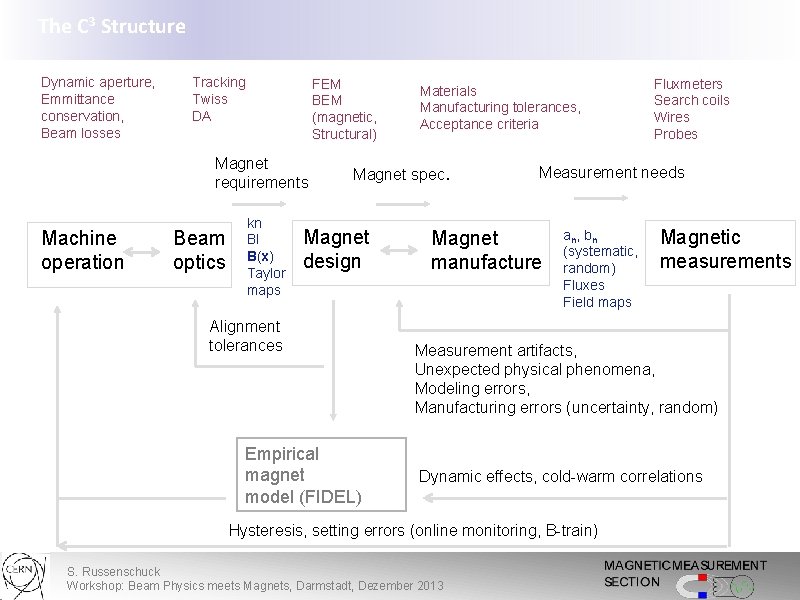
The C 3 Structure Dynamic aperture, Emmittance conservation, Beam losses Tracking Twiss DA FEM BEM (magnetic, Structural) Magnet requirements Machine operation Beam optics kn Bl B(x) Taylor maps Materials Manufacturing tolerances, Acceptance criteria Magnet spec. Magnet design Alignment tolerances Empirical magnet model (FIDEL) Fluxmeters Search coils Wires Probes Measurement needs Magnet manufacture an, bn (systematic, random) Fluxes Field maps Magnetic measurements Measurement artifacts, Unexpected physical phenomena, Modeling errors, Manufacturing errors (uncertainty, random) Dynamic effects, cold-warm correlations Hysteresis, setting errors (online monitoring, B-train) S. Russenschuck Workshop: Beam Physics meets Magnets, Darmstadt, Dezember 2013
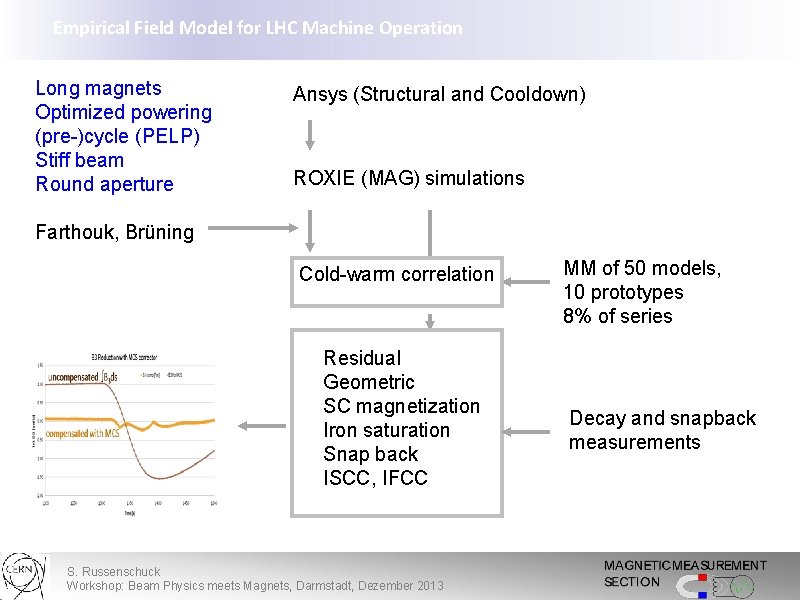
Empirical Field Model for LHC Machine Operation Long magnets Optimized powering (pre-)cycle (PELP) Stiff beam Round aperture Ansys (Structural and Cooldown) ROXIE (MAG) simulations Farthouk, Brüning Cold-warm correlation Residual Geometric SC magnetization Iron saturation Snap back ISCC, IFCC S. Russenschuck Workshop: Beam Physics meets Magnets, Darmstadt, Dezember 2013 MM of 50 models, 10 prototypes 8% of series Decay and snapback measurements

CERN PS Combined-Function Magnets è Strongly coupled excitation circuits è No 10 -4 predictive model è Remanent field 0. 2% FMR field marker Fluxmeter for gradient measurements Figure-of-eight loop to control B 2 4 pole face windings affecting B 1 to B 5 S. Russenschuck Workshop: Beam Physics meets Magnets, Darmstadt, Dezember 2013
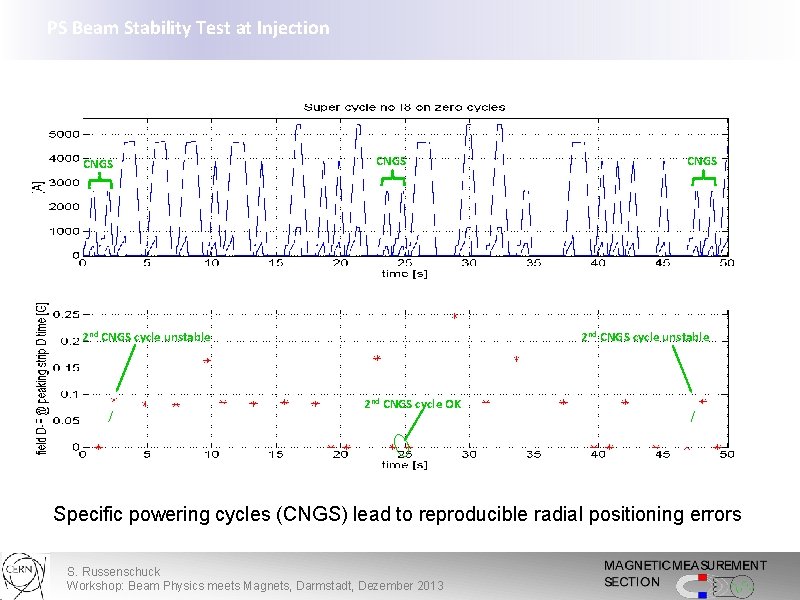
PS Beam Stability Test at Injection CNGS 2 nd CNGS cycle unstable 2 nd CNGS cycle OK Specific powering cycles (CNGS) lead to reproducible radial positioning errors S. Russenschuck Workshop: Beam Physics meets Magnets, Darmstadt, Dezember 2013
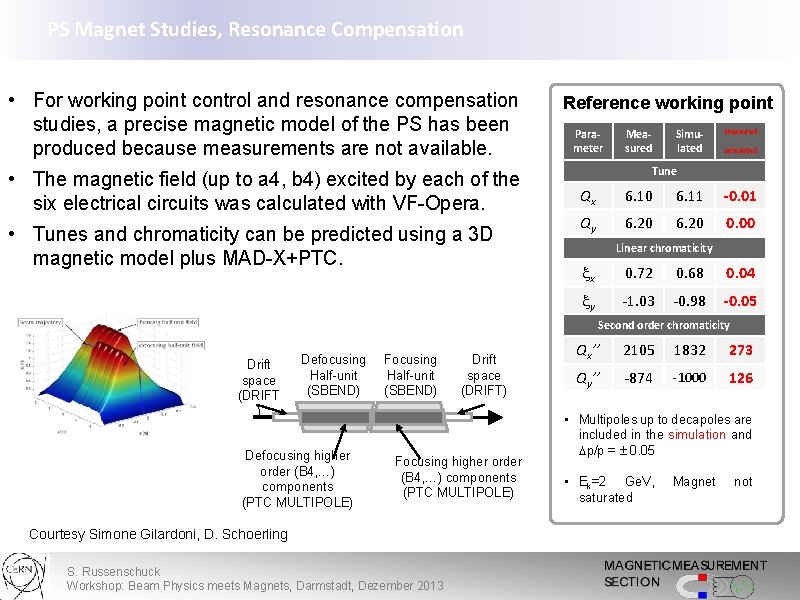
PS Magnet Studies, Resonance Compensation • For working point control and resonance compensation studies, a precise magnetic model of the PS has been produced because measurements are not available. • The magnetic field (up to a 4, b 4) excited by each of the six electrical circuits was calculated with VF-Opera. • Tunes and chromaticity can be predicted using a 3 D magnetic model plus MAD-X+PTC. Reference working point Parameter Measured Simulated Tune Qx 6. 10 6. 11 -0. 01 Qy 6. 20 0. 00 Linear chromaticity x 0. 72 0. 68 0. 04 y -1. 03 -0. 98 -0. 05 Second order chromaticity Drift space (DRIFT ) Defocusing Half-unit (SBEND) Defocusing higher order (B 4, …) components (PTC MULTIPOLE) Focusing Half-unit (SBEND) Drift space (DRIFT) Focusing higher order (B 4, …) components (PTC MULTIPOLE) Courtesy Simone Gilardoni, D. Schoerling S. Russenschuck Workshop: Beam Physics meets Magnets, Darmstadt, Dezember 2013 Qx’’ 2105 1832 273 Qy’’ -874 -1000 126 • Multipoles up to decapoles are included in the simulation and p/p = 0. 05 • Ek=2 Ge. V, saturated Magnet not
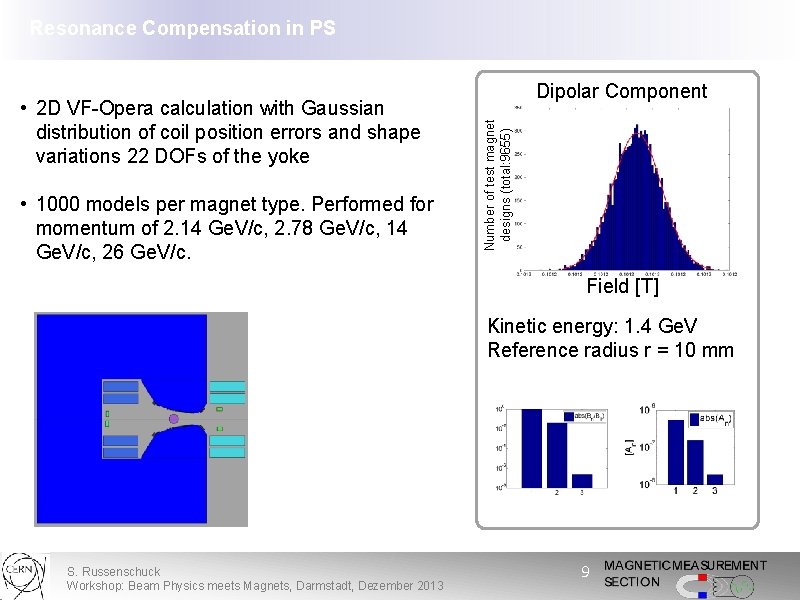
Resonance Compensation in PS • 1000 models per magnet type. Performed for momentum of 2. 14 Ge. V/c, 2. 78 Ge. V/c, 14 Ge. V/c, 26 Ge. V/c. Number of test magnet designs (total: 9655) • 2 D VF-Opera calculation with Gaussian distribution of coil position errors and shape variations 22 DOFs of the yoke Dipolar Component Field [T] Kinetic energy: 1. 4 Ge. V Reference radius r = 10 mm S. Russenschuck Workshop: Beam Physics meets Magnets, Darmstadt, Dezember 2013 9

Resonance Compensation in PS Compensated resonance 2 qx+qy=1 A resonances compensation scheme could be implemented based on predicted field errors in the PS machine. A 3 D magnetic model will be used to repeat the statistical study to include the effects from fringe fields and inter-blocks gaps. S. Russenschuck Workshop: Beam Physics meets Magnets, Darmstadt, Dezember 2013

Limitations of Rotating Coil Measurements Standardization of equipment for measurements in horizontal (rt) and vertical (cryogenic temp. ) position S. Russenschuck Workshop: Beam Physics meets Magnets, Darmstadt, Dezember 2013

Solving Boundary Value Problems I 1. Governing equation in the air domain 2. Chose a suitable coordinate system, make a guess, look it up in a book, use the method of separation, that is, find orthogonal and complete eigenfunctions. Coefficients are not know at this stage 3. Incorporate a bit of knowledge, rename, and calculate field components S. Russenschuck Workshop: Beam Physics meets Magnets, Darmstadt, Dezember 2013
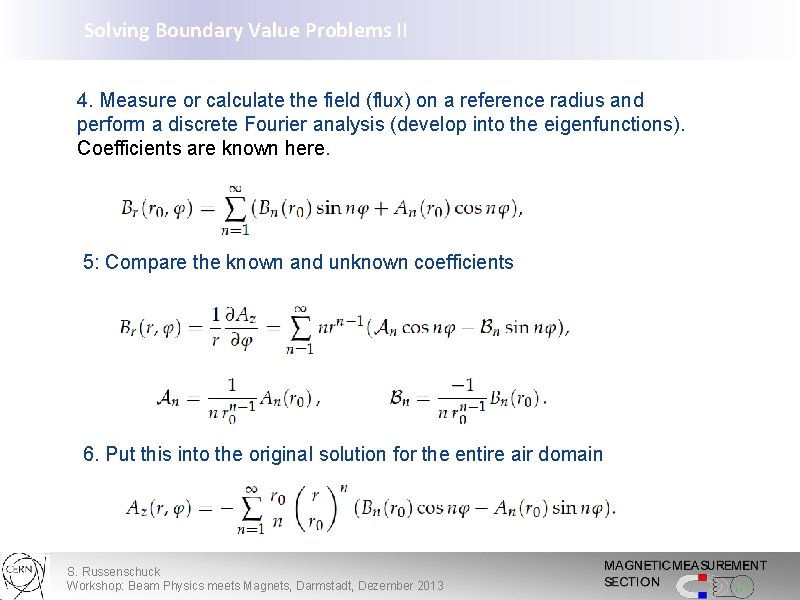
Solving Boundary Value Problems II 4. Measure or calculate the field (flux) on a reference radius and perform a discrete Fourier analysis (develop into the eigenfunctions). Coefficients are known here. 5: Compare the known and unknown coefficients 6. Put this into the original solution for the entire air domain S. Russenschuck Workshop: Beam Physics meets Magnets, Darmstadt, Dezember 2013

Solving Boundary Value Problems II Take any 2 p periodic function and develop according to The operators div, grad, curl of vector analysis are isomorphic to algebraic operators in the L 2 space of our field harmonics We can use fields, potentials, fluxes, or wire-oscillation amplitudes as “raw data”. S. Russenschuck Workshop: Beam Physics meets Magnets, Darmstadt, Dezember 2013
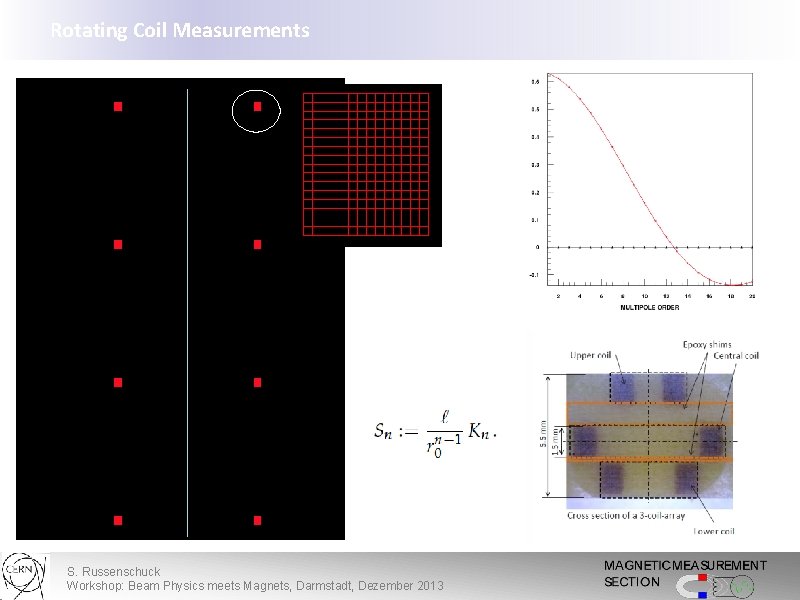
Rotating Coil Measurements S. Russenschuck Workshop: Beam Physics meets Magnets, Darmstadt, Dezember 2013
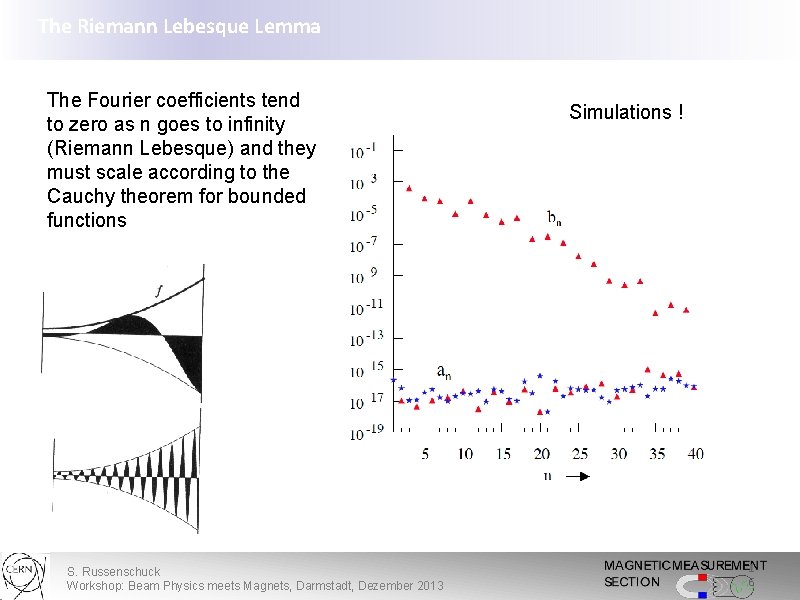
The Riemann Lebesque Lemma The Fourier coefficients tend to zero as n goes to infinity (Riemann Lebesque) and they must scale according to the Cauchy theorem for bounded functions S. Russenschuck Workshop: Beam Physics meets Magnets, Darmstadt, Dezember 2013 Simulations ! 1 6
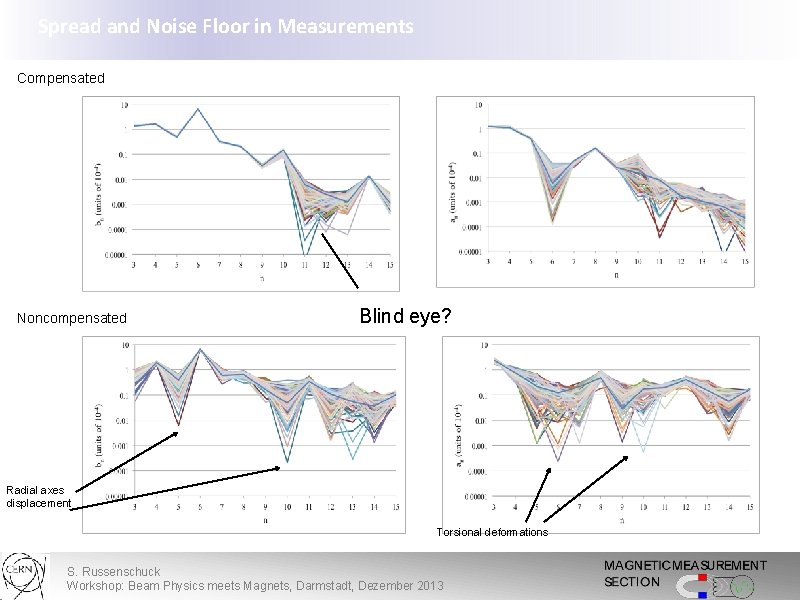
Spread and Noise Floor in Measurements Compensated Noncompensated Blind eye? Radial axes displacement Torsional deformations S. Russenschuck Workshop: Beam Physics meets Magnets, Darmstadt, Dezember 2013

Hall Probe Mappers • Difficulty of guaranteeing good absolute calibration and precise positioning S. Russenschuck Workshop: Beam Physics meets Magnets, Darmstadt, Dezember 2013
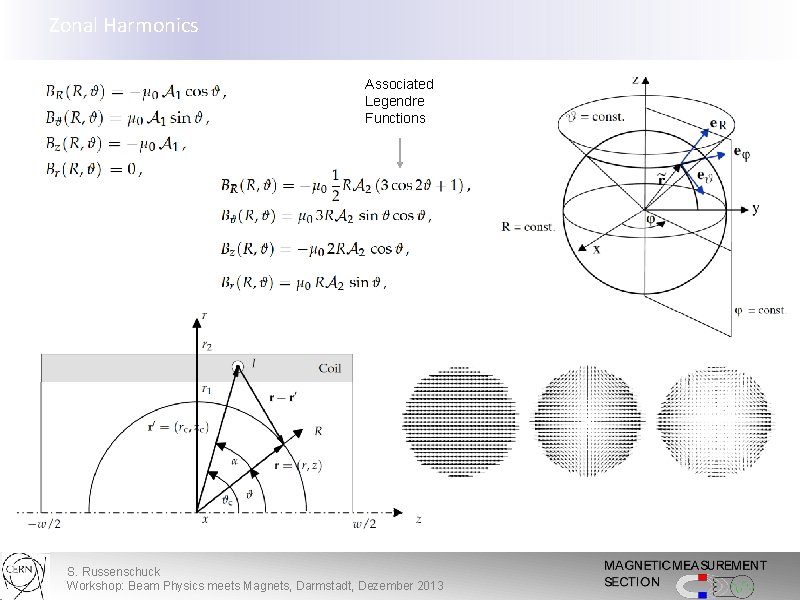
Zonal Harmonics Associated Legendre Functions S. Russenschuck Workshop: Beam Physics meets Magnets, Darmstadt, Dezember 2013

Zonal Harmonics III (Applications to Solenoids) Solid: Approximation to first order S. Russenschuck Workshop: Beam Physics meets Magnets, Darmstadt, Dezember 2013
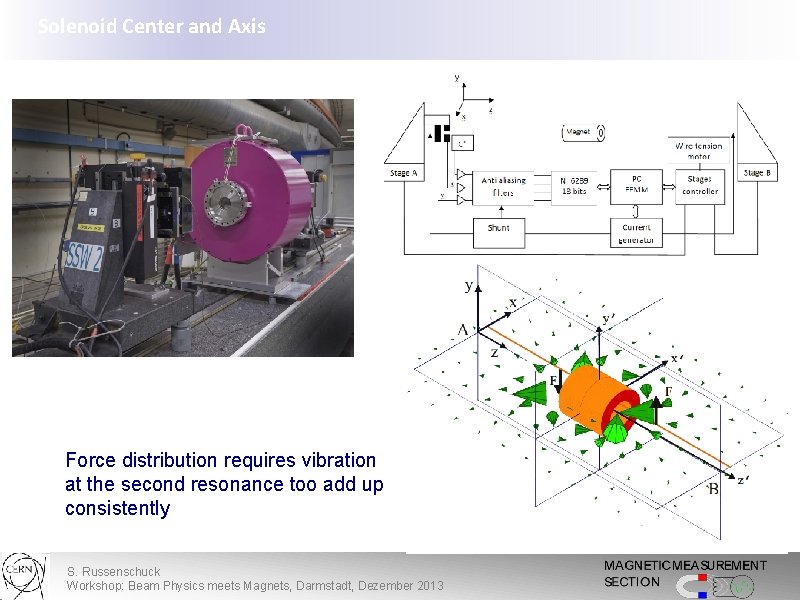
Solenoid Center and Axis Force distribution requires vibration at the second resonance too add up consistently S. Russenschuck Workshop: Beam Physics meets Magnets, Darmstadt, Dezember 2013
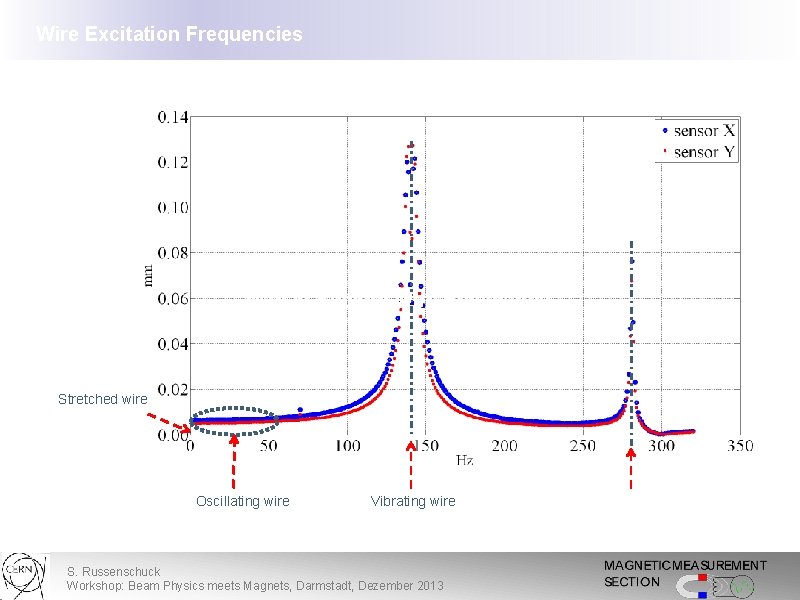
Wire Excitation Frequencies Measurement system design Map of Second Wire Resonance Stretched wire Oscillating wire Vibrating wire S. Russenschuck Workshop: Beam Physics meets Magnets, Darmstadt, Dezember 2013
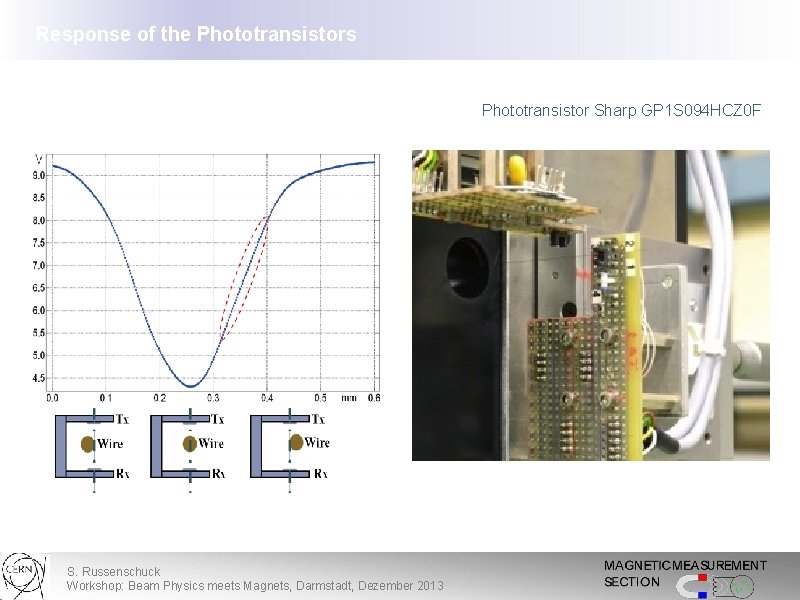
Response of the Phototransistors Optical sensors. Sharp GP 1 S 094 HCZ 0 F Phototransistor S. Russenschuck Workshop: Beam Physics meets Magnets, Darmstadt, Dezember 2013
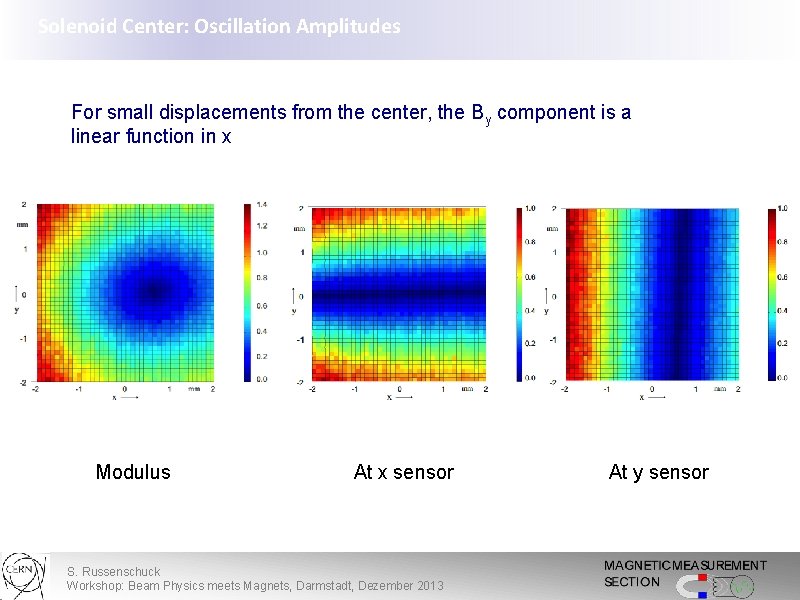
Solenoid Center: Oscillation Amplitudes For small displacements from the center, the By component is a linear function in x Modulus At x sensor S. Russenschuck Workshop: Beam Physics meets Magnets, Darmstadt, Dezember 2013 At y sensor
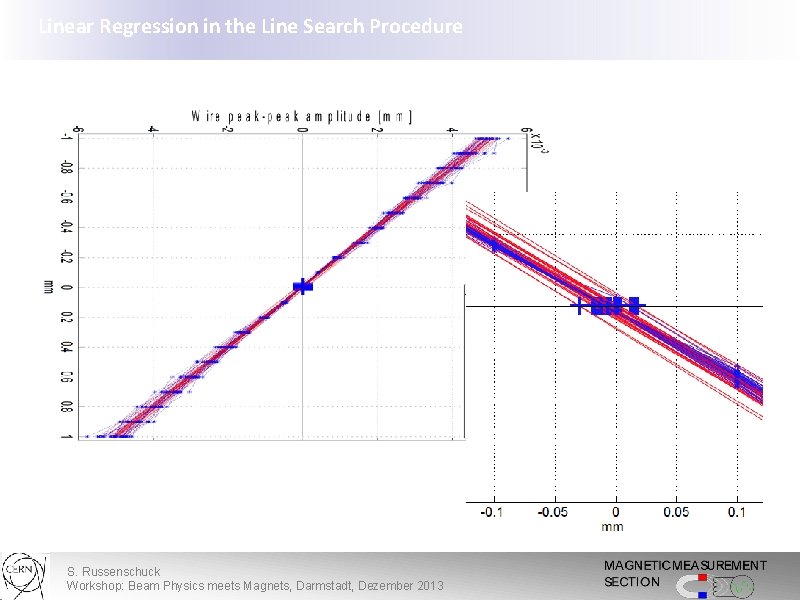
Linear Regression in the Line Search Procedure S. Russenschuck Workshop: Beam Physics meets Magnets, Darmstadt, Dezember 2013
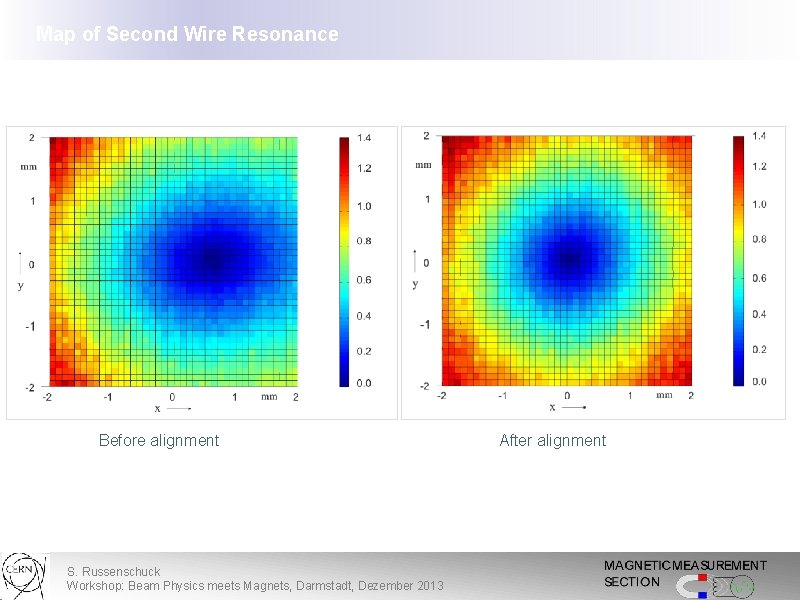
Map of Second Wire Resonance Solenoid magnet Vibrating wire for magnetic axis Before alignment S. Russenschuck Workshop: Beam Physics meets Magnets, Darmstadt, Dezember 2013 After alignment
Map of Second Wire Resonance (on 2 mm radius) Vibrating wire for magnetic axis S. Russenschuck Workshop: Beam Physics meets Magnets, Darmstadt, Dezember 2013 Solenoid magnet
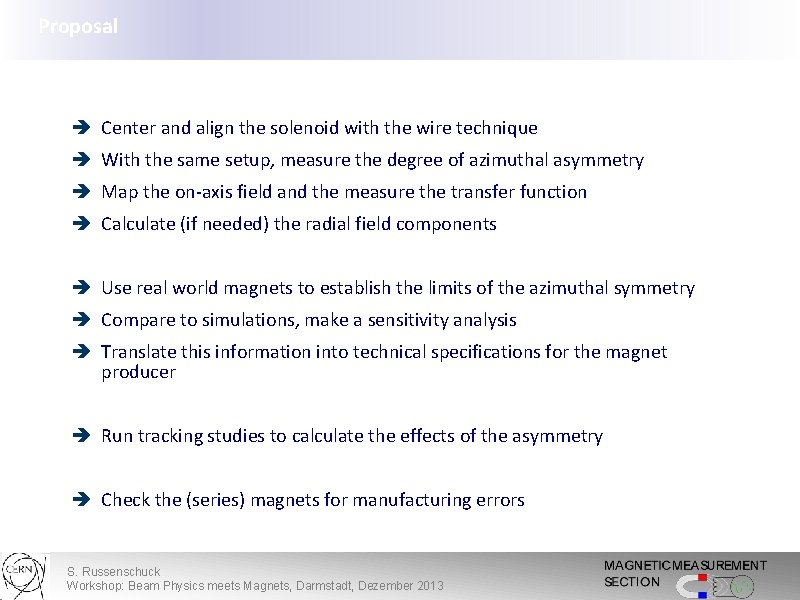
Proposal è Center and align the solenoid with the wire technique è With the same setup, measure the degree of azimuthal asymmetry è Map the on-axis field and the measure the transfer function è Calculate (if needed) the radial field components è Use real world magnets to establish the limits of the azimuthal symmetry è Compare to simulations, make a sensitivity analysis è Translate this information into technical specifications for the magnet producer è Run tracking studies to calculate the effects of the asymmetry è Check the (series) magnets for manufacturing errors S. Russenschuck Workshop: Beam Physics meets Magnets, Darmstadt, Dezember 2013

Multipole Measurements with the Oscillating-Wire Method Proposition: We are done if: S. Russenschuck Workshop: Beam Physics meets Magnets, Darmstadt, Dezember 2013
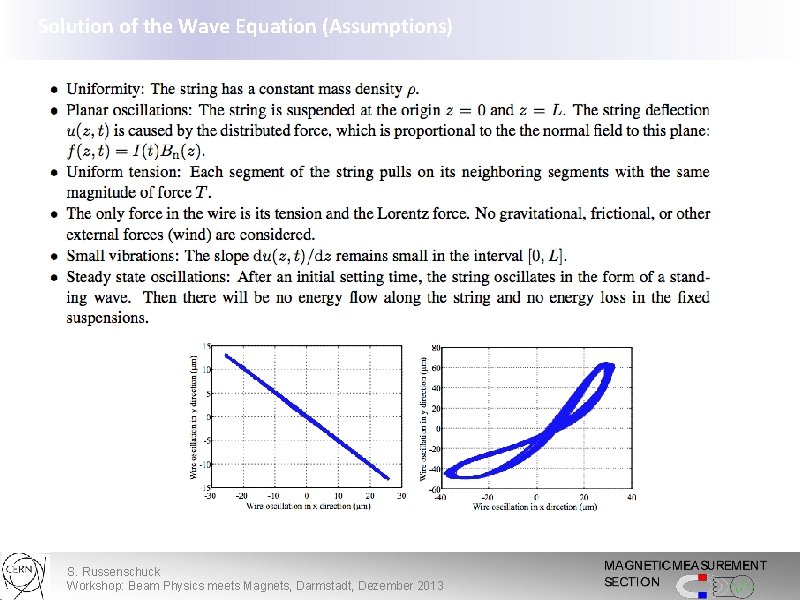
Solution of the Wave Equation (Assumptions) S. Russenschuck Workshop: Beam Physics meets Magnets, Darmstadt, Dezember 2013
Check: Numerical simulation (FDTD) and the Steady State Solution S. Russenschuck Workshop: Beam Physics meets Magnets, Darmstadt, Dezember 2013
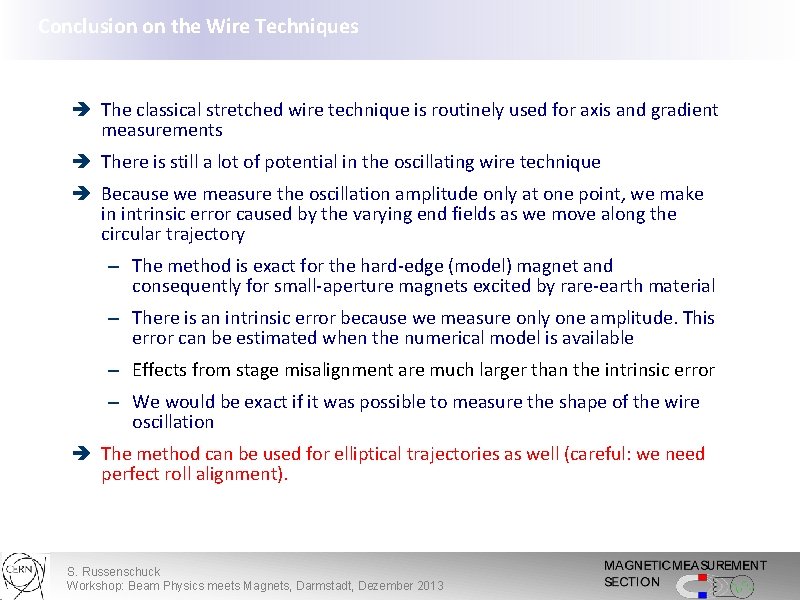
Conclusion on the Wire Techniques è The classical stretched wire technique is routinely used for axis and gradient measurements è There is still a lot of potential in the oscillating wire technique è Because we measure the oscillation amplitude only at one point, we make in intrinsic error caused by the varying end fields as we move along the circular trajectory – The method is exact for the hard-edge (model) magnet and consequently for small-aperture magnets excited by rare-earth material – There is an intrinsic error because we measure only one amplitude. This error can be estimated when the numerical model is available – Effects from stage misalignment are much larger than the intrinsic error – We would be exact if it was possible to measure the shape of the wire oscillation è The method can be used for elliptical trajectories as well (careful: we need perfect roll alignment). S. Russenschuck Workshop: Beam Physics meets Magnets, Darmstadt, Dezember 2013
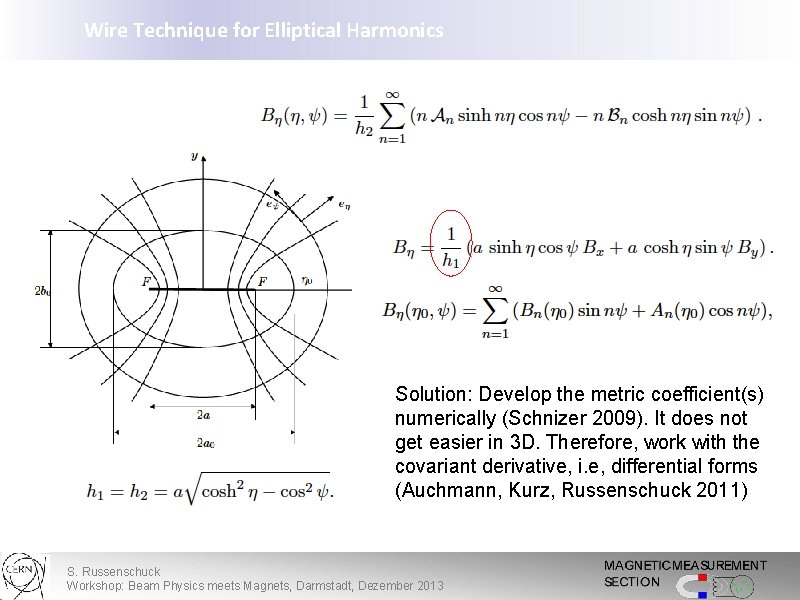
Wire Technique for Elliptical Harmonics Solution: Develop the metric coefficient(s) numerically (Schnizer 2009). It does not get easier in 3 D. Therefore, work with the covariant derivative, i. e, differential forms (Auchmann, Kurz, Russenschuck 2011) S. Russenschuck Workshop: Beam Physics meets Magnets, Darmstadt, Dezember 2013
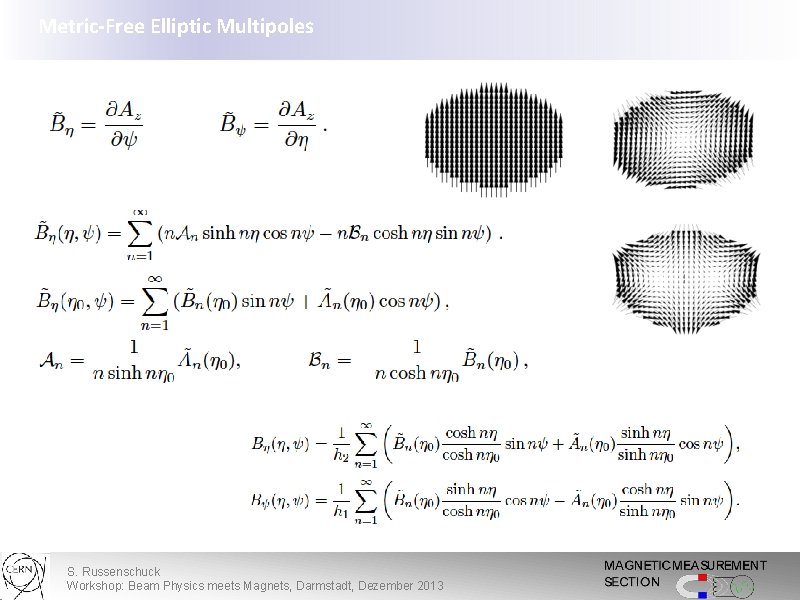
Metric-Free Elliptic Multipoles S. Russenschuck Workshop: Beam Physics meets Magnets, Darmstadt, Dezember 2013
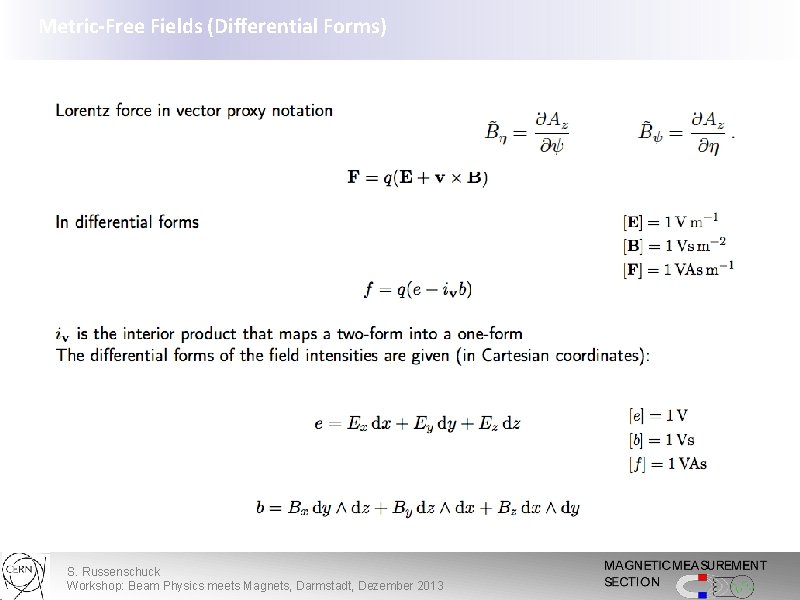
Metric-Free Fields (Differential Forms) S. Russenschuck Workshop: Beam Physics meets Magnets, Darmstadt, Dezember 2013
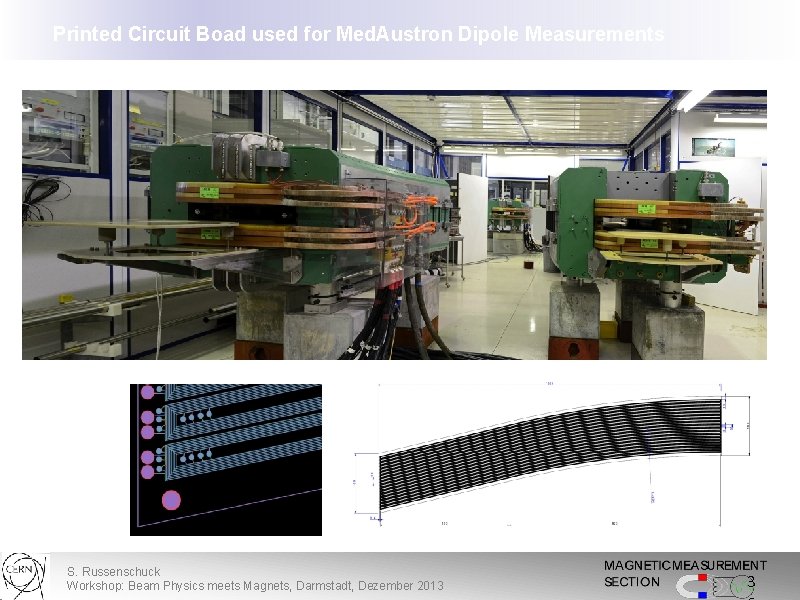
Printed Circuit Boad used for Med. Austron Dipole Measurements S. Russenschuck Workshop: Beam Physics meets Magnets, Darmstadt, Dezember 2013 3
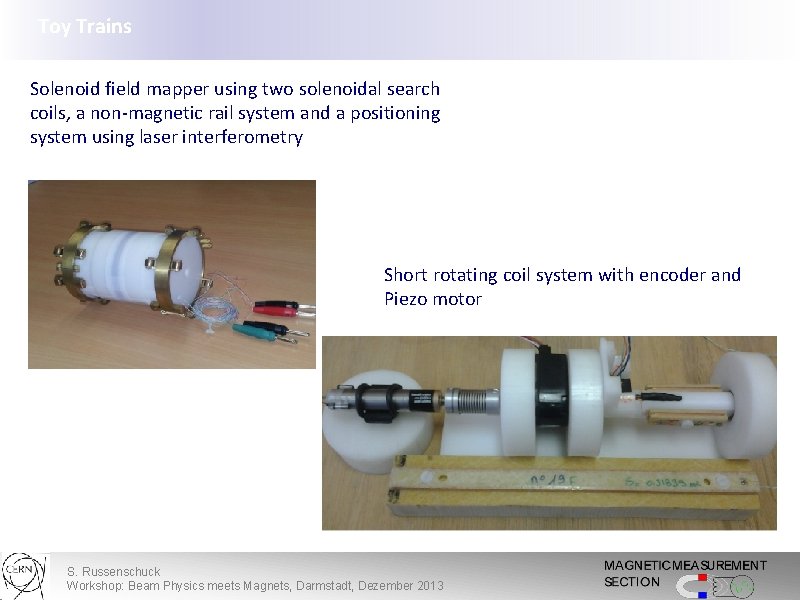
Toy Trains Solenoid field mapper using two solenoidal search coils, a non-magnetic rail system and a positioning system using laser interferometry Short rotating coil system with encoder and Piezo motor S. Russenschuck Workshop: Beam Physics meets Magnets, Darmstadt, Dezember 2013

Bipolar Coordinates (Legendre Functions) S. Russenschuck Workshop: Beam Physics meets Magnets, Darmstadt, Dezember 2013
Some Open Questions è Machine requirements: What are the requirements for magnets in beam transfer lines, linacs, light sources, storage rings? How to define the “good field zone”? Fast and slow ramping machines. Field error budget. What is possible with field tuning, magnet shimming, corrector schemes, alignment. è Interfaces: What are the” system variables” in beam tracking, field computation and mag. measurements? Vector-potentials, flux density, field maps, integrands, multipoles, Taylor maps, kicks? Which assumptions are made on the field distribution in the magnets? è Magnet manufacture: What defines the magnet requirements? How does the field requirements translate into mechanical tolerances for the magnets (perturbation theory, RMS versus normal distribution). Functional specifications, build to print, acceptance criteria, magnet-to-magnet reproducibility? How many magnets from a series must be measured. è Magnetic measurements: Do we really need field maps of solenoids? How to characterize curved magnets; coherence of the definition of edge focusing, magnetic length. Are integrated quantities sufficient? What is the accuracy and precision of the methods? What are the measurements good for? Measurements on materials, measurements to validate numerical simulations, measurements of models and prototypes. Measurements of series magnets. What can (cannot) be achieved with online monitoring and beam-based measurements? S. Russenschuck Workshop: Beam Physics meets Magnets, Darmstadt, Dezember 2013
- Slides: 39