
Establishing Benchmarks for the Fourth Industrial Fluid Properties
Establishing Benchmarks for the Fourth Industrial Fluid Properties Simulation Challenge James D. Olson The Dow Chemical Company November 8, 2007 11/8/2007 4 th Challenge IFPSC 1
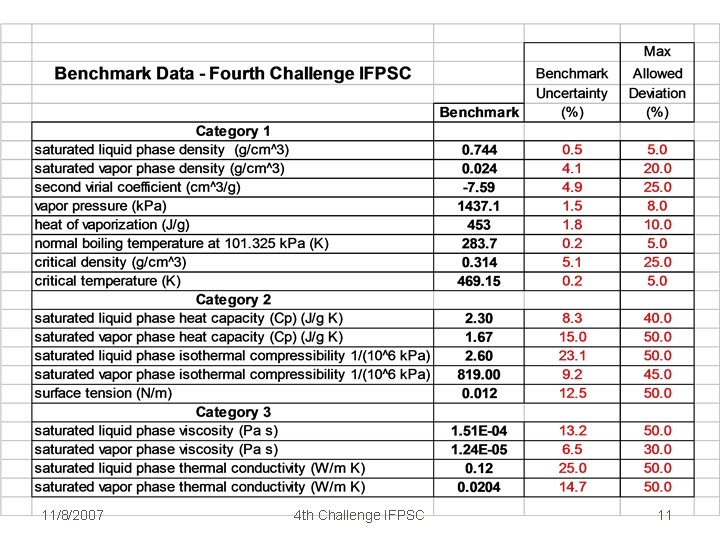
Overview z The Fourth Challenge · Three Categories of Benchmarks z Benchmark Data Sources · Literature and estimations from DIPPR and PPDS z The 17 Benchmarks and Uncertainties · Second virial coefficient Benchmark value was revised 11/8/2007 4 th Challenge IFPSC 2
Acknowledgements – Data Reviewed by: z. Dan Friend – NIST z. Rob Chirico – NIST (TRC) z. Marcia Huber - NIST 11/8/2007 4 th Challenge IFPSC 3

Industrial Fluid Properties Simulation Challenge z Industrial use of molecular simulation: · Qualitative use vs quantitative chemical use: x. Qualitative - explore structure and mechanisms at the molecular level, pico-sec time scale; e. g. , to study formation and structure of surfactant micelles. x. Quantitative - produce process design data for state conditions not (easily) accessible to lab measurements. 11/8/2007 4 th Challenge IFPSC 4
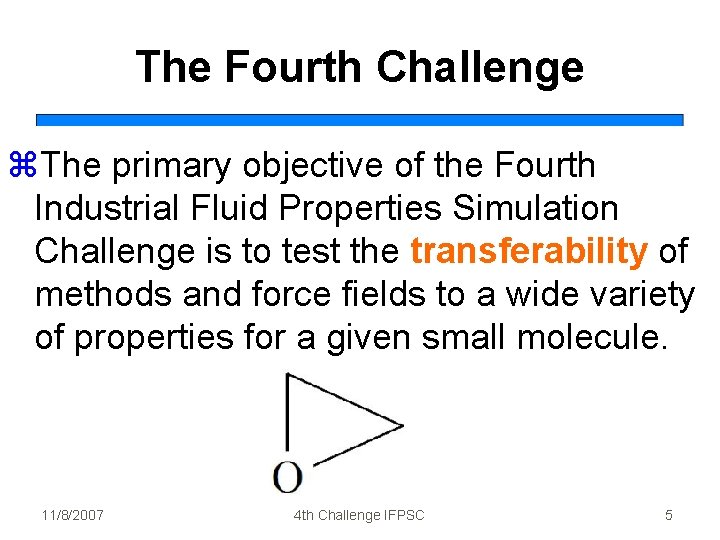
The Fourth Challenge z. The primary objective of the Fourth Industrial Fluid Properties Simulation Challenge is to test the transferability of methods and force fields to a wide variety of properties for a given small molecule. 11/8/2007 4 th Challenge IFPSC 5
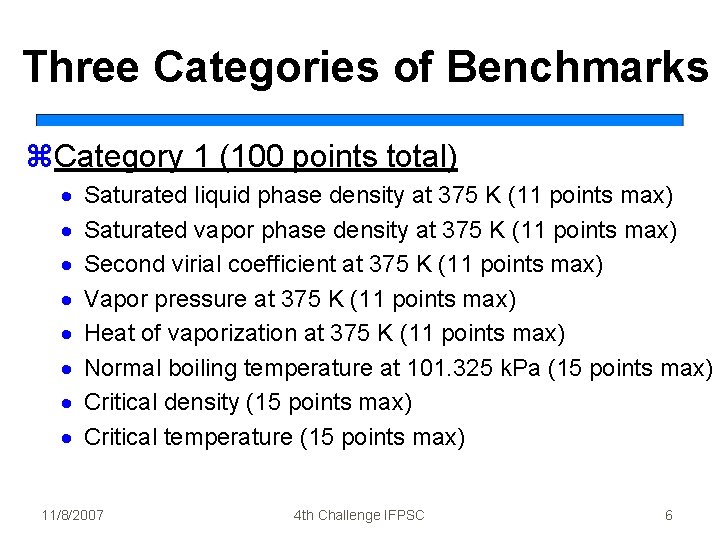
Three Categories of Benchmarks z. Category 1 (100 points total) · · · · Saturated liquid phase density at 375 K (11 points max) Saturated vapor phase density at 375 K (11 points max) Second virial coefficient at 375 K (11 points max) Vapor pressure at 375 K (11 points max) Heat of vaporization at 375 K (11 points max) Normal boiling temperature at 101. 325 k. Pa (15 points max) Critical density (15 points max) Critical temperature (15 points max) 11/8/2007 4 th Challenge IFPSC 6
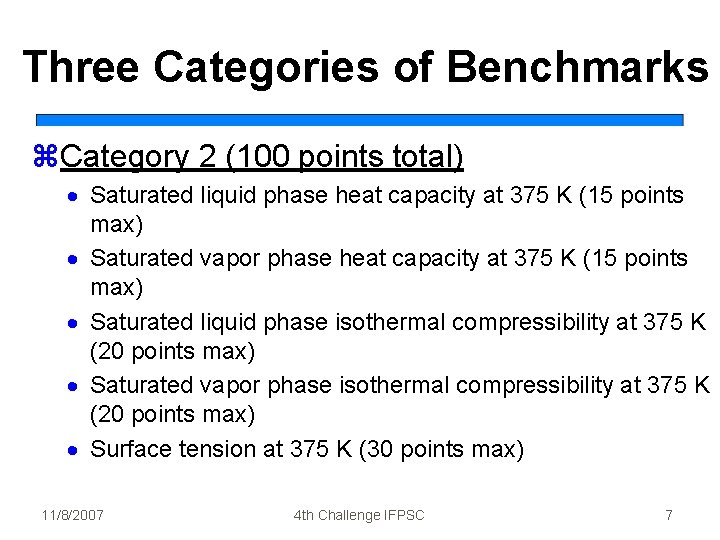
Three Categories of Benchmarks z. Category 2 (100 points total) · Saturated liquid phase heat capacity at 375 K (15 points max) · Saturated vapor phase heat capacity at 375 K (15 points max) · Saturated liquid phase isothermal compressibility at 375 K (20 points max) · Saturated vapor phase isothermal compressibility at 375 K (20 points max) · Surface tension at 375 K (30 points max) 11/8/2007 4 th Challenge IFPSC 7
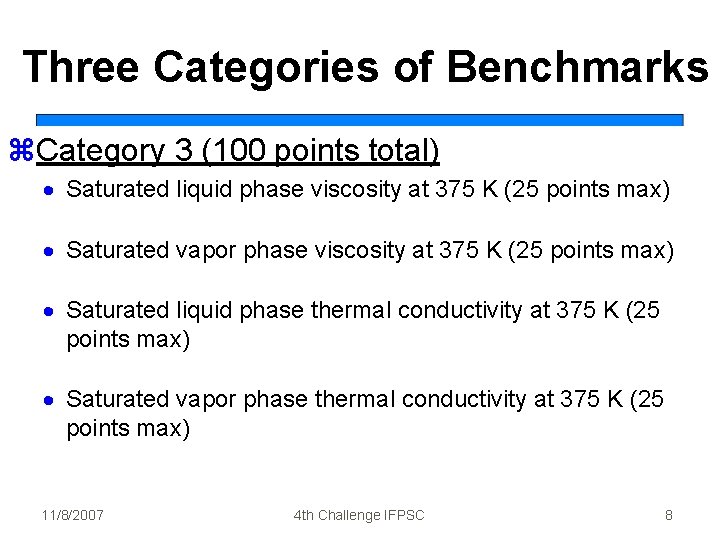
Three Categories of Benchmarks z. Category 3 (100 points total) · Saturated liquid phase viscosity at 375 K (25 points max) · Saturated vapor phase viscosity at 375 K (25 points max) · Saturated liquid phase thermal conductivity at 375 K (25 points max) · Saturated vapor phase thermal conductivity at 375 K (25 points max) 11/8/2007 4 th Challenge IFPSC 8
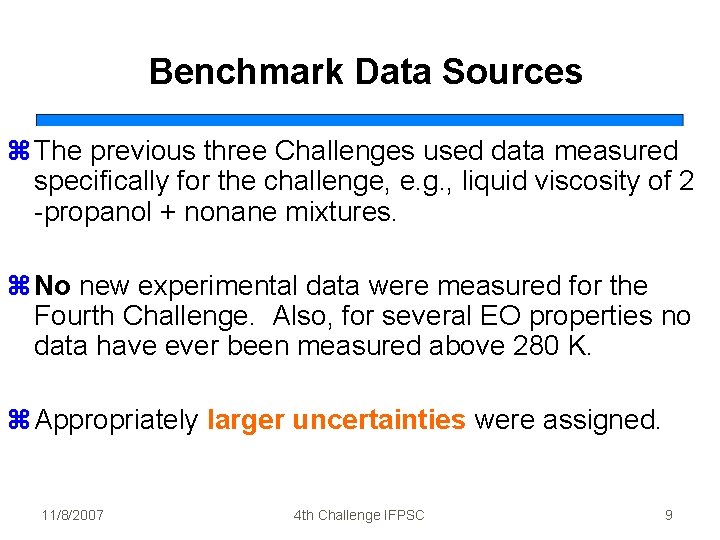
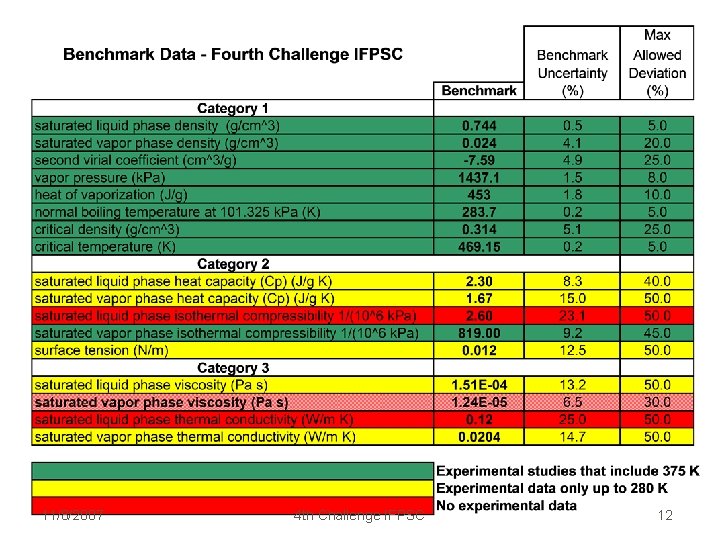
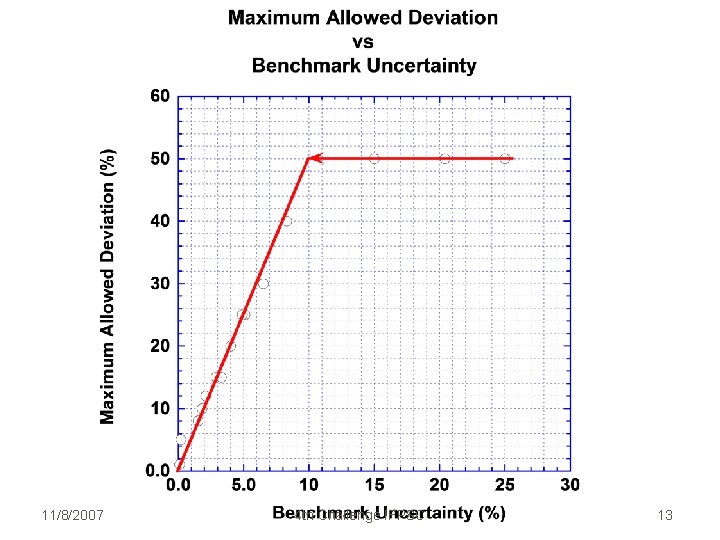
Benchmark Data Sources z The previous three Challenges used data measured specifically for the challenge, e. g. , liquid viscosity of 2 -propanol + nonane mixtures. z No new experimental data were measured for the Fourth Challenge. Also, for several EO properties no data have ever been measured above 280 K. z Appropriately larger uncertainties were assigned. 11/8/2007 4 th Challenge IFPSC 9
Benchmark Data Source Strategy z Three data sources were used (similar strategy to that used in an industrial process design): · Data published in peer-reviewed scientific literature. · Data from AICHE DIPPR Database – correlations fitted to experimental data where available or estimation methods. · Data from Physical Properties Data Service (PPDS) – associated with UK NPL 11/8/2007 4 th Challenge IFPSC 10
11/8/2007 4 th Challenge IFPSC 11
11/8/2007 4 th Challenge IFPSC 12
11/8/2007 4 th Challenge IFPSC 13
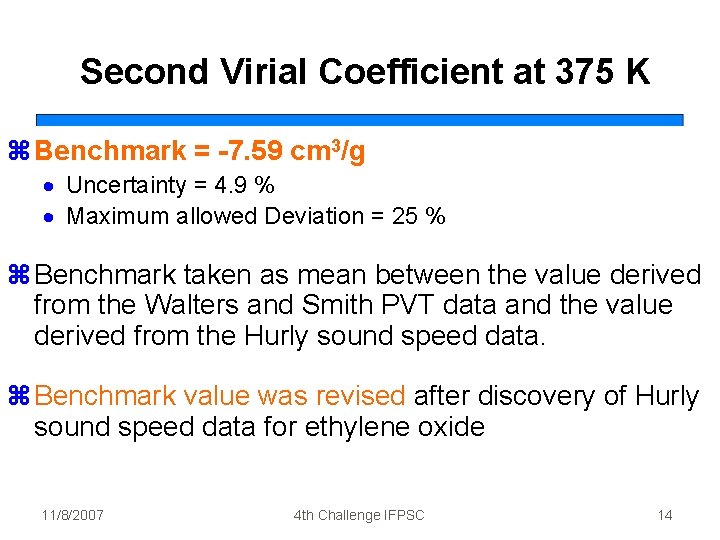
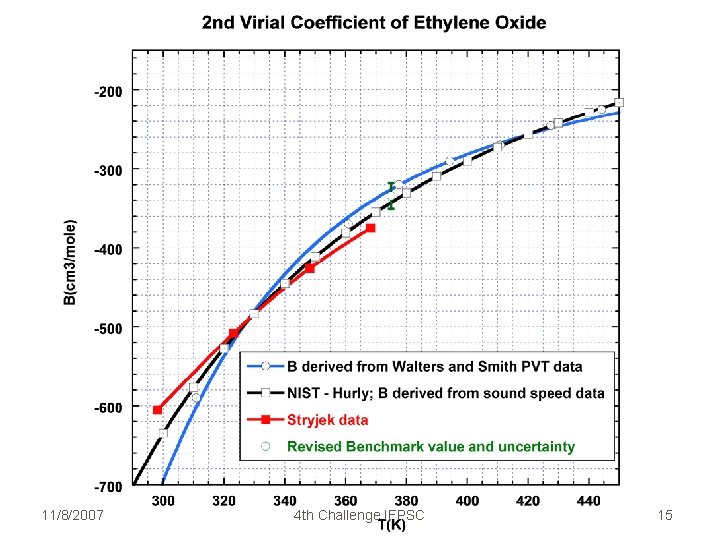
Second Virial Coefficient at 375 K z Benchmark = -7. 59 cm 3/g · Uncertainty = 4. 9 % · Maximum allowed Deviation = 25 % z Benchmark taken as mean between the value derived from the Walters and Smith PVT data and the value derived from the Hurly sound speed data. z Benchmark value was revised after discovery of Hurly sound speed data for ethylene oxide 11/8/2007 4 th Challenge IFPSC 14
11/8/2007 4 th Challenge IFPSC 15
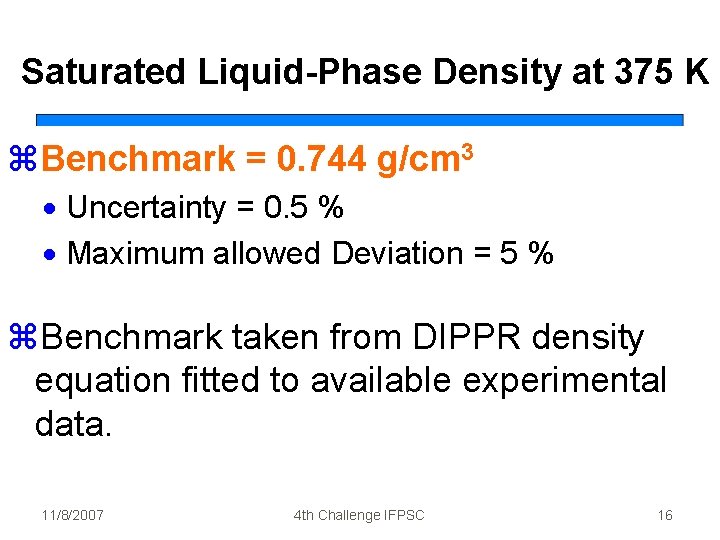
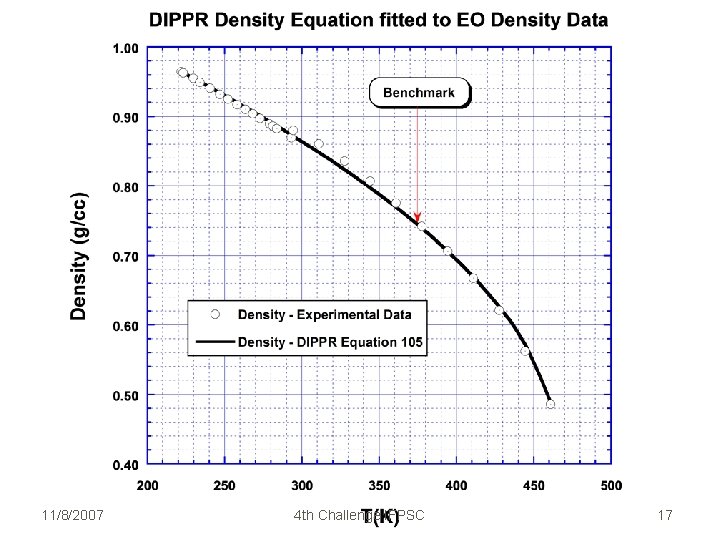
Saturated Liquid-Phase Density at 375 K z. Benchmark = 0. 744 g/cm 3 · Uncertainty = 0. 5 % · Maximum allowed Deviation = 5 % z. Benchmark taken from DIPPR density equation fitted to available experimental data. 11/8/2007 4 th Challenge IFPSC 16
11/8/2007 4 th Challenge IFPSC 17
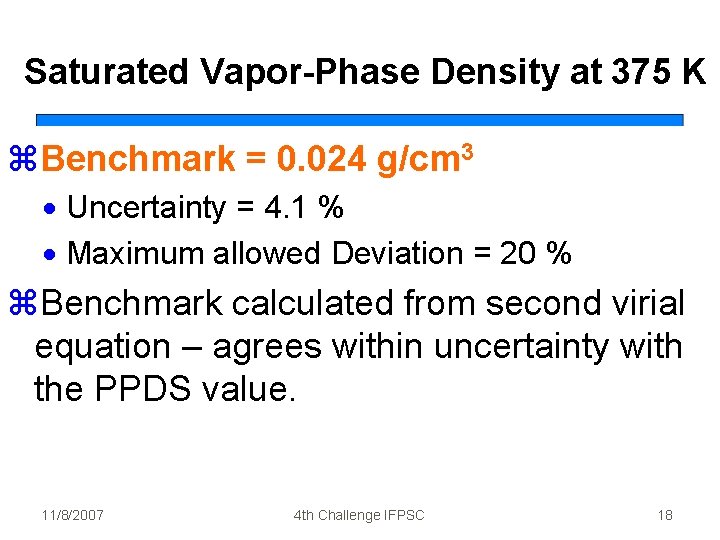
Saturated Vapor-Phase Density at 375 K z. Benchmark = 0. 024 g/cm 3 · Uncertainty = 4. 1 % · Maximum allowed Deviation = 20 % z. Benchmark calculated from second virial equation – agrees within uncertainty with the PPDS value. 11/8/2007 4 th Challenge IFPSC 18
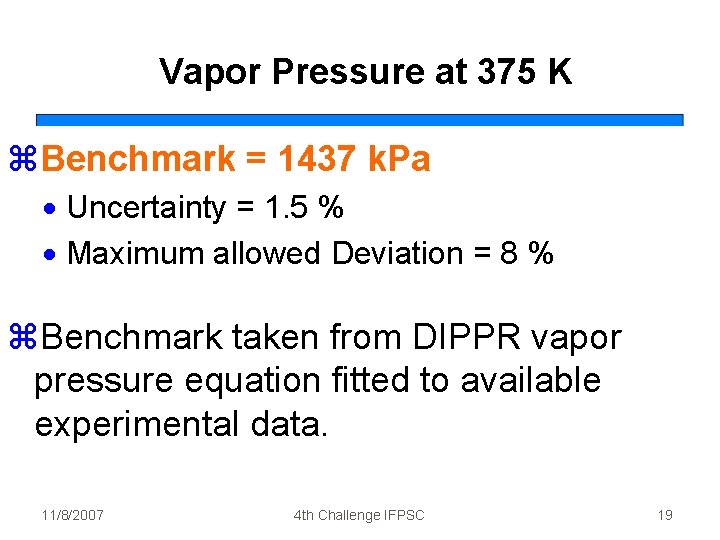
Vapor Pressure at 375 K z. Benchmark = 1437 k. Pa · Uncertainty = 1. 5 % · Maximum allowed Deviation = 8 % z. Benchmark taken from DIPPR vapor pressure equation fitted to available experimental data. 11/8/2007 4 th Challenge IFPSC 19
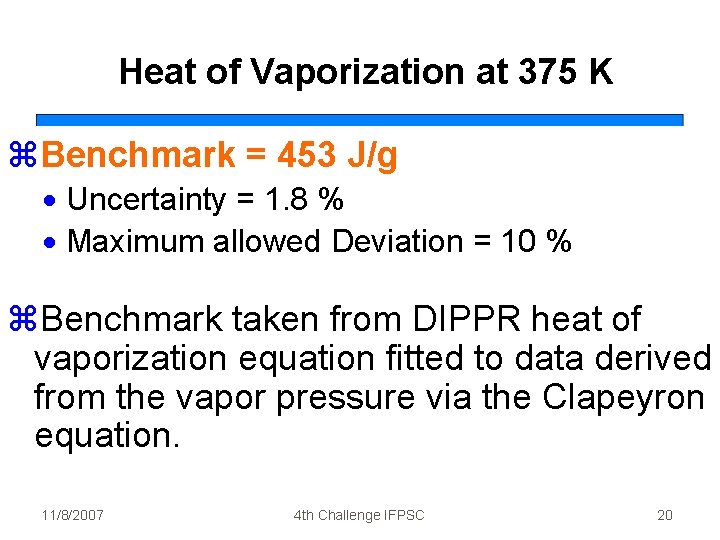
Heat of Vaporization at 375 K z. Benchmark = 453 J/g · Uncertainty = 1. 8 % · Maximum allowed Deviation = 10 % z. Benchmark taken from DIPPR heat of vaporization equation fitted to data derived from the vapor pressure via the Clapeyron equation. 11/8/2007 4 th Challenge IFPSC 20
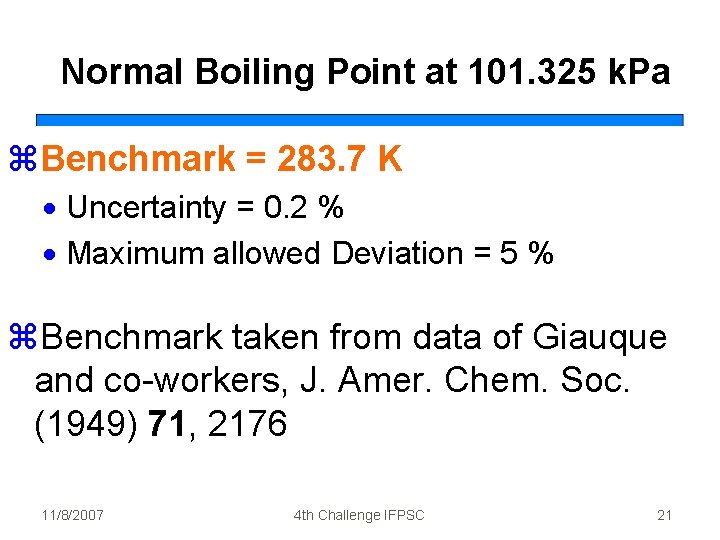
Normal Boiling Point at 101. 325 k. Pa z. Benchmark = 283. 7 K · Uncertainty = 0. 2 % · Maximum allowed Deviation = 5 % z. Benchmark taken from data of Giauque and co-workers, J. Amer. Chem. Soc. (1949) 71, 2176 11/8/2007 4 th Challenge IFPSC 21
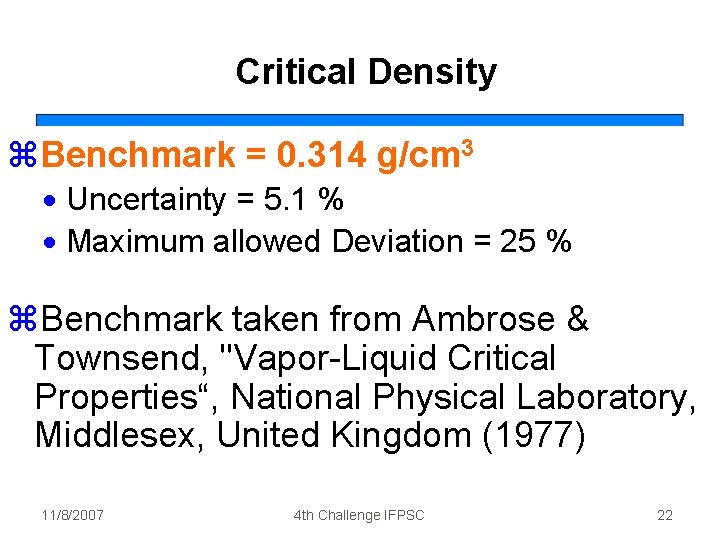
Critical Density z. Benchmark = 0. 314 g/cm 3 · Uncertainty = 5. 1 % · Maximum allowed Deviation = 25 % z. Benchmark taken from Ambrose & Townsend, "Vapor-Liquid Critical Properties“, National Physical Laboratory, Middlesex, United Kingdom (1977) 11/8/2007 4 th Challenge IFPSC 22
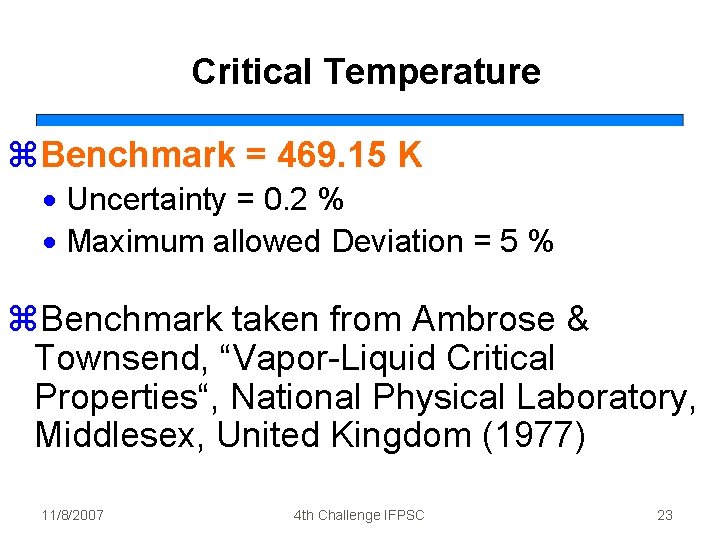
Critical Temperature z. Benchmark = 469. 15 K · Uncertainty = 0. 2 % · Maximum allowed Deviation = 5 % z. Benchmark taken from Ambrose & Townsend, “Vapor-Liquid Critical Properties“, National Physical Laboratory, Middlesex, United Kingdom (1977) 11/8/2007 4 th Challenge IFPSC 23
![Saturated Liquid Heat Capacity at 375 K z. Benchmark = 2. 30 J/[g-K] ·](http://slidetodoc.com/presentation_image/04cbc2d56d6590c1e74eb1f40e72f8d6/image-24.jpg "Saturated Liquid Heat Capacity at 375 K z. Benchmark = 2. 30 J/[g-K] ·")
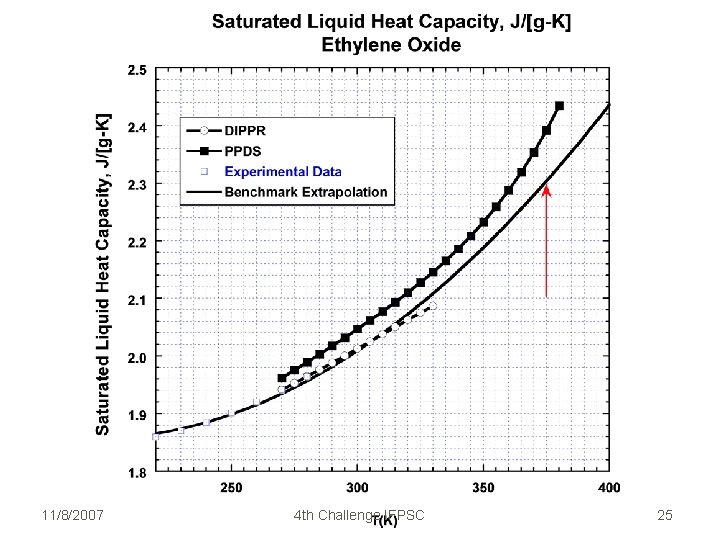
Saturated Liquid Heat Capacity at 375 K z. Benchmark = 2. 30 J/[g-K] · Uncertainty = 8. 3 % · Maximum allowed Deviation = 40 % z. Benchmark taken from an extrapolation of the measured data of Giauque and coworkers compared to PPDS and DIPPR 11/8/2007 4 th Challenge IFPSC 24
11/8/2007 4 th Challenge IFPSC 25
![Saturated Vapor Heat Capacity at 375 K z. Benchmark = 1. 67 J/[g-K] ·](http://slidetodoc.com/presentation_image/04cbc2d56d6590c1e74eb1f40e72f8d6/image-26.jpg "Saturated Vapor Heat Capacity at 375 K z. Benchmark = 1. 67 J/[g-K] ·")
Saturated Vapor Heat Capacity at 375 K z. Benchmark = 1. 67 J/[g-K] · Uncertainty = 15 % · Maximum allowed Deviation = 50 % z. Benchmark taken from PPDS real gas correction to ideal gas heat capacity. 11/8/2007 4 th Challenge IFPSC 26
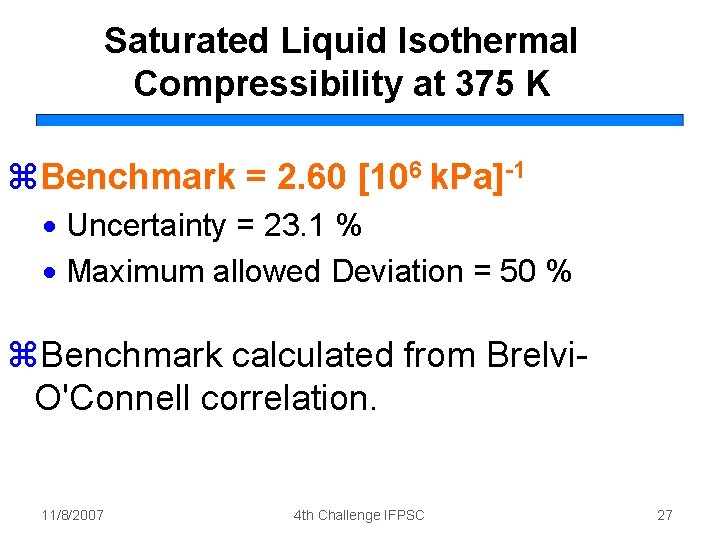
Saturated Liquid Isothermal Compressibility at 375 K z. Benchmark = 2. 60 [106 k. Pa]-1 · Uncertainty = 23. 1 % · Maximum allowed Deviation = 50 % z. Benchmark calculated from Brelvi. O'Connell correlation. 11/8/2007 4 th Challenge IFPSC 27
![Saturated Vapor Isothermal Compressibility at 375 K z. Benchmark = 819 [106 k. Pa]-1](http://slidetodoc.com/presentation_image/04cbc2d56d6590c1e74eb1f40e72f8d6/image-28.jpg "Saturated Vapor Isothermal Compressibility at 375 K z. Benchmark = 819 [106 k. Pa]-1")
Saturated Vapor Isothermal Compressibility at 375 K z. Benchmark = 819 [106 k. Pa]-1 · Uncertainty = 9. 2 % · Maximum allowed Deviation = 45 % z. Benchmark calculated from second virial equation. 11/8/2007 4 th Challenge IFPSC 28
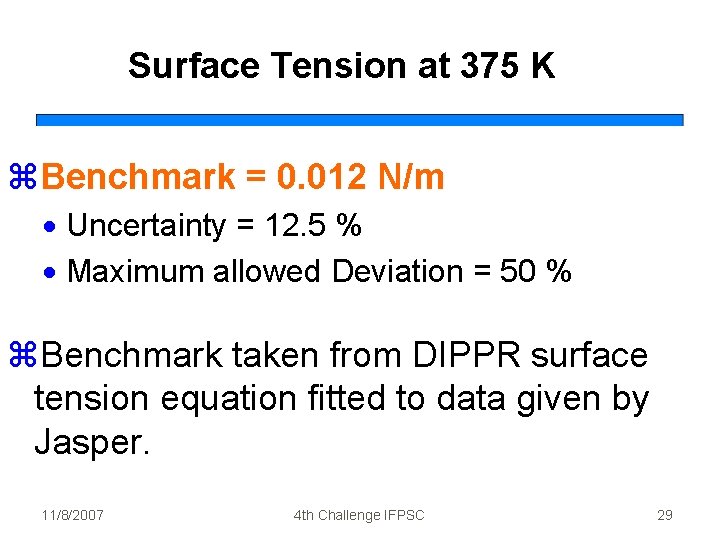
Surface Tension at 375 K z. Benchmark = 0. 012 N/m · Uncertainty = 12. 5 % · Maximum allowed Deviation = 50 % z. Benchmark taken from DIPPR surface tension equation fitted to data given by Jasper. 11/8/2007 4 th Challenge IFPSC 29
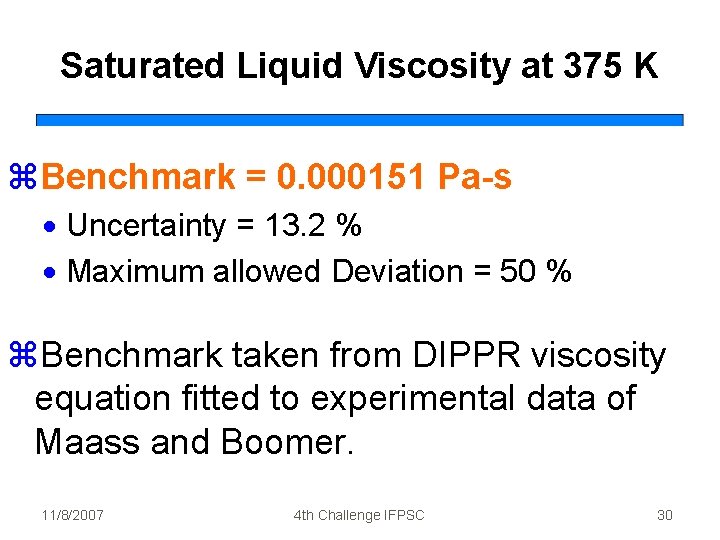
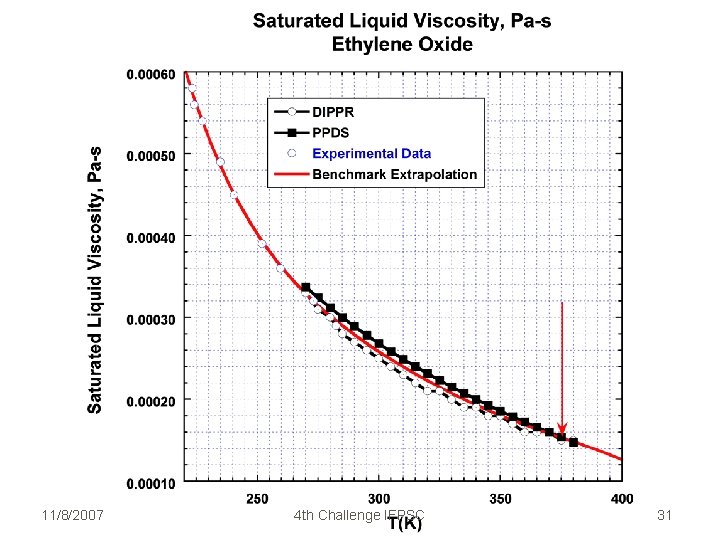
Saturated Liquid Viscosity at 375 K z. Benchmark = 0. 000151 Pa-s · Uncertainty = 13. 2 % · Maximum allowed Deviation = 50 % z. Benchmark taken from DIPPR viscosity equation fitted to experimental data of Maass and Boomer. 11/8/2007 4 th Challenge IFPSC 30
11/8/2007 4 th Challenge IFPSC 31
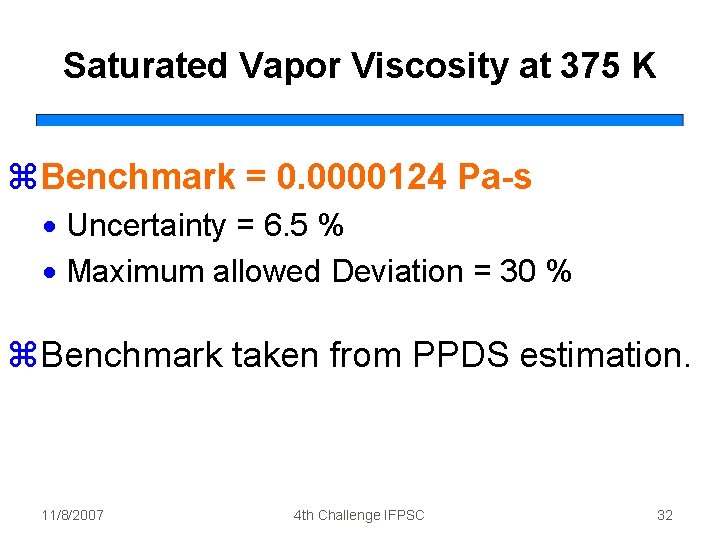
Saturated Vapor Viscosity at 375 K z. Benchmark = 0. 0000124 Pa-s · Uncertainty = 6. 5 % · Maximum allowed Deviation = 30 % z. Benchmark taken from PPDS estimation. 11/8/2007 4 th Challenge IFPSC 32
![Saturated Liquid Thermal Conductivity at 375 K z. Benchmark = 0. 12 W/[m-K] ·](http://slidetodoc.com/presentation_image/04cbc2d56d6590c1e74eb1f40e72f8d6/image-33.jpg "Saturated Liquid Thermal Conductivity at 375 K z. Benchmark = 0. 12 W/[m-K] ·")
Saturated Liquid Thermal Conductivity at 375 K z. Benchmark = 0. 12 W/[m-K] · Uncertainty = 25 % · Maximum allowed Deviation = 50 % z. Benchmark taken from DIPPR thermal conductivity equation fitted to data estimated by Missenard method (there are no experimental data at any temperature). 11/8/2007 4 th Challenge IFPSC 33
![Saturated Vapor Thermal Conductivity at 375 K z. Benchmark = 0. 0204 W/[m-K] ·](http://slidetodoc.com/presentation_image/04cbc2d56d6590c1e74eb1f40e72f8d6/image-34.jpg "Saturated Vapor Thermal Conductivity at 375 K z. Benchmark = 0. 0204 W/[m-K] ·")
Saturated Vapor Thermal Conductivity at 375 K z. Benchmark = 0. 0204 W/[m-K] · Uncertainty = 14. 7 % · Maximum allowed Deviation = 50 % z. Benchmark taken from DIPPR thermal conductivity equation fitted to data measured by Senftleben. 11/8/2007 4 th Challenge IFPSC 34
- Slides: 34