
ESTABLISHING A DIGITAL AUDIT TRAIL Presented by SAI
ESTABLISHING A DIGITAL AUDIT TRAIL Presented by: SAI Pakistan 1
Sequence of Presentation 1. Introduction 2. Audit Evidence and Audit Trails 3. Establishing a digital audit Trail 4. Challenges faced in developing a digital trail 5. Opportunities presented by a digital trail 6. Laws for digital transactions in Pakistan 7. SAI Pakistan’s initiatives 2
1. Introduction ■ In an IT environment relying on paper trail to review and give assurance on transactions and events has become increasingly difficult for public sector auditors. ■ A digital audit trail linking all activities of a transaction irrefutably needs to be established by the auditor to be able to build reasonable assurance on the operations of the auditee. 3
2. Audit evidence & Audit trails ■ ISSAI 100 describes public sector auditing as a systematic process of objectively obtaining and evaluating evidence to determine whether actual conditions conform to established criteria. ■ The ISSAI further goes on to highlight the importance of audit evidence by stating that, public sector auditing contributes good governance by providing intended users with, conclusions or opinions based on sufficient and appropriate evidence relating to public entities. 4
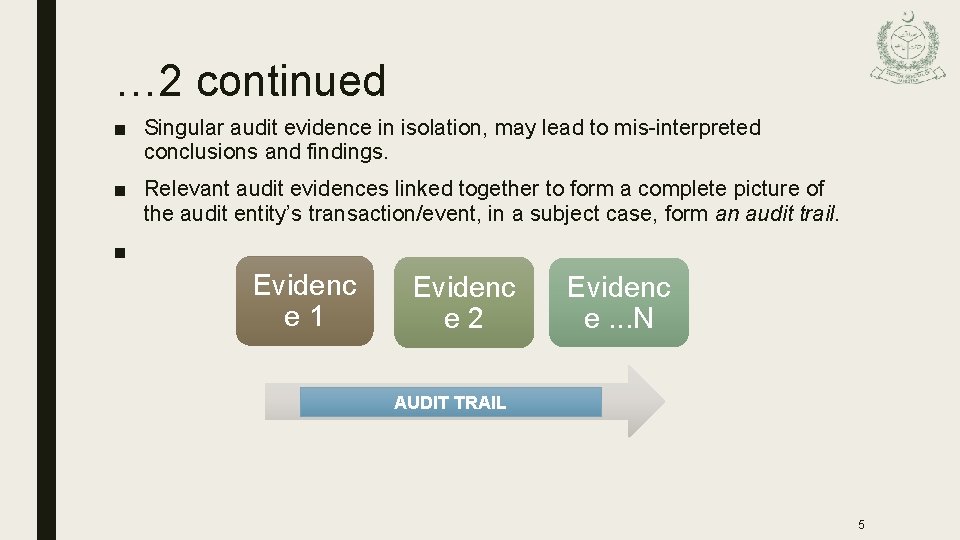
… 2 continued ■ Singular audit evidence in isolation, may lead to mis-interpreted conclusions and findings. ■ Relevant audit evidences linked together to form a complete picture of the audit entity’s transaction/event, in a subject case, form an audit trail. ■ Evidenc e 1 Evidenc e 2 Evidenc e. . . N AUDIT TRAIL 5
… 2 Continued ■ For example the audit trail for a typical procurement transaction, may comprise of audit evidences relating to: – – – – Need for the procurement Funding for the procurement Approval for the procurement Transparency and open competition in tendering Application of taxes Authentication of vendor Reconciliation of cash disbursement 6
3. Establishing a digital audit trail ■ A digital audit trail represents a set of digitalized (soft) irrefutable evidences linked in a logical manner to show a complete event or transaction related to an auditee organization. ■ A digital audit trail comprises of at least the following two steps: 1. Understanding the IT Environment of the auditee business: It is imperative to have a sound understanding of the IT processes of the entity. Who is authorized to do what ? What steps are involved in the completion of a particular event ? What are the business critical IT applications and how are they managed? 7
… 3 Continued ■ Example : A public owned gas distribution company uses an IT based Inventory system. The auditor needs to know: ■ The basic features of the inventory system application. ■ The transaction by which new store items are added in the warehouse. ■ The aging and depreciation of the stored items. ■ The inventory-labeling methodology. ■ The transaction by which store items are disbursed. ■ The user management roles for the inventory management system. ■ The monthly /year-end stock closing and evaluation processes. 8
…. 3 continued 2. Collecting the IT evidences: The second step is to collect IT evidence in such a way that it is irrefutable subsequently. 9
3. 1 Classification of digital audit trails ■ Digital trail of Financial Transactions: Digital evidence that answer questions such as, what payment was made, when it was made, how it was made etc? Same scenarios exist for liabilities and accruals. Banking transactions, online transfers, third party disbursements etc. fall under this category. ■ Digital trail of Non-financial processes: Digital evidence relating to the business specific details of an entity. For example for a HMIS (Hospital Management Information System), the patient information, medicine inventory system etc. 10
4. Challenges faced in developing a digital trail ■ Complexity of digital transactions: Digital processes have enabled organizations to perform a whole new range of business activities that was not plausible in a manual transaction environment. Hence digital transactions are diverse and complex. ■ Assessing data consistency: In many cases the public sector auditor gets flooded with lots of digital data. The auditor first has to select a dataset to review. Next step is to ensure that the selected data-set has reliable and accurate information. Hence the internal controls for recording, updating and retaining the subject digital information have to be assessed. 11
… 4 Continued ■ Translating digital evidence in to an audit report: On one hand audit reports are meant to be presented to legislative forums in easy to comprehend manner with complete clarity. On the other hand error and anomalies found in a digital audit trail are technical in nature. 12
5. Opportunities presented by a digital trail ■ Comprehensive view of the auditee operations: – Paper trail had the inherent disadvantage that only pieces of information could be analyzed separately and then linkages made. With a digital trail a complete view of all events relating to a transaction can be analyzed. – Example: a digital trail of a pension case, would include: – i) the trigger for initiating pension processing of an employee, – ii) reconciliation of final emoluments and any liabilities of the retiring employee, – iii) approval of pension disbursement by concerned authority, – iv) generation of pension payment instrument and lastly – v) bank reconciliation document generation. 13
… 5 continued ■ Cross-sectional analysis: Using modern IT auditing tools complex data analysis can now be formed on multiple sets of digitalized information. This can greatly facilitate performance audits and forensic studies. ■ Real-time auditing: By establishing audit check-marks/flags within the applications being used by the auditee organization real-time auditing can be implemented. 14
6. Laws for Digital Transactions in Pakistan ■ Electronic Transactions Ordinance 2002 ■ It was enacted to recognize and facilitate documents, records, information, communications and transactions in electronic form, and to provide for the accreditation of certification service providers. ■ It described the procedure for retention of electronic record. ■ Electronic signatures were defined. 15
… 6 continued ■ An Electronic Certification Accreditation Council was established under this ordinance – Some of the main responsibilities of this council included: – to grant and renew accreditation certificates to certification service providers, their cryptography services and security procedure. – To monitor and ensure compliance by accredited certification providers with their terms of accreditation – To revoke or suspend accreditation in case of violations – To recognize or accredit foreign certification service providers 16
… 6 continued ■ Payment Systems and Electronic Fund Transfers Act of 2007: ■ It was promulgated in 2007 to supervise and regulate Payment Systems and Electronic Fund Transfers in Pakistan and ■ to provide standards for protection of the consumer ■ and to determine respective rights and liabilities of the financial institutions and other Service Providers, their consumers and participants. 17
7. SAI Pakistan’s initiatives ■ SAI Pakistan takes advantage of using digitalized audit trail where ever the same is plausible considering the state of IT implementation in auditee organizations. ■ All civil government departments have their Financial and HR information maintained in SAP ERP system. Hence audit team start preparing the digital audit trail at the desk audit stage by accessing SAP record. ■ Findings based on digital audit trails are made during annual compliance audit exercises by field audit offices. ■ Subject specific Data Sufficiency Analysis reports and Information Systems audits are also routinely carried out by the SAI. 18
… 7 Continued ■ Capacity Building measures: – A dedicated Center for Information Systems and Auditing has established for IT Audit related training exercises. – CISA, CISM, ACL and CFE certifications trainings for the SAI auditors are being pursued. – Moreover diversified auditing topics are also being reviewed for future needs through workshops. Some important workshops held in this regard were on “Audit of Banks” and “Forensic Accounting” 19

THANKYOU 20
- Slides: 20