
Establishing a conceptual framework of postdisaster risk reduction
Establishing a conceptual framework of post-disaster risk reduction and relocation decision making Shaye Palagi 1, Dr. Ali Mostafavi 2, and Dr. Amy Javernick. Will 1 1 Department of Civil, Environmental, and Architectural Engineering, University of Colorado Boulder 2 Zachry Department of Civil Engineering, Texas A&M University
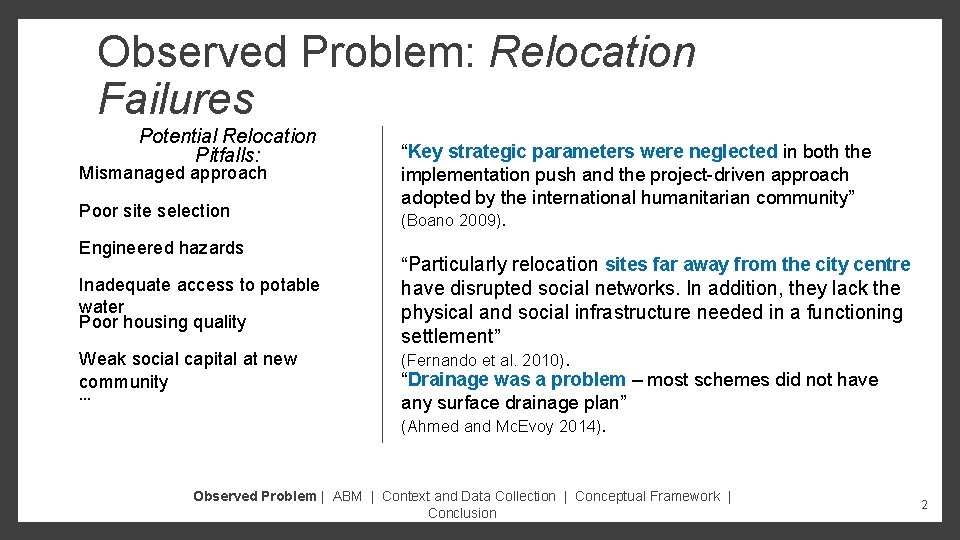
Observed Problem: Relocation Failures Potential Relocation Pitfalls: Mismanaged approach Poor site selection Engineered hazards Inadequate access to potable water Poor housing quality Weak social capital at new community … “Key strategic parameters were neglected in both the implementation push and the project-driven approach adopted by the international humanitarian community” (Boano 2009). “Particularly relocation sites far away from the city centre have disrupted social networks. In addition, they lack the physical and social infrastructure needed in a functioning settlement” (Fernando et al. 2010). “Drainage was a problem – most schemes did not have any surface drainage plan” (Ahmed and Mc. Evoy 2014). Observed Problem | ABM | Context and Data Collection | Conceptual Framework | Conclusion 2
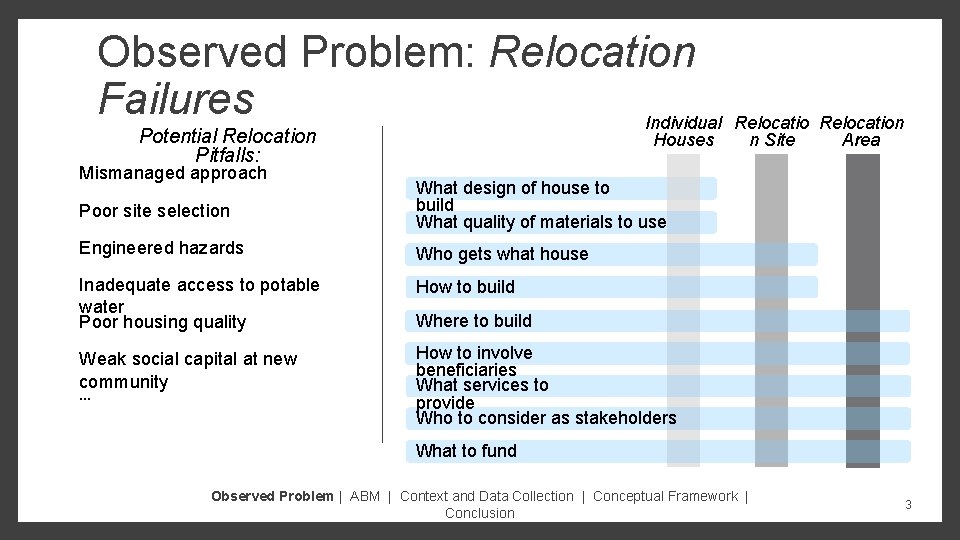
Observed Problem: Relocation Failures Individual Relocation Potential Relocation Pitfalls: Mismanaged approach Houses Poor site selection What design of house to build What quality of materials to use Engineered hazards Who gets what house Inadequate access to potable water Poor housing quality How to build Weak social capital at new community … How to involve beneficiaries What services to provide Who to consider as stakeholders n Site Area Where to build What to fund Observed Problem | ABM | Context and Data Collection | Conceptual Framework | Conclusion 3
Observed Problem: Relocation Failures 1 Relocation implementation is often severely flawed 2 Need to facilitate better relocation decision processes 3 First, we must improve knowledge of existing decision processes Observed Problem | ABM | Context and Data Collection | Conceptual Framework | Conclusion 4
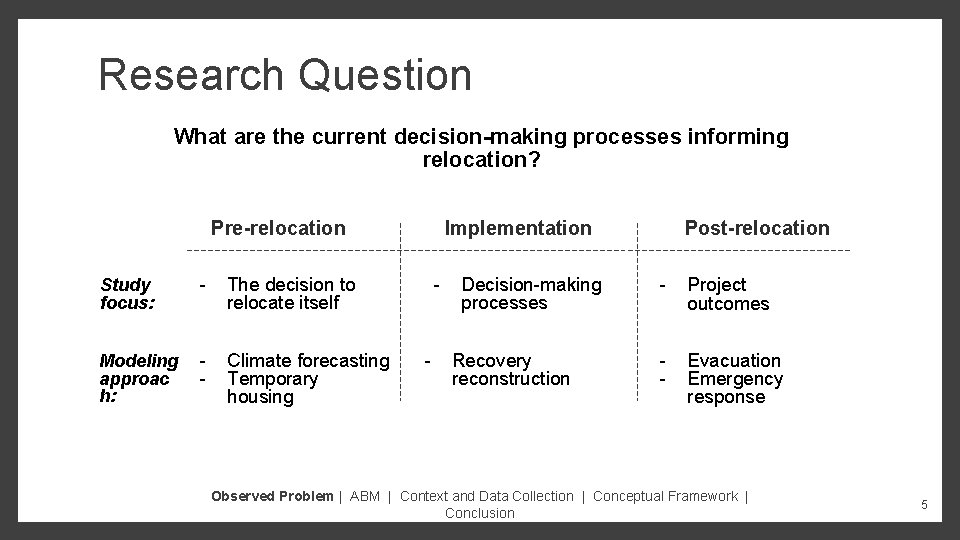
Research Question What are the current decision-making processes informing relocation? Pre-relocation Study focus: - The decision to relocate itself Modeling approac h: - Climate forecasting Temporary housing Implementation - - Decision-making processes Recovery reconstruction Post-relocation - Project outcomes - Evacuation Emergency response Observed Problem | ABM | Context and Data Collection | Conceptual Framework | Conclusion 5
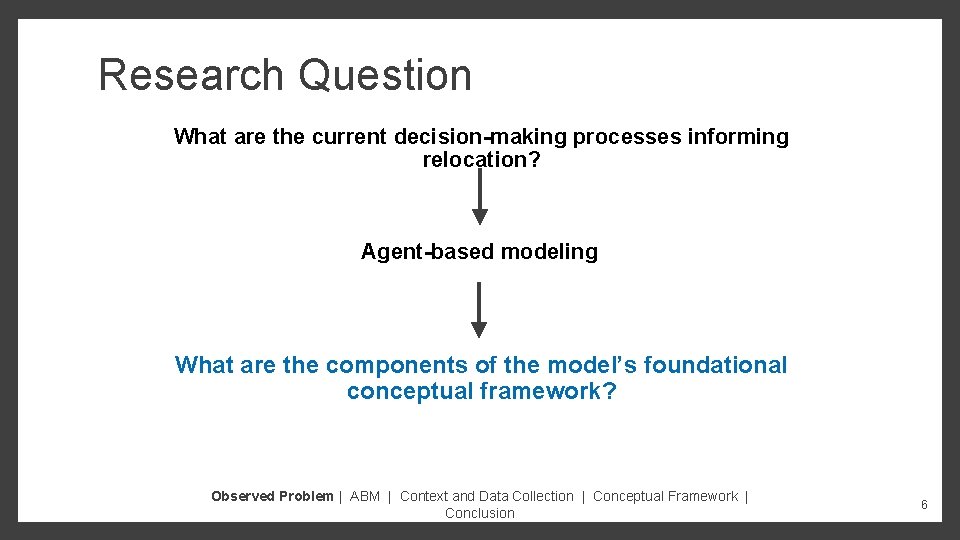
Research Question What are the current decision-making processes informing relocation? Agent-based modeling What are the components of the model’s foundational conceptual framework? Observed Problem | ABM | Context and Data Collection | Conceptual Framework | Conclusion 6
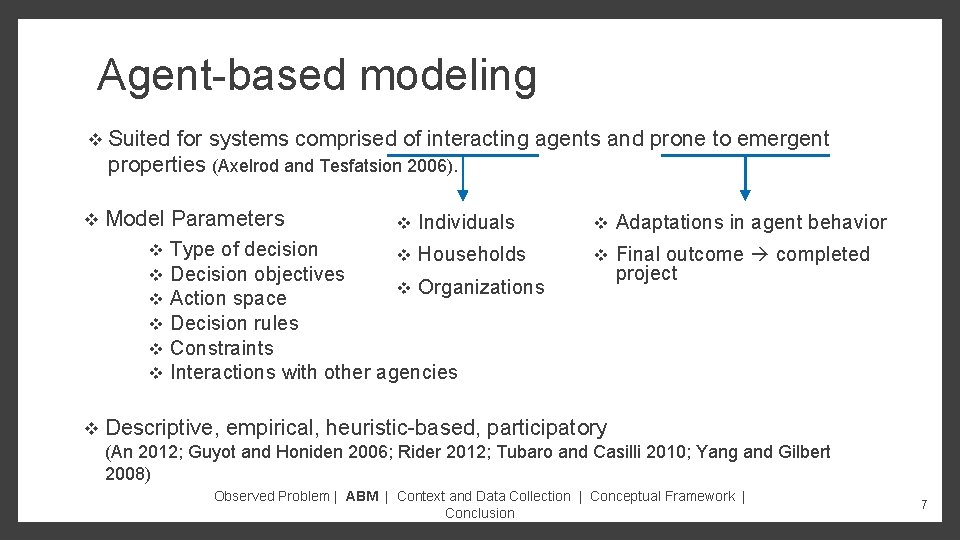
Agent-based modeling v Suited for systems comprised of interacting agents and prone to emergent properties (Axelrod and Tesfatsion 2006). v Model Parameters v v v v Individuals Type of decision v Households Decision objectives v Organizations Action space Decision rules Constraints Interactions with other agencies v Adaptations in agent behavior v Final outcome completed project Descriptive, empirical, heuristic-based, participatory (An 2012; Guyot and Honiden 2006; Rider 2012; Tubaro and Casilli 2010; Yang and Gilbert 2008) Observed Problem | ABM | Context and Data Collection | Conceptual Framework | Conclusion 7
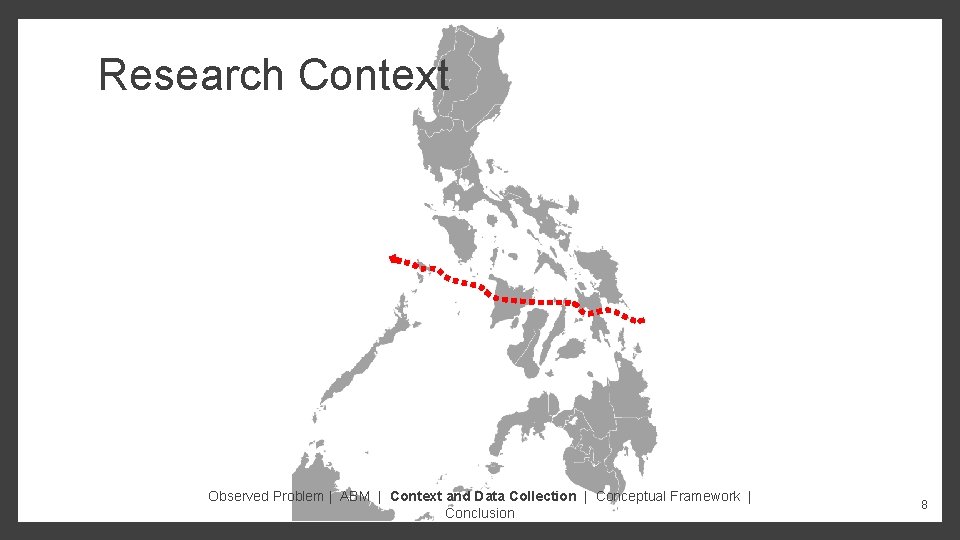
Research Context Observed Problem | ABM | Context and Data Collection | Conceptual Framework | Conclusion 8
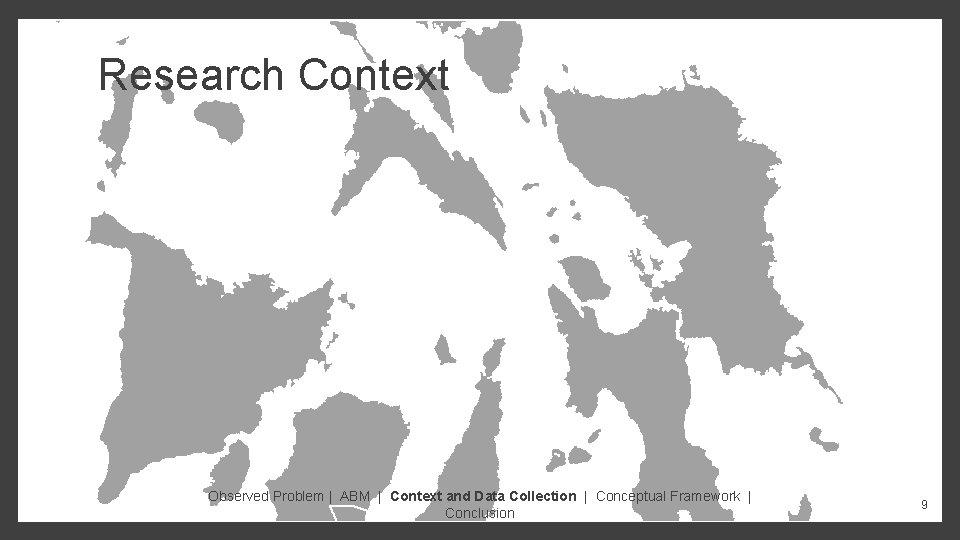
Research Context Observed Problem | ABM | Context and Data Collection | Conceptual Framework | Conclusion 9
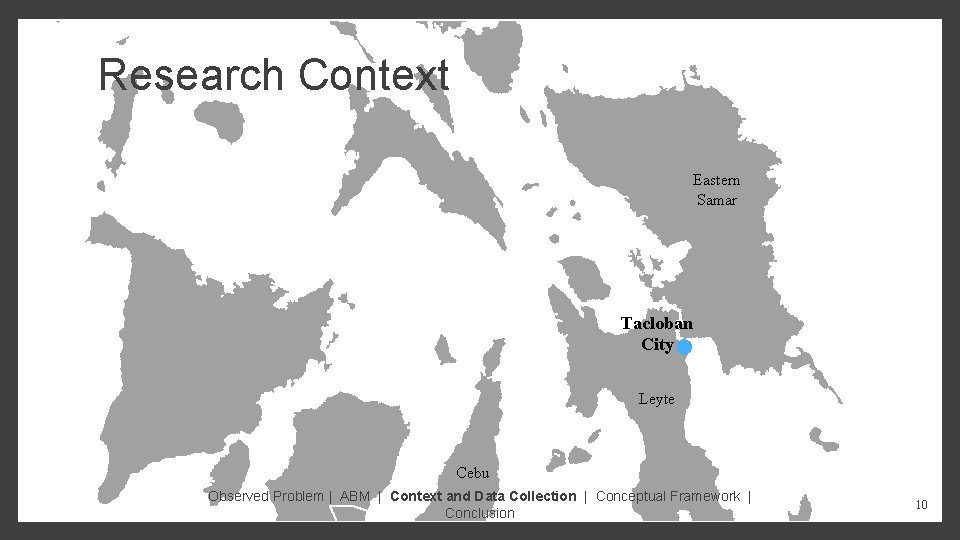
Research Context Eastern Samar Tacloban City Leyte Cebu Observed Problem | ABM | Context and Data Collection | Conceptual Framework | Conclusion 10
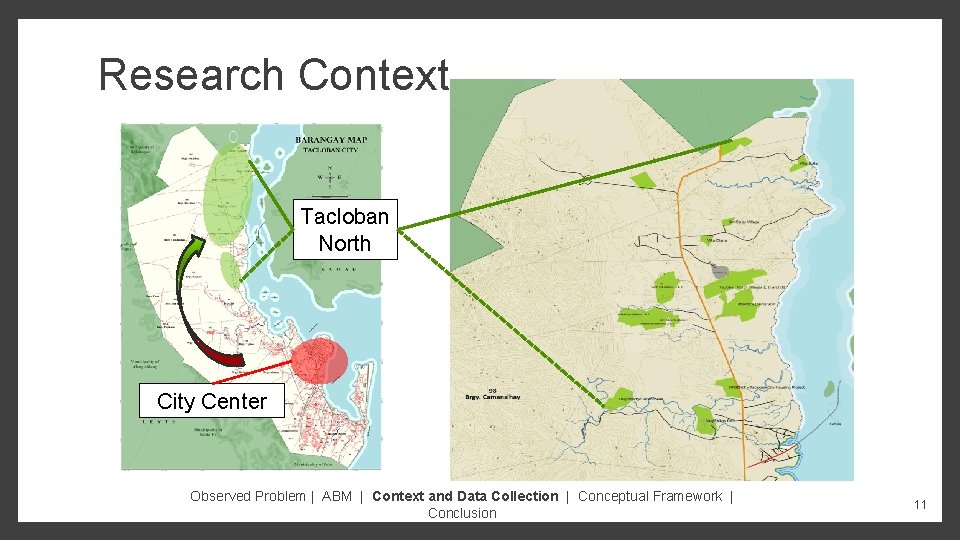
Research Context Tacloban North City Center Observed Problem | ABM | Context and Data Collection | Conceptual Framework | Conclusion 11
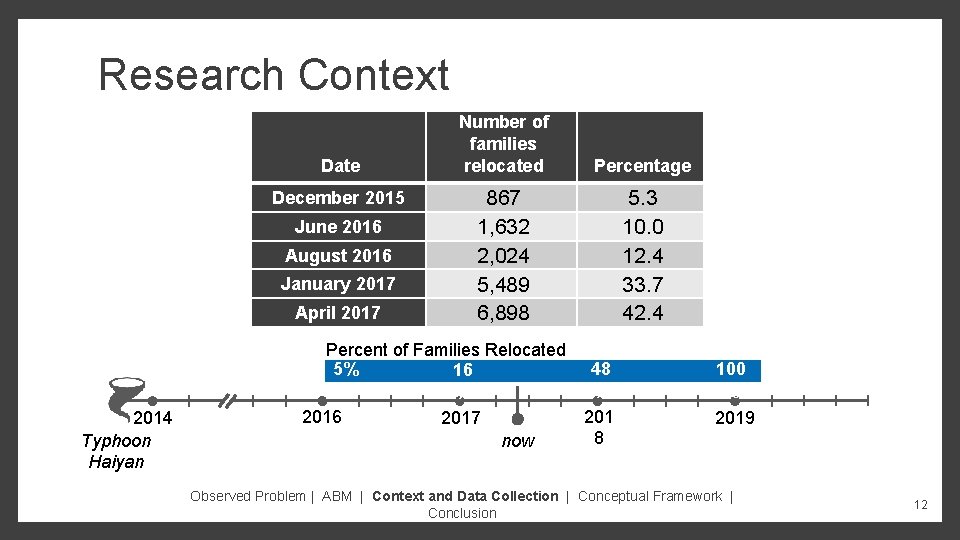
Research Context Date December 2015 June 2016 August 2016 January 2017 April 2017 2014 Typhoon Haiyan Number of families relocated Percentage 867 1, 632 2, 024 5, 489 6, 898 5. 3 10. 0 12. 4 33. 7 42. 4 Percent of Families Relocated 5% 48 16 % % 2016 2017 8 now 100 % 2019 Observed Problem | ABM | Context and Data Collection | Conceptual Framework | Conclusion 12
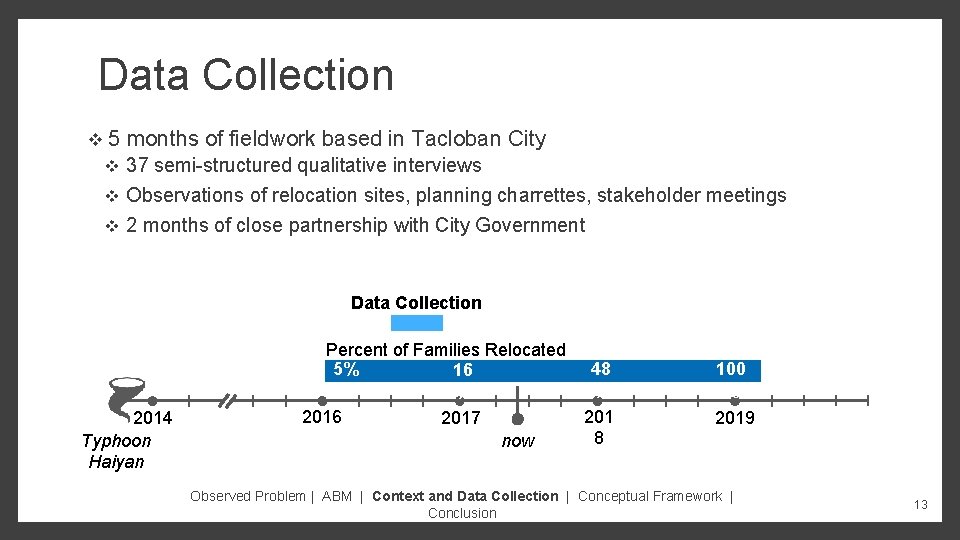
Data Collection v 5 months of fieldwork based in Tacloban City v 37 semi-structured qualitative interviews Observations of relocation sites, planning charrettes, stakeholder meetings v 2 months of close partnership with City Government v Data Collection 2014 Typhoon Haiyan Percent of Families Relocated 5% 48 16 % % 2016 2017 8 now 100 % 2019 Observed Problem | ABM | Context and Data Collection | Conceptual Framework | Conclusion 13
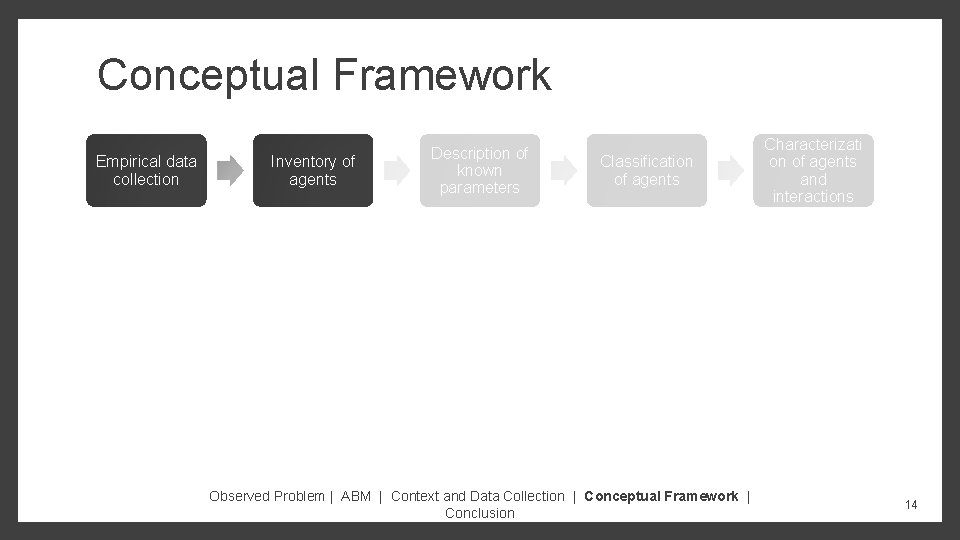
Conceptual Framework Empirical data collection Inventory of agents Description of known parameters Classification of agents Observed Problem | ABM | Context and Data Collection | Conceptual Framework | Conclusion Characterizati on of agents and interactions 14
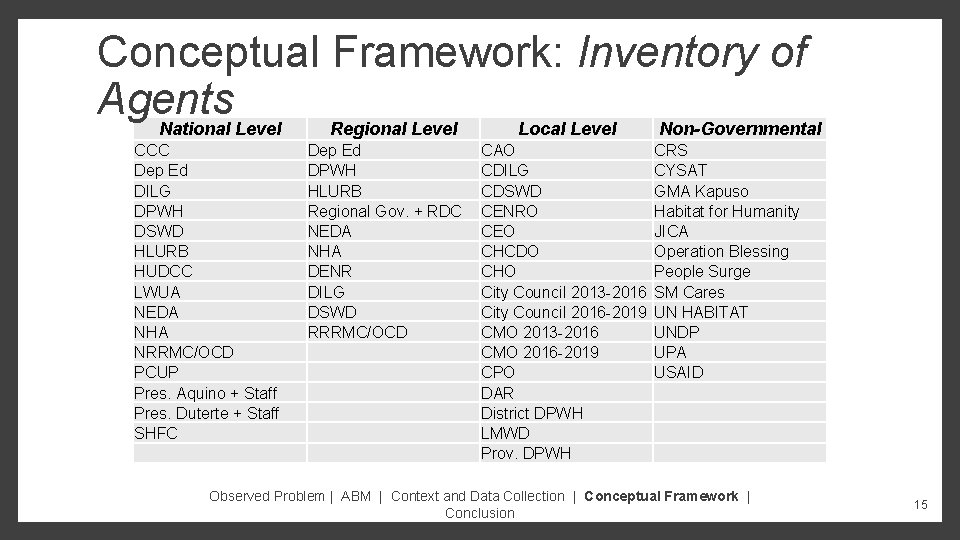
Conceptual Framework: Inventory of Agents National Level Regional Level Local Level Non-Governmental CCC Dep Ed DILG DPWH DSWD HLURB HUDCC LWUA NEDA NHA NRRMC/OCD PCUP Pres. Aquino + Staff Pres. Duterte + Staff SHFC Dep Ed DPWH HLURB Regional Gov. + RDC NEDA NHA DENR DILG DSWD RRRMC/OCD CAO CDILG CDSWD CENRO CEO CHCDO CHO City Council 2013 -2016 City Council 2016 -2019 CMO 2013 -2016 CMO 2016 -2019 CPO DAR District DPWH LMWD Prov. DPWH CRS CYSAT GMA Kapuso Habitat for Humanity JICA Operation Blessing People Surge SM Cares UN HABITAT UNDP UPA USAID Observed Problem | ABM | Context and Data Collection | Conceptual Framework | Conclusion 15
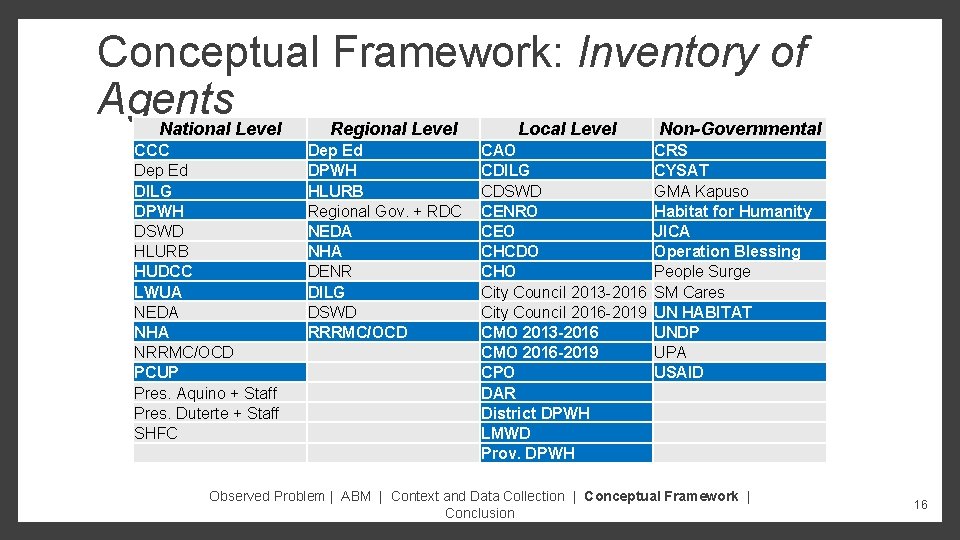
Conceptual Framework: Inventory of Agents National Level Regional Level Local Level Non-Governmental CCC Dep Ed DILG DPWH DSWD HLURB HUDCC LWUA NEDA NHA NRRMC/OCD PCUP Pres. Aquino + Staff Pres. Duterte + Staff SHFC Dep Ed DPWH HLURB Regional Gov. + RDC NEDA NHA DENR DILG DSWD RRRMC/OCD CAO CDILG CDSWD CENRO CEO CHCDO CHO City Council 2013 -2016 City Council 2016 -2019 CMO 2013 -2016 CMO 2016 -2019 CPO DAR District DPWH LMWD Prov. DPWH CRS CYSAT GMA Kapuso Habitat for Humanity JICA Operation Blessing People Surge SM Cares UN HABITAT UNDP UPA USAID Observed Problem | ABM | Context and Data Collection | Conceptual Framework | Conclusion 16
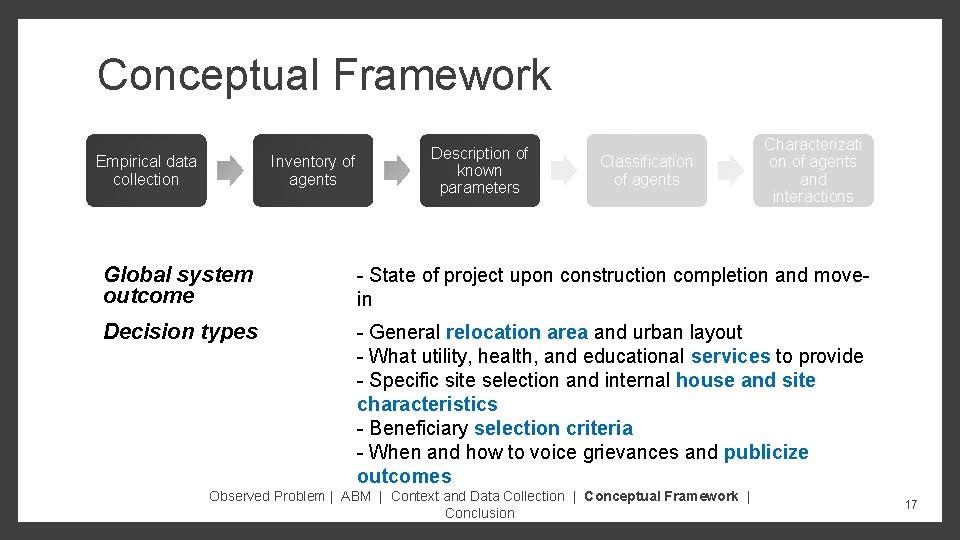
Conceptual Framework Empirical data collection Inventory of agents Description of known parameters Classification of agents Characterizati on of agents and interactions Global system outcome - State of project upon construction completion and movein Decision types - General relocation area and urban layout - What utility, health, and educational services to provide - Specific site selection and internal house and site characteristics - Beneficiary selection criteria - When and how to voice grievances and publicize outcomes Observed Problem | ABM | Context and Data Collection | Conceptual Framework | Conclusion 17
Conceptual Framework: Agent Classification Empirical data collection Inventory of agents Description of known parameters Classification of agents Observed Problem | ABM | Context and Data Collection | Conceptual Framework | Conclusion Characterizati on of agents and interactions 18
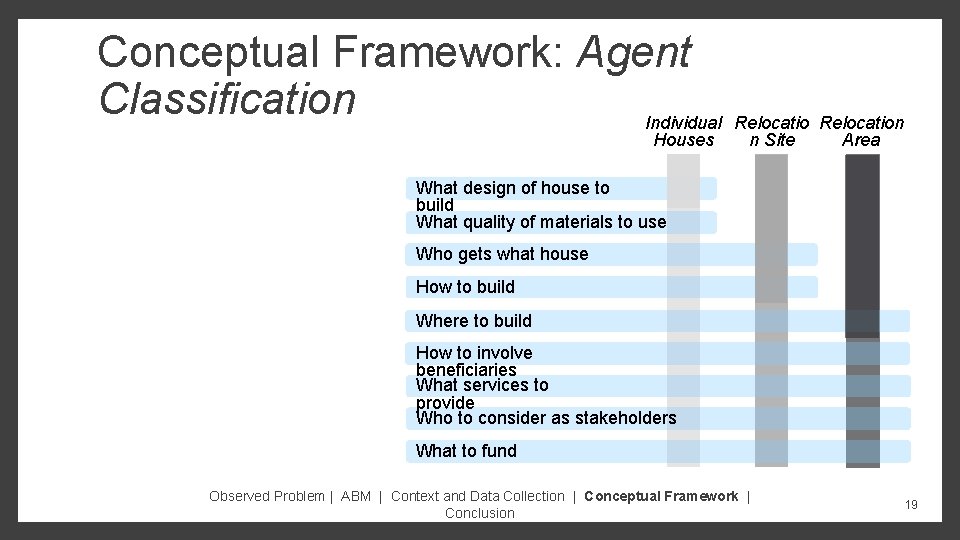
Conceptual Framework: Agent Classification Individual Relocation Houses n Site Area What design of house to build What quality of materials to use Who gets what house How to build Where to build How to involve beneficiaries What services to provide Who to consider as stakeholders What to fund Observed Problem | ABM | Context and Data Collection | Conceptual Framework | Conclusion 19
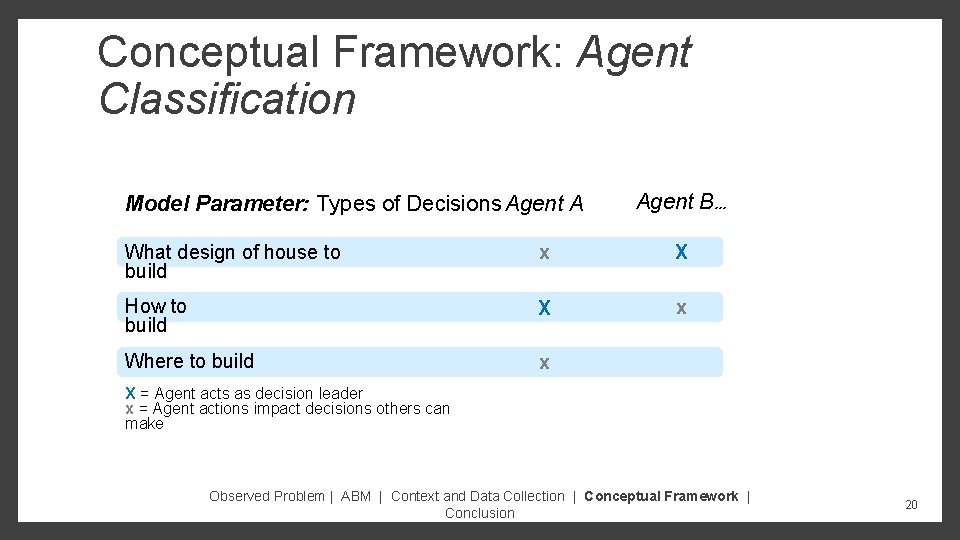
Conceptual Framework: Agent Classification Model Parameter: Types of Decisions Agent A Agent B… What design of house to build x X How to build X x Where to build x X = Agent acts as decision leader x = Agent actions impact decisions others can make Observed Problem | ABM | Context and Data Collection | Conceptual Framework | Conclusion 20
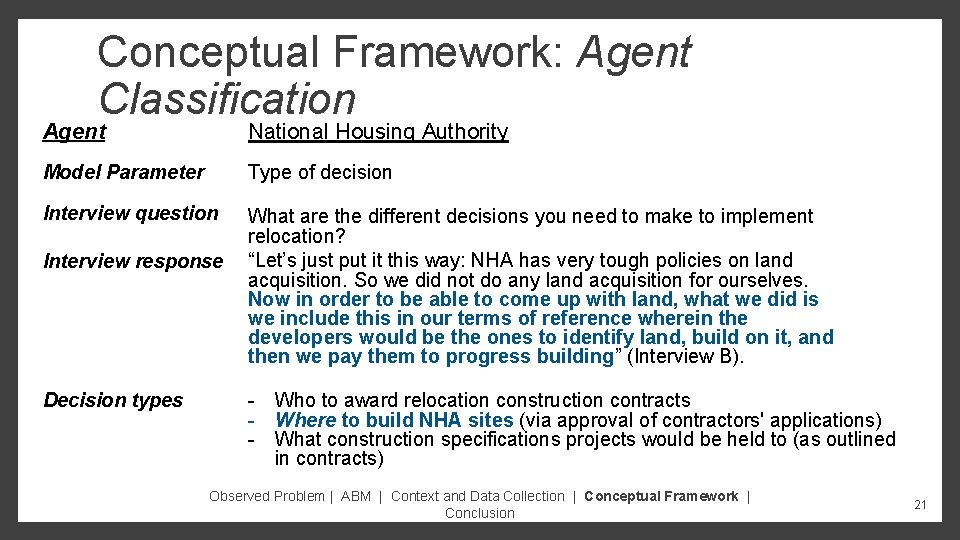
Conceptual Framework: Agent Classification Agent National Housing Authority Model Parameter Type of decision Interview question What are the different decisions you need to make to implement relocation? “Let’s just put it this way: NHA has very tough policies on land acquisition. So we did not do any land acquisition for ourselves. Now in order to be able to come up with land, what we did is we include this in our terms of reference wherein the developers would be the ones to identify land, build on it, and then we pay them to progress building” (Interview B). Interview response Decision types - Who to award relocation construction contracts - Where to build NHA sites (via approval of contractors' applications) - What construction specifications projects would be held to (as outlined in contracts) Observed Problem | ABM | Context and Data Collection | Conceptual Framework | Conclusion 21
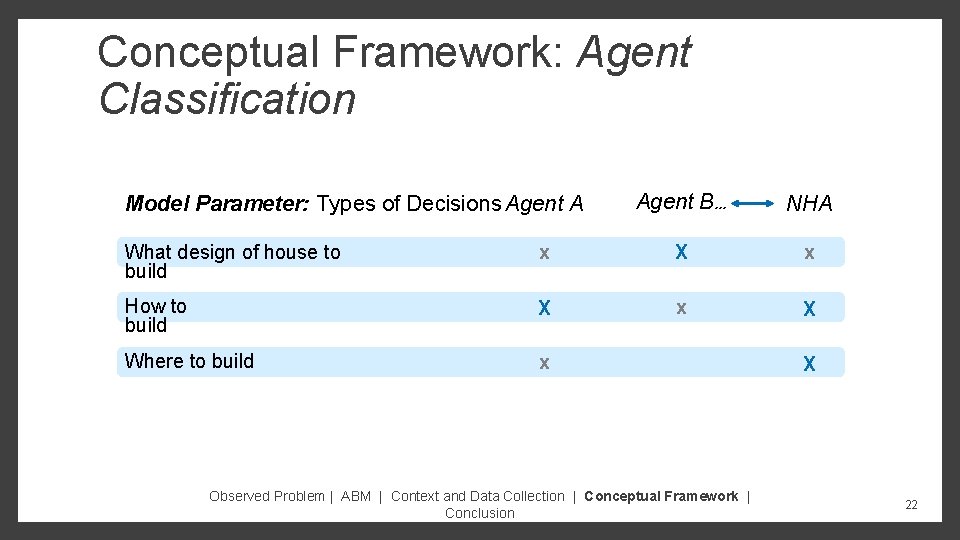
Conceptual Framework: Agent Classification Model Parameter: Types of Decisions Agent A Agent B… NHA What design of house to build x X x How to build X x X Where to build x Observed Problem | ABM | Context and Data Collection | Conceptual Framework | Conclusion X 22
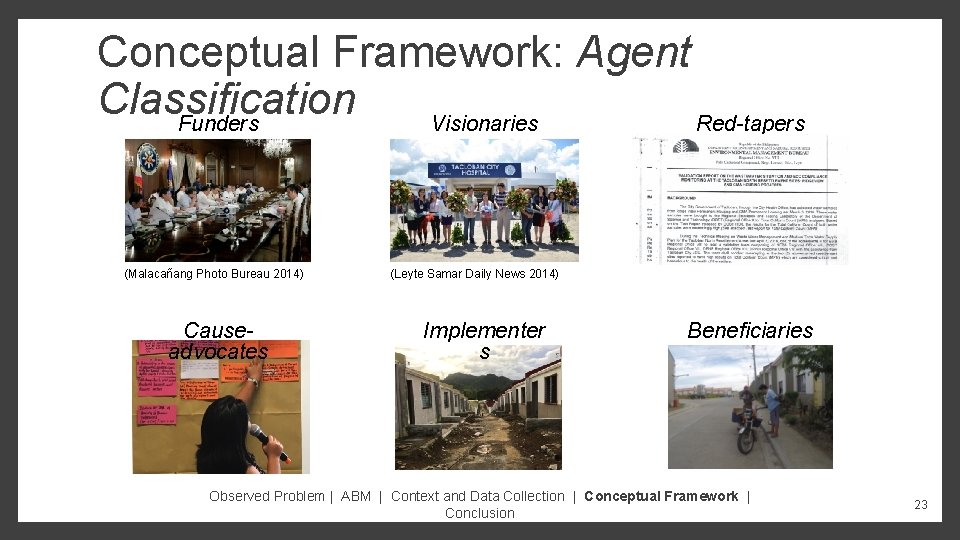
Conceptual Framework: Agent Classification Funders Visionaries Red-tapers (Malacañang Photo Bureau 2014) Causeadvocates (Leyte Samar Daily News 2014) Implementer s Beneficiaries Observed Problem | ABM | Context and Data Collection | Conceptual Framework | Conclusion 23
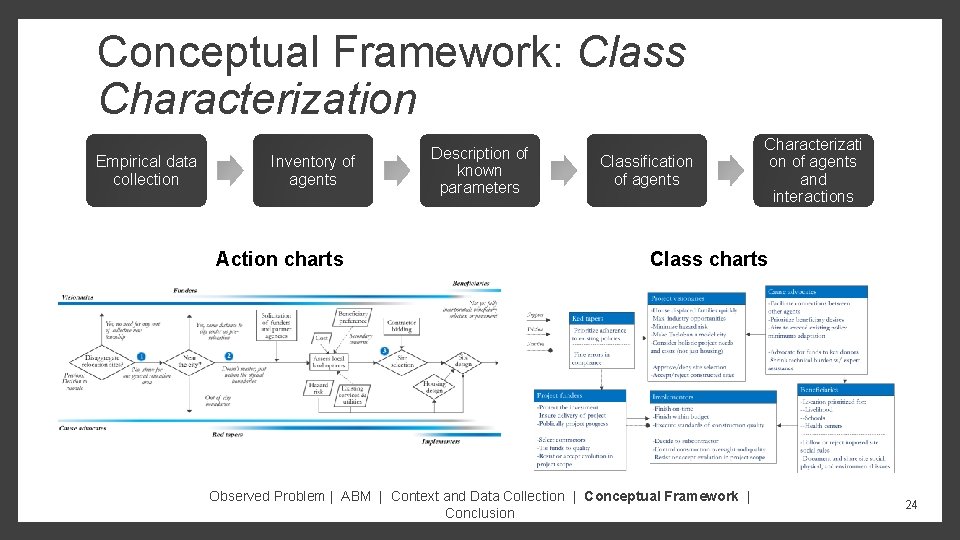
Conceptual Framework: Class Characterization Empirical data collection Inventory of agents Action charts Description of known parameters Classification of agents Characterizati on of agents and interactions Class charts Observed Problem | ABM | Context and Data Collection | Conceptual Framework | Conclusion 24
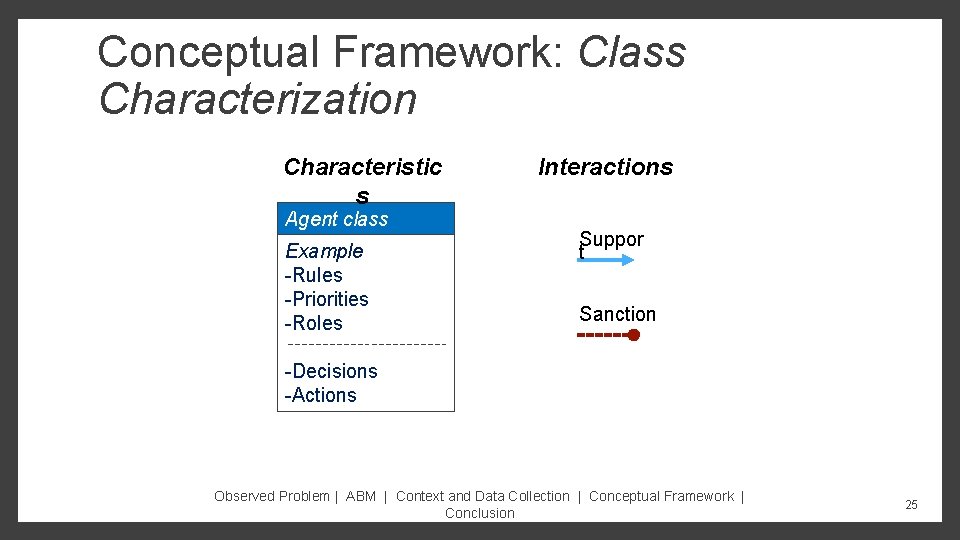
Conceptual Framework: Class Characterization Characteristic s Agent class Example -Rules -Priorities -Roles Interactions Suppor t Sanction -Decisions -Actions Observed Problem | ABM | Context and Data Collection | Conceptual Framework | Conclusion 25
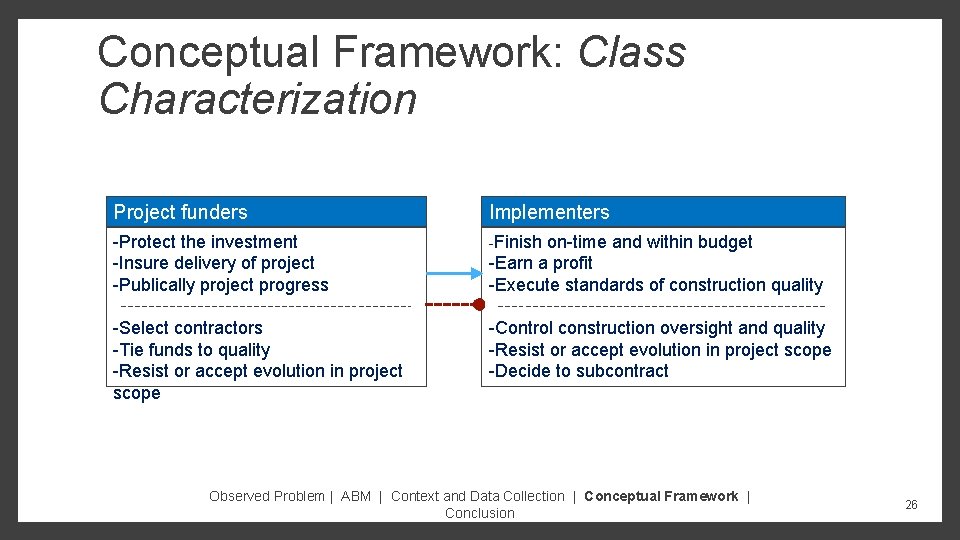
Conceptual Framework: Class Characterization Project funders Implementers -Protect the investment -Insure delivery of project -Publically project progress -Finish on-time and within budget -Select contractors -Tie funds to quality -Resist or accept evolution in project scope -Control construction oversight and quality -Resist or accept evolution in project scope -Decide to subcontract -Earn a profit -Execute standards of construction quality Observed Problem | ABM | Context and Data Collection | Conceptual Framework | Conclusion 26
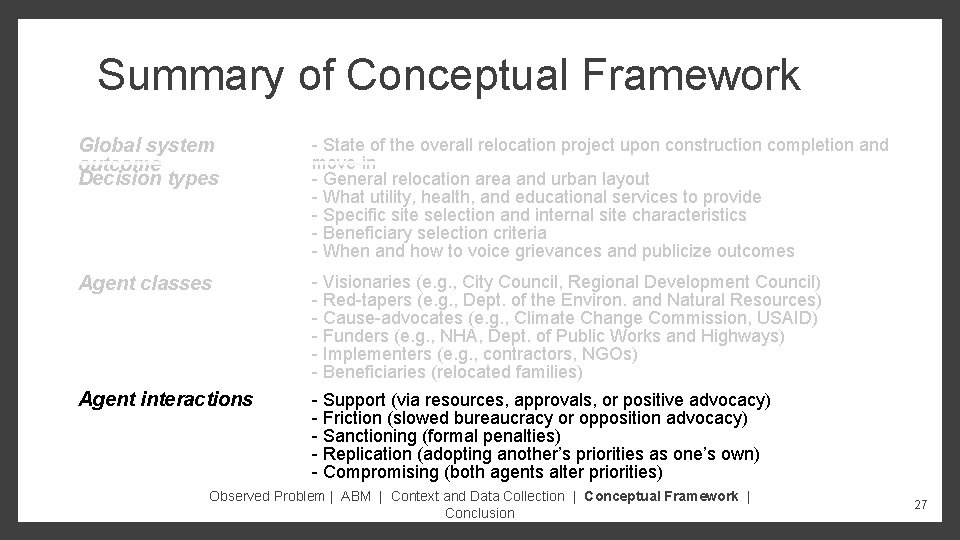
Summary of Conceptual Framework Global system outcome Decision types - State of the overall relocation project upon construction completion and move-in - General relocation area and urban layout - What utility, health, and educational services to provide - Specific site selection and internal site characteristics - Beneficiary selection criteria - When and how to voice grievances and publicize outcomes Agent classes - Visionaries (e. g. , City Council, Regional Development Council) - Red-tapers (e. g. , Dept. of the Environ. and Natural Resources) - Cause-advocates (e. g. , Climate Change Commission, USAID) - Funders (e. g. , NHA, Dept. of Public Works and Highways) - Implementers (e. g. , contractors, NGOs) - Beneficiaries (relocated families) Agent interactions - Support (via resources, approvals, or positive advocacy) - Friction (slowed bureaucracy or opposition advocacy) - Sanctioning (formal penalties) - Replication (adopting another’s priorities as one’s own) - Compromising (both agents alter priorities) Observed Problem | ABM | Context and Data Collection | Conceptual Framework | Conclusion 27
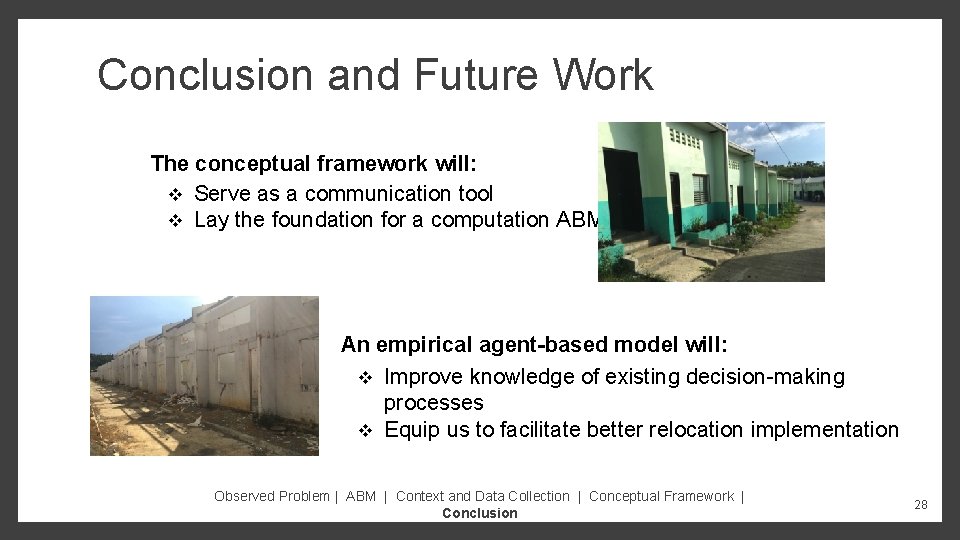
Conclusion and Future Work The conceptual framework will: v Serve as a communication tool v Lay the foundation for a computation ABM An empirical agent-based model will: v Improve knowledge of existing decision-making processes v Equip us to facilitate better relocation implementation Observed Problem | ABM | Context and Data Collection | Conceptual Framework | Conclusion 28

Shaye Palagi Ph. D Student | Civil Systems shaye. palagi@colorado. edu Dr. Ali Mostafavi Assistant Professor Texas A&M University Dr. Amy Javernick-Will Associate Professor University of Colorado Boulder Questions? Global Projects and Organizations Research Group Department of Civil, Environmental, and Architectural Engineering University of Colorado Boulder www. projectorganizations. com 29
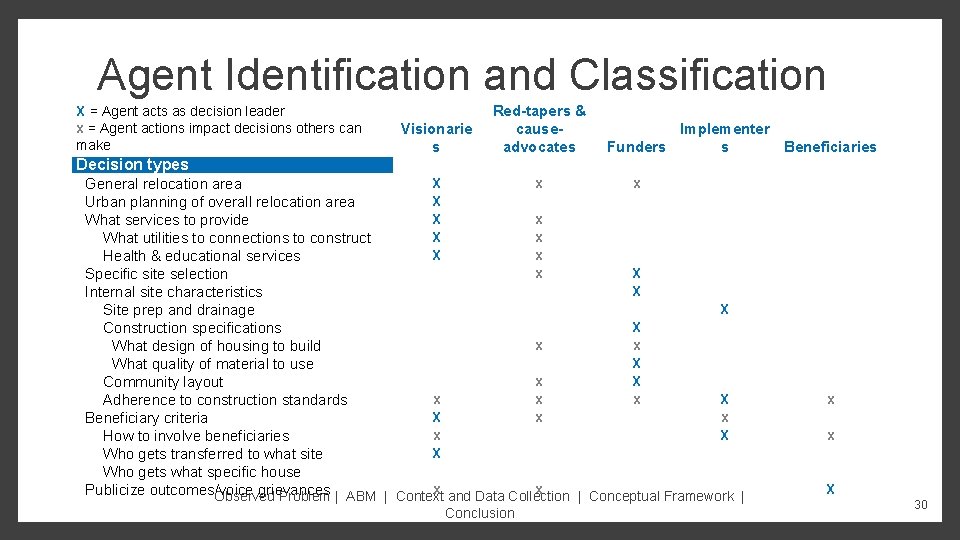
Agent Identification and Classification X = Agent acts as decision leader x = Agent actions impact decisions others can make Visionarie s Red-tapers & causeadvocates Implementer Funders s Beneficiaries Decision types X x x General relocation area X Urban planning of overall relocation area X x What services to provide X x What utilities to connections to construct X x Health & educational services x X Specific site selection X Internal site characteristics X Site prep and drainage X Construction specifications x x What design of housing to build X What quality of material to use x X Community layout x x x X Adherence to construction standards X x x Beneficiary criteria x X How to involve beneficiaries X Who gets transferred to what site Who gets what specific house x and Data Collection x Publicize outcomes/voice grievances Observed Problem | ABM | Context | Conceptual Framework | Conclusion x x X 30
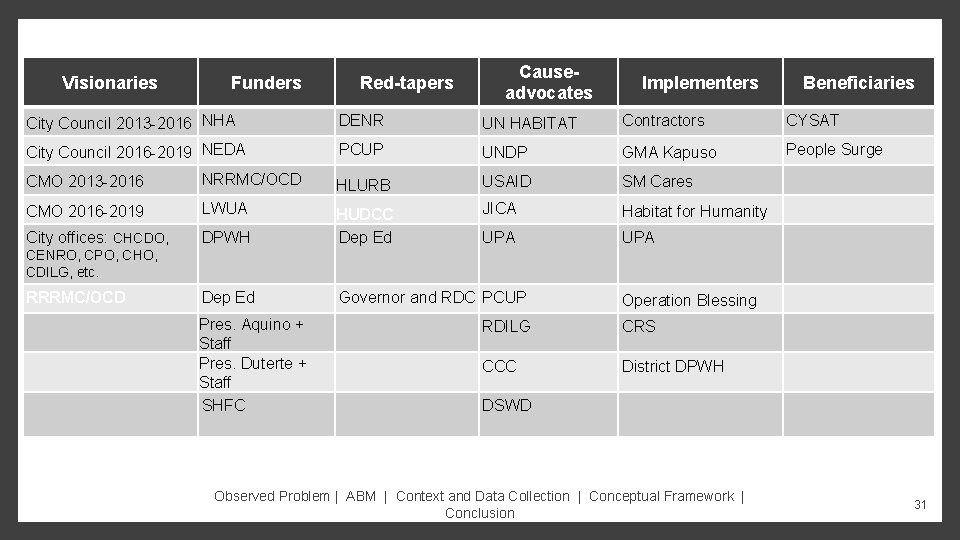
Visionaries Funders Red-tapers Causeadvocates Implementers Beneficiaries City Council 2013 -2016 NHA DENR UN HABITAT Contractors CYSAT City Council 2016 -2019 NEDA PCUP UNDP GMA Kapuso People Surge CMO 2013 -2016 NRRMC/OCD HLURB USAID SM Cares CMO 2016 -2019 LWUA JICA Habitat for Humanity City offices: CHCDO, DPWH HUDCC Dep Ed UPA Dep Ed Governor and RDC PCUP CENRO, CPO, CHO, CDILG, etc. RRRMC/OCD Pres. Aquino + Staff Pres. Duterte + Staff SHFC Operation Blessing RDILG CRS CCC District DPWH DSWD Observed Problem | ABM | Context and Data Collection | Conceptual Framework | Conclusion 31
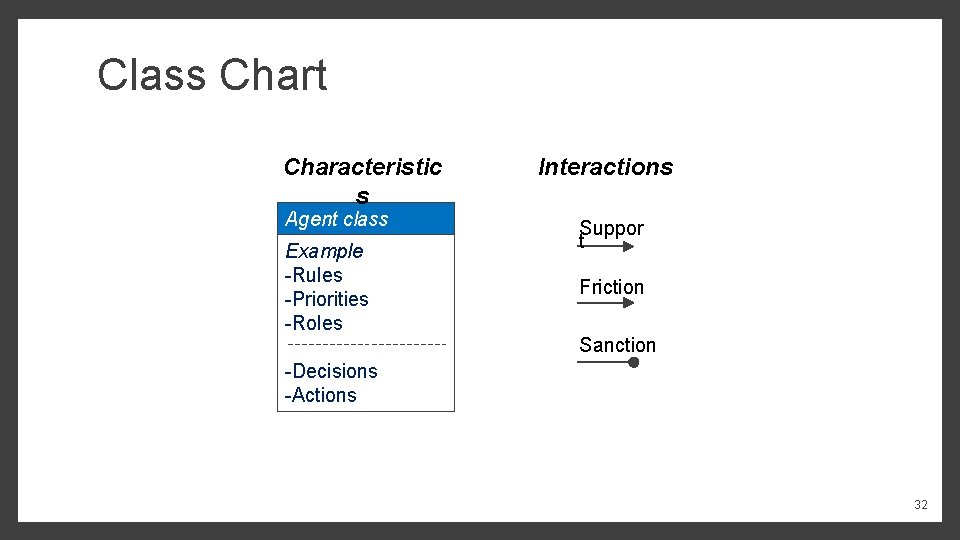
Class Chart Characteristic s Agent class Example -Rules -Priorities -Roles Interactions Suppor t Friction Sanction -Decisions -Actions 32
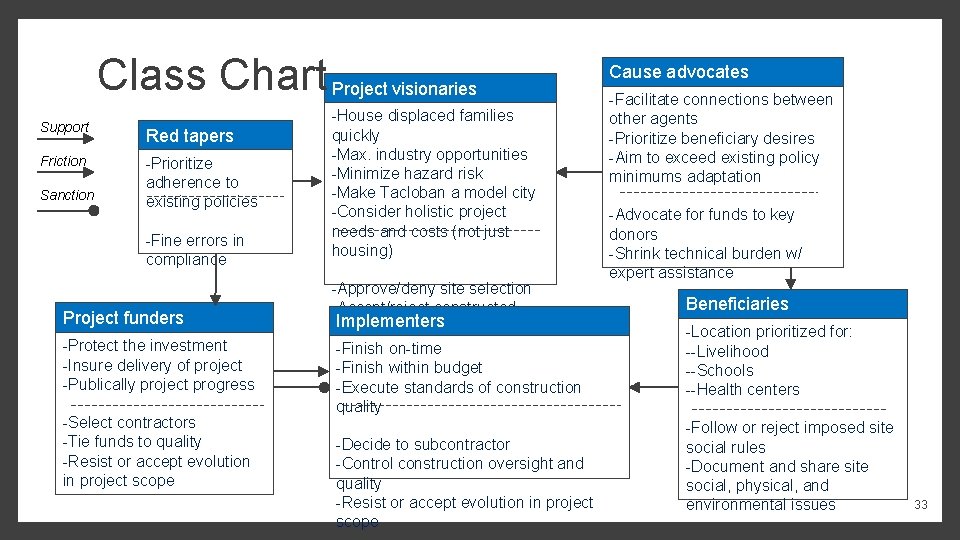
Class Chart Project visionaries Support Red tapers Friction -Prioritize adherence to existing policies Sanction -Fine errors in compliance Project funders -Protect the investment -Insure delivery of project -Publically project progress -Select contractors -Tie funds to quality -Resist or accept evolution in project scope -House displaced families quickly -Max. industry opportunities -Minimize hazard risk -Make Tacloban a model city -Consider holistic project needs and costs (not just housing) -Approve/deny site selection -Accept/reject constructed Implementers sites -Finish on-time -Finish within budget -Execute standards of construction quality -Decide to subcontractor -Control construction oversight and quality -Resist or accept evolution in project scope Cause advocates -Facilitate connections between other agents -Prioritize beneficiary desires -Aim to exceed existing policy minimums adaptation -Advocate for funds to key donors -Shrink technical burden w/ expert assistance Beneficiaries -Location prioritized for: --Livelihood --Schools --Health centers -Follow or reject imposed site social rules -Document and share site social, physical, and environmental issues 33
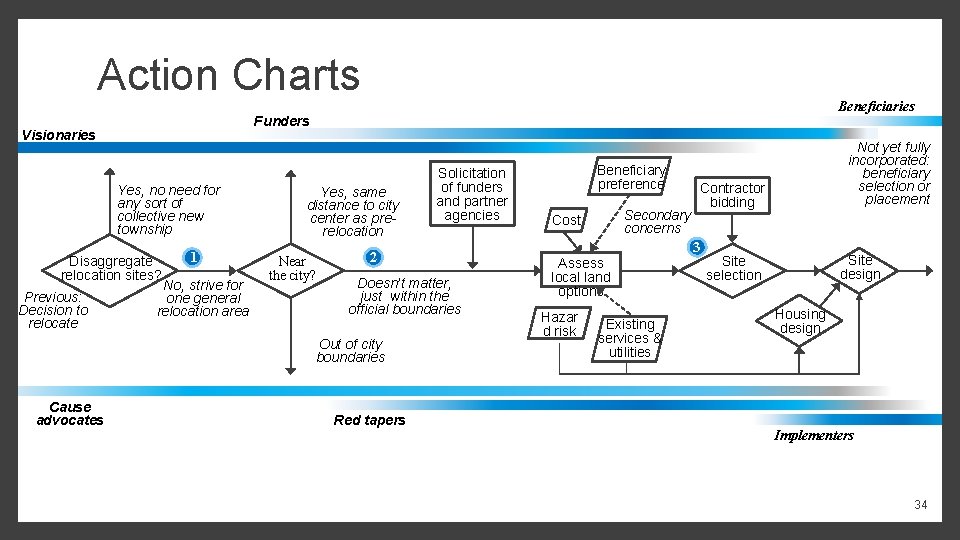
Action Charts Funders Visionaries Yes, no need for any sort of collective new township Disaggregate relocation sites? Previous: Decision to relocate Beneficiaries 1 No, strive for one general relocation area Yes, same distance to city center as prerelocation Near the city? 2 Doesn’t matter, just within the official boundaries Out of city boundaries Cause advocates Solicitation of funders and partner agencies Red tapers Beneficiary preference Secondary concerns Cost Assess local land options Hazar d risk Existing services & utilities Not yet fully incorporated: beneficiary selection or placement Contractor bidding 3 Site design Site selection Housing design Implementers 34
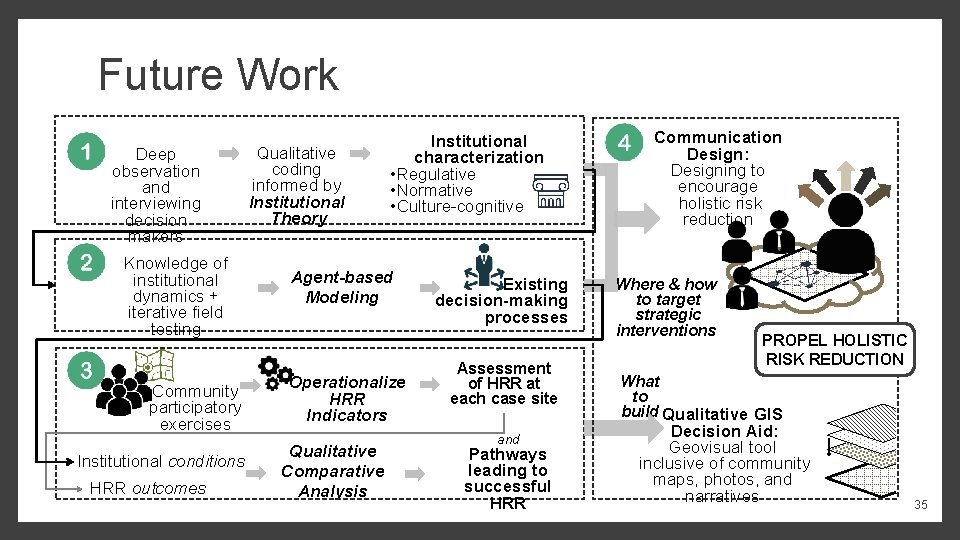
Future Work Deep observation and interviewing decision makers Knowledge of institutional dynamics + iterative field testing Community participatory exercises Institutional conditions HRR outcomes Qualitative coding informed by Institutional Theory Institutional characterization • Regulative • Normative • Culture-cognitive Agent-based Modeling Operationalize HRR Indicators Qualitative Comparative Analysis Existing decision-making processes Assessment of HRR at each case site and Pathways leading to successful HRR Communication Design: Designing to encourage holistic risk reduction Where & how to target strategic interventions PROPEL HOLISTIC RISK REDUCTION What to build Qualitative GIS Decision Aid: Geovisual tool inclusive of community maps, photos, and narratives 35
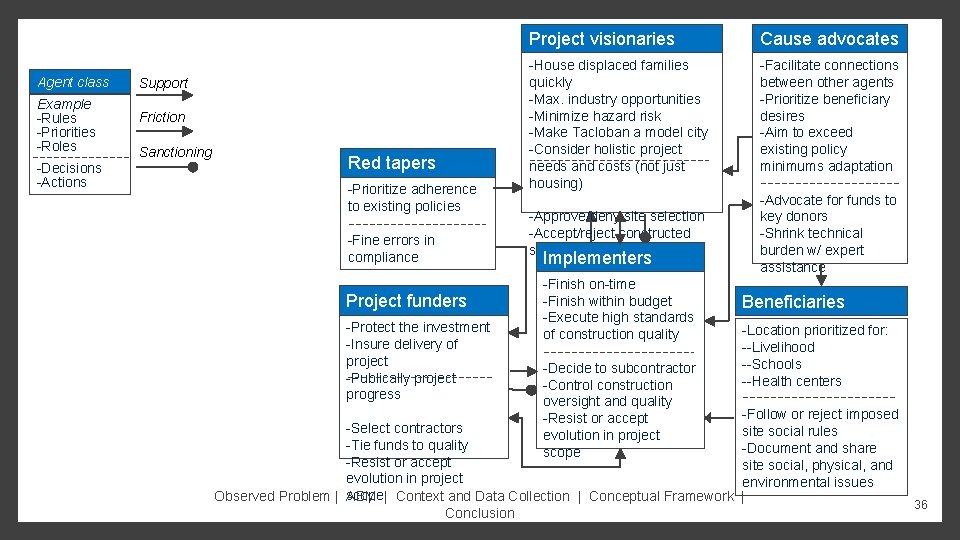
Agent class Example -Rules -Priorities -Roles -Decisions -Actions Support Friction Sanctioning Red tapers -Prioritize adherence to existing policies -Fine errors in compliance Project funders -Protect the investment -Insure delivery of project -Publically project progress Project visionaries Cause advocates -House displaced families quickly -Max. industry opportunities -Minimize hazard risk -Make Tacloban a model city -Consider holistic project needs and costs (not just housing) -Facilitate connections between other agents -Prioritize beneficiary desires -Aim to exceed existing policy minimums adaptation -Approve/deny site selection -Accept/reject constructed sites Implementers -Finish on-time -Finish within budget -Execute high standards of construction quality -Decide to subcontractor -Control construction oversight and quality -Resist or accept evolution in project scope -Advocate for funds to key donors -Shrink technical burden w/ expert assistance Beneficiaries -Location prioritized for: --Livelihood --Schools --Health centers -Follow or reject imposed -Select contractors site social rules -Tie funds to quality -Document and share -Resist or accept site social, physical, and evolution in project environmental issues scope | Context and Data Collection | Conceptual Framework | Observed Problem | ABM Conclusion 36
- Slides: 36