
ESTABLISH AND MAINTAIN A BUSINESS RELATIONSHIP D 1
ESTABLISH AND MAINTAIN A BUSINESS RELATIONSHIP D 1. HCS. CL 6. 02 D 1. HSM. CL 5. 05 D 2. TCS. CL 5. 15 Slide 1
Establish and maintain a business relationship This unit comprises four Elements: � Establish and conduct business relationships � Conduct negotiations � Make formal business agreements � Foster and maintain business relationships. Slide 2
Assessment for this unit may include: � Oral questions � Written questions � Work projects � Workplace observation of practical skills � Practical exercises � Formal report from employer or supervisor. Slide 3
Establish and conduct business relationships Performance Criteria for this Element are : � Establish business relationships in a manner that promotes goodwill and trust between the enterprise, its customers and suppliers � Build trust and respect in business relationships � Identify and take up opportunities to maintain regular contact with customers and suppliers. Slide 4
Establish business relationships Establishing and maintaining good business relationships is vital – relationships may need to be created with: � Customers (also known as patrons, clients or pax): • Corporate • Government • Private • Sectors. (Continued) Slide 5
Establish business relationships � Customers can be classified by demographic characteristics: • Gender • Age • Religion • Income • Marital status • Domestic or international. (Continued) Slide 6
Establish business relationships Customers may also be identified & classified as: � Regular customers � New customers � Potential customers � Prospects. Slide 7
Establish business relationships A business relationship may also be developed with suppliers including: � Wholesalers � Retailers � Combined wholesale-retailers. Slide 8

Establish business relationships Business relationships will also exist with ‘strategic partners’ – these are deliberate partnerships with other businesses to: � Capitalise on a logical link between the partners � Gain some operational advantage � Engage in mutually beneficial promotions, advertising, campaigns � Save money and/or increase sales or profit. Slide 9
Establish business relationships Relationships may also occur with finance companies: � Banks � Financial institutions. Slide 10
Establish business relationships Relationships are also important with other businesses with whom you have: � Service contracts � Commission-based arrangements � Association-based links. Slide 11
Establish business relationships There will always be a relationship between the business and its employees – addressing issues such as: � Remuneration � Working conditions � IR issues � Insurance � OHS. Slide 12
Establish business relationships Business relationships with ‘industry bodies’ are also common: � Government agencies and authorities � Unions � Peak industry bodies. Slide 13
Establish business relationships There is need to develop a business relationship with: � Local council � Local offices of government agencies and authorities. Slide 14
Establish business relationships Business relationships can be initiated: � By you making contact with the ‘other party’ � By the ‘other party’ making contact with you. Slide 15
Establish business relationships ‘Goodwill’, ‘trust’ and ‘respect’ are vital to business relationships. Goodwill = positive feelings towards the business as a result of: � Positive community involvement � Its ethical behaviour � Gifts given � Public statements and commitments � Its observable behavior (‘track record’). Slide 16
Build trust and respect ‘Trust’ in a business relationship: � Refers to the ability of parties to believe you � Is a result of actions – not promises � Is a result of doing everything that was promised. Slide 17
Build trust and respect Basic pre-requisites for developing trust in a business relationship: � Be careful about what you promise � Under-promise and over-deliver � Read things before you sign them. Slide 18
Build trust and respect Actions to foster trust in you include: � Follow-up on all promises made � Honour promises made � Tell others about the ‘bad’ bits too – never just promote the positive aspects of a product, service, deal or package (Continued) Slide 19
Build trust and respect � Give customers what they are entitled to � Advise them about issues relevant to their needs, wants, preferences, constraints and/or circumstances (Continued) Slide 20
Build trust and respect � Maintain confidentialities � Charge the prices quoted � Be honest with suppliers. Slide 21
Build trust and respect ‘Respect’ = the regard for others – it can be demonstrated by displaying: � Consideration for them � Politeness and civility � Getting to know them and their needs, wants and preferences (Continued) Slide 22
Build trust and respect � Providing deferential treatment � Showing appreciation for their time � Valuing their custom and the opportunities they represent � Never taking them for granted (Continued) Slide 23
Build trust and respect � Identifying and showing regard for individual differences � Demonstrating ‘nothing is too much trouble’ � Understanding every person is a unique individual � Proving you want to be of service (Continued) Slide 24
Build trust and respect There is a need to demonstrate respect and trust on an ongoing basis: � Using the person’s name � Being punctual � Maintaining a professional distance � Paying attention non-verbal cues � Avoiding judgement. Slide 25
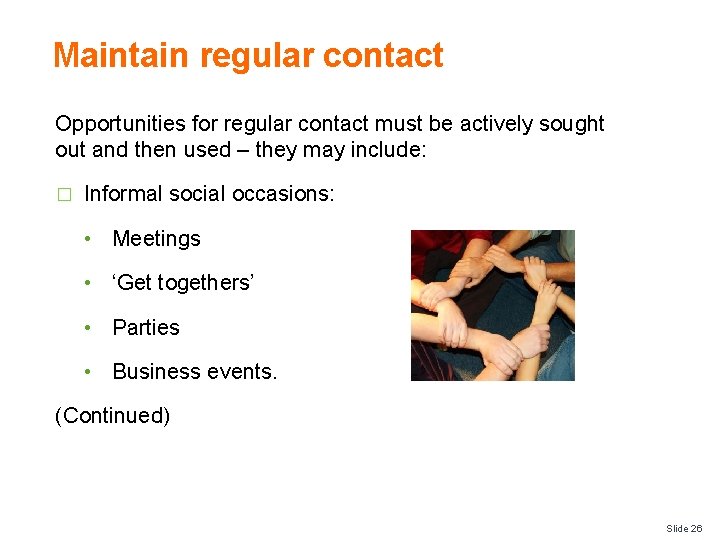
Maintain regular contact Opportunities for regular contact must be actively sought out and then used – they may include: � Informal social occasions: • Meetings • ‘Get togethers’ • Parties • Business events. (Continued) Slide 26
Maintain regular contact All ‘social occasions’ provide an opportunity to: � Make new contacts � Reinforce existing contacts � Learn new information. Be prepare to: ‘Network’ Slide 27
Maintain regular contact ‘Industry functions’ (product launches and exhibitions) are opportunities to make contact – plan your attendance: Take business cards � Wear a name tag � Determine who you want to make contact with � Take pen and paper. � Slide 28
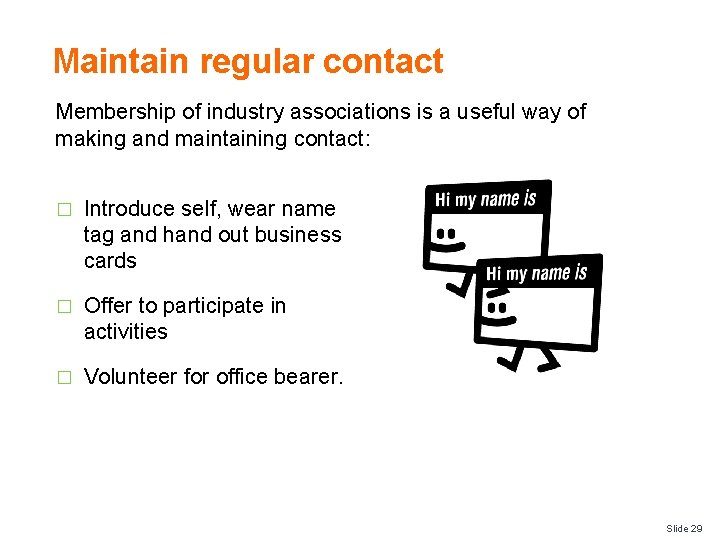
Maintain regular contact Membership of industry associations is a useful way of making and maintaining contact: � Introduce self, wear name tag and hand out business cards � Offer to participate in activities � Volunteer for office bearer. Slide 29
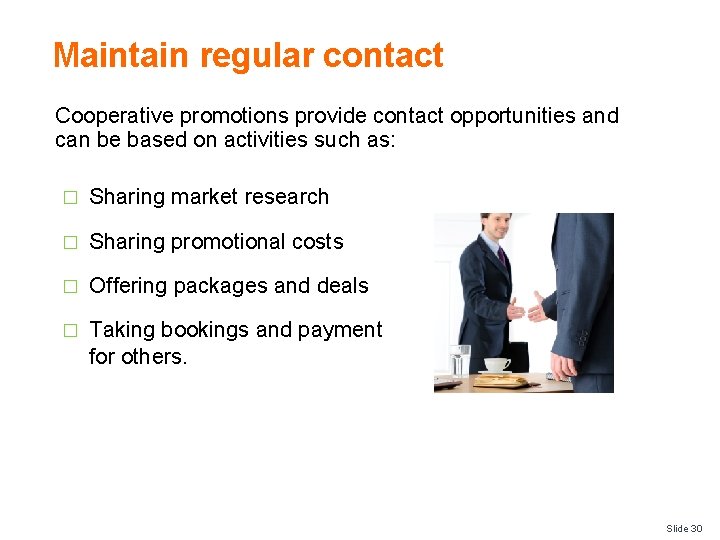
Maintain regular contact Cooperative promotions provide contact opportunities and can be based on activities such as: � Sharing market research � Sharing promotional costs � Offering packages and deals � Taking bookings and payment for others. Slide 30
Maintain regular contact Cooperative promotions relationships demand: � Honesty � Total disclosure � Hard work � Regular contact � Mutual support. Slide 31
Maintain regular contact The telephone is vital in business relationships - it: � Is inexpensive to use � Allows regular contact � Requires a schedule of calls to be truly effective. If people indicate they do not want to be phoned - do not phone them! An attempt to call is not the same as talking to them on the phone. Slide 32
Maintain regular contact Topics for discussion when making contact: � General comments about yourself, work and family � Advice about new information, products, offers, packages and deals � General enquiries about them, their business and family � Undertakings and promises made � Answers to questions asked. Slide 33
Maintain regular contact Never raise or talk about: � Sex � Religion � Politics � Jokes � Other people or businesses. Slide 34
Summary – Element 1 When establishing and conducting business relationships: � Ensure all potential and required businesses, bodies and individuals are identified � Know why the relationship is necessary � Meet or make contact with a person as distinct from an organisation or enterprise � Generate and maintain goodwill (Continued) Slide 35
Summary – Element 1 � Build trust and respect in the relationship and sustain these on an on-going basis � Search for and take advantage of opportunities to maintain regular contact � Establish and adhere to a regular contact schedule � Share information. Slide 36
Conduct negotiations Performance Criteria for this Element are: � Conduct negotiations in a business-like and professional manner within the relevant cultural context � Conduct negotiations in the context of the current enterprise marketing focus and within legal and ethical considerations (Continued) Slide 37
Conduct negotiations � Maximise benefits for all parties in the negotiation through use of established negotiation techniques � Incorporate feedback and input from colleagues into the negotiation where appropriate � Communicate the results of negotiations to appropriate colleagues and stakeholders within appropriate timeframes. Slide 38
Conduct negotiations in a businesslike and professional manner ‘Negotiations’ are part of most business relationships - they: � Must be conducted in a correct manner � Must accommodate cultural contexts � Are the best way to resolve differences � Should achieve a win-win outcome � Require compromise. Slide 39
Conduct negotiations in a businesslike and professional manner Negotiations may relate to: � Corporate accounts (B 2 B relationships) � Service contracts � Agency agreements (Continued) Slide 40
Conduct negotiations in a businesslike and professional manner � Venue contracts • For services provided. � Rate negotiations – which must reflect: • Reliability • Quality • Availability • Overall considerations. (Continued) Slide 41
Conduct negotiations in a businesslike and professional manner � Marketing agreements � Preferred product or provider agreements. Slide 42
Conduct negotiations in a businesslike and professional manner Negotiation is: � 'A process in which two or more parties confront a problem and arrive at a solution which best meets the needs of all of them‘. Slide 43
Conduct negotiations in a businesslike and professional manner To be effective in negotiation you need: � Good preparation: • Get the facts • Know the other party. � Knowledge of your goals and limits (Continued) Slide 44
Conduct negotiations in a businesslike and professional manner � A calm mind a calm approach � Good listening and communication skills � Knowledge of the relevant cultural context � Knowledge of how to close a deal. Slide 45
Conduct negotiations in a businesslike and professional manner Before negotiating you must be able to answer all the following: � What are venue or department needs? � What is required (‘bottom line’) as a result of the negotiation? � When will you walk away? � What are the needs of the other party? Slide 46
Conduct negotiations in a businesslike and professional manner Negotiating ‘rules’: � Sit-in on other negotiations: • Listen • Watch � Be business-like � Try to get initial about the agenda � Try to get agreement about required outcomes (Continued) Slide 47
Conduct negotiations in a businesslike and professional manner � Deal with easily agreed small issues first • Shows willingness to negotiate or compromise. � Take notes during the negotiation: • Refer to them during the negotiation • They are useful after the negotiation. (Continued) Slide 48
Conduct negotiations in a businesslike and professional manner � � � Apply listening skills Use appropriate questioning techniques Monitor body language Be assertive Monitor and give feedback (Continued) Slide 49
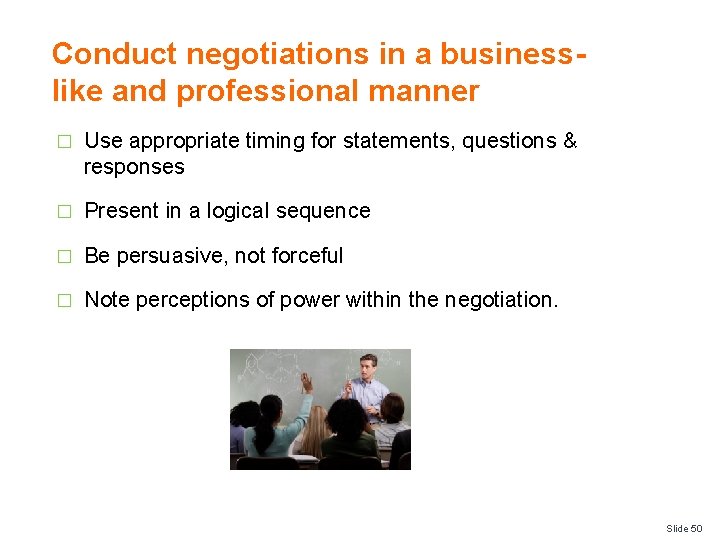
Conduct negotiations in a businesslike and professional manner � Use appropriate timing for statements, questions & responses � Present in a logical sequence � Be persuasive, not forceful � Note perceptions of power within the negotiation. Slide 50
Conduct negotiations legally, ethically and in context All negotiations must: � Reflect needs for the business as stated in: • Business plans • Marketing plans. � Align with legal requirements � Reflect ethical considerations. Slide 51
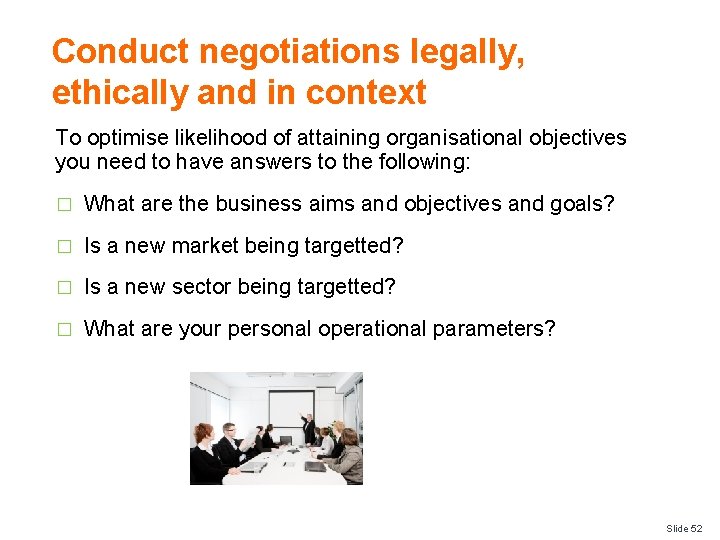
Conduct negotiations legally, ethically and in context To optimise likelihood of attaining organisational objectives you need to have answers to the following: � What are the business aims and objectives and goals? � Is a new market being targetted? � Is a new sector being targetted? � What are your personal operational parameters? Slide 52
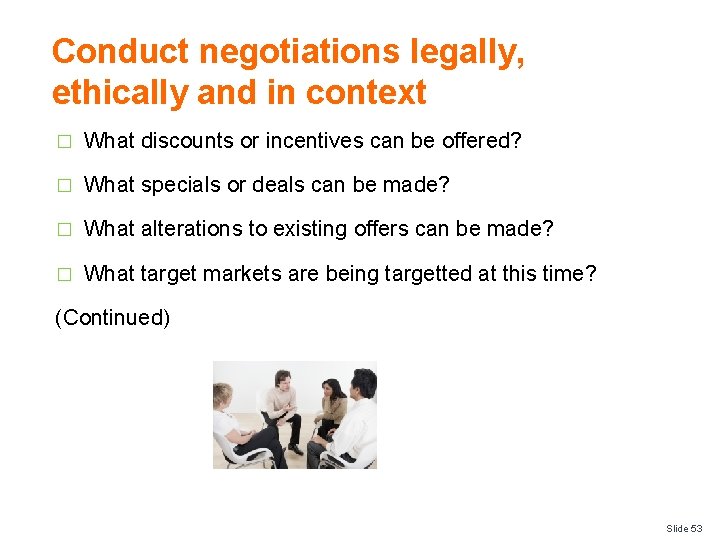
Conduct negotiations legally, ethically and in context � What discounts or incentives can be offered? � What specials or deals can be made? � What alterations to existing offers can be made? � What target markets are being targetted at this time? (Continued) Slide 53
Conduct negotiations legally, ethically and in context � What image or market position is being sought? � What are the department objectives? (as distinct to venue goals) � What are others in your business offering to their customers and prospects? Slide 54
Conduct negotiations legally, ethically and in context Be alert to the fact ‘Change is Constant’: � Products, services and facilities available can and will change throughout a year or over time � Customers change over time � Seasons change � ‘Special events’ occur regularly. Slide 55
Conduct negotiations legally, ethically and in context You must ensure negotiations comply with all legal requirements – as imposed by: � Legislation � Regulations. Slide 56
Conduct negotiations legally, ethically and in context To identify your legal obligations: � Speak to supervisor or manager � Talk to more experienced staff � Contact relevant authorities � Visit authority websites � Ask questions of industry and employee or employer associations. Slide 57
Conduct negotiations legally, ethically and in context Failure to comply with legislated obligations can result in penalties to the venue and individual staff: � Warning � Fine � Imprisonment � ‘Order’ – to act, or refrain from action � Business closure. Slide 58
Conduct negotiations legally, ethically & in context Businesses must also meet ethical constraints/requirements – which can result from: � Public ‘organisational statements’ made by the business � Company policies & procedures � Directives from head office (Continued) Slide 59
Conduct negotiations legally, ethically and in context � Codes of Practice and or Codes of Conduct – addressing: • Business practices • Staff performance and actions • Guarantees • Commitments. (Continued) Slide 60
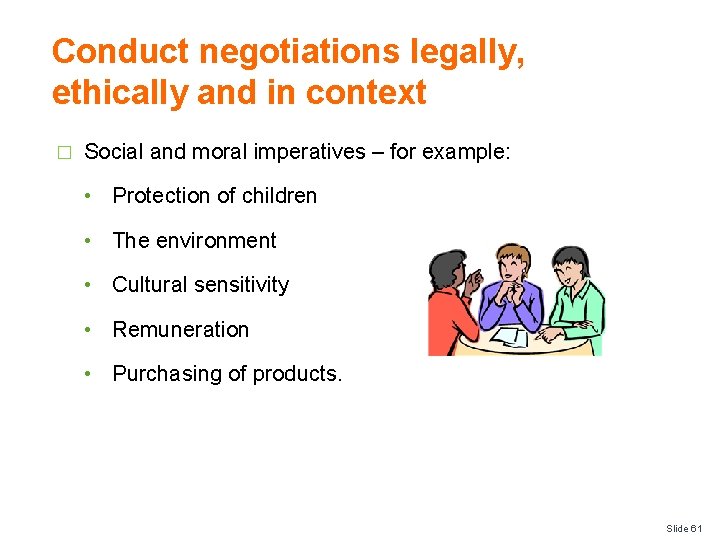
Conduct negotiations legally, ethically and in context � Social and moral imperatives – for example: • Protection of children • The environment • Cultural sensitivity • Remuneration • Purchasing of products. Slide 61
Conduct negotiations legally, ethically and in context Breaches of ethical constraints may result in: � No legal action � Warning from relevant body � Termination of agreements � Expulsion form an association � Negative media publicity. Slide 62
Maximise opportunities using established techniques Negotiations must: � Maximise the outcomes for both parties � Accept a failure this time may result in success next time. Slide 63
Maximise opportunities using established techniques Negotiation tactics: � The other party walks out – you might: • Ask them to return • Re-frame statements • Make new offers • Try to find a compromise. (Continued) Slide 64
Maximise opportunities using established techniques � The other party delays/stalls – you might: • Use this time positively • Seek a compromise • Seek clarification. (Continued) Slide 65
Maximise opportunities using established techniques � If other party sets limits – you might: • State and explain why these are unacceptable • Give your limits • Have a frank discussion on the issues (Continued) Slide 66
Maximise opportunities using established techniques � If there is a deadlock – you might: • Claim you do not have the authority to do or offer more • Say you will need to refer the deadlock to a superior • Use the ‘bought’ time to re-think the situation and or generate a different proposal or counter-offer. (Continued) Slide 67
Maximise opportunities using established techniques � If the other party keeps silent – you might: • Ask questions • Ignore the silence • Respond with silence. (Continued) Slide 68
Maximise opportunities using established techniques � If a personal attack is made – you might: • Ignore it • Walk out. (Continued) Slide 69
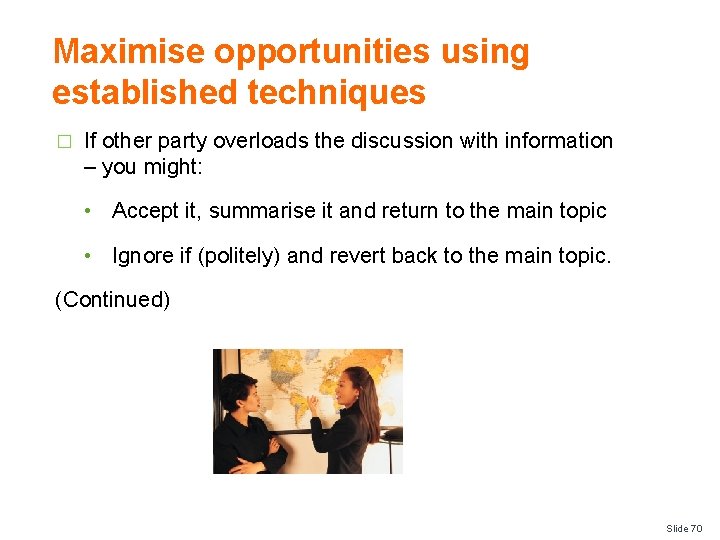
Maximise opportunities using established techniques � If other party overloads the discussion with information – you might: • Accept it, summarise it and return to the main topic • Ignore if (politely) and revert back to the main topic. (Continued) Slide 70
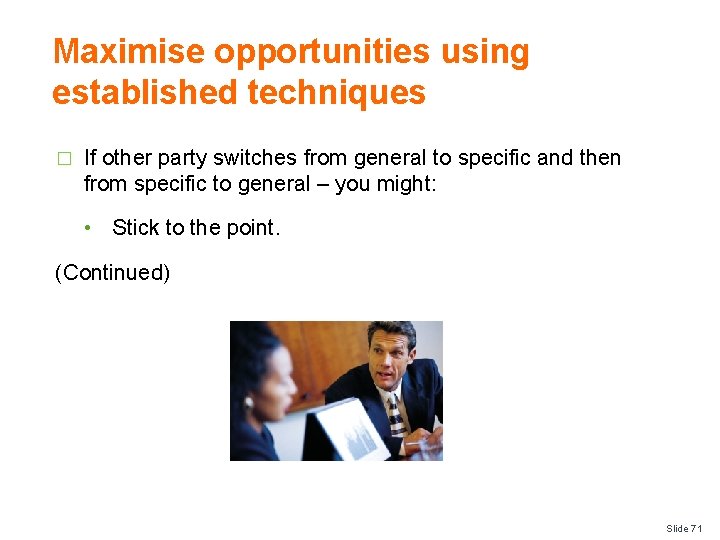
Maximise opportunities using established techniques � If other party switches from general to specific and then from specific to general – you might: • Stick to the point. (Continued) Slide 71
Maximise opportunities using established techniques � If the other party acts ignorant – you might: • Ask questions to determine level of knowledge • Provide base information. (Continued) Slide 72
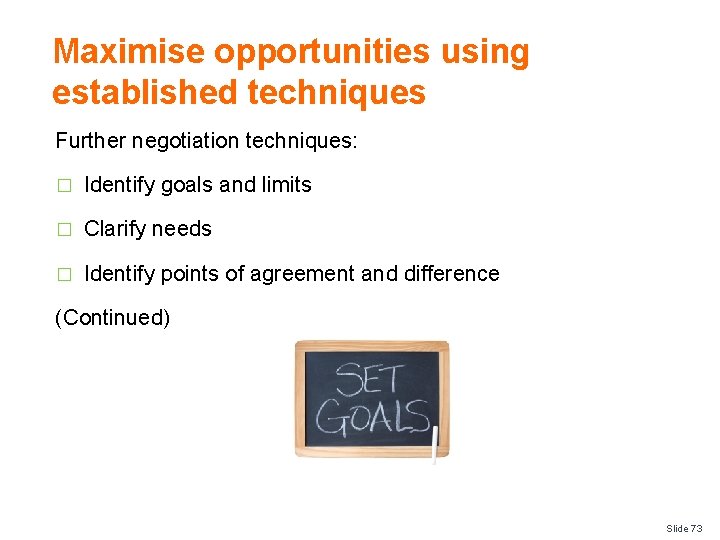
Maximise opportunities using established techniques Further negotiation techniques: � Identify goals and limits � Clarify needs � Identify points of agreement and difference (Continued) Slide 73
Maximise opportunities using established techniques � Demonstrate research undertaken – of the facts � Use appropriate language � Use appropriate non-communication (Continued) Slide 74
Maximise opportunities using established techniques � Bargain with the other party – ‘this for that’ � Develop options � Be cultural appropriate and respectful � Confirm agreements. Slide 75
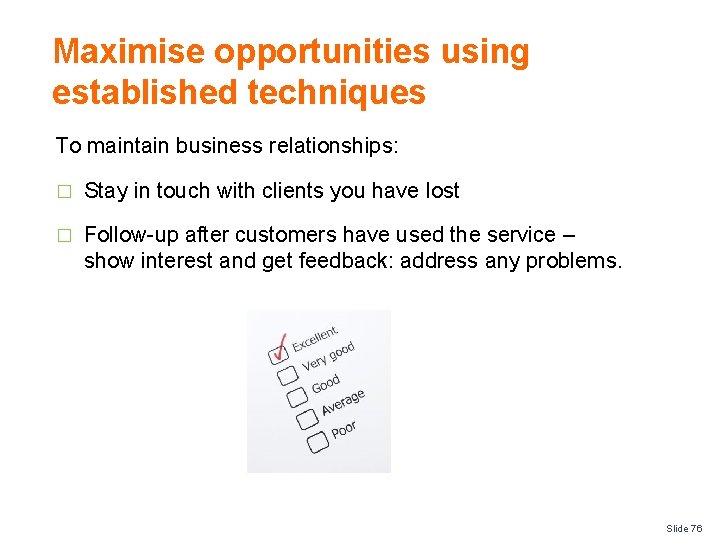
Maximise opportunities using established techniques To maintain business relationships: � Stay in touch with clients you have lost � Follow-up after customers have used the service – show interest and get feedback: address any problems. Slide 76
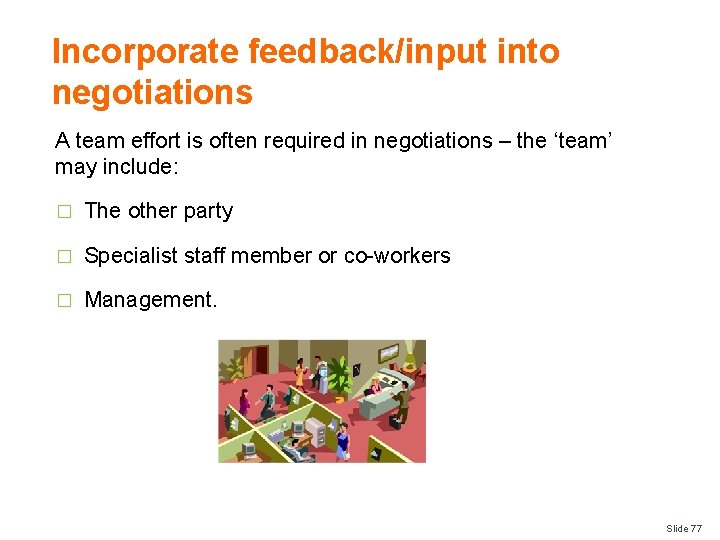
Incorporate feedback/input into negotiations A team effort is often required in negotiations – the ‘team’ may include: � The other party � Specialist staff member or co-workers � Management. Slide 77
Incorporate feedback into negotiations All information used in negotiations must be comprehensive, accurate and current: � Comprehensive � Accurate � Current. Slide 78
Incorporate feedback into negotiations Information must be comprehensive, accurate and current because: � It is the basis of ‘the deal’ � Providing insufficient, poor, dated or wrong information is highly unprofessional � The other party will use it to make a decision � There are potential legal implications for providing misleading or false information. Slide 79
Incorporate feedback into negotiations Information provided by colleagues to assist with negotiations may include: � History about previous dealings with the client � Factual information, details and data (Continued) Slide 80
Incorporate feedback into negotiations � Historical information � Practical help by trialling the proposed negotiation to see what works, and what does not. Slide 81
Incorporate feedback into negotiations Feedback from the other party: � Must be continually sought � May be positive � May be negative. All feedback is good – even ‘negative’ feedback. ‘Feedback is the breakfast of Champions’ Slide 82
Incorporate feedback into negotiations Feedback may be verbal or non-verbal – pay attention to: � What is said � How it is said � Body language � Facial expressions � Whether or not the body language matched or were different to the spoken words. Slide 83
Incorporate feedback into negotiations It is vital to use feedback from the other party in negotiations – keys are: � Thanking the person for their feedback � Clarify (if needed) understanding of the feedback � Reflect on it � Act on the feedback. (Continued) Slide 84
Incorporate feedback into negotiations � Always stay within your scope of authority � Work through unreasonable and inaccurate feedback with the other party – stand your ground explaining your reasons for believing the feedback is unfair or wrong � Learn from the experience. Slide 85
Incorporate feedback into negotiations When providing feedback as part of the negotiation process: � Be positive and constructive � Ensure feedback is fact-based – as opposed to opinionbased, or a result of personal judgements (Continued) Slide 86
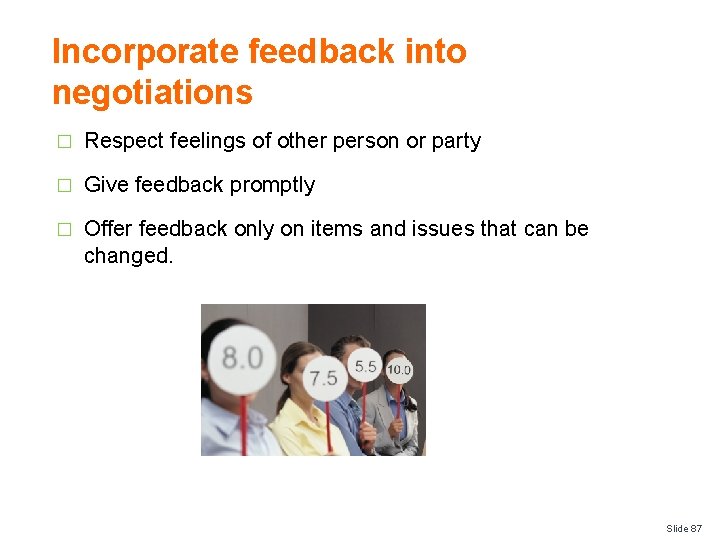
Incorporate feedback into negotiations � Respect feelings of other person or party � Give feedback promptly � Offer feedback only on items and issues that can be changed. Slide 87
Communicate results of negotiations When negotiations have concluded, ‘others’ may need to be advised: � ‘Within designated timeframes’ � As soon as possible � Within seconds of the deal being signed. Slide 88
Communicate results of negotiations Communication options: � In person, face-to-face � By telephone � Via email. Slide 89
Communicate results of negotiations You may need to communicate with: � Anyone who had involvement in the process � Owners and or management-level personnel � Support departments and staff � Head office � Operational staff who will be impacted or involved. Slide 90
Communicate results of negotiations Written reports on negotiations should address: � Names of those involved � Basic issues involved � Attempts to satisfy and resolve issues � Reasons attempts to satisfy and resolve failed (were rejected) (Continued) Slide 91
Communicate results of negotiations � Figures and statistics � Statement about venue or department desired or preferred outcome � Details of final offer made � Result or outcome of final agreement � Notifications � Lessons learned � Recommendations for future action. Slide 92
Summary – Element 2 When conducting negotiations: Act in a business-like & professional manner � Realise the outcome of a successful negotiation is a win-win result � Do the necessary research & preparation prior to the negotiation process � Involve others in the planning & preparation (Continued) � Slide 93
Summary – Element 2 Know your limitations for negotiating and never exceed them � Prepare a plan, know the plan and stick to the plan to the greatest extent possible � Use appropriate communication skills � Align the negotiation with workplace demands and focus (Continued) � Slide 94
Summary – Element 2 Ensure all negotiations occur within legal and ethical constraints � Use established negotiation techniques but seek a positive outcome for all parties � Be flexible and be prepared to amend offers to reflect emerging need, changed circumstances and varying requirements (Continued) � Slide 95
Summary – Element 2 Use feedback from others to plan and guide the process � Communicate the outcome or results of negotiation promptly and comprehensively to designated persons according to internal requirements. � Slide 96
Make formal business agreements Performance Criteria for this Element are: � Confirm agreements in writing using formal contracts where appropriate and in accordance with enterprise requirements � Check and gain appropriate approvals for all aspects of formal agreements in accordance with enterprise procedures � Identify the need for, and seek, specialist advice in the development of contracts where appropriate. Slide 97
Confirm agreements in writing After negotiations, most agreements are ‘reduced to writing’: � Not all agreements are put in writing – many are legally enforceable ‘verbal’ agreements or contracts � Written agreements/contracts remove confusion about terms and conditions and give clarity to all � The services of a solicitor may be used � You, or a colleague from your venue can write the agreement or contract. Slide 98
Confirm agreements in writing Contracts: � Are agreements enforceable at law � Parties agree to do (or not do) something � Most are ‘simple’ contracts. Slide 99
Confirm agreements in writing Six elements of a valid contract: � Intention to create legal relations � Agreement � Consideration (Continued) Slide 100
Confirm agreements in writing � Capacity � Certainty of terms � Legality of objects. Slide 101
Confirm agreements in writing If one or more elements of a valid contract is missing, the contract may be: � Voidable � Unenforceable � Illegal. Slide 102
Confirm agreements in writing In relation to contracts: � Parties need to be certain about the contents of the contract � Parties must consent to the contents, terms and conditions � The contract or negotiation must not involve: • Mistake • Misrepresentation • Duress • Undue influence. Slide 103
Confirm agreements in writing There are four kinds of ‘mistake’: � Common mistake � Mutual mistake � Unilateral mistake � ‘Non est factum’ (‘it is not my deed or option’). Slide 104
Confirm agreements in writing Misrepresentation can be: � Fraudulent misrepresentation – see following slides � Innocent misrepresentation: • No intention to deceive exists • ‘Damages’ will not be awarded as a consequence. Slide 105
Confirm agreements in writing Fraudulent misrepresentation: � A false representation of fact made with the knowledge it is false, or is a statement or representation made carelessly or indifferently without any real regard to what may be the true facts � Can result in the need to pay ‘damages’. Slide 106
Confirm agreements in writing All following seven factors must be present or occur for fraudulent misrepresentation to be proven: 1. A false 2. Fraudulent 3. Representation 4. Of fact 5. Made by one person to another 6. With the object of inducing the other to alter his position to his prejudice 7. Which actually induces the other to alter his position to his prejudice. Slide 107
Confirm agreements in writing ‘Silence’: � Does not mean agreement � Can amount, in certain cases, to misrepresentation. Slide 108
Confirm agreements in writing ‘Duress’: � Actual or threatened violence � Means the contract is voidable. Slide 109
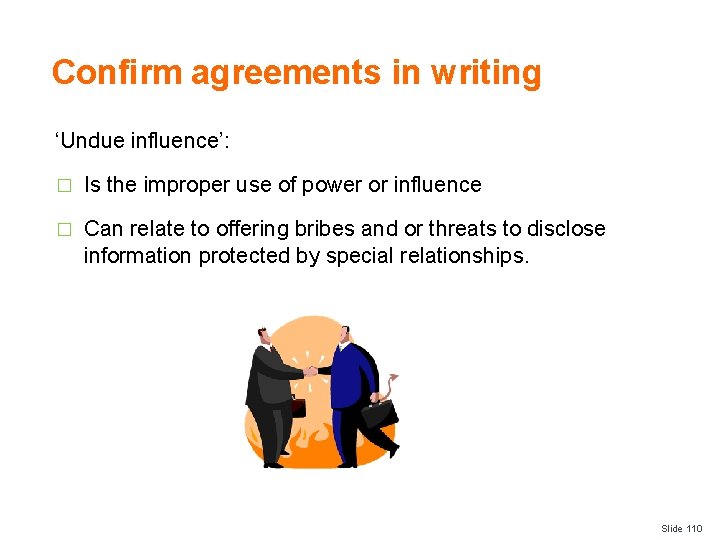
Confirm agreements in writing ‘Undue influence’: � Is the improper use of power or influence � Can relate to offering bribes and or threats to disclose information protected by special relationships. Slide 110
Confirm agreements in writing Topics discussed during negotiations can be distinguished as being either a ‘term of the contract’ or ‘mere representation’ related to the discussions: � A ‘term’ is central to the contract and gives rise to ‘breach of contract’ action � ‘Mere representation’ is not part of the contract and does not give rise to breach of contract action (unless deliberately fraudulent). Slide 111
Confirm agreements in writing Courts will identify if things are ‘terms’ or ‘representations’ based on: The stage at which the crucial statement was made during the course of the transaction � The importance attached to the statement by the parties � The form of the statement � � Knowledge of the person making the statement. Slide 112
Confirm agreements in writing Is the ‘term’ a ‘condition’ or ‘warranty’? � Courts make the distinction trying to identify the intention of parties when they contracted � ‘Conditions’ go to the heart of the contract – remedy for breach of these terms includes suing for damages and treating contract as repudiated � ‘Warranties’ are lesser terms – remedy for breach only allows damages to be claimed. Slide 113
Confirm agreements in writing ‘Exclusion clauses’: � Also known as ‘exclusion terms’ � Seek to limit liability of one party in respect of the contract � Found in many standard form contracts � Courts commonly finding for the party to whom the exclusion clause is applied � You will be bound by exclusion clauses if they are contained in a contract you sign regardless of whether or not you have read the contract. Slide 114
Confirm agreements in writing ‘Privity’: � Provides rules relating to govern legal relationships (responsibilities and rights) under contracts � In general terms ‘Parties to a contract cannot confer rights, or impose liabilities, upon anyone but themselves’. Slide 115
Confirm agreements in writing ‘Discharging’ a contract can occur one of six ways: � Performance � Tender or Attempted performance � Agreement (Continued) Slide 116
Confirm agreements in writing � Frustration � Breach � Operation of law. Slide 117
Confirm agreements in writing Operations of law: � Merger � Material alteration to written document � Death � Insolvency � Losing of the contract. Slide 118
Confirm agreements in writing Remedies for breach of contract: � Sue for damages � ‘Equitable remedy’” • ‘Specific performance’ • ‘Injunction’. Slide 119
Check and gain appropriate approvals formal agreements Before signing formal agreements they must be checked & approved by one (or more) of the following: � Owner or manager � Finance and accounting department � Department heads – as appropriate to the agreement � Sales and marketing department � Legal representative. Slide 120
Check and gain appropriate approvals formal agreements If approval is not given for a formal agreement, options include: � Re-negotiation � Withdrawal from negotiations and the proposed agreement. Slide 121
Identify need for, and seek, specialist advice From time-to-time specialist advice regarding contracts can be necessary in relation to: � Legal matters � Financial matters � Industrial relations matters. Slide 122
Identify need for, and seek, specialist advice Specialist legal advice may be needed when: Entering into a relationship with a new party � Entering into an agreement that is a new area for your organisation � Legislation relevant to the agreement has changed � The agreement involves a large sum of money (Continued) � Slide 123
Identify need for, and seek, specialist advice � � � There is a degree of urgency associated with the agreement The agreement involves a very high level of risk Where you are entering into a contract about something where you previously experienced legal problems The project is a long or large one The nature of the agreement is such it is contentious, risky or liable to be actioned. Slide 124
Identify need for, and seek, specialist advice Specialist financial advice may be needed to: � Source funds � Determine alternatives for obtaining equipment � Identify financial planning imperatives. Slide 125
Identify need for, and seek, specialist advice Specialist IR advice may be needed in relation to: � Preparation of employment instruments and work contracts � Determination of working conditions and pay rates � Establishment of dispute resolution protocols (Continued) Slide 126
Identify need for, and seek, specialist advice � Resolution of IR issues and disputes � Staff recruitment and selection � Disciplinary matters � Clarification of roles and responsibilities � Legal compliance issues. Slide 127
Summary – Element 3 When making formal business agreements: � Realise many industry contracts are not put in writing – a handshake or verbal agreement is often the only agreement � Putting it ‘in writing’ is the preferred option as it reduces confusion and gives certainty about intentions � Ensure the contract is valid from a legal perspective (Continued) Slide 128
Summary – Element 3 � Never make false statements or misrepresentations when negotiation a contract or agreement � Avoid applying duress or undue influence when contracting � Strive to clarify ambiguities � Be certain about all terms and conditions, warranties and guarantees (Continued) Slide 129
Summary – Element 3 � Realise signing a document commits you to whatever is in the document or contract you have signed � Understand the penalties for failing to discharge your obligations under the agreement � Obtain approval and authorisation before entering into any agreement � Seek legal, financial and industrial advice when necessary. Slide 130
Foster and maintain business relationships Performance Criteria for this Element are: � Pro-actively seek, review and act upon information needed to maintain sound business relationships � Honour agreements within the scope of individual responsibility (Continued) Slide 131
Foster and maintain business relationships � Make adjustments to agreements in consultation with the customer or supplier and share information with appropriate colleagues � Nurture relationships through regular contact. Slide 132
Maintain sound business relationships Opportunities to maintain relationships = those available to create them in the first place: � What are they? You MUST be proactive. Slide 133
Maintain sound business relationships Research is also needed to maintain relationships: � Talk to your network of industry contacts � Keep an eye on the news in the media � Be observant about media advertising � Obtain relevant annual reports � Visit relevant web sites and opposition properties. Slide 134
Maintain sound business relationships Benefits of fostering business relationships: � Personal friendships � Peer support � Chances to learn � Increased trade � More current information � Better access to better information. Slide 135
Maintain sound business relationships It is vital to use all information obtained about those with whom a business relationship exists to, for example: � Contact and congratulate them � Contact them and say you saw them in an article, on TV � Contact them and say you were talking to someone who knew and mentioned them � Contact them and make a revised offer or suggestion (Continued) Slide 136
Maintain sound business relationships � Contact them and provide new materials � Make contact with a new person � Update internal files � Share information. Slide 137
Honour agreements Honour all agreements within personal scope of authority, which will be: � Be explained to you when you join a business � Be relatively small to begin with � Grow as your experience grows. Slide 138
Honour agreements In relation to individual scope of authority: � Fully understand limits and parameters � Never act outside your scope of authority � Failure to adhere to existing scope of authority guidelines can result in all scope of authority permissions being revoked (or dismissal). Slide 139
Honour agreements Failing to honour agreements may result in: � Reduced customer satisfaction � Harm done to trust and rapport � Feeling the business is self-focussed � Legal action � Negative publicity � No ongoing relationship. Slide 140
Honour agreements Honouring agreements also involves: � Meeting ethical business standards and expectations � Achieving KPIs as specified in the agreement. Slide 141
Make adjustments and share information Where there is a need to adjust an existing arrangement or agreement: � Apply appropriate interpersonal skills � Be clear about the changes required � A verbal agreement may be all that is necessary � Never make unilateral changes. Slide 142
Make adjustments and share information Keys when making changes to agreements or arrangements: Clarify revised arrangements � Determine if extra charges (or refunds) need to be made � Advise others (as necessary) about the revised arrangements. � Slide 143
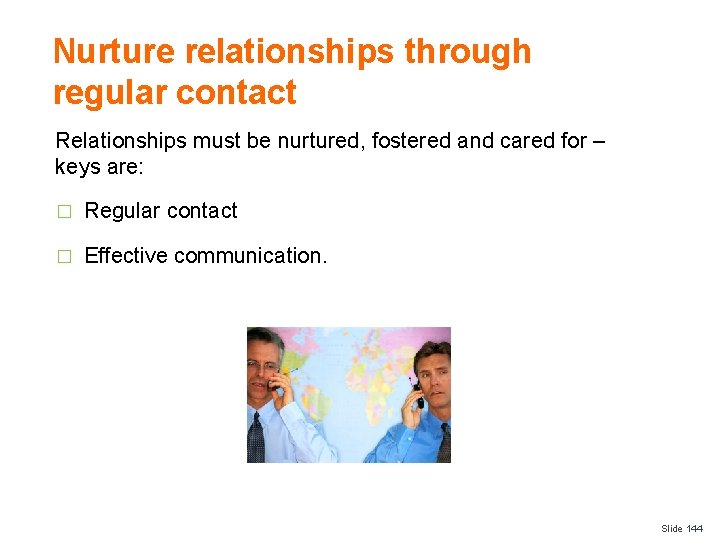
Nurture relationships through regular contact Relationships must be nurtured, fostered and cared for – keys are: � Regular contact � Effective communication. Slide 144
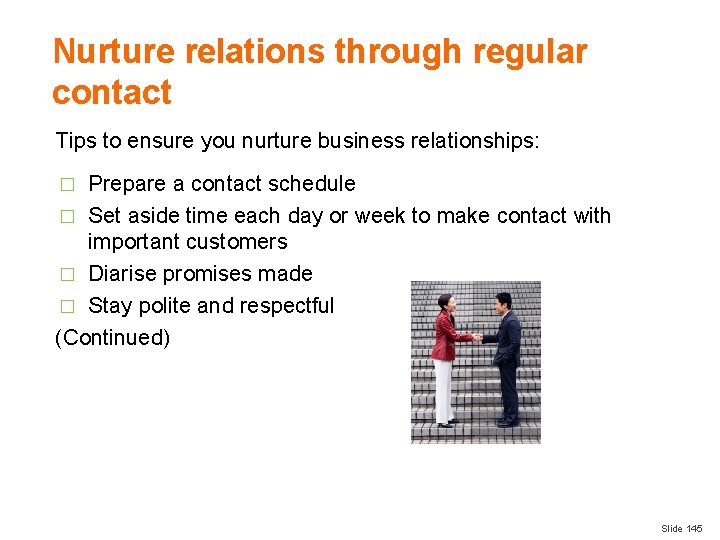
Nurture relations through regular contact Tips to ensure you nurture business relationships: Prepare a contact schedule � Set aside time each day or week to make contact with important customers � Diarise promises made � Stay polite and respectful (Continued) � Slide 145
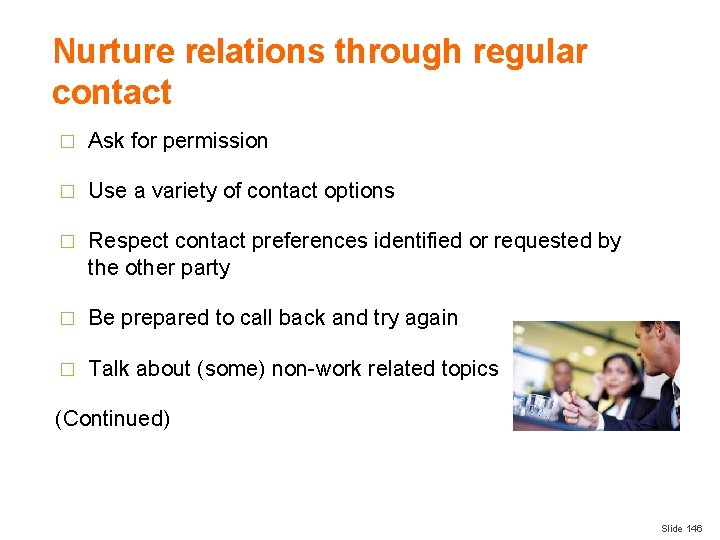
Nurture relations through regular contact � Ask for permission � Use a variety of contact options � Respect contact preferences identified or requested by the other party � Be prepared to call back and try again � Talk about (some) non-work related topics (Continued) Slide 146
Nurture relations through regular contact � Thank them � Meet with people in ‘out of work’ situations � Follow-up � Focus on the important things � Keep all promises made � Share the load � Review personal performance and adjust as required on the basis of feedback and or reflection. Slide 147
Summary – Element 4 When fostering and maintaining business relationships: � Understand the need to be proactive – never wait for the other party to make contact or nurture the relationship � Undertake research into identified important relationships to discover new or revised information � Use information discovered as the basis for making contact with other parties and communicating with them (Continued) Slide 148
Summary – Element 4 � Contact others outside a strictly work context � Keep all contacts professional, polite and respectful � Honour agreements made � Adhere to individual scope of authority when dealing with others – or involve others where needed to make decisions/ and take necessary action as required (Continued) Slide 149
Summary – Element 4 � Know the contents of all contracts and agreements so you know what customers expect and are entitled to � Seek to meet (or exceed) customer expectations � Apply standard business ethics in all dealings � Be prepared to make adjustments based on issues arising and changes to customer circumstances (Continued) Slide 150
Summary – Element 4 � Make regular contact � Use clear and effective communication � Review personal performance and adjust action accordingly. Slide 151
- Slides: 151