
Essentials of Transport Packaging An output from Sustainable
Essentials of Transport Packaging An output from Sustainable Packaging Coalition’s Member-led Working Group February 2013
Content • • Introduction to transport packaging Definition of Sustainable Packaging Transport packaging examples Value of transport packaging Business models Relations and implications to municipal solid waste Sustainability considerations Supply chain optimization
INTRODUCTION TO TRANSPORT PACKAGING
Tertiary or Transport Package is – A shipping unit that provides containment and protection to goods during handling, storage, and transportation. The term includes all industrial packaging and the shipping containers for consumer products. Source: Io. PP
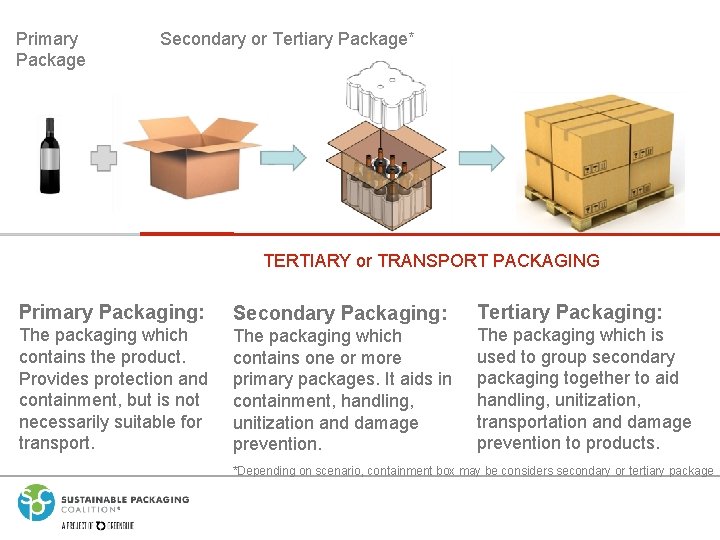
Primary Package Secondary or Tertiary Package* TERTIARY or TRANSPORT PACKAGING Primary Packaging: Secondary Packaging: Tertiary Packaging: The packaging which contains the product. Provides protection and containment, but is not necessarily suitable for transport. The packaging which contains one or more primary packages. It aids in containment, handling, unitization and damage prevention. The packaging which is used to group secondary packaging together to aid handling, unitization, transportation and damage prevention to products. *Depending on scenario, containment box may be considers secondary or tertiary package
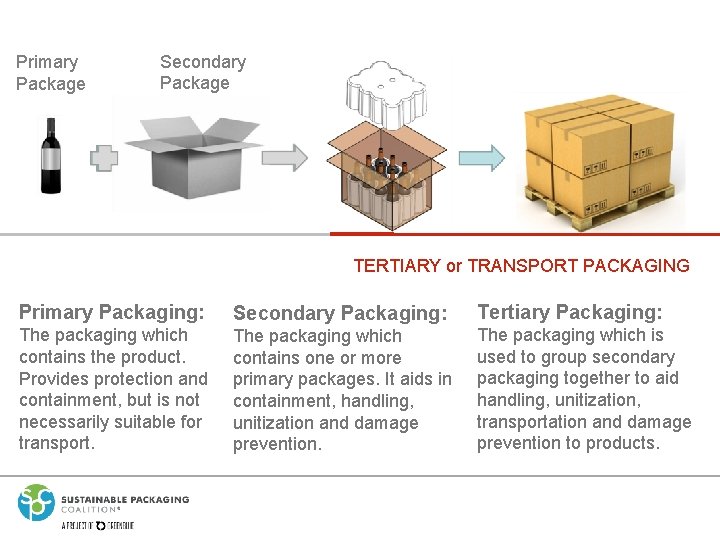
Primary Package Secondary Package TERTIARY or TRANSPORT PACKAGING Primary Packaging: Secondary Packaging: Tertiary Packaging: The packaging which contains the product. Provides protection and containment, but is not necessarily suitable for transport. The packaging which contains one or more primary packages. It aids in containment, handling, unitization and damage prevention. The packaging which is used to group secondary packaging together to aid handling, unitization, transportation and damage prevention to products.
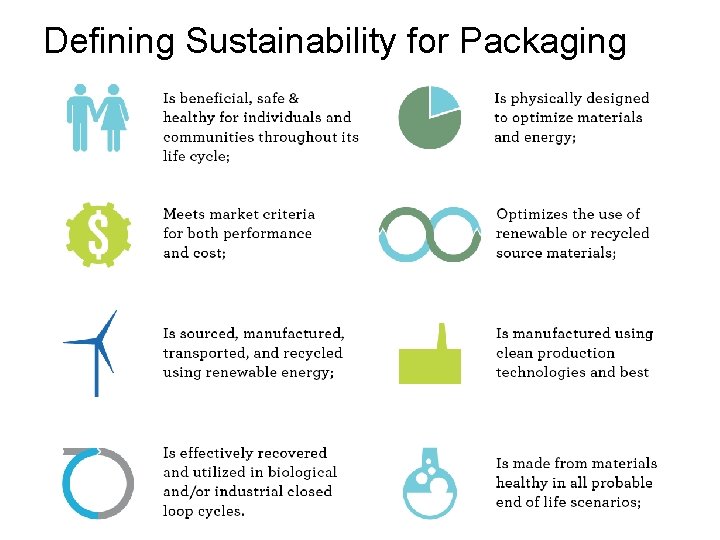
Defining Sustainability for Packaging
TRANSPORT PACKAGING EXAMPLES
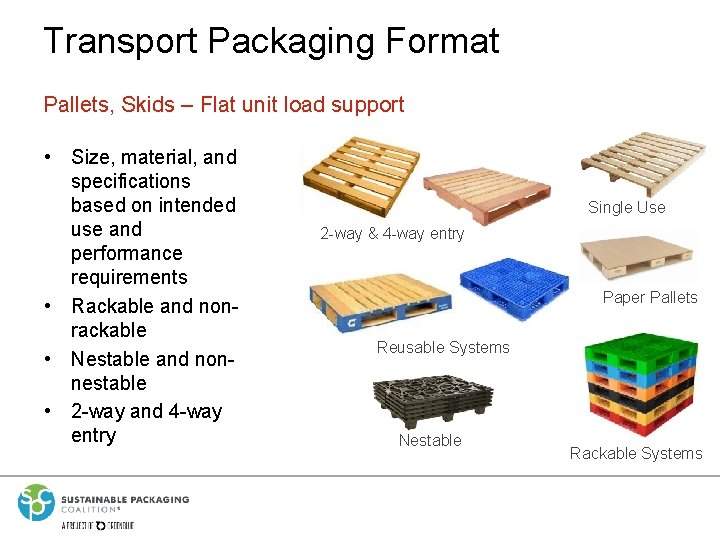
Transport Packaging Format Pallets, Skids – Flat unit load support • Size, material, and specifications based on intended use and performance requirements • Rackable and nonrackable • Nestable and nonnestable • 2 -way and 4 -way entry Single Use 2 -way & 4 -way entry Paper Pallets Reusable Systems Nestable Rackable Systems
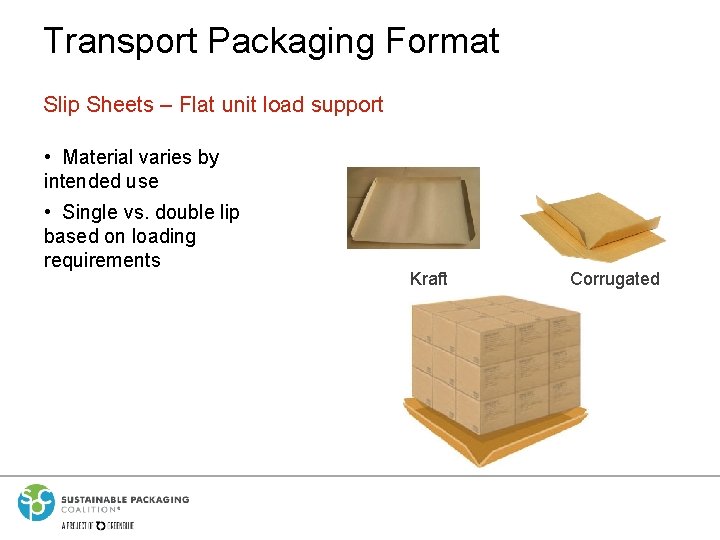
Transport Packaging Format Slip Sheets – Flat unit load support • Material varies by intended use • Single vs. double lip based on loading requirements Kraft Corrugated
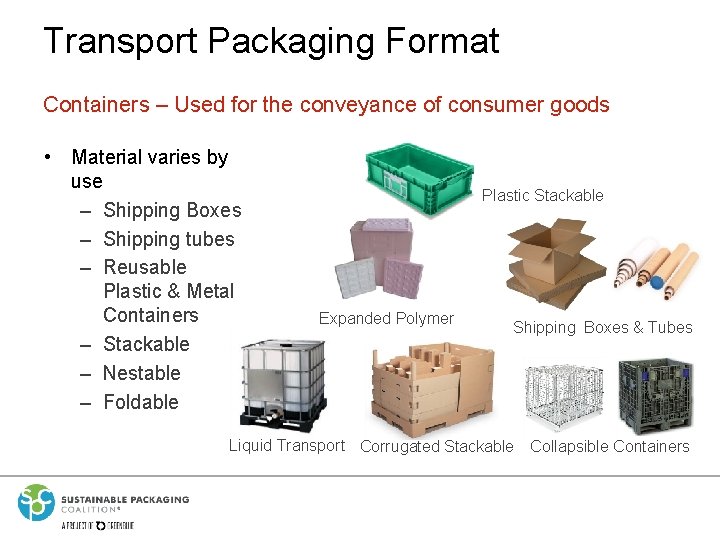
Transport Packaging Format Containers – Used for the conveyance of consumer goods • Material varies by use – Shipping Boxes – Shipping tubes – Reusable Plastic & Metal Containers – Stackable – Nestable – Foldable Plastic Stackable Expanded Polymer Shipping Boxes & Tubes Liquid Transport Corrugated Stackable Collapsible Containers
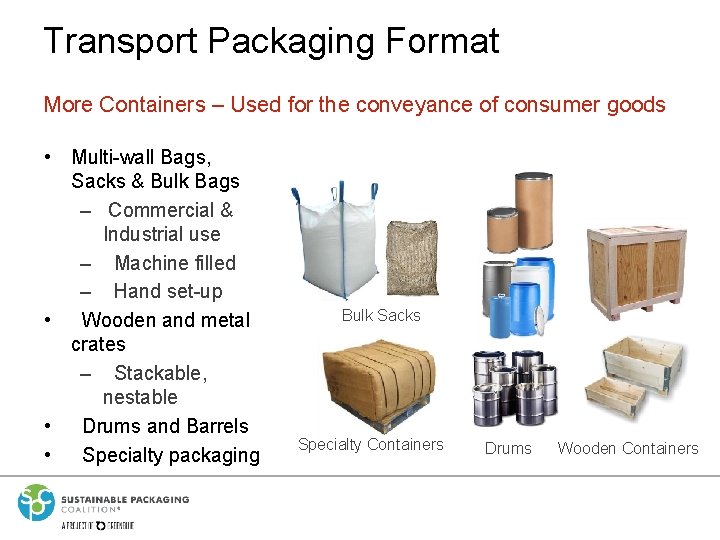
Transport Packaging Format More Containers – Used for the conveyance of consumer goods • Multi-wall Bags, Sacks & Bulk Bags – Commercial & Industrial use – Machine filled – Hand set-up • Wooden and metal crates – Stackable, nestable • Drums and Barrels • Specialty packaging Bulk Sacks Specialty Containers Drums Wooden Containers
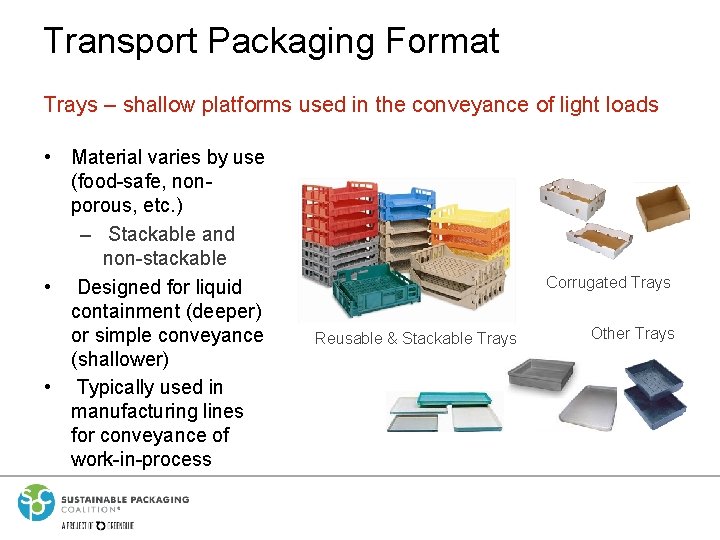
Transport Packaging Format Trays – shallow platforms used in the conveyance of light loads • Material varies by use (food-safe, nonporous, etc. ) – Stackable and non-stackable • Designed for liquid containment (deeper) or simple conveyance (shallower) • Typically used in manufacturing lines for conveyance of work-in-process Corrugated Trays Reusable & Stackable Trays Other Trays
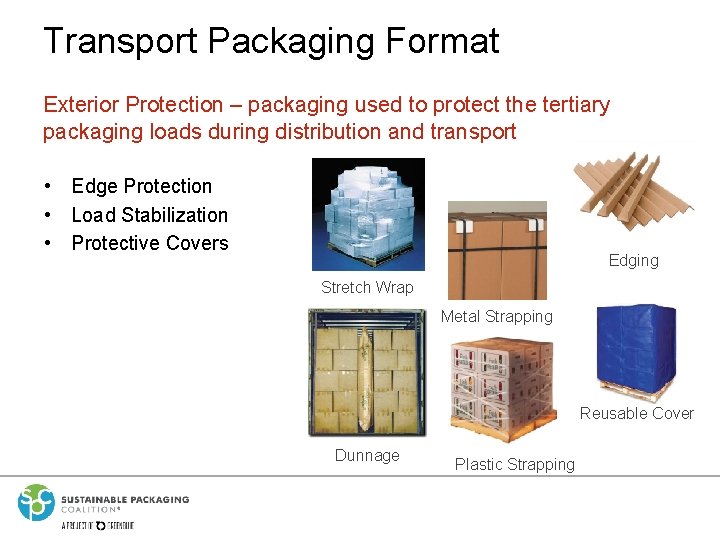
Transport Packaging Format Exterior Protection – packaging used to protect the tertiary packaging loads during distribution and transport • Edge Protection • Load Stabilization • Protective Covers Edging Stretch Wrap Metal Strapping Reusable Cover Dunnage Plastic Strapping
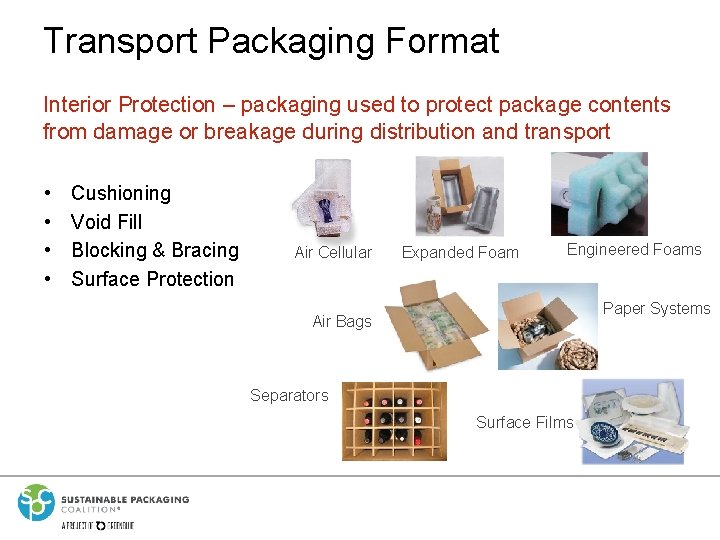
Transport Packaging Format Interior Protection – packaging used to protect package contents from damage or breakage during distribution and transport • • Cushioning Void Fill Blocking & Bracing Surface Protection Air Cellular Expanded Foam Engineered Foams Paper Systems Air Bags Separators Surface Films
VALUE OF TRANSPORT PACKAGING
Value of Transport Packaging Activities Benefits • Efficient movement of product • Efficient storage of product • Labels, tracking, graphics • Protection • Reducing fuel and transportation costs • Ease of retrieval, storage, material handling • Product identification and communication • Security, tamper evidence, damage minimization
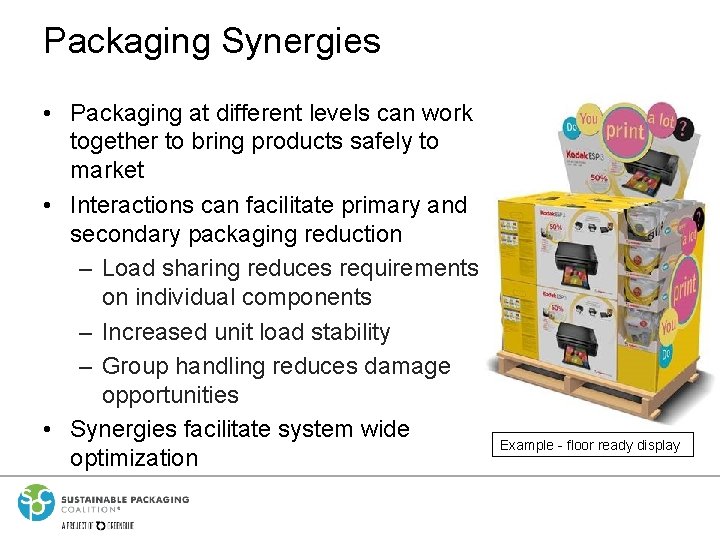
Packaging Synergies • Packaging at different levels can work together to bring products safely to market • Interactions can facilitate primary and secondary packaging reduction – Load sharing reduces requirements on individual components – Increased unit load stability – Group handling reduces damage opportunities • Synergies facilitate system wide optimization Example - floor ready display

BUSINESS MODELS
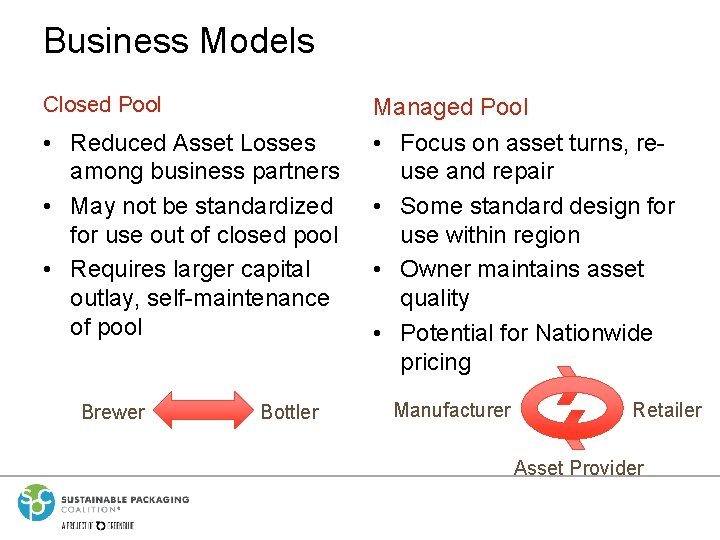
Business Models Closed Pool • Reduced Asset Losses among business partners • May not be standardized for use out of closed pool • Requires larger capital outlay, self-maintenance of pool Brewer Bottler Managed Pool • Focus on asset turns, reuse and repair • Some standard design for use within region • Owner maintains asset quality • Potential for Nationwide pricing Manufacturer Retailer Asset Provider
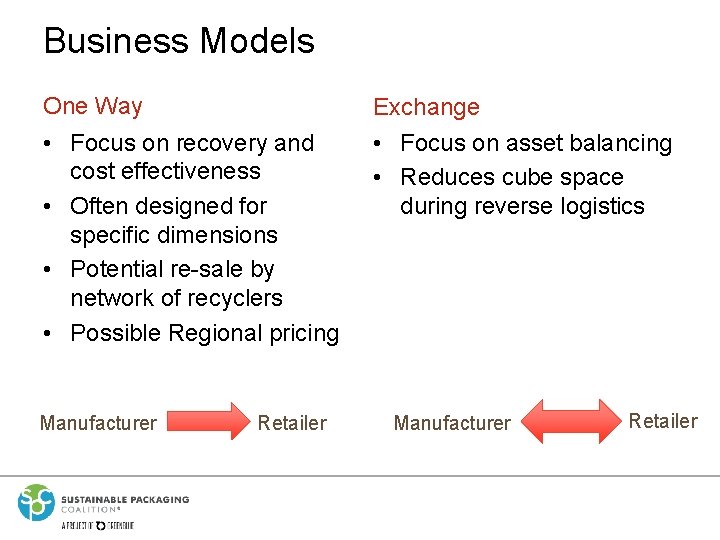
Business Models One Way • Focus on recovery and cost effectiveness • Often designed for specific dimensions • Potential re-sale by network of recyclers • Possible Regional pricing Manufacturer Retailer Exchange • Focus on asset balancing • Reduces cube space during reverse logistics Manufacturer Retailer
PACKAGING IN MUNICIPAL SOLID WASTE
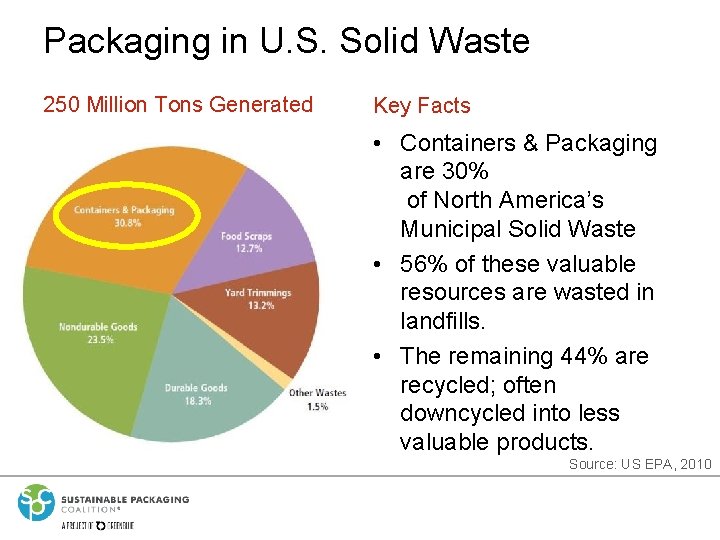
Packaging in U. S. Solid Waste 250 Million Tons Generated Key Facts • Containers & Packaging are 30% of North America’s Municipal Solid Waste • 56% of these valuable resources are wasted in landfills. • The remaining 44% are recycled; often downcycled into less valuable products. Source: US EPA, 2010
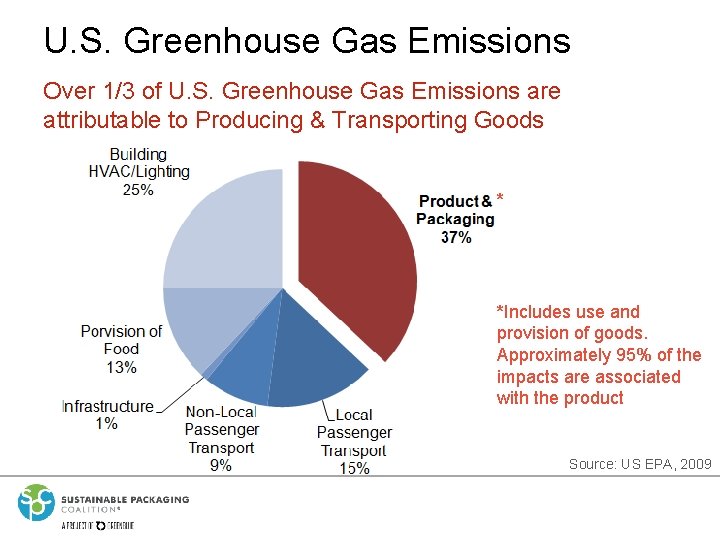
U. S. Greenhouse Gas Emissions Over 1/3 of U. S. Greenhouse Gas Emissions are attributable to Producing & Transporting Goods * *Includes use and provision of goods. Approximately 95% of the impacts are associated with the product Source: US EPA, 2009
SUSTAINABILITY CONSIDERATIONS
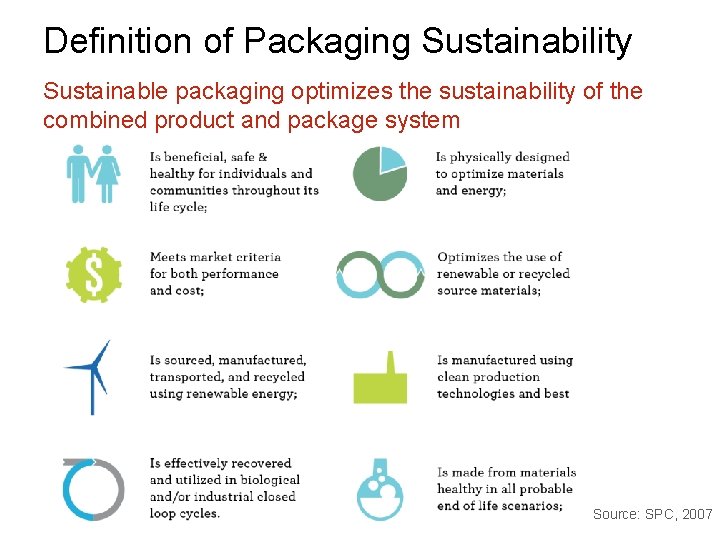
Definition of Packaging Sustainability Sustainable packaging optimizes the sustainability of the combined product and package system Source: SPC, 2007
Important Sustainability Considerations • Damage Reduction: – As “light weighting” removes material, Transport Packaging increasingly needs to facilitate damage reduction • Cost / Material Value – What cost is market willing to pay? – Will package be recoverable for reuse, recycling, or composting? • Dimensions – Loaded footprint, loaded trailer cube, return cube – Nestable or collapsable
Important Sustainability Considerations • Weight – Lower weight saves fuel but can sacrifice strength • Strength – Racking safety, payload capacity • Ease of Handling – Manual or equipment focus – Load / unload / clean time • Conveyance of Information – May accept labels, identify regulation compliance, or track units
Important Sustainability Considerations • Material Health – Is the package safe and healthy for individuals and communities throughout its life cycle? – Is it beneficial/restorative to the natural environment? – What chemicals/materials are used to meet fire or invasive species codes? • Reusability – Is it able to be re-used in its current form multiple times in the supply chain?
Important Sustainability Considerations • Recyclability – Can it be effectively recovered and utilized in biological and/or industrial closed loop cycles? – Recyclable – in theory or practice? • Recycled Content – Does it optimizes the use of renewable or recycled source materials? • Material Weight / Strength – Lower weight saves fuel but can sacrifice strength and ability to repair the asset
Important Sustainability Considerations • Repairability – Easy to repair and reclaim individual components? • Ease of Sourcing – How rare and far away does the material come from?
Important Sustainability Considerations • Quantifying and Communicating Environmental Benefits • Use widely accepted, third party verified standards and certifications (eg. ISO 14040) • Life Cycle Assessment (LCA) • Consider waste, energy, GHG emissions.
SUPPLY CHAIN OPTIMIZATION & COLLABORATION
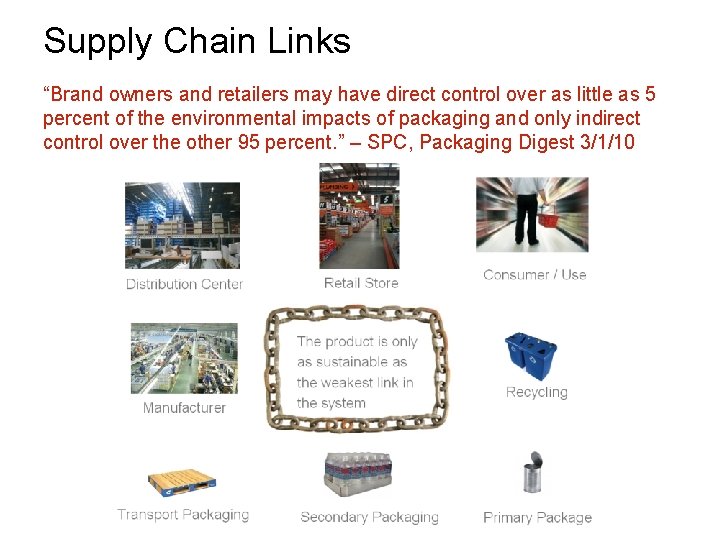
Supply Chain Links “Brand owners and retailers may have direct control over as little as 5 percent of the environmental impacts of packaging and only indirect control over the other 95 percent. ” – SPC, Packaging Digest 3/1/10
Collaboration for Packaging Value Benefits of Collaboration Considerations • Best Practices Sharing • Solve Challenges outside of vacuum • Solutions can be expanded & transferred to other businesses or industries • Interaction with other companies help businesses develop their technology • Performance requirements • Regulatory compliance requirements • Technical/operational factors • Aesthetic considerations • Material availability • Cost
- Slides: 35