
Essentials of Organizational Behavior 13 e Stephen P
Essentials of Organizational Behavior 13 e Stephen P. Robbins & Timothy A. Judge Chapter 5 Personality and Values Copyright © 2016 Pearson Education, Inc. 5 -1

Chapter 1 What Is Organizational Behavior? Copyright © 2016 Pearson Education, Inc. 1 -2
After studying this chapter you should be able to: 1. Demonstrate the importance of interpersonal skills in the workplace. 2. Define organizational behavior (OB). 3. Show the value to OB of systematic study. 4. Identify the major behavioral science disciplines that contribute to OB. 5. Demonstrate why few absolutes apply to OB. 6. Identify the challenges and opportunities managers have in applying OB concepts. 7. Compare three levels of analysis in this text’s OB model. Copyright © 2016 Pearson Education, Inc. 1 -3
The Importance of Interpersonal Skills Good people skills are important Good places to work have superior financial performance Developing managers’ interpersonal skills helps attract and keep high-performing employees There is a strong association between the quality of workplace relationships and employee job satisfaction, stress, and turnover Increasing OB principles can foster social responsibility awareness Copyright © 2016 Pearson Education, Inc. 1 -4
The Field of Organizational Behavior Organizational behavior studies the influence that individuals, groups, and structure have on behavior within organizations Its chief goal is to apply that knowledge toward improving an organization’s effectiveness Copyright © 2016 Pearson Education, Inc. 1 -5
Focal Points of OB Jobs Work Absenteeism Employment turnover Productivity Human performance Management Copyright © 2016 Pearson Education, Inc. 1 -6
Complementing Intuition with Systematic Study Intuition: your “gut feeling” explanation of behavior Systematic study improves ability to accurately predict behavior Assumes behavior is not random Fundamental consistencies underlie behavior These can be identified and modified to reflect individual differences Copyright © 2016 Pearson Education, Inc. 1 -7
Systematic Study Examines relationships Attempts to attribute causes and effects Bases conclusions on scientific evidence: Data is gathered under controlled conditions Data is measured and interpreted in a reasonably rigorous manner Copyright © 2016 Pearson Education, Inc. 1 -8
Evidence-Based Management Evidence-based management: Bases decisions on the best available scientific evidence Complements systematic study Forces managers to become more scientific in their thinking Copyright © 2016 Pearson Education, Inc. 1 -9
Big Data Big data: the extensive use of statistical compilation and analysis Identify persistent and predictive statistics Create targeted marketing strategies Using big data for managerial practices: Define objectives, develop theories of causality, test theories to see which employee activities are relevant to the objectives Copyright © 2016 Pearson Education, Inc. 1 -10
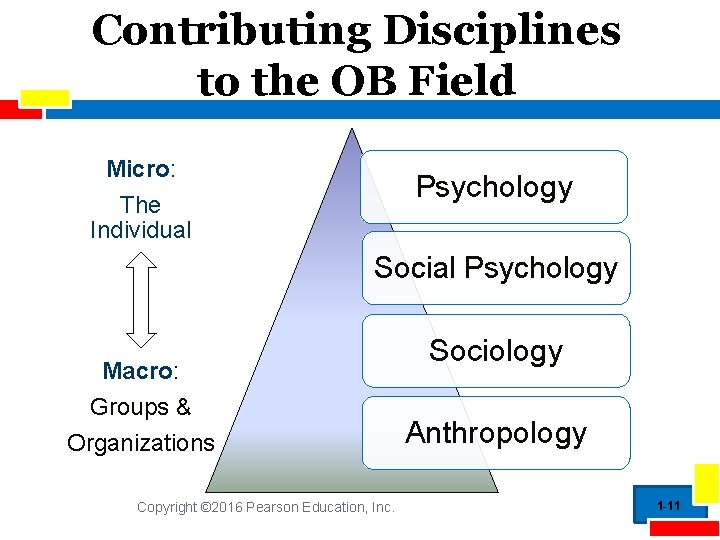
Contributing Disciplines to the OB Field Micro: The Individual Psychology Social Psychology Macro: Groups & Organizations Copyright © 2016 Pearson Education, Inc. Sociology Anthropology 1 -11
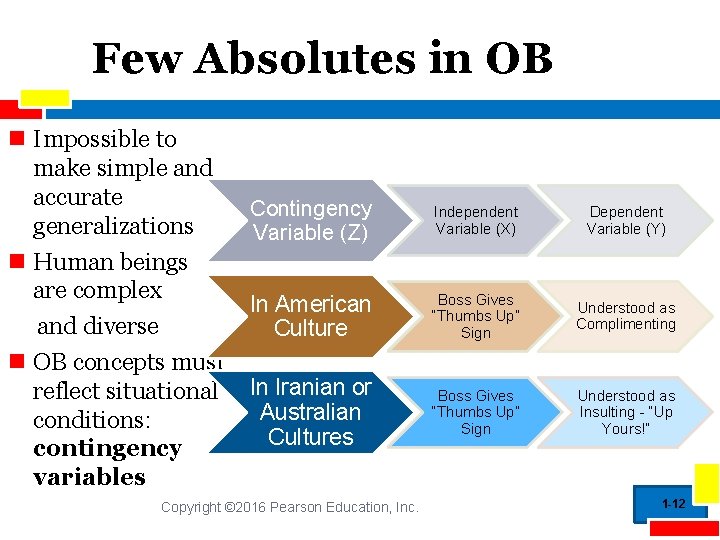
Few Absolutes in OB Impossible to make simple and accurate generalizations Human beings are complex and diverse OB concepts must reflect situational conditions: contingency variables Contingency Variable (Z) Independent Variable (X) Dependent Variable (Y) In American Culture Boss Gives “Thumbs Up” Sign Understood as Complimenting In Iranian or Australian Cultures Boss Gives “Thumbs Up” Sign Understood as Insulting - “Up Yours!” Copyright © 2016 Pearson Education, Inc. 1 -12
Challenges and Opportunities for OB Responding to economic pressures Responding to globalization Managing workplace diversity Improving customer service Improving people skills Working in networked organizations Enhancing employee well-being at work Creating a positive work environment Improving ethical behavior Copyright © 2016 Pearson Education, Inc. 1 -13
Responding to Economic Pressures Effective management can be just as hard, if not harder, in ‘good’ economic times as in ‘bad’ economic times Good management can be the difference between survival and failure Copyright © 2016 Pearson Education, Inc. 1 -14
Responding to Globalization Increased foreign assignments Working with people from different cultures Overseeing movement of jobs to countries with low-cost labor Adapting to differing cultural and regulatory norms Copyright © 2016 Pearson Education, Inc. 1 -15
Managing Workforce Diversity Workforce diversity: organizations are becoming a more heterogeneous mix of people in terms of gender, age, race, ethnicity, and sexual orientation Copyright © 2016 Pearson Education, Inc. 1 -16
Improving Customer Service and People Skills The majority of employees in developed nations work in service jobs They must know how to please their customers People skills are essential to success in today’s organizations Copyright © 2016 Pearson Education, Inc. 1 -17
Working in Networked Organizations Managers must adapt their skills and communication styles to succeed in a networked organization Copyright © 2016 Pearson Education, Inc. 1 -18
Enhancing Employee Well-Being at Work The line between work and non-work has blurred and managers are increasingly dealing with conflicts that arise between work and life away from work Copyright © 2016 Pearson Education, Inc. 1 -19
Creating a Positive Work Environment Positive organizational scholarship: how organizations develop human strengths, foster vitality and resilience, and unlock potential Focus on what’s good about an organization, not what’s bad Copyright © 2016 Pearson Education, Inc. 1 -20
Improving Ethical Behavior Managers facing ethical dilemmas or ethical choices are required to identify right and wrong conduct This can be difficult in a global economy where different cultures approach decisions from different perspectives Companies promoting strong ethical missions: Encourage employees to behave with integrity Provide strong leadership that influence employee decisions to behave ethically Copyright © 2016 Pearson Education, Inc. 1 -21
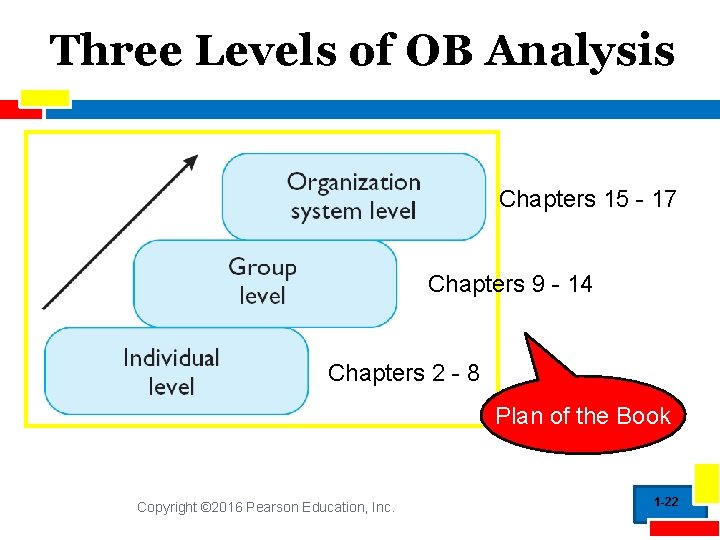
Three Levels of OB Analysis Chapters 15 - 17 Chapters 9 - 14 Chapters 2 - 8 Plan of the Book Copyright © 2016 Pearson Education, Inc. 1 -22
Implications for Managers Don’t rely on generalizations Use metrics and situational variables rather than “hunches” to explain cause-and-effect relationships Increase leadership potential by improving interpersonal skills Improve technical and conceptual skills by staying current with trends like big data Recognize the role of organizational behavior on employee work quality and productivity Use organizational behavior to help design and implement change programs, improve customer service, and address the work-life balance conflict Copyright © 2016 Pearson Education, Inc. 1 -23
Keep in Mind… OB’s goal is to understand predict human behavior in organizations Fundamental consistencies underlie behavior It is more important than ever to learn OB concepts Both managers and employees must learn to cope with temporariness Copyright © 2016 Pearson Education, Inc. 1 -24
Summary 1. Demonstrated the importance of interpersonal skills in the workplace. 2. Defined Organizational Behavior (OB). 3. Showed the value to OB of systematic study. 4. Identified the major behavioral science disciplines that contribute to OB. 5. Demonstrated how few absolutes apply in OB. 6. Identified the major challenges and opportunities managers have in applying OB concepts. 7. Identified the three levels of analysis in OB. Copyright © 2016 Pearson Education, Inc. 1 -25
Copyright © 2016 Pearson Education, Inc. 1 -26
- Slides: 26