
Essentials of Modern Business Statistics 7 e Anderson
Essentials of Modern Business Statistics (7 e) Anderson, Sweeney, Williams, Camm, Cochran © 2018 Cengage Learning © 2018 Cengage Learning. May not be scanned, copied or duplicated, or posted to a publicly accessible website, in whole or in part, except for use as permitted in a license distributed with a certain product or service or otherwise on a password-protected website or school-approved learning management system for classroom use. 1

Essentials of Modern Business Statistics (7 e) § Chapter 7 Sampling and Sampling Distributions © 2018 Cengage Learning. May not be scanned, copied or duplicated, or posted to a publicly accessible website, in whole or in part, except for use as permitted in a license distributed with a certain product or service or otherwise on a password-protected website or school-approved learning management system for classroom use. 2
Essentials of Modern Business Statistics (7 e) Introduction An element is the entity on which data are collected. A population is a collection of all the elements of interest. A sample is a subset of the population. The sampled population is the population from which the sample is drawn. § A frame is a list of the elements that the sample will be selected from. § § © 2018 Cengage Learning. May not be scanned, copied or duplicated, or posted to a publicly accessible website, in whole or in part, except for use as permitted in a license distributed with a certain product or service or otherwise on a password-protected website or school-approved learning management system for classroom use. 3
Essentials of Modern Business Statistics (7 e) Introduction § The reason we select a sample is to collect data to answer a research question about a population. § The sample results provide only estimates of the values of the population characteristics. § The reason is simply that the sample contains only a portion of the population. § With proper sampling methods, the sample results can provide “good” estimates of the population characteristics. © 2018 Cengage Learning. May not be scanned, copied or duplicated, or posted to a publicly accessible website, in whole or in part, except for use as permitted in a license distributed with a certain product or service or otherwise on a password-protected website or school-approved learning management system for classroom use. 4
Essentials of Modern Business Statistics (7 e) Selecting a Sample § Sampling from a Finite Population § Sampling from an Infinite Population © 2018 Cengage Learning. May not be scanned, copied or duplicated, or posted to a publicly accessible website, in whole or in part, except for use as permitted in a license distributed with a certain product or service or otherwise on a password-protected website or school-approved learning management system for classroom use. 5
Essentials of Modern Business Statistics (7 e) Sampling from a Finite Population § Finite populations are often defined by lists such as: § Organization membership roster § Credit card account numbers § Inventory product numbers § A simple random sample of size n from a finite population of size N is a sample selected such that each possible sample of size n has the same probability of being selected. © 2018 Cengage Learning. May not be scanned, copied or duplicated, or posted to a publicly accessible website, in whole or in part, except for use as permitted in a license distributed with a certain product or service or otherwise on a password-protected website or school-approved learning management system for classroom use. 6
Essentials of Modern Business Statistics (7 e) Sampling from a Finite Population § Replacing each sampled element before selecting subsequent elements is called sampling with replacement. § Sampling without replacement is the procedure used most often. § In large sampling projects, computer-generated random numbers are often used to automate the sample selection process. © 2018 Cengage Learning. May not be scanned, copied or duplicated, or posted to a publicly accessible website, in whole or in part, except for use as permitted in a license distributed with a certain product or service or otherwise on a password-protected website or school-approved learning management system for classroom use. 7
Essentials of Modern Business Statistics (7 e) Sampling from a Finite Population Example: National Baseball League teams There are 16 teams that played in 2012 national baseball league. Suppose we want to select a simple random sample of 5 teams to conduct in-depth interviews about how they manage their minor legal franchises. © 2018 Cengage Learning. May not be scanned, copied or duplicated, or posted to a publicly accessible website, in whole or in part, except for use as permitted in a license distributed with a certain product or service or otherwise on a password-protected website or school-approved learning management system for classroom use. 8
Essentials of Modern Business Statistics (7 e) Sampling from a Finite Population Example: National Baseball League teams Step 1: Assign a random number to each of the 16 teams in the population. The random numbers generated by Excel’s RAND function follow a uniform probability distribution between 0 and 1. Step 2: Select the five teams corresponding to the 5 smallest random numbers as the sample. © 2018 Cengage Learning. May not be scanned, copied or duplicated, or posted to a publicly accessible website, in whole or in part, except for use as permitted in a license distributed with a certain product or service or otherwise on a password-protected website or school-approved learning management system for classroom use. 9
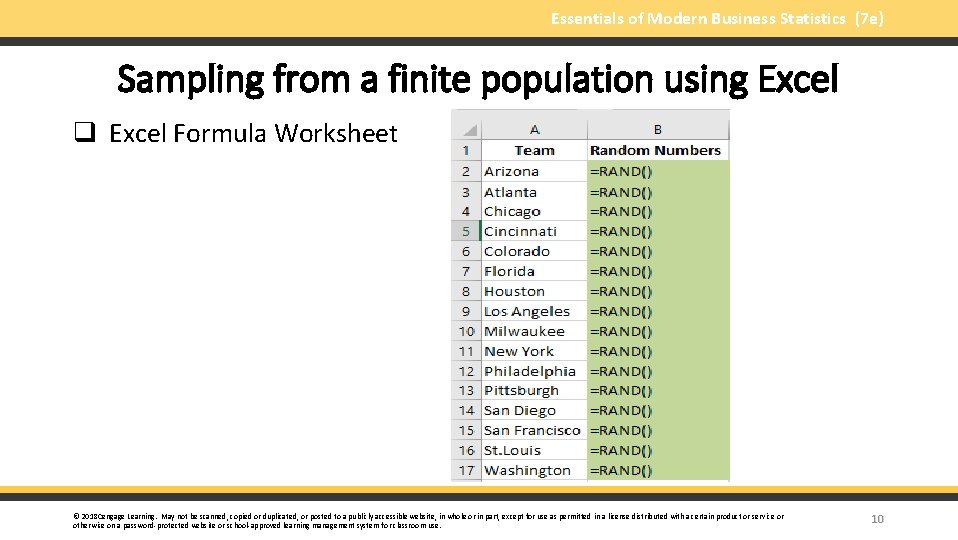
Essentials of Modern Business Statistics (7 e) Sampling from a finite population using Excel q Excel Formula Worksheet © 2018 Cengage Learning. May not be scanned, copied or duplicated, or posted to a publicly accessible website, in whole or in part, except for use as permitted in a license distributed with a certain product or service or otherwise on a password-protected website or school-approved learning management system for classroom use. 10
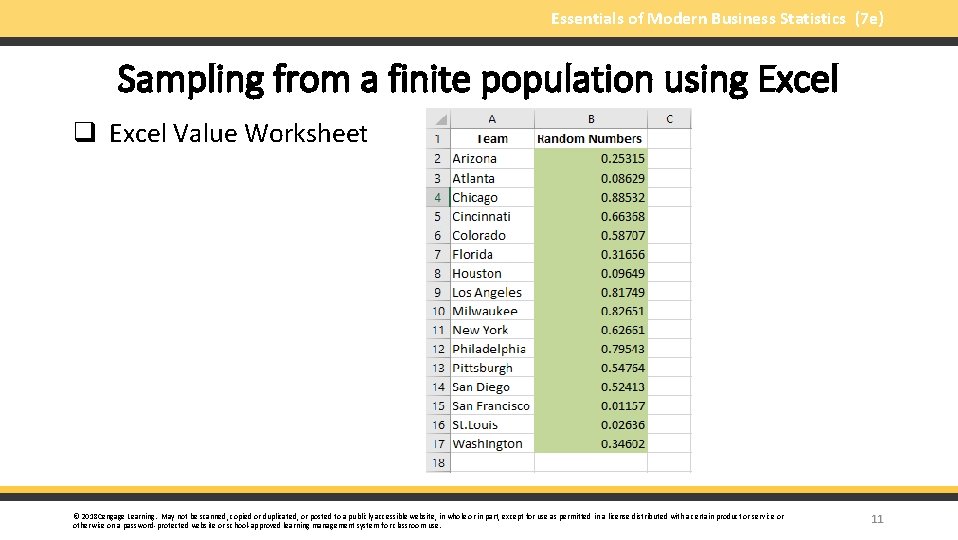
Essentials of Modern Business Statistics (7 e) Sampling from a finite population using Excel q Excel Value Worksheet © 2018 Cengage Learning. May not be scanned, copied or duplicated, or posted to a publicly accessible website, in whole or in part, except for use as permitted in a license distributed with a certain product or service or otherwise on a password-protected website or school-approved learning management system for classroom use. 11
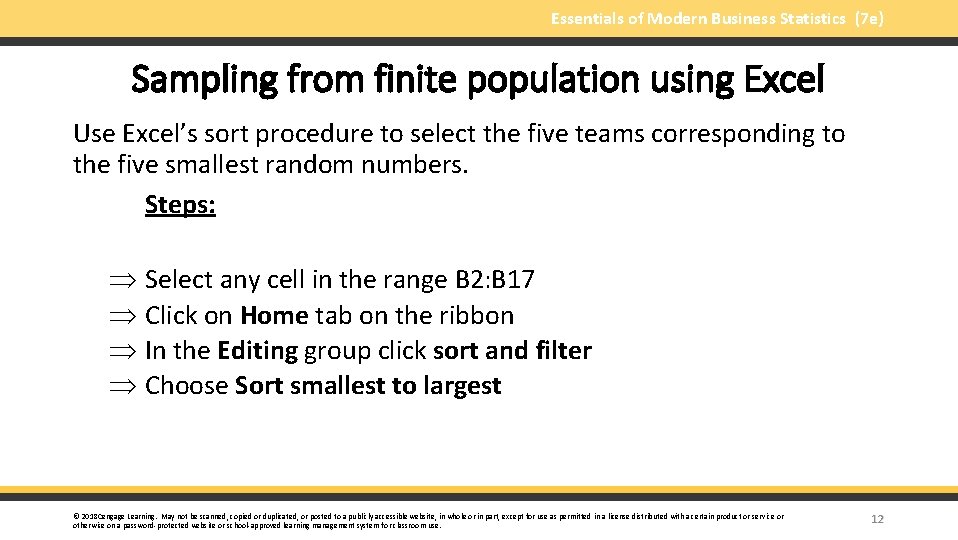
Essentials of Modern Business Statistics (7 e) Sampling from finite population using Excel Use Excel’s sort procedure to select the five teams corresponding to the five smallest random numbers. Steps: Þ Select any cell in the range B 2: B 17 Þ Click on Home tab on the ribbon Þ In the Editing group click sort and filter Þ Choose Sort smallest to largest © 2018 Cengage Learning. May not be scanned, copied or duplicated, or posted to a publicly accessible website, in whole or in part, except for use as permitted in a license distributed with a certain product or service or otherwise on a password-protected website or school-approved learning management system for classroom use. 12
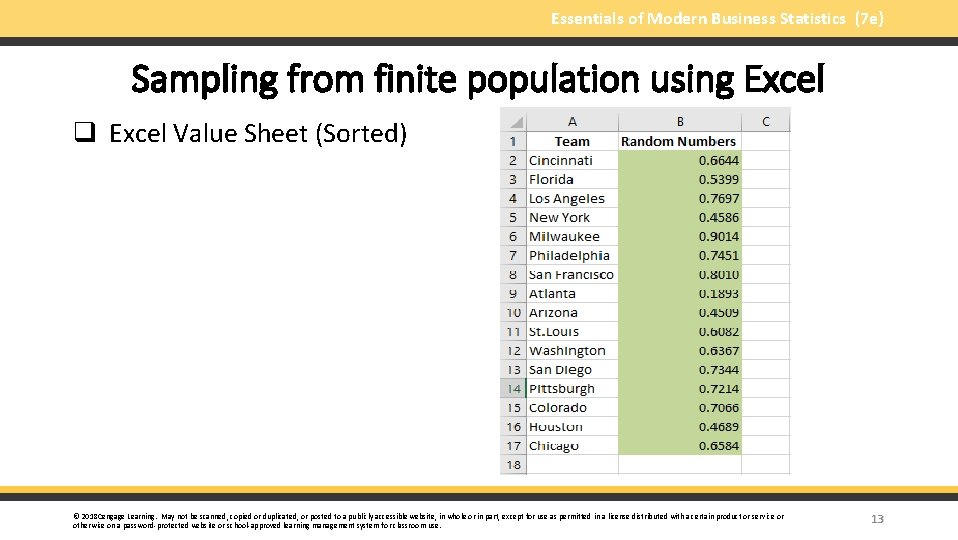
Essentials of Modern Business Statistics (7 e) Sampling from finite population using Excel q Excel Value Sheet (Sorted) © 2018 Cengage Learning. May not be scanned, copied or duplicated, or posted to a publicly accessible website, in whole or in part, except for use as permitted in a license distributed with a certain product or service or otherwise on a password-protected website or school-approved learning management system for classroom use. 13
Essentials of Modern Business Statistics (7 e) Sampling from an Infinite Population § Sometimes we want to select a sample, but find it is not possible to obtain a list of all elements in the population. § As a result, we cannot construct a frame for the population. § Hence, we cannot use the random number selection procedure. § Most often this situation occurs in infinite population cases. © 2018 Cengage Learning. May not be scanned, copied or duplicated, or posted to a publicly accessible website, in whole or in part, except for use as permitted in a license distributed with a certain product or service or otherwise on a password-protected website or school-approved learning management system for classroom use. 14
Essentials of Modern Business Statistics (7 e) Sampling from an Infinite Population § Populations are often generated by an ongoing process where there is no upper limit on the number of units that can be generated. § Some examples of on-going processes, with infinite populations, are: Ø Parts being manufactured on a production line Ø Transactions occurring at a bank Ø Telephone calls arriving at a technical help desk Ø Customers entering a store © 2018 Cengage Learning. May not be scanned, copied or duplicated, or posted to a publicly accessible website, in whole or in part, except for use as permitted in a license distributed with a certain product or service or otherwise on a password-protected website or school-approved learning management system for classroom use. 15
Essentials of Modern Business Statistics (7 e) Sampling from an Infinite Population § In the case of an infinite population, we must select a random sample in order to make valid statistical inferences about the population from which the sample is taken. § A random sample from an infinite population is a sample selected such that the following conditions are satisfied. § Each element selected comes from the population of interest. § Each element is selected independently. © 2018 Cengage Learning. May not be scanned, copied or duplicated, or posted to a publicly accessible website, in whole or in part, except for use as permitted in a license distributed with a certain product or service or otherwise on a password-protected website or school-approved learning management system for classroom use. 16
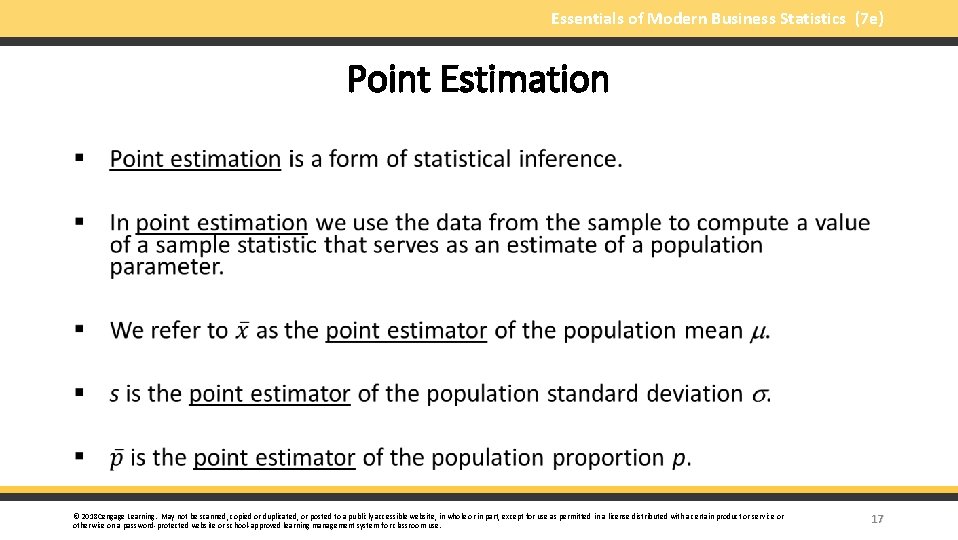
Essentials of Modern Business Statistics (7 e) Point Estimation § © 2018 Cengage Learning. May not be scanned, copied or duplicated, or posted to a publicly accessible website, in whole or in part, except for use as permitted in a license distributed with a certain product or service or otherwise on a password-protected website or school-approved learning management system for classroom use. 17
Essentials of Modern Business Statistics (7 e) Point Estimation Example: EAI Employee Data Out of a total number of 2500 employees, a simple random sample of 30 employees and corresponding data on annual salary and management training program participation are shown in the given table. x 1, x 2 …. . xn is used to denote annual salary of the employees and the participation in the management training program is indicated by a yes / no. © 2018 Cengage Learning. May not be scanned, copied or duplicated, or posted to a publicly accessible website, in whole or in part, except for use as permitted in a license distributed with a certain product or service or otherwise on a password-protected website or school-approved learning management system for classroom use. 18
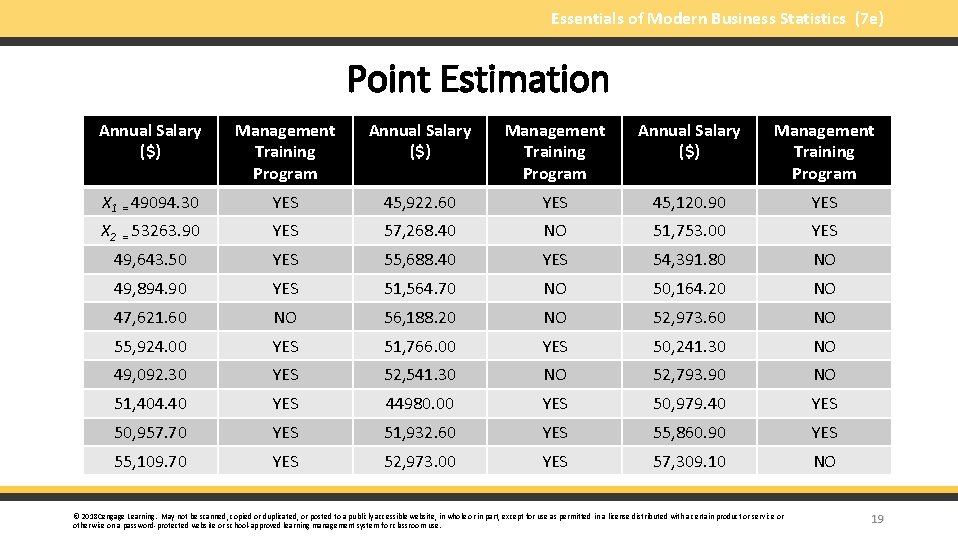
Essentials of Modern Business Statistics (7 e) Point Estimation Annual Salary ($) Management Training Program X 1 = 49094. 30 YES 45, 922. 60 YES 45, 120. 90 YES X 2 = 53263. 90 YES 57, 268. 40 NO 51, 753. 00 YES 49, 643. 50 YES 55, 688. 40 YES 54, 391. 80 NO 49, 894. 90 YES 51, 564. 70 NO 50, 164. 20 NO 47, 621. 60 NO 56, 188. 20 NO 52, 973. 60 NO 55, 924. 00 YES 51, 766. 00 YES 50, 241. 30 NO 49, 092. 30 YES 52, 541. 30 NO 52, 793. 90 NO 51, 404. 40 YES 44980. 00 YES 50, 979. 40 YES 50, 957. 70 YES 51, 932. 60 YES 55, 860. 90 YES 55, 109. 70 YES 52, 973. 00 YES 57, 309. 10 NO © 2018 Cengage Learning. May not be scanned, copied or duplicated, or posted to a publicly accessible website, in whole or in part, except for use as permitted in a license distributed with a certain product or service or otherwise on a password-protected website or school-approved learning management system for classroom use. 19
Essentials of Modern Business Statistics (7 e) Point Estimation To estimate the value of population parameter, we can compute the corresponding characteristic of the sample, referred to as sample statistic. Note: Different random numbers will identify different sample which would result different point estimates. © 2018 Cengage Learning. May not be scanned, copied or duplicated, or posted to a publicly accessible website, in whole or in part, except for use as permitted in a license distributed with a certain product or service or otherwise on a password-protected website or school-approved learning management system for classroom use. 20
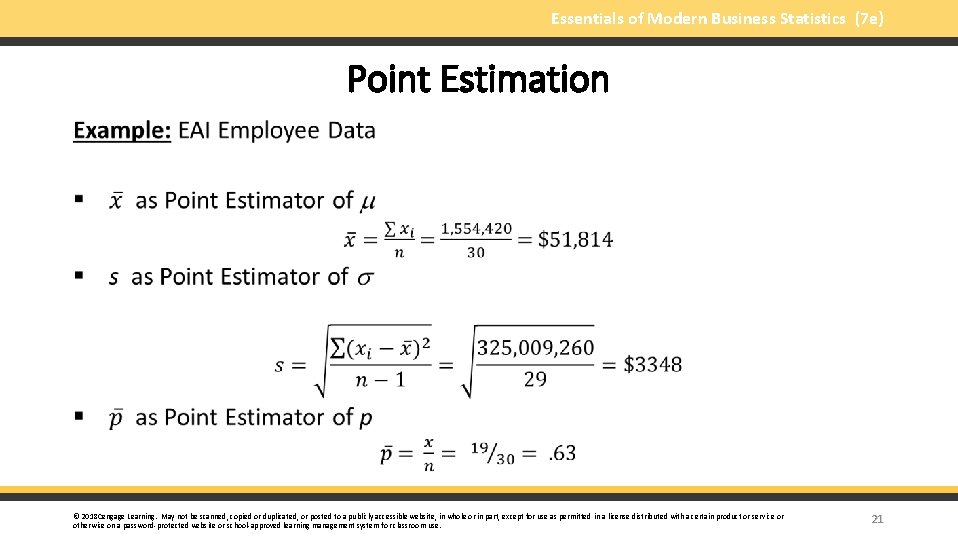
Essentials of Modern Business Statistics (7 e) Point Estimation § © 2018 Cengage Learning. May not be scanned, copied or duplicated, or posted to a publicly accessible website, in whole or in part, except for use as permitted in a license distributed with a certain product or service or otherwise on a password-protected website or school-approved learning management system for classroom use. 21
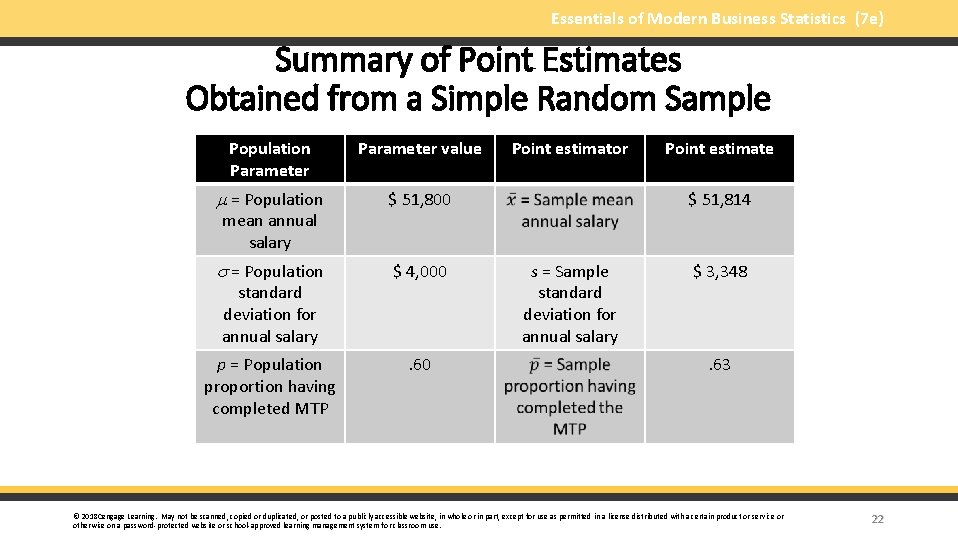
Essentials of Modern Business Statistics (7 e) Summary of Point Estimates Obtained from a Simple Random Sample Population Parameter value m = Population $ 51, 800 s = Population $ 4, 000 p = Population proportion having completed MTP . 60 mean annual salary standard deviation for annual salary Point estimator Point estimate $ 51, 814 s = Sample standard deviation for annual salary $ 3, 348 . 63 © 2018 Cengage Learning. May not be scanned, copied or duplicated, or posted to a publicly accessible website, in whole or in part, except for use as permitted in a license distributed with a certain product or service or otherwise on a password-protected website or school-approved learning management system for classroom use. 22
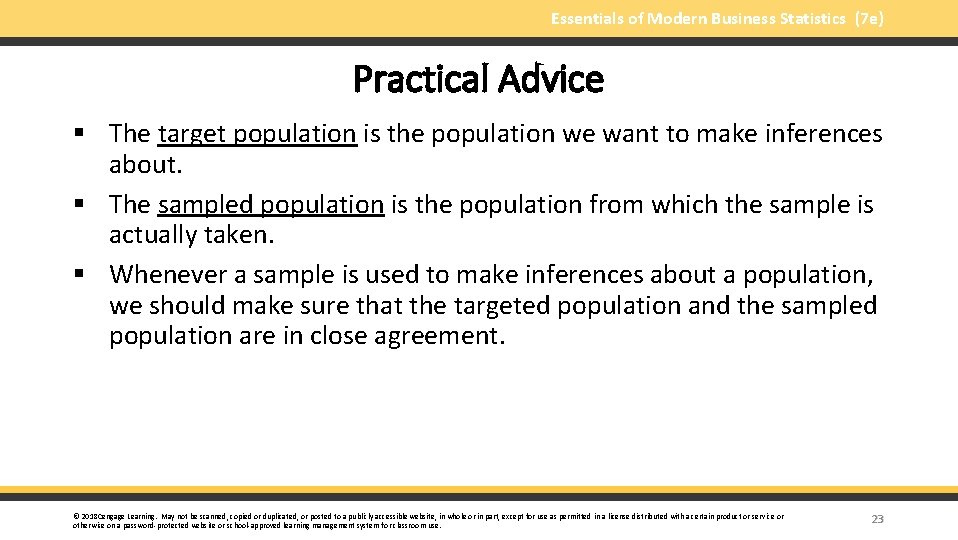
Essentials of Modern Business Statistics (7 e) Practical Advice § The target population is the population we want to make inferences about. § The sampled population is the population from which the sample is actually taken. § Whenever a sample is used to make inferences about a population, we should make sure that the targeted population and the sampled population are in close agreement. © 2018 Cengage Learning. May not be scanned, copied or duplicated, or posted to a publicly accessible website, in whole or in part, except for use as permitted in a license distributed with a certain product or service or otherwise on a password-protected website or school-approved learning management system for classroom use. 23
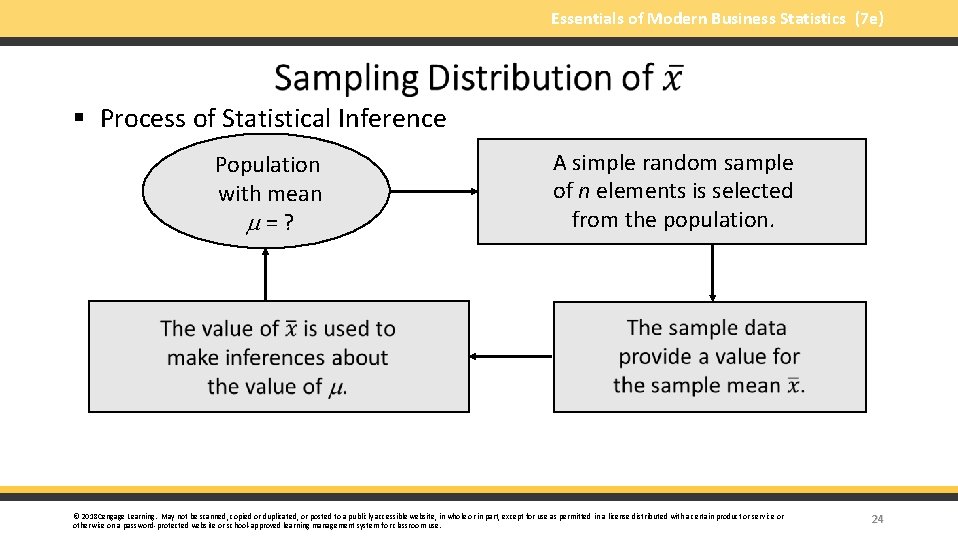
Essentials of Modern Business Statistics (7 e) § Process of Statistical Inference Population with mean m = ? A simple random sample of n elements is selected from the population. © 2018 Cengage Learning. May not be scanned, copied or duplicated, or posted to a publicly accessible website, in whole or in part, except for use as permitted in a license distributed with a certain product or service or otherwise on a password-protected website or school-approved learning management system for classroom use. 24
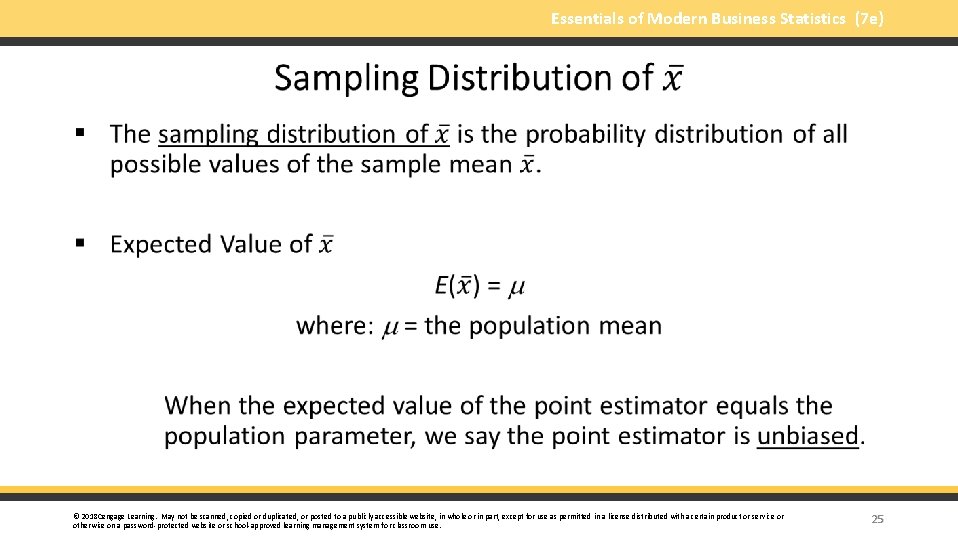
Essentials of Modern Business Statistics (7 e) § © 2018 Cengage Learning. May not be scanned, copied or duplicated, or posted to a publicly accessible website, in whole or in part, except for use as permitted in a license distributed with a certain product or service or otherwise on a password-protected website or school-approved learning management system for classroom use. 25
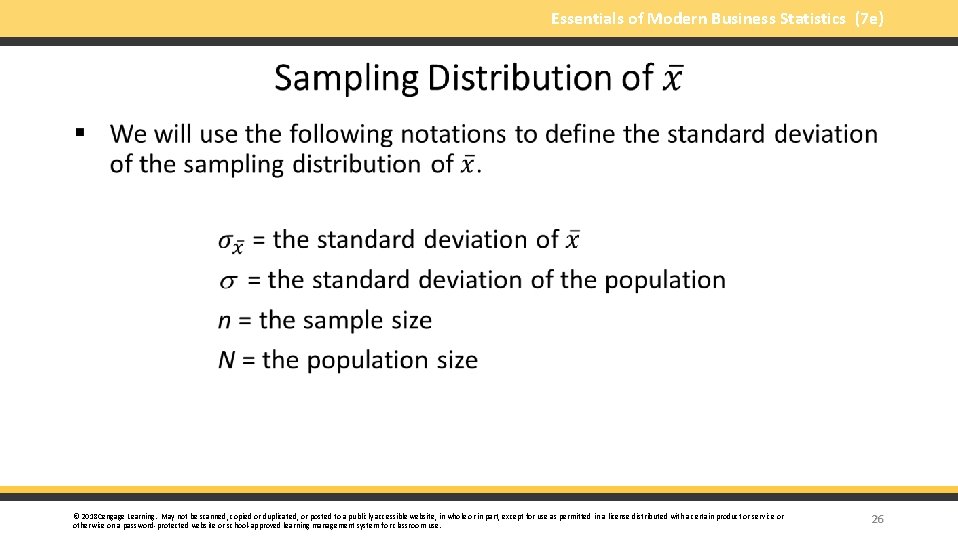
Essentials of Modern Business Statistics (7 e) § © 2018 Cengage Learning. May not be scanned, copied or duplicated, or posted to a publicly accessible website, in whole or in part, except for use as permitted in a license distributed with a certain product or service or otherwise on a password-protected website or school-approved learning management system for classroom use. 26
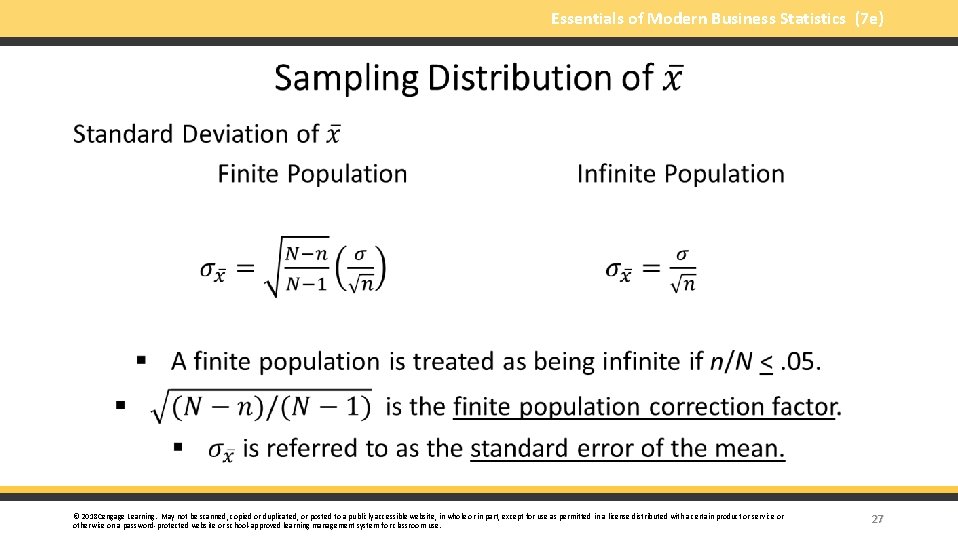
Essentials of Modern Business Statistics (7 e) § © 2018 Cengage Learning. May not be scanned, copied or duplicated, or posted to a publicly accessible website, in whole or in part, except for use as permitted in a license distributed with a certain product or service or otherwise on a password-protected website or school-approved learning management system for classroom use. 27
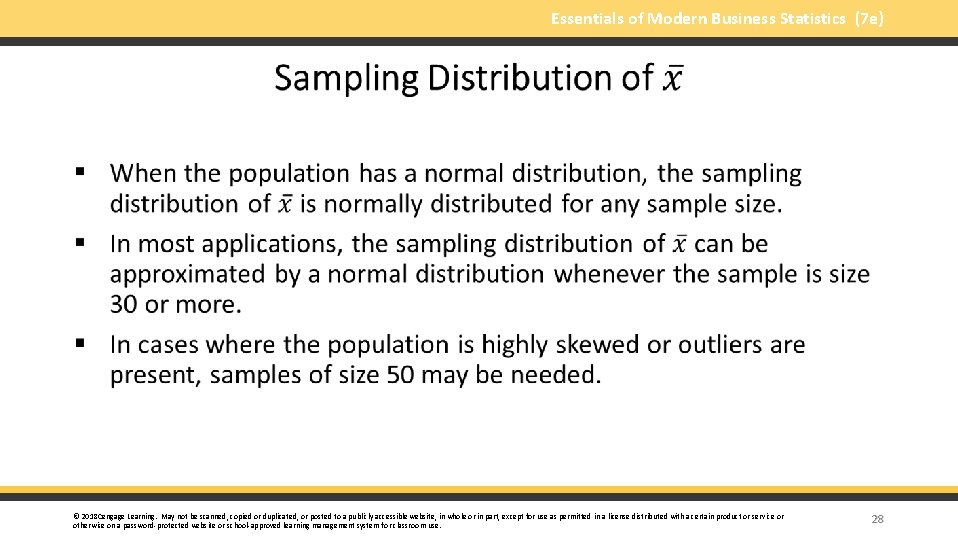
Essentials of Modern Business Statistics (7 e) § © 2018 Cengage Learning. May not be scanned, copied or duplicated, or posted to a publicly accessible website, in whole or in part, except for use as permitted in a license distributed with a certain product or service or otherwise on a password-protected website or school-approved learning management system for classroom use. 28
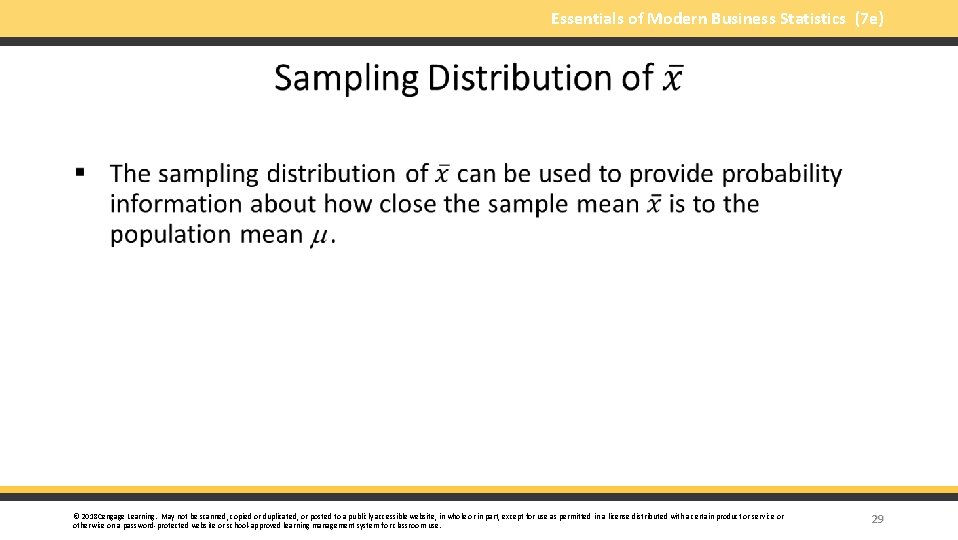
Essentials of Modern Business Statistics (7 e) § © 2018 Cengage Learning. May not be scanned, copied or duplicated, or posted to a publicly accessible website, in whole or in part, except for use as permitted in a license distributed with a certain product or service or otherwise on a password-protected website or school-approved learning management system for classroom use. 29
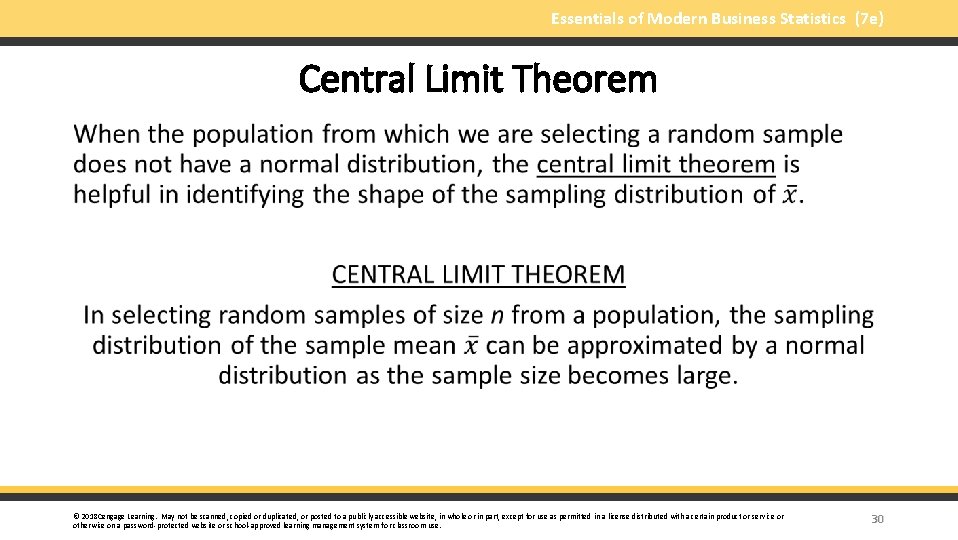
Essentials of Modern Business Statistics (7 e) Central Limit Theorem § © 2018 Cengage Learning. May not be scanned, copied or duplicated, or posted to a publicly accessible website, in whole or in part, except for use as permitted in a license distributed with a certain product or service or otherwise on a password-protected website or school-approved learning management system for classroom use. 30
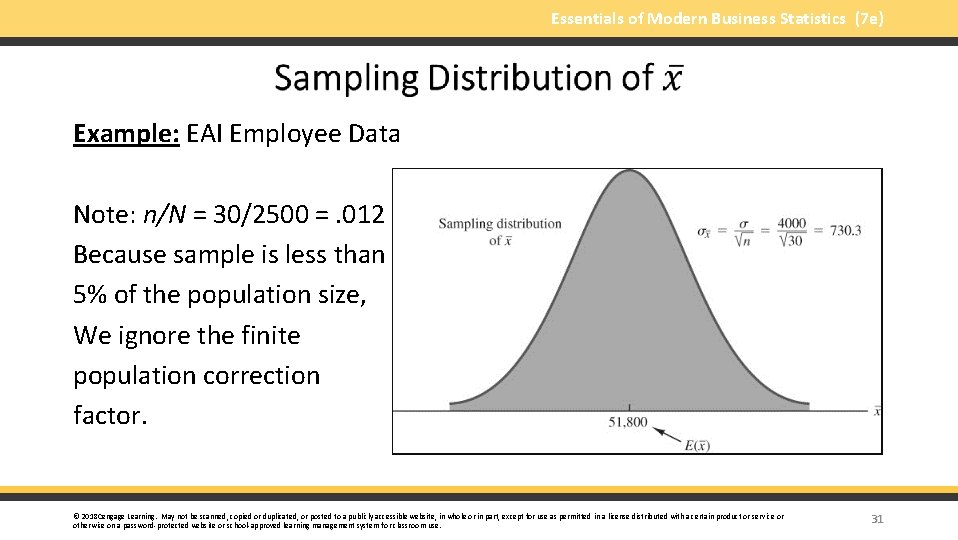
Essentials of Modern Business Statistics (7 e) Example: EAI Employee Data Note: n/N = 30/2500 =. 012 Because sample is less than 5% of the population size, We ignore the finite population correction factor. © 2018 Cengage Learning. May not be scanned, copied or duplicated, or posted to a publicly accessible website, in whole or in part, except for use as permitted in a license distributed with a certain product or service or otherwise on a password-protected website or school-approved learning management system for classroom use. 31
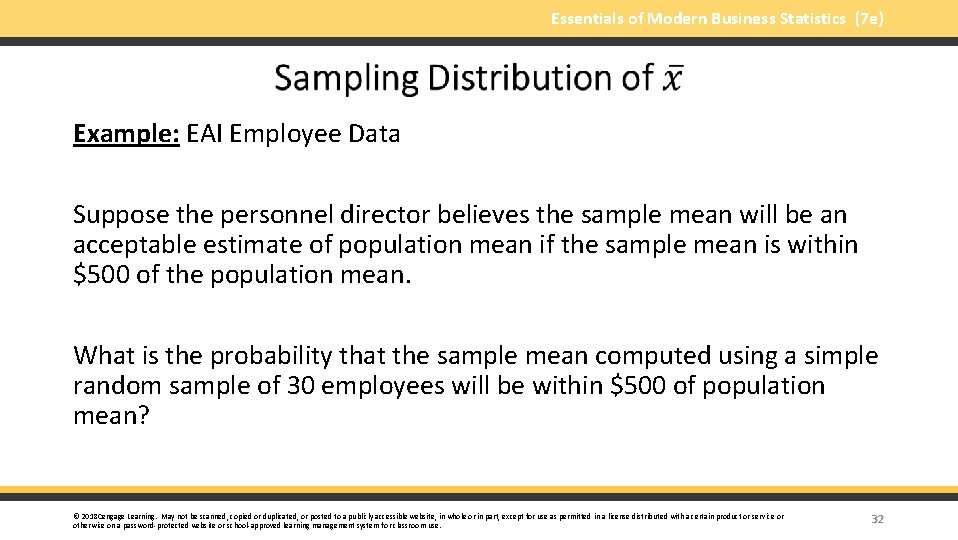
Essentials of Modern Business Statistics (7 e) Example: EAI Employee Data Suppose the personnel director believes the sample mean will be an acceptable estimate of population mean if the sample mean is within $500 of the population mean. What is the probability that the sample mean computed using a simple random sample of 30 employees will be within $500 of population mean? © 2018 Cengage Learning. May not be scanned, copied or duplicated, or posted to a publicly accessible website, in whole or in part, except for use as permitted in a license distributed with a certain product or service or otherwise on a password-protected website or school-approved learning management system for classroom use. 32
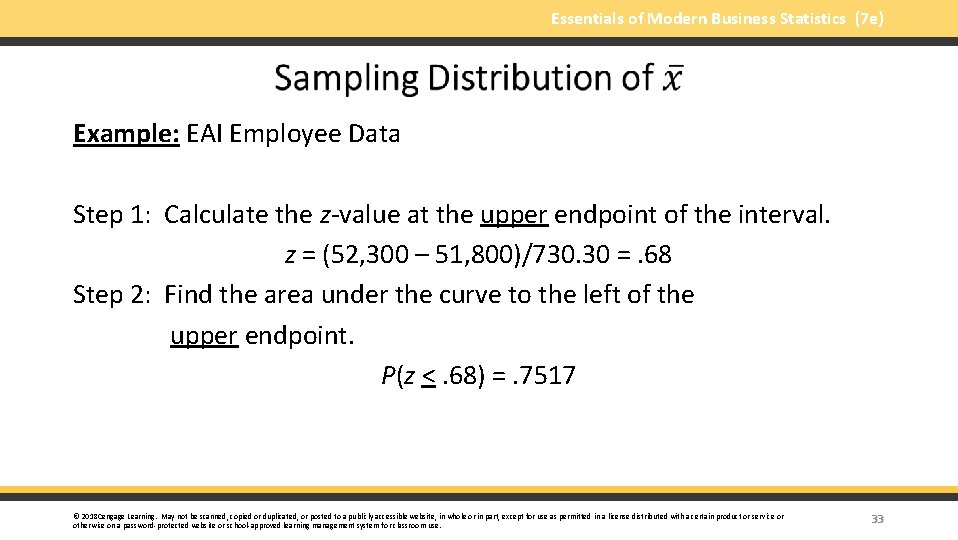
Essentials of Modern Business Statistics (7 e) Example: EAI Employee Data Step 1: Calculate the z-value at the upper endpoint of the interval. z = (52, 300 – 51, 800)/730. 30 =. 68 Step 2: Find the area under the curve to the left of the upper endpoint. P(z <. 68) =. 7517 © 2018 Cengage Learning. May not be scanned, copied or duplicated, or posted to a publicly accessible website, in whole or in part, except for use as permitted in a license distributed with a certain product or service or otherwise on a password-protected website or school-approved learning management system for classroom use. 33
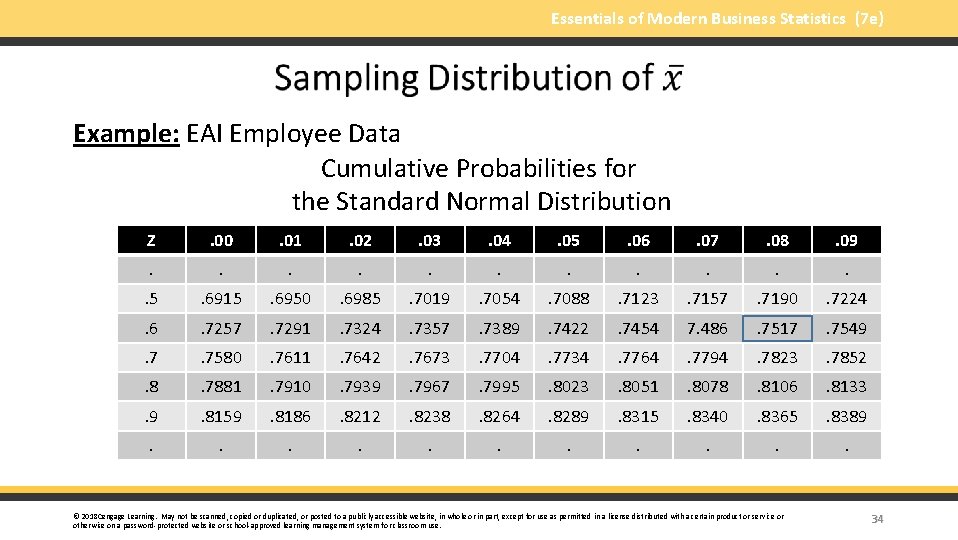
Essentials of Modern Business Statistics (7 e) Example: EAI Employee Data Cumulative Probabilities for the Standard Normal Distribution Z . 00 . 01 . 02 . 03 . 04 . 05 . 06 . 07 . 08 . 09 . . . 5 . 6915 . 6950 . 6985 . 7019 . 7054 . 7088 . 7123 . 7157 . 7190 . 7224 . 6 . 7257 . 7291 . 7324 . 7357 . 7389 . 7422 . 7454 7. 486 . 7517 . 7549 . 7580 . 7611 . 7642 . 7673 . 7704 . 7734 . 7764 . 7794 . 7823 . 7852 . 8 . 7881 . 7910 . 7939 . 7967 . 7995 . 8023 . 8051 . 8078 . 8106 . 8133 . 9 . 8159 . 8186 . 8212 . 8238 . 8264 . 8289 . 8315 . 8340 . 8365 . 8389 . . . © 2018 Cengage Learning. May not be scanned, copied or duplicated, or posted to a publicly accessible website, in whole or in part, except for use as permitted in a license distributed with a certain product or service or otherwise on a password-protected website or school-approved learning management system for classroom use. 34
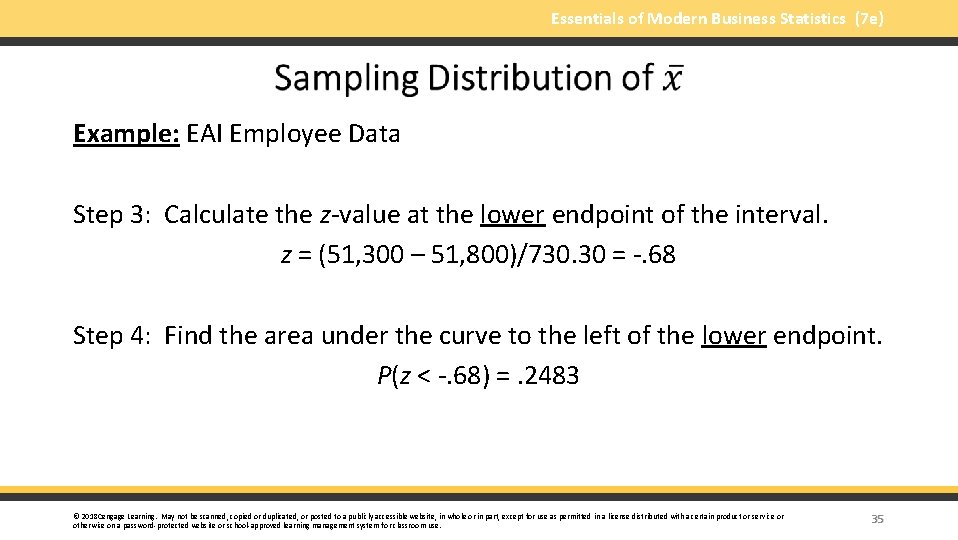
Essentials of Modern Business Statistics (7 e) Example: EAI Employee Data Step 3: Calculate the z-value at the lower endpoint of the interval. z = (51, 300 – 51, 800)/730. 30 = -. 68 Step 4: Find the area under the curve to the left of the lower endpoint. P(z < -. 68) =. 2483 © 2018 Cengage Learning. May not be scanned, copied or duplicated, or posted to a publicly accessible website, in whole or in part, except for use as permitted in a license distributed with a certain product or service or otherwise on a password-protected website or school-approved learning management system for classroom use. 35
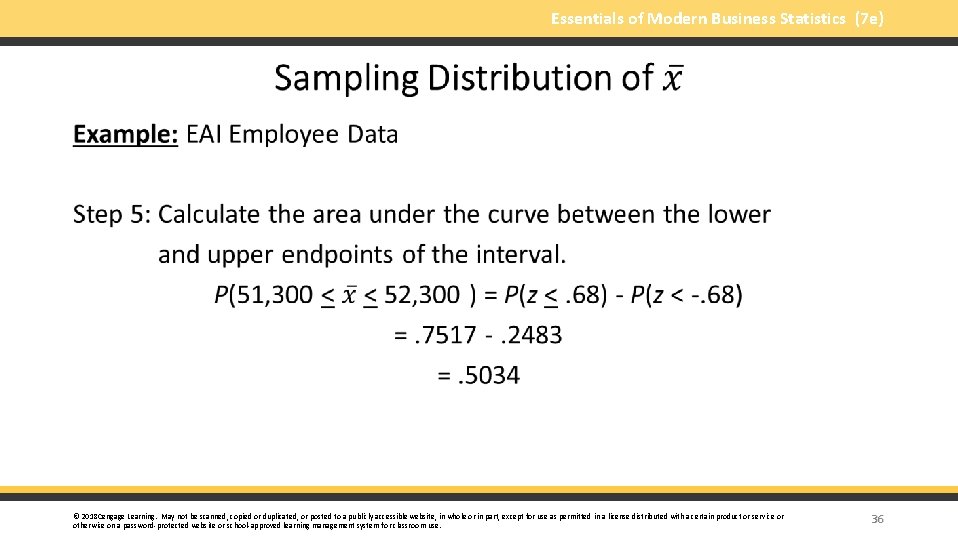
Essentials of Modern Business Statistics (7 e) § © 2018 Cengage Learning. May not be scanned, copied or duplicated, or posted to a publicly accessible website, in whole or in part, except for use as permitted in a license distributed with a certain product or service or otherwise on a password-protected website or school-approved learning management system for classroom use. 36
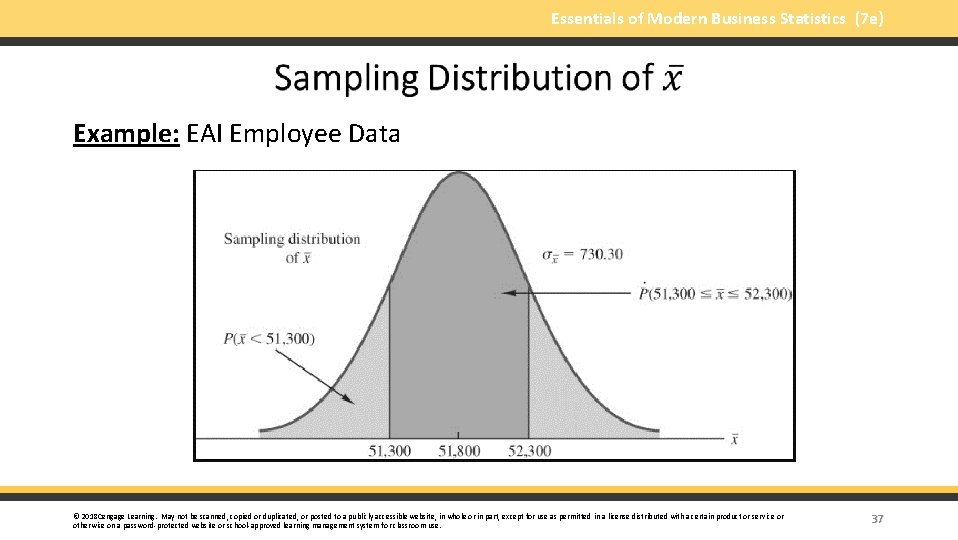
Essentials of Modern Business Statistics (7 e) Example: EAI Employee Data © 2018 Cengage Learning. May not be scanned, copied or duplicated, or posted to a publicly accessible website, in whole or in part, except for use as permitted in a license distributed with a certain product or service or otherwise on a password-protected website or school-approved learning management system for classroom use. 37
Essentials of Modern Business Statistics (7 e) § Function used - NORM. DIST § We do not have to make separate computation of z value. § Evaluating NORM. DIST function at each end point of the interval provides cumulative probability at the specified end point of the interval. § The result obtained using NORM. DIST is more accurate. © 2018 Cengage Learning. May not be scanned, copied or duplicated, or posted to a publicly accessible website, in whole or in part, except for use as permitted in a license distributed with a certain product or service or otherwise on a password-protected website or school-approved learning management system for classroom use. 38
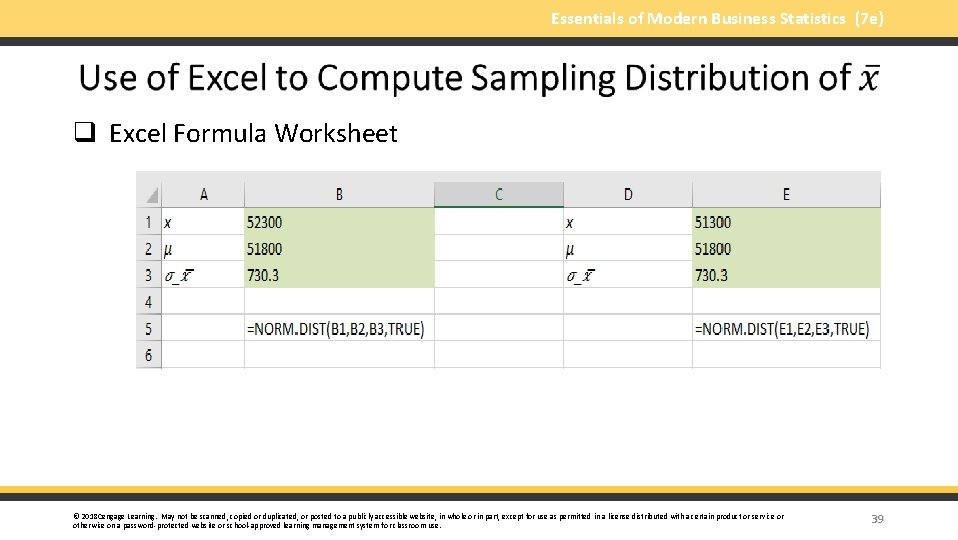
Essentials of Modern Business Statistics (7 e) q Excel Formula Worksheet © 2018 Cengage Learning. May not be scanned, copied or duplicated, or posted to a publicly accessible website, in whole or in part, except for use as permitted in a license distributed with a certain product or service or otherwise on a password-protected website or school-approved learning management system for classroom use. 39
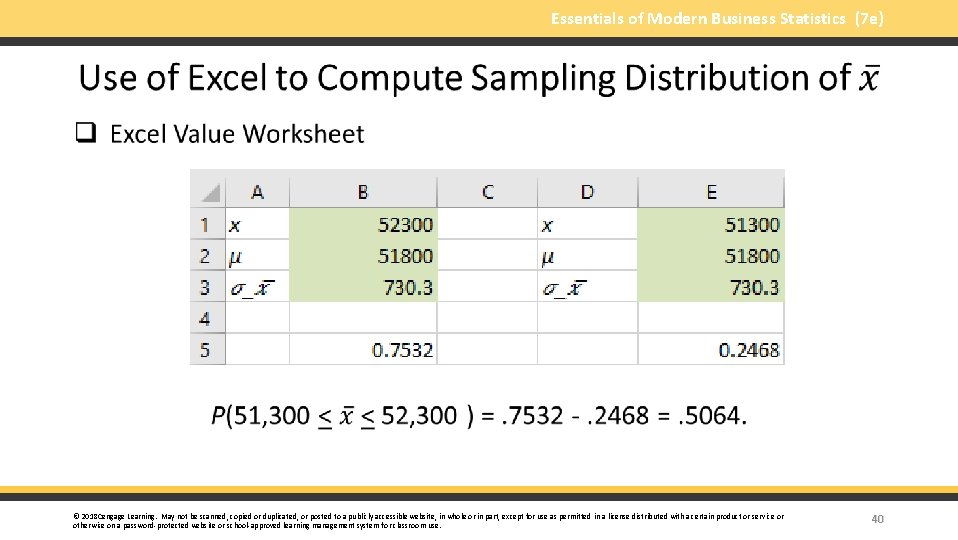
Essentials of Modern Business Statistics (7 e) § © 2018 Cengage Learning. May not be scanned, copied or duplicated, or posted to a publicly accessible website, in whole or in part, except for use as permitted in a license distributed with a certain product or service or otherwise on a password-protected website or school-approved learning management system for classroom use. 40
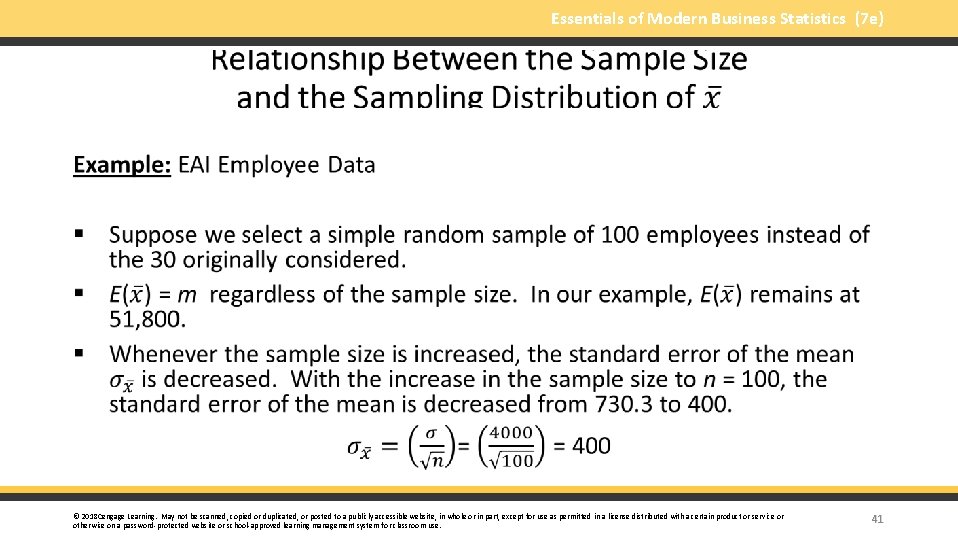
Essentials of Modern Business Statistics (7 e) § © 2018 Cengage Learning. May not be scanned, copied or duplicated, or posted to a publicly accessible website, in whole or in part, except for use as permitted in a license distributed with a certain product or service or otherwise on a password-protected website or school-approved learning management system for classroom use. 41
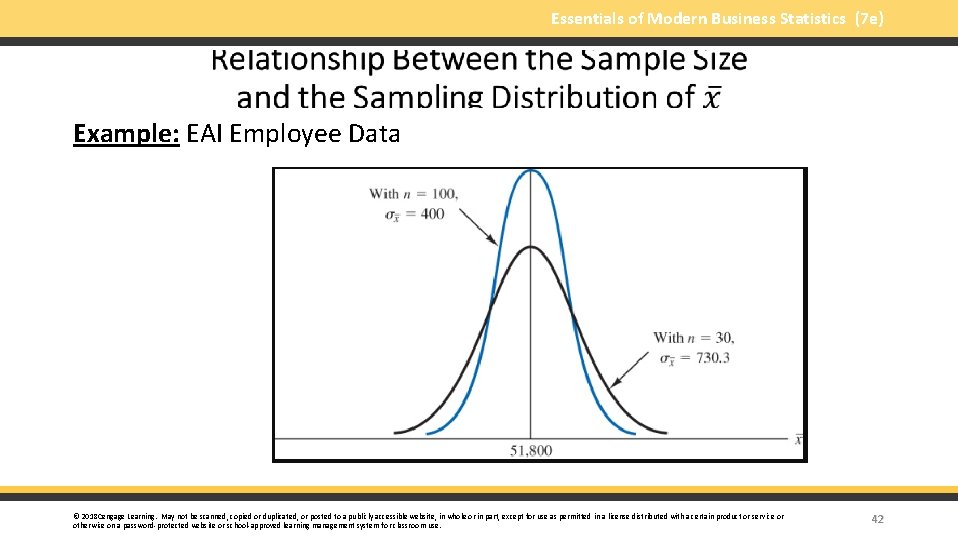
Essentials of Modern Business Statistics (7 e) Example: EAI Employee Data © 2018 Cengage Learning. May not be scanned, copied or duplicated, or posted to a publicly accessible website, in whole or in part, except for use as permitted in a license distributed with a certain product or service or otherwise on a password-protected website or school-approved learning management system for classroom use. 42
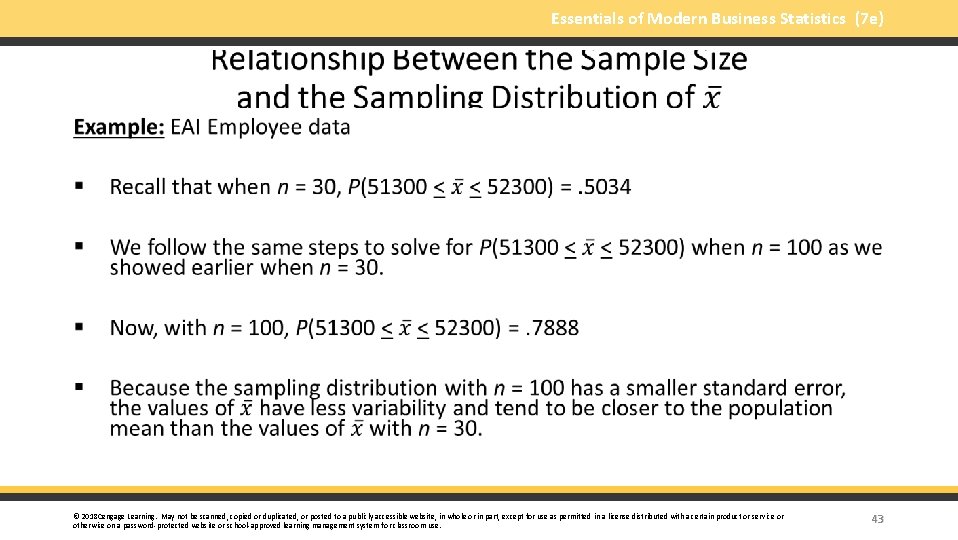
Essentials of Modern Business Statistics (7 e) § © 2018 Cengage Learning. May not be scanned, copied or duplicated, or posted to a publicly accessible website, in whole or in part, except for use as permitted in a license distributed with a certain product or service or otherwise on a password-protected website or school-approved learning management system for classroom use. 43
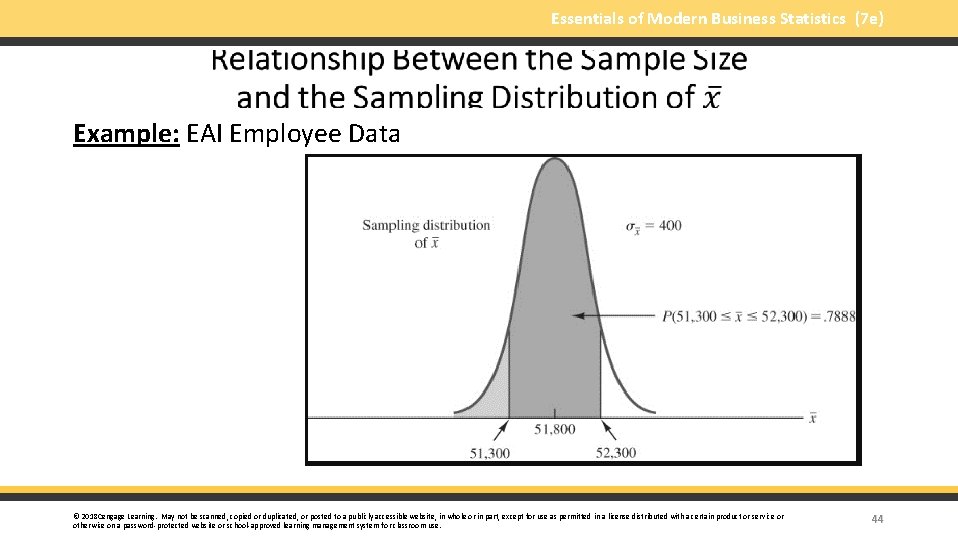
Essentials of Modern Business Statistics (7 e) Example: EAI Employee Data © 2018 Cengage Learning. May not be scanned, copied or duplicated, or posted to a publicly accessible website, in whole or in part, except for use as permitted in a license distributed with a certain product or service or otherwise on a password-protected website or school-approved learning management system for classroom use. 44
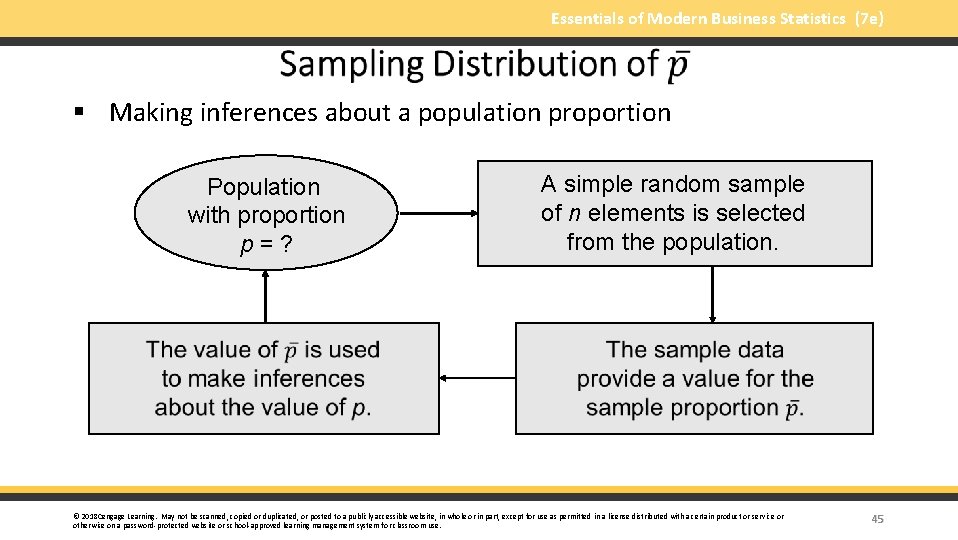
Essentials of Modern Business Statistics (7 e) § Making inferences about a population proportion Population with proportion p=? A simple random sample of n elements is selected from the population. © 2018 Cengage Learning. May not be scanned, copied or duplicated, or posted to a publicly accessible website, in whole or in part, except for use as permitted in a license distributed with a certain product or service or otherwise on a password-protected website or school-approved learning management system for classroom use. 45
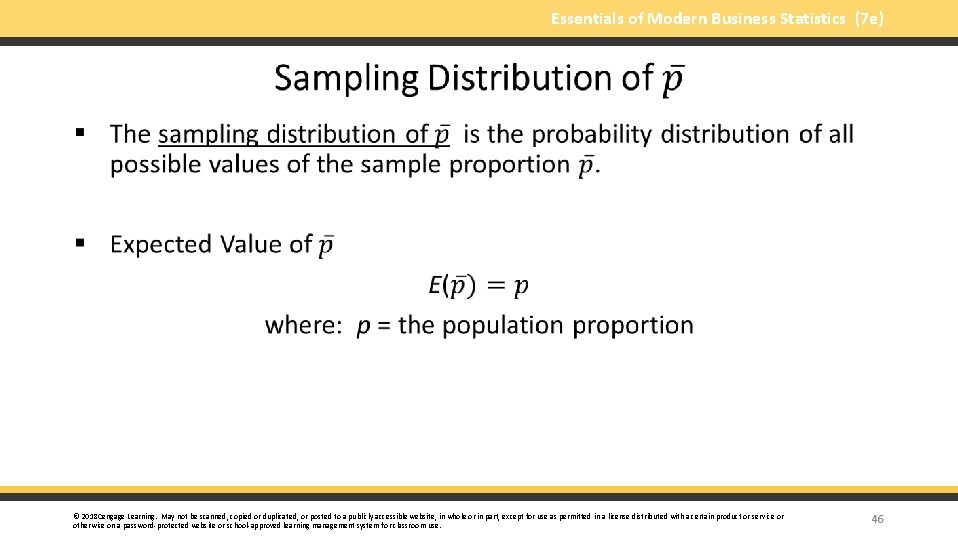
Essentials of Modern Business Statistics (7 e) § © 2018 Cengage Learning. May not be scanned, copied or duplicated, or posted to a publicly accessible website, in whole or in part, except for use as permitted in a license distributed with a certain product or service or otherwise on a password-protected website or school-approved learning management system for classroom use. 46
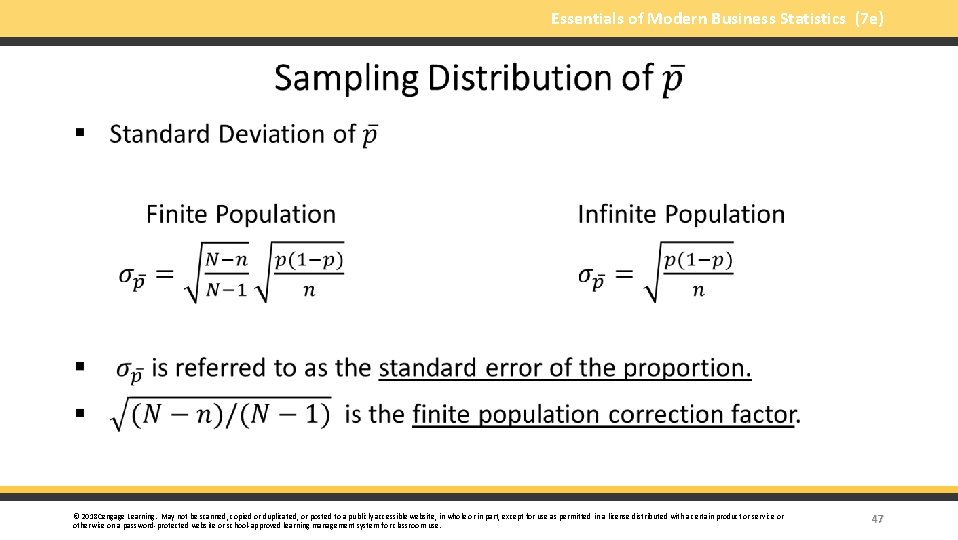
Essentials of Modern Business Statistics (7 e) § © 2018 Cengage Learning. May not be scanned, copied or duplicated, or posted to a publicly accessible website, in whole or in part, except for use as permitted in a license distributed with a certain product or service or otherwise on a password-protected website or school-approved learning management system for classroom use. 47
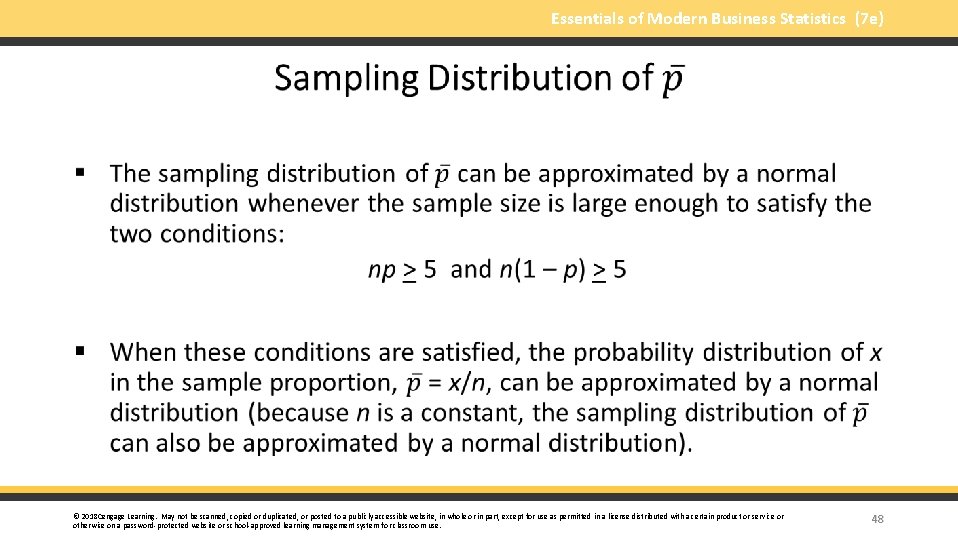
Essentials of Modern Business Statistics (7 e) § © 2018 Cengage Learning. May not be scanned, copied or duplicated, or posted to a publicly accessible website, in whole or in part, except for use as permitted in a license distributed with a certain product or service or otherwise on a password-protected website or school-approved learning management system for classroom use. 48
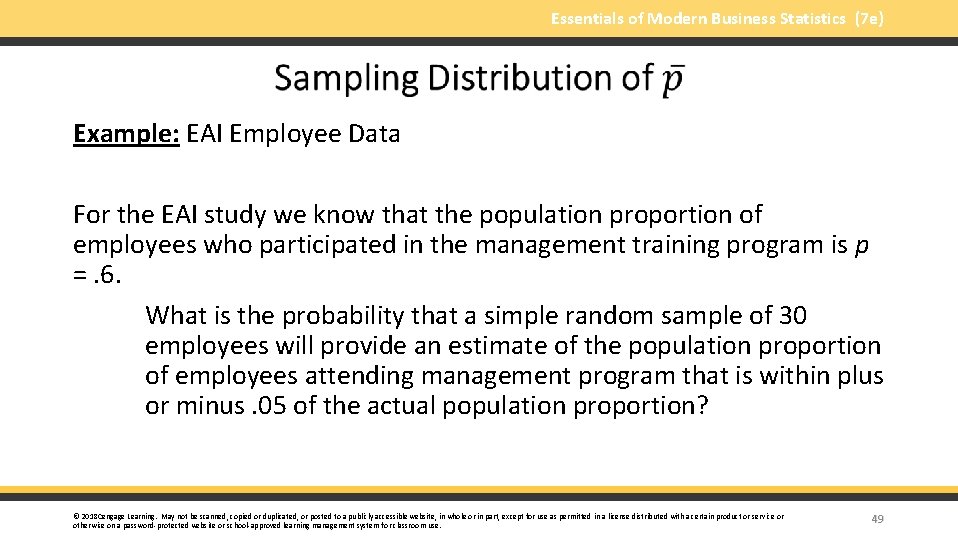
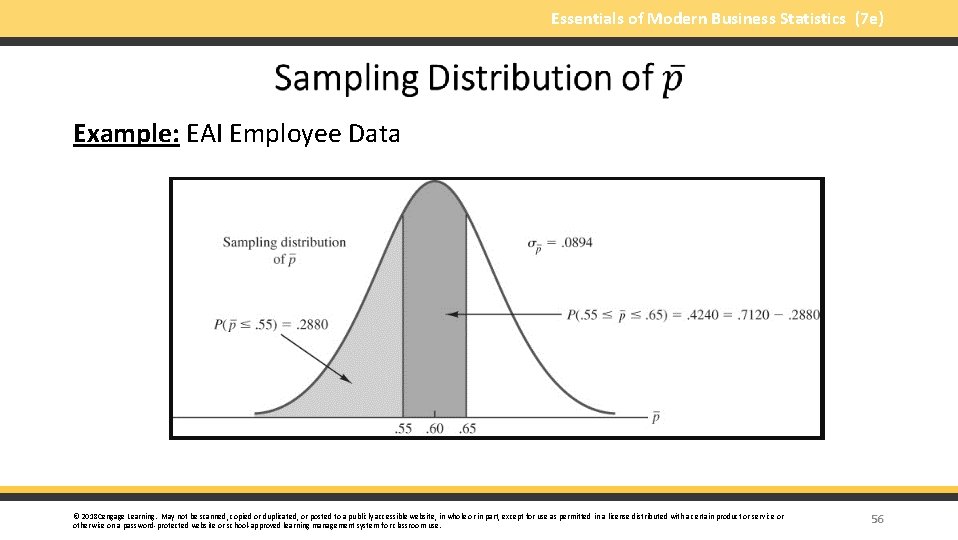
Essentials of Modern Business Statistics (7 e) Example: EAI Employee Data For the EAI study we know that the population proportion of employees who participated in the management training program is p =. 6. What is the probability that a simple random sample of 30 employees will provide an estimate of the population proportion of employees attending management program that is within plus or minus. 05 of the actual population proportion? © 2018 Cengage Learning. May not be scanned, copied or duplicated, or posted to a publicly accessible website, in whole or in part, except for use as permitted in a license distributed with a certain product or service or otherwise on a password-protected website or school-approved learning management system for classroom use. 49
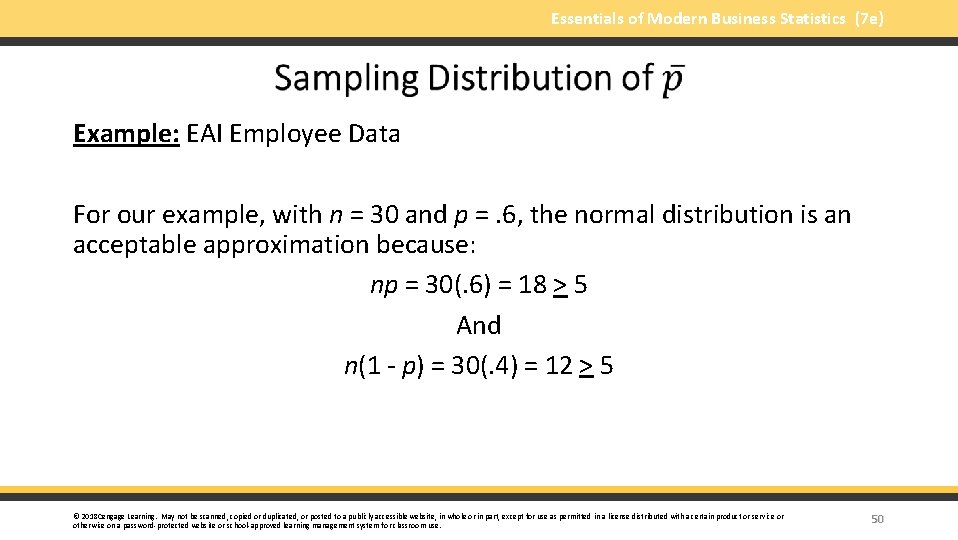
Essentials of Modern Business Statistics (7 e) Example: EAI Employee Data For our example, with n = 30 and p =. 6, the normal distribution is an acceptable approximation because: np = 30(. 6) = 18 > 5 And n(1 - p) = 30(. 4) = 12 > 5 © 2018 Cengage Learning. May not be scanned, copied or duplicated, or posted to a publicly accessible website, in whole or in part, except for use as permitted in a license distributed with a certain product or service or otherwise on a password-protected website or school-approved learning management system for classroom use. 50
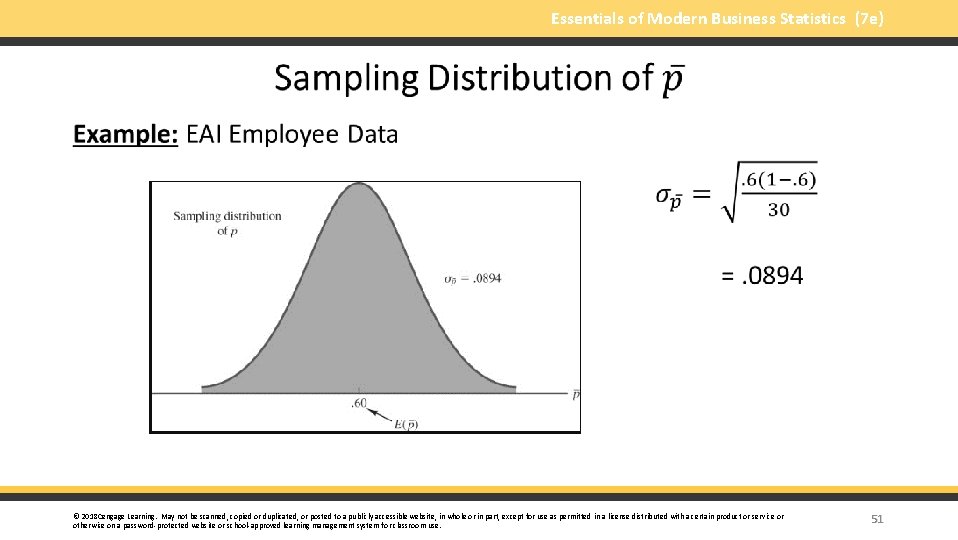
Essentials of Modern Business Statistics (7 e) § © 2018 Cengage Learning. May not be scanned, copied or duplicated, or posted to a publicly accessible website, in whole or in part, except for use as permitted in a license distributed with a certain product or service or otherwise on a password-protected website or school-approved learning management system for classroom use. 51
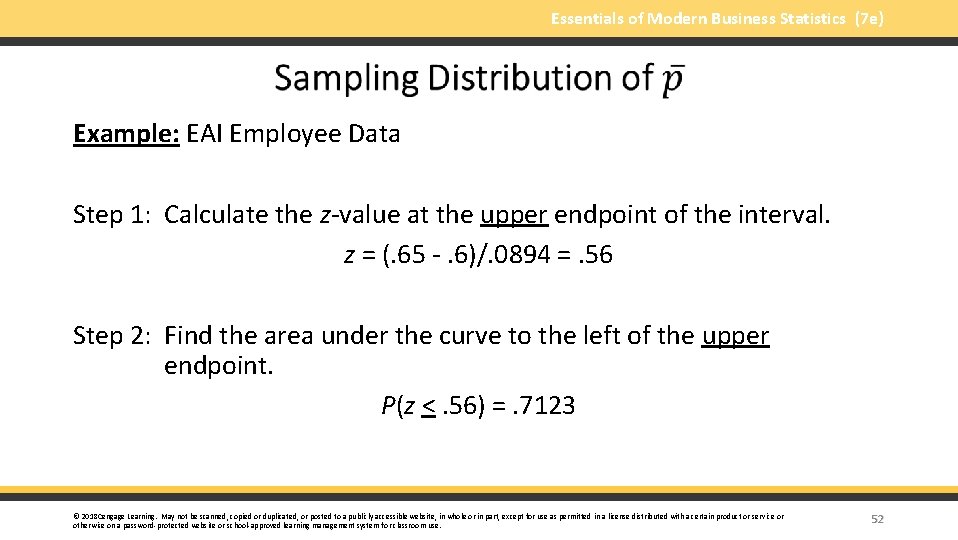
Essentials of Modern Business Statistics (7 e) Example: EAI Employee Data Step 1: Calculate the z-value at the upper endpoint of the interval. z = (. 65 -. 6)/. 0894 =. 56 Step 2: Find the area under the curve to the left of the upper endpoint. P(z <. 56) =. 7123 © 2018 Cengage Learning. May not be scanned, copied or duplicated, or posted to a publicly accessible website, in whole or in part, except for use as permitted in a license distributed with a certain product or service or otherwise on a password-protected website or school-approved learning management system for classroom use. 52
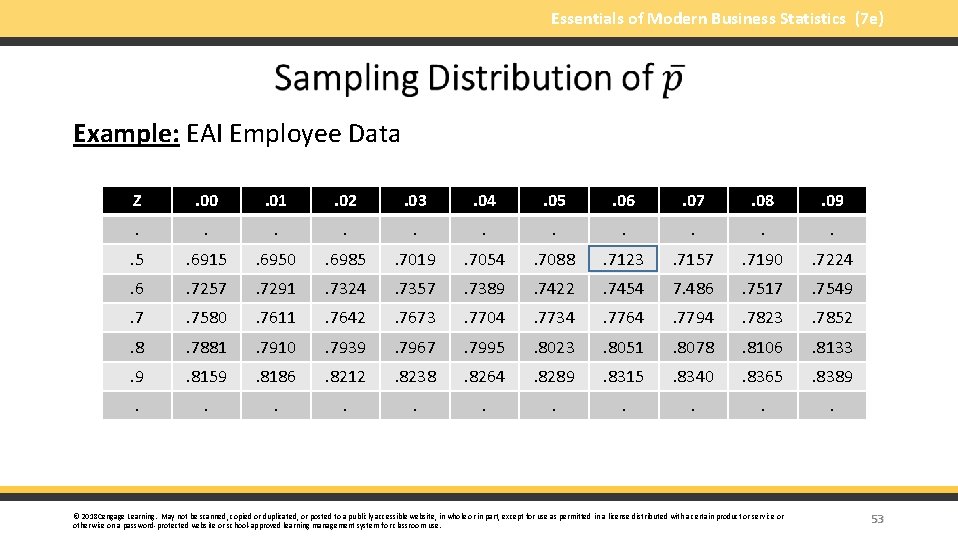
Essentials of Modern Business Statistics (7 e) Example: EAI Employee Data Z . 00 . 01 . 02 . 03 . 04 . 05 . 06 . 07 . 08 . 09 . . . 5 . 6915 . 6950 . 6985 . 7019 . 7054 . 7088 . 7123 . 7157 . 7190 . 7224 . 6 . 7257 . 7291 . 7324 . 7357 . 7389 . 7422 . 7454 7. 486 . 7517 . 7549 . 7580 . 7611 . 7642 . 7673 . 7704 . 7734 . 7764 . 7794 . 7823 . 7852 . 8 . 7881 . 7910 . 7939 . 7967 . 7995 . 8023 . 8051 . 8078 . 8106 . 8133 . 9 . 8159 . 8186 . 8212 . 8238 . 8264 . 8289 . 8315 . 8340 . 8365 . 8389 . . . © 2018 Cengage Learning. May not be scanned, copied or duplicated, or posted to a publicly accessible website, in whole or in part, except for use as permitted in a license distributed with a certain product or service or otherwise on a password-protected website or school-approved learning management system for classroom use. 53
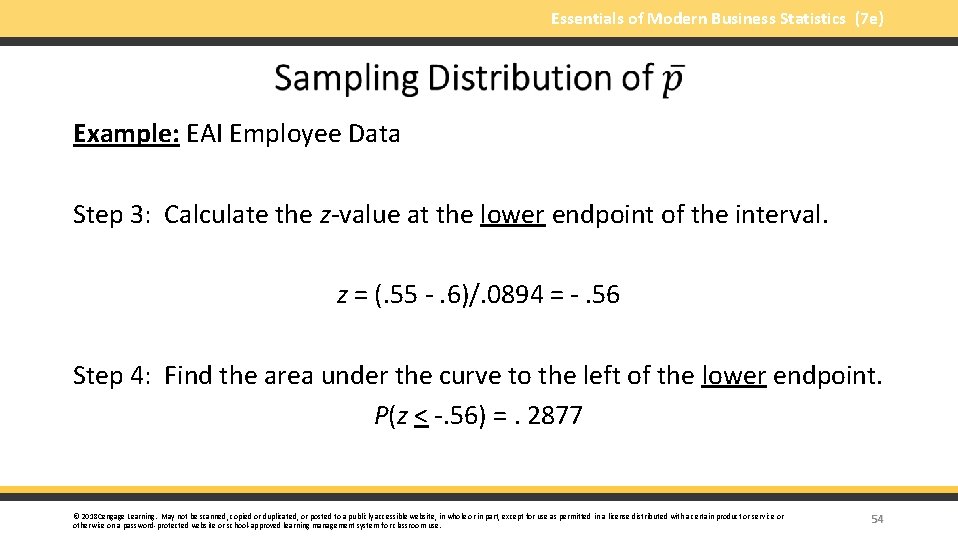
Essentials of Modern Business Statistics (7 e) Example: EAI Employee Data Step 3: Calculate the z-value at the lower endpoint of the interval. z = (. 55 -. 6)/. 0894 = -. 56 Step 4: Find the area under the curve to the left of the lower endpoint. P(z < -. 56) =. 2877 © 2018 Cengage Learning. May not be scanned, copied or duplicated, or posted to a publicly accessible website, in whole or in part, except for use as permitted in a license distributed with a certain product or service or otherwise on a password-protected website or school-approved learning management system for classroom use. 54
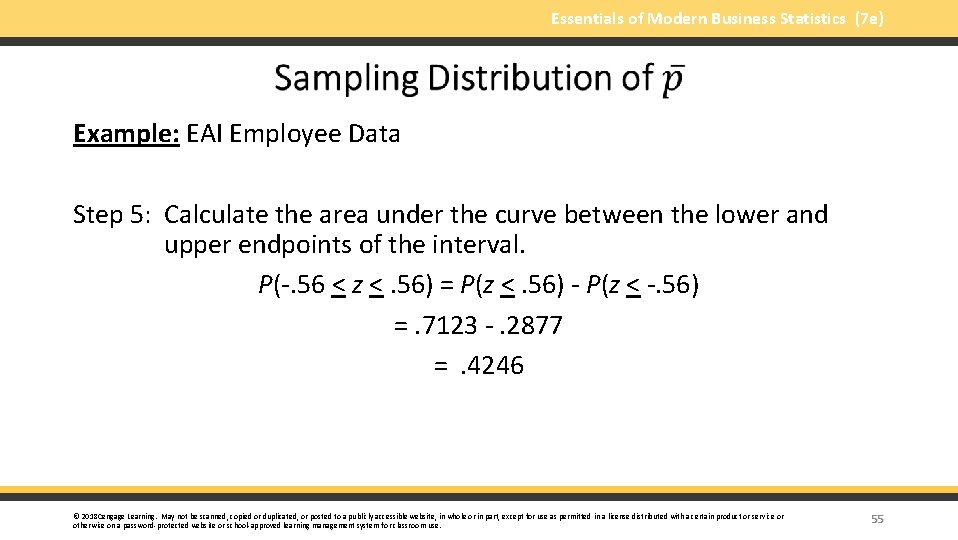
Essentials of Modern Business Statistics (7 e) Example: EAI Employee Data Step 5: Calculate the area under the curve between the lower and upper endpoints of the interval. P(-. 56 < z <. 56) = P(z <. 56) - P(z < -. 56) =. 7123 -. 2877 = . 4246 © 2018 Cengage Learning. May not be scanned, copied or duplicated, or posted to a publicly accessible website, in whole or in part, except for use as permitted in a license distributed with a certain product or service or otherwise on a password-protected website or school-approved learning management system for classroom use. 55
Essentials of Modern Business Statistics (7 e) Example: EAI Employee Data © 2018 Cengage Learning. May not be scanned, copied or duplicated, or posted to a publicly accessible website, in whole or in part, except for use as permitted in a license distributed with a certain product or service or otherwise on a password-protected website or school-approved learning management system for classroom use. 56
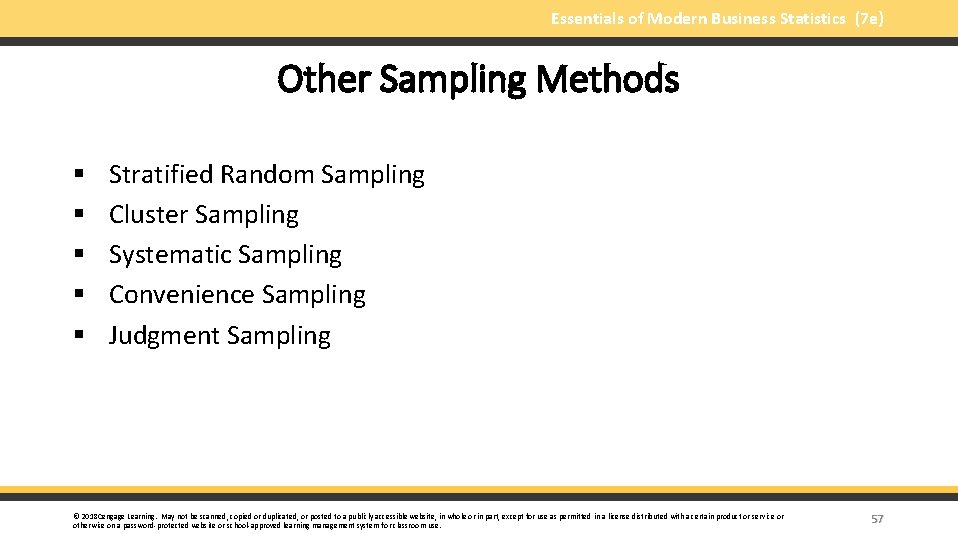
Essentials of Modern Business Statistics (7 e) Other Sampling Methods § § § Stratified Random Sampling Cluster Sampling Systematic Sampling Convenience Sampling Judgment Sampling © 2018 Cengage Learning. May not be scanned, copied or duplicated, or posted to a publicly accessible website, in whole or in part, except for use as permitted in a license distributed with a certain product or service or otherwise on a password-protected website or school-approved learning management system for classroom use. 57
Essentials of Modern Business Statistics (7 e) Stratified Random Sampling § The population is first divided into groups of elements called strata. § Each element in the population belongs to one and only one stratum. § Best results are obtained when the elements within each stratum are as much alike as possible (i. e. a homogeneous group). © 2018 Cengage Learning. May not be scanned, copied or duplicated, or posted to a publicly accessible website, in whole or in part, except for use as permitted in a license distributed with a certain product or service or otherwise on a password-protected website or school-approved learning management system for classroom use. 58
Essentials of Modern Business Statistics (7 e) Stratified Random Sampling § A simple random sample is taken from each stratum. § Formulas are available for combining the stratum sample results into one population parameter estimate. § Advantage: If strata are homogeneous, this method is as “precise” as simple random sampling but with a smaller total sample size. Example: The basis forming the strata might be department, location, age, industry type, and so on. © 2018 Cengage Learning. May not be scanned, copied or duplicated, or posted to a publicly accessible website, in whole or in part, except for use as permitted in a license distributed with a certain product or service or otherwise on a password-protected website or school-approved learning management system for classroom use. 59
Essentials of Modern Business Statistics (7 e) Cluster Sampling § The population is first divided into separate groups of elements called clusters. § Ideally, each cluster is a representative small-scale version of the population (i. e. heterogeneous group). § A simple random sample of the clusters is then taken. § All elements within each sampled (chosen) cluster form the sample. © 2018 Cengage Learning. May not be scanned, copied or duplicated, or posted to a publicly accessible website, in whole or in part, except for use as permitted in a license distributed with a certain product or service or otherwise on a password-protected website or school-approved learning management system for classroom use. 60
Essentials of Modern Business Statistics (7 e) Cluster Sampling § Advantage: The close proximity of elements can be cost effective (i. e. many sample observations can be obtained in a short time) § Disadvantage: This method generally requires a larger total sample size than simple or stratified random sampling. Example: A primary application is area sampling, where clusters are city blocks or other well-defined areas. © 2018 Cengage Learning. May not be scanned, copied or duplicated, or posted to a publicly accessible website, in whole or in part, except for use as permitted in a license distributed with a certain product or service or otherwise on a password-protected website or school-approved learning management system for classroom use. 61
Essentials of Modern Business Statistics (7 e) Systematic Sampling § If a sample size of n is desired from a population containing N elements, we might sample one element for every n/N elements in the population. § We randomly select one of the first n/N elements from the population list. § We then select every n/Nth element that follows in the population list. © 2018 Cengage Learning. May not be scanned, copied or duplicated, or posted to a publicly accessible website, in whole or in part, except for use as permitted in a license distributed with a certain product or service or otherwise on a password-protected website or school-approved learning management system for classroom use. 62
Essentials of Modern Business Statistics (7 e) Systematic Sampling § This method has the properties of a simple random sample, especially if the list of the population elements is a random ordering. § Advantage: The sample usually will be easier to identify than it would be if simple random sampling were used. Example: Selecting every 100 th listing in a telephone book after the first randomly selected listing © 2018 Cengage Learning. May not be scanned, copied or duplicated, or posted to a publicly accessible website, in whole or in part, except for use as permitted in a license distributed with a certain product or service or otherwise on a password-protected website or school-approved learning management system for classroom use. 63
Essentials of Modern Business Statistics (7 e) Convenience Sampling § It is a nonprobability sampling technique. Items are included in the sample without known probabilities of being selected. § The sample is identified primarily by convenience. Example: A professor conducting research might use student volunteers to constitute a sample. © 2018 Cengage Learning. May not be scanned, copied or duplicated, or posted to a publicly accessible website, in whole or in part, except for use as permitted in a license distributed with a certain product or service or otherwise on a password-protected website or school-approved learning management system for classroom use. 64
Essentials of Modern Business Statistics (7 e) Convenience Sampling § Advantage: Sample selection and data collection are relatively easy. § Disadvantage: It is impossible to determine how representative of the population the sample is. © 2018 Cengage Learning. May not be scanned, copied or duplicated, or posted to a publicly accessible website, in whole or in part, except for use as permitted in a license distributed with a certain product or service or otherwise on a password-protected website or school-approved learning management system for classroom use. 65
Essentials of Modern Business Statistics (7 e) Judgment Sampling § The person most knowledgeable on the subject of the study selects elements of the population that he or she feels are most representative of the population. § It is a nonprobability sampling technique. Example: A reporter might sample three or four senators, judging them as reflecting the general opinion of the senate. © 2018 Cengage Learning. May not be scanned, copied or duplicated, or posted to a publicly accessible website, in whole or in part, except for use as permitted in a license distributed with a certain product or service or otherwise on a password-protected website or school-approved learning management system for classroom use. 66
Essentials of Modern Business Statistics (7 e) Judgment Sampling § Advantage: It is a relatively easy way of selecting a sample. § Disadvantage: The quality of the sample results depends on the judgment of the person selecting the sample. © 2018 Cengage Learning. May not be scanned, copied or duplicated, or posted to a publicly accessible website, in whole or in part, except for use as permitted in a license distributed with a certain product or service or otherwise on a password-protected website or school-approved learning management system for classroom use. 67
Essentials of Modern Business Statistics (7 e) Recommendation § It is recommended that probability sampling methods (simple random, stratified, cluster, or systematic) be used. § For these methods, formulas are available for evaluating the “goodness” of the sample results in terms of the closeness of the results to the population parameters being estimated. § An evaluation of the goodness cannot be made with non-probability (convenience or judgment) sampling methods. © 2018 Cengage Learning. May not be scanned, copied or duplicated, or posted to a publicly accessible website, in whole or in part, except for use as permitted in a license distributed with a certain product or service or otherwise on a password-protected website or school-approved learning management system for classroom use. 68
Essentials of Modern Business Statistics (7 e) Errors in Sampling § The difference between the value of sample statistic and the corresponding value of the population parameters is called the sampling error. § Deviations of the sample from the population that occur for reasons other than random sampling are referred to as nonsampling errors. § Nonsampling error can occur in a sample or a census. © 2018 Cengage Learning. May not be scanned, copied or duplicated, or posted to a publicly accessible website, in whole or in part, except for use as permitted in a license distributed with a certain product or service or otherwise on a password-protected website or school-approved learning management system for classroom use. 69
Essentials of Modern Business Statistics (7 e) Errors in Sampling q Reasons for Nonsampling Errors § Coverage error § Non-response error • Interviewer error • Processing error § Measurement error © 2018 Cengage Learning. May not be scanned, copied or duplicated, or posted to a publicly accessible website, in whole or in part, except for use as permitted in a license distributed with a certain product or service or otherwise on a password-protected website or school-approved learning management system for classroom use. 70
Essentials of Modern Business Statistics (7 e) Steps to minimise nonsampling Errors § Carefully define the target population and design the data collection procedure. § Carefully design the data collection process and train the data collectors § Pretest the data collection procedure § Use stratified random sampling when population-level information about an important qualitative characteristic is available. § Use systematic sampling when population-level information about an important quantitative characteristic is available. © 2018 Cengage Learning. May not be scanned, copied or duplicated, or posted to a publicly accessible website, in whole or in part, except for use as permitted in a license distributed with a certain product or service or otherwise on a password-protected website or school-approved learning management system for classroom use. 71
Essentials of Modern Business Statistics (7 e) End of Chapter 7 © 2018 Cengage Learning. May not be scanned, copied or duplicated, or posted to a publicly accessible website, in whole or in part, except for use as permitted in a license distributed with a certain product or service or otherwise on a password-protected website or school-approved learning management system for classroom use. 72
- Slides: 72