
Essentials of Human Anatomy Physiology Elaine N Marieb
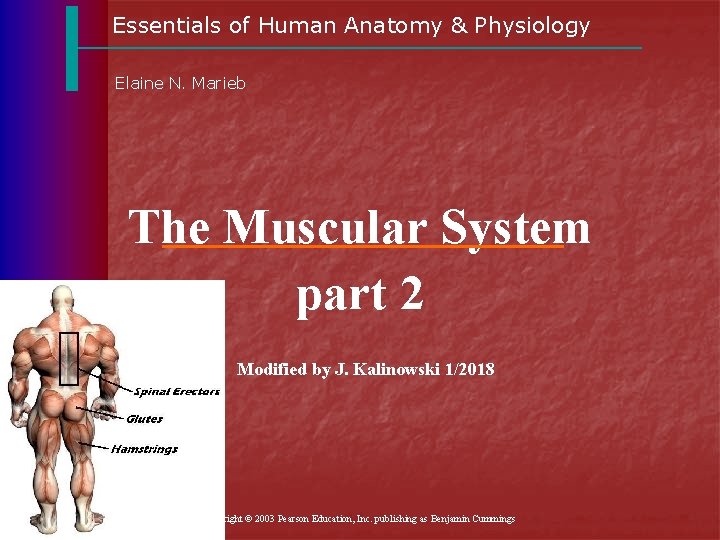
Essentials of Human Anatomy & Physiology Elaine N. Marieb The Muscular System part 2 Modified by J. Kalinowski 1/2018 Copyright © 2003 Pearson Education, Inc. publishing as Benjamin Cummings

ENERGY SOURCES FOR CONTRACTION
Cellular Respiration n 3 main factors affect your cellular respiration type: n. Your nutrition n. Your respiratory efficiency n. Your cardiovascular fitness
Muscle Metabolism · ATP is the ONLY energy source used to power muscles · Must be generated continuously · Only 4 -6 seconds worth of ATP is stored by muscles · After this initial time, other pathways must be utilized to produce ATP Copyright © 2003 Pearson Education, Inc. publishing as Benjamin Cummings Slide 6. 23
Instructions n n n Please read the following slides carefully! You are responsible for filling in the chart BUT also for knowing all the info already typed into the chart. You need to be able to compare/contract the 3 main pathways that the muscles have to generate ATP
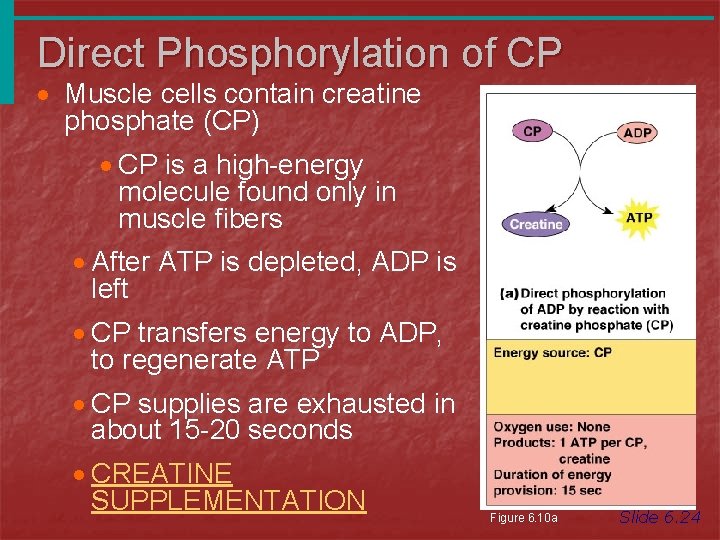
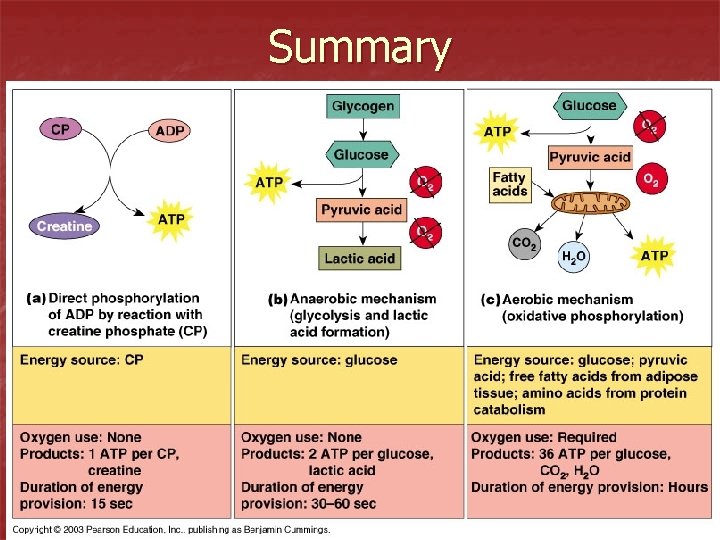
Direct Phosphorylation of CP · Muscle cells contain creatine phosphate (CP) · CP is a high-energy molecule found only in muscle fibers · After ATP is depleted, ADP is left · CP transfers energy to ADP, to regenerate ATP · CP supplies are exhausted in about 15 -20 seconds · CREATINE SUPPLEMENTATION Figure 6. 10 a Slide 6. 24
Direct Phosphorylation n n Used for activities that require brief yet massive power surges Weightlifting, sprinting, diving, etc. VERY fast since CP is already in the muscle Very reversible SO is easily & quickly replenished when muscles are inactive
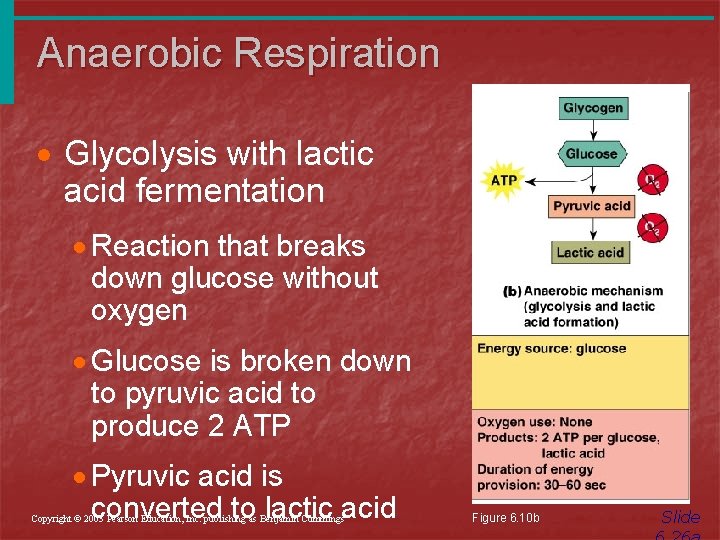
Anaerobic Respiration · Glycolysis with lactic acid fermentation · Reaction that breaks down glucose without oxygen · Glucose is broken down to pyruvic acid to produce 2 ATP · Pyruvic acid is converted to lactic acid Copyright © 2003 Pearson Education, Inc. publishing as Benjamin Cummings Figure 6. 10 b Slide
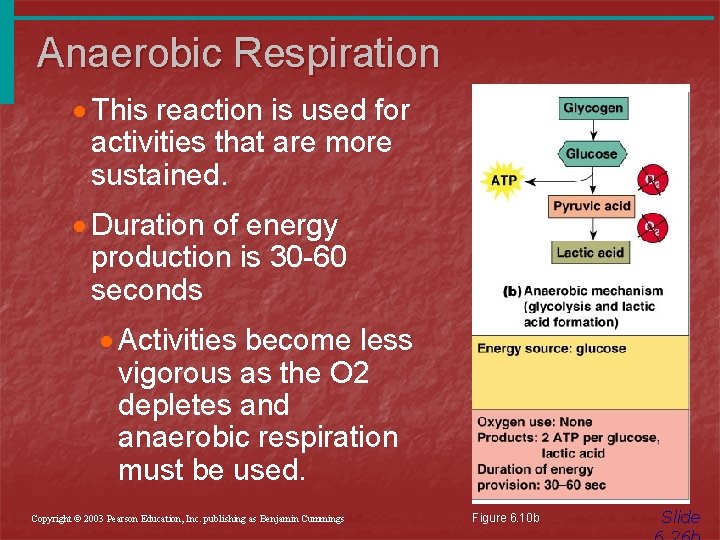
Anaerobic Respiration · This reaction is used for activities that are more sustained. · Duration of energy production is 30 -60 seconds · Activities become less vigorous as the O 2 depletes and anaerobic respiration must be used. Copyright © 2003 Pearson Education, Inc. publishing as Benjamin Cummings Figure 6. 10 b Slide
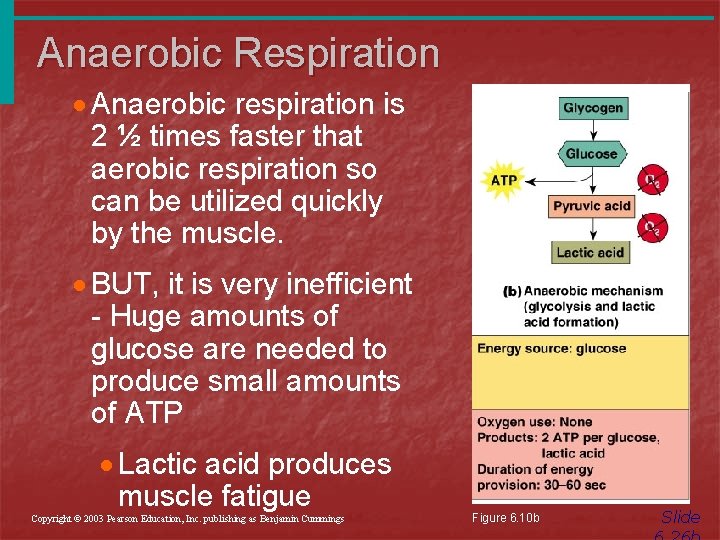
Anaerobic Respiration · Anaerobic respiration is 2 ½ times faster that aerobic respiration so can be utilized quickly by the muscle. · BUT, it is very inefficient - Huge amounts of glucose are needed to produce small amounts of ATP · Lactic acid produces muscle fatigue Copyright © 2003 Pearson Education, Inc. publishing as Benjamin Cummings Figure 6. 10 b Slide
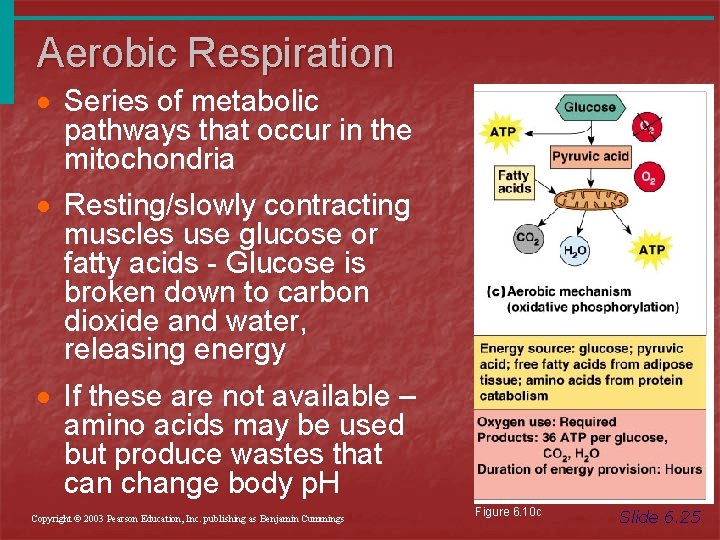
Aerobic Respiration · Series of metabolic pathways that occur in the mitochondria · Resting/slowly contracting muscles use glucose or fatty acids - Glucose is broken down to carbon dioxide and water, releasing energy · If these are not available – amino acids may be used but produce wastes that can change body p. H Copyright © 2003 Pearson Education, Inc. publishing as Benjamin Cummings Figure 6. 10 c Slide 6. 25
Aerobic Respiration n Glucose + oxygen are required produce 36 -38 ATP + carbon dioxide + water Duration of energy produced can be hours This type of energy production is used for activities that require endurance rather than power n Jogging, marathon running, walking, etc
Summary
DONE WITH CHART – STUDY THE INFO CONTAINED IN IT
Muscle Fatigue & Oxygen Debt
Oxygen Debt n n Oxygen debt is the extra amount of oxygen that must be taken into the body to provide for these restorative processes Difference between amount of oxygen needed for totally aerobic respiration during muscle activity and the amount that is actually used.
Oxygen Debt n n All nonaerobic sources of ATP used during muscle activity contribute to this debt Repaid by rapid, deep breathing (triggered by change in p. H from lactic acid) after exertion is ended
Oxygen n n Breathing pure oxygen does not help to repay this debt in the short term! Oxygen must have some time to get to the muscles. There are limitations due to your circulatory/cardiovascular system and your respiratory system. Supplemental Oxygen
Efficiency of Oxygen Use n n n Athlete: ~10 % greater rate and efficiency of oxygen use than normal person Marathon runner: ~45 % greater Working your muscles, heart, lungs, etc out on a regular basis increases your efficiency n Things like smoking, poor nutrition, too much sugar, etc. decreases your efficiency
Physiological Fatigue · When a muscle is fatigued, it is unable to contract EVEN when stimulated · The common reasons for muscle fatigue are: · Lactic acid buildup · Lack of oxygen in muscle · Ionic imbalance · Contractures will occur when no ATP is available (no cross bridge detachment) · Example: writer’s cramp Copyright © 2003 Pearson Education, Inc. publishing as Benjamin Cummings Slide 6. 27
Psychological Fatigue · Psychological fatigue is voluntarily discontinuing activity when you start to “feel tired” · May be caused by a decrease in the amount of available ATP
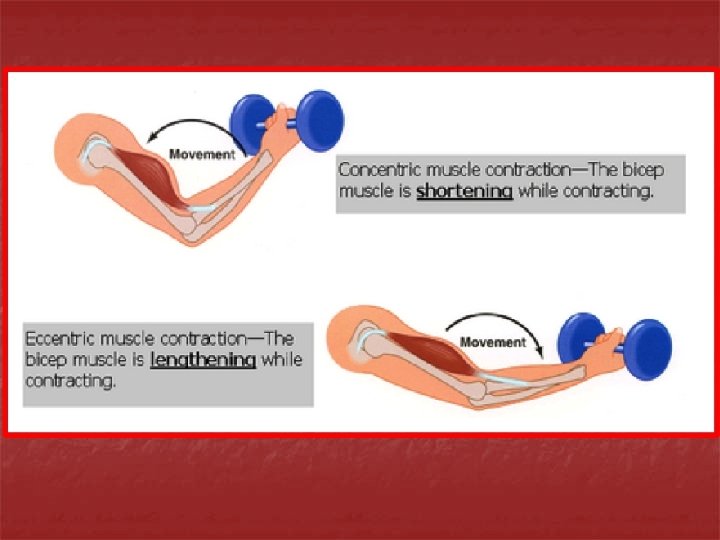
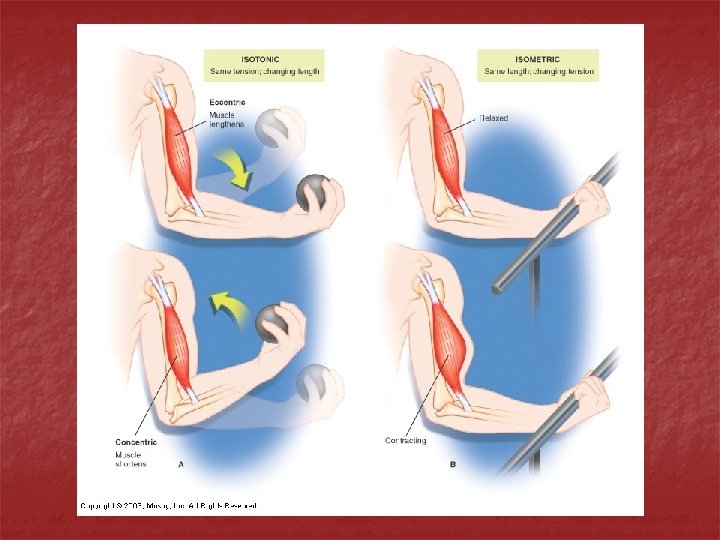
Types of Muscle Contractions · Isotonic (same tension) contractions · Myofilaments are able to slide past each other during contractions · The muscle shortens & movement occurs · Concentric – notes that shortening has occurred (example: flexion of bicep muscle) · Eccentric – notes that lengthening has occurred and force was not enough to move the object (example: slow extension of bicep with weight in hand) Copyright © 2003 Pearson Education, Inc. publishing as Benjamin Cummings Slide 6. 28
Types of Muscle Contractions · Isometric (same length) contractions · Tension in the muscles increases · The muscle does not shorten or lengthen & no movement occurs · Most movements involve both types of activity Copyright © 2003 Pearson Education, Inc. publishing as Benjamin Cummings Slide 6. 28
Types of fibers n n n Force, velocity, and duration of muscle contraction are affected by several factors. A main factor is fiber type Muscle fiber types (and ratios) are genetically determined. Muscles are a mixture of fibers but different muscles will have different ratios of types. Article: Fiber types in Mammalian Skeletal Muscle
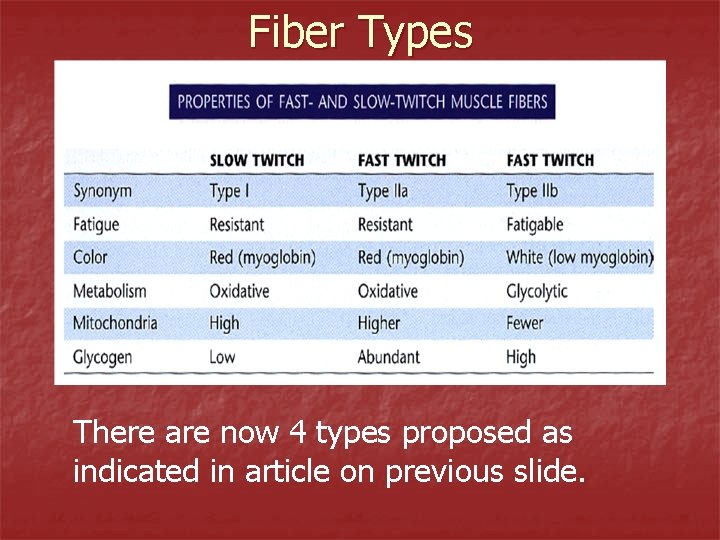
Fiber Types There are now 4 types proposed as indicated in article on previous slide.

White vs. Dark meat
MUSCLE DEVELOPMENT & STRENGTH
Add to notes: Developmental Aspects n n Muscular development reflects neuromuscular coordination Due to the way neural pathways are developed in your brain
Add to notes: Developmental Aspects Progresses superior to inferior direction n Baby can lift head before walking n Progresses proximal to distal n Baby can move arm before grasping object n
FYI n n n Women’s skeletal muscles make up 36 % of body weight Men’s is 42 % due to effects of testosterone Muscle strength per unit mass is equal
LEVER ACTION BIOMECHANICS
Biomechanics Muscles exert force by use of lever action n Bones act as levers for muscles to pull on. Each type of lever has advantages and disadvantages in either the strength required to move the body part or the distance (ROM) that the body part can be moved or the speed of the motion. n
Modifying muscle activity n Differences in the positioning of the fulcrum. load, and effort modify muscle activity with respect to: n speed of contraction n Direction of motion n range of motion (ROM) n Strength - weight that can be lifted
Terms to understand n n n Effort – applied force – provided by muscle contraction Load – resistance – bone, overlying tissues, and any other object you are trying to move Fulcrum – fixed point - joints
Application n Understanding lever action, angles and position, and muscle fiber direction is extremely important: To maximize the effectiveness of your work outs n To prevent injury n
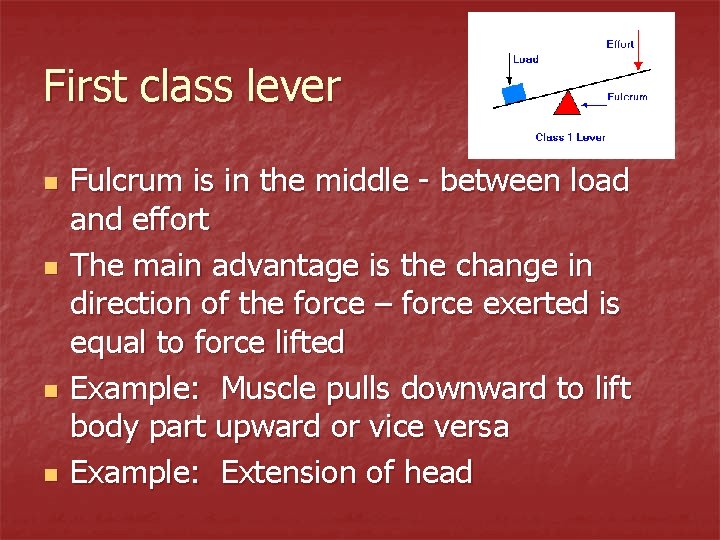
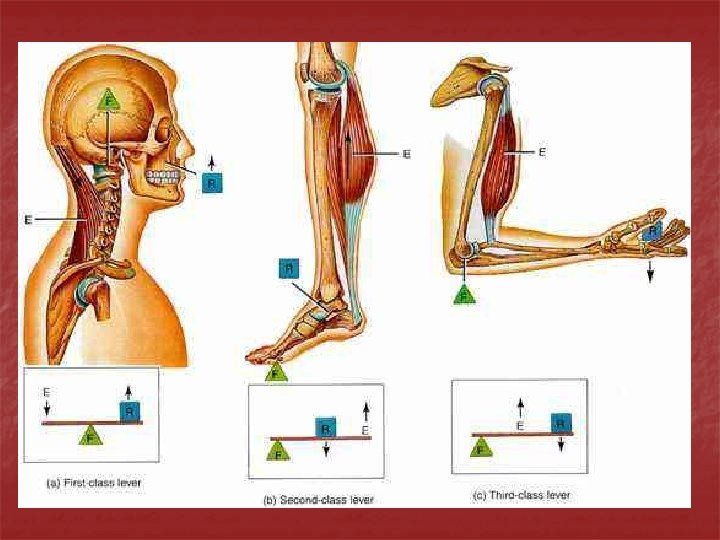
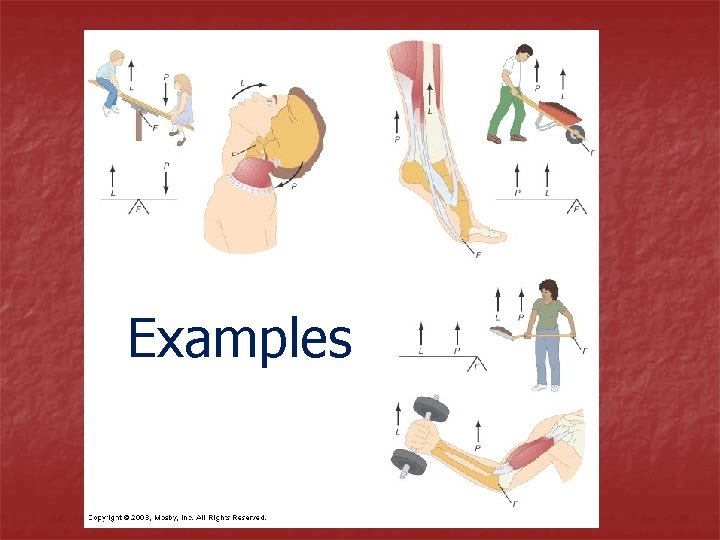
First class lever n n Fulcrum is in the middle - between load and effort The main advantage is the change in direction of the force – force exerted is equal to force lifted Example: Muscle pulls downward to lift body part upward or vice versa Example: Extension of head
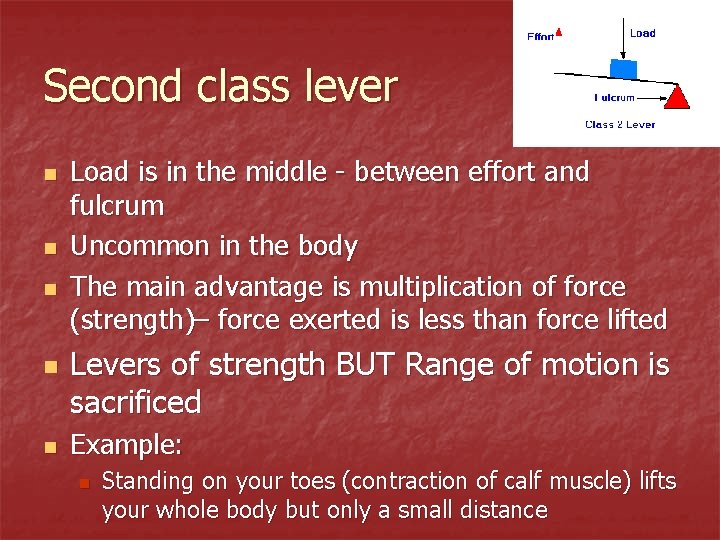
Second class lever n n n Load is in the middle - between effort and fulcrum Uncommon in the body The main advantage is multiplication of force (strength)– force exerted is less than force lifted Levers of strength BUT Range of motion is sacrificed Example: n Standing on your toes (contraction of calf muscle) lifts your whole body but only a small distance
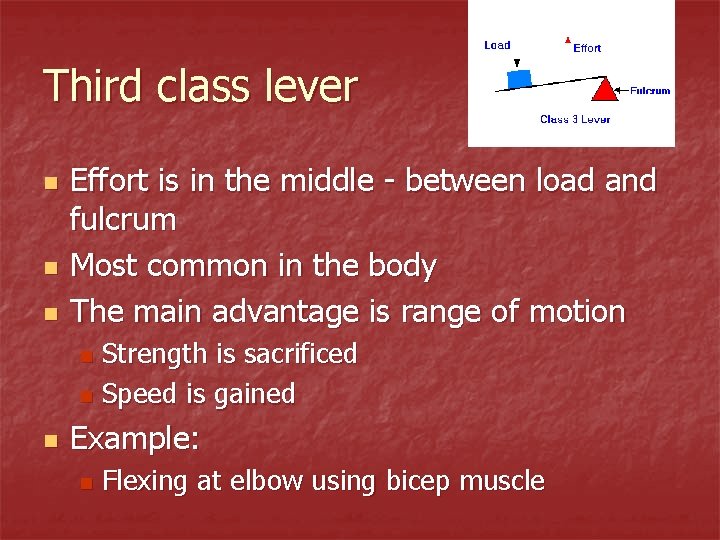
Third class lever n n n Effort is in the middle - between load and fulcrum Most common in the body The main advantage is range of motion Strength is sacrificed n Speed is gained n n Example: n Flexing at elbow using bicep muscle
Examples
The 5 Golden Rules of Skeletal Muscle Activity
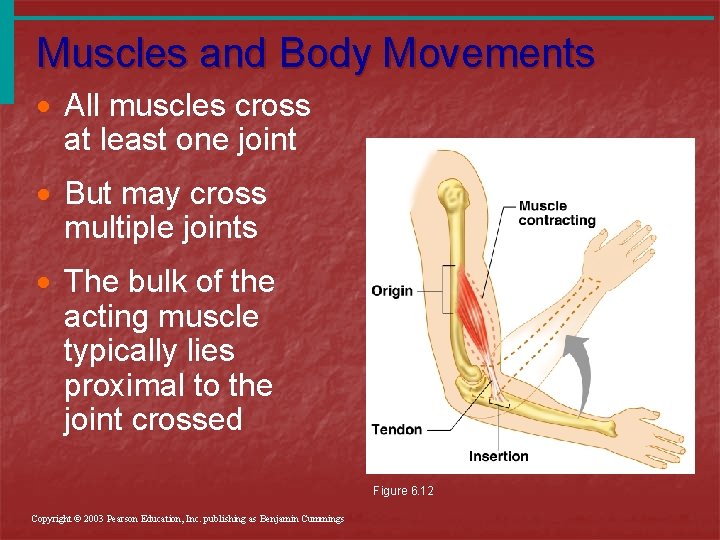
Muscles and Body Movements · All muscles cross at least one joint · But may cross multiple joints · The bulk of the acting muscle typically lies proximal to the joint crossed Figure 6. 12 Copyright © 2003 Pearson Education, Inc. publishing as Benjamin Cummings
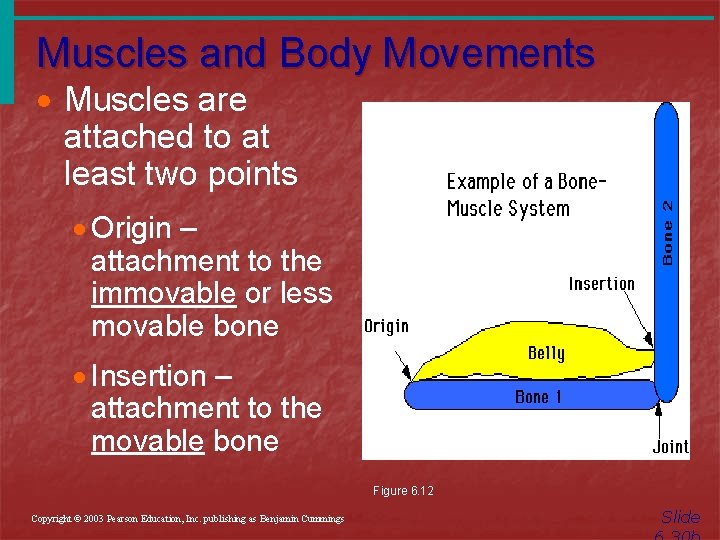
Muscles and Body Movements · Muscles are attached to at least two points · Origin – attachment to the immovable or less movable bone · Insertion – attachment to the movable bone Figure 6. 12 Copyright © 2003 Pearson Education, Inc. publishing as Benjamin Cummings Slide
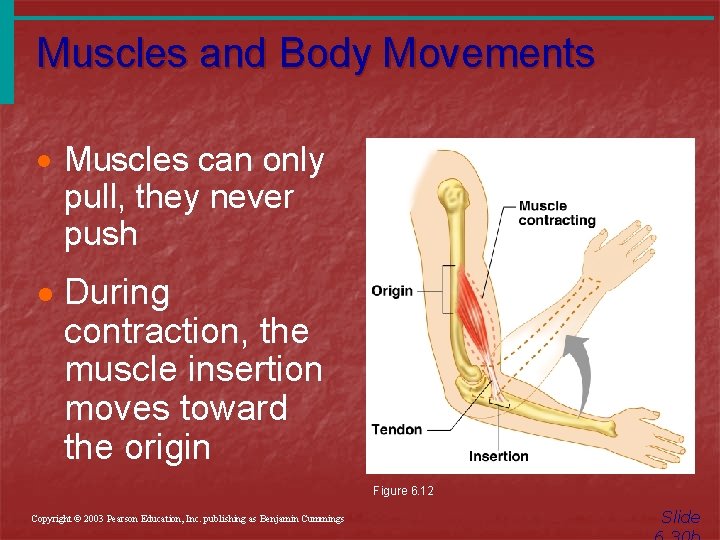
Muscles and Body Movements · Muscles can only pull, they never push · During contraction, the muscle insertion moves toward the origin Figure 6. 12 Copyright © 2003 Pearson Education, Inc. publishing as Benjamin Cummings Slide
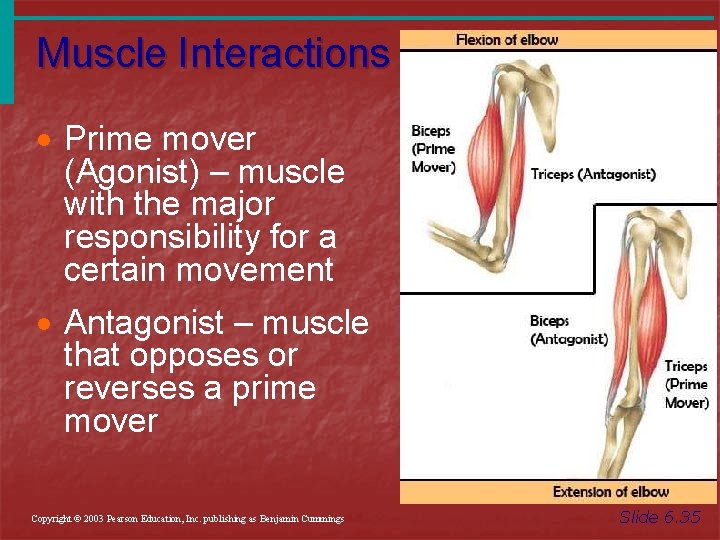
Muscle Interactions · Prime mover (Agonist) – muscle with the major responsibility for a certain movement · Antagonist – muscle that opposes or reverses a prime mover Copyright © 2003 Pearson Education, Inc. publishing as Benjamin Cummings Slide 6. 35
Muscle Interactions · Synergist – muscle that aids an agonist in a movement and helps stabilize the motion · Fixator – synergists that helps immobilize a bone or muscle origin (while the insertion point moves) Copyright © 2003 Pearson Education, Inc. publishing as Benjamin Cummings Slide 6. 35
Coordination n Actions of antagonistic and synergistic muscles are important in causing smooth, coordinated, and precise muscle motions.
Building Muscle Mass n In order to work a muscle effectively & to minimize risk of injury, the above factors must be considered. Number of reps and amount of weight depends on purpose of exercise (building vs. toning). n Type of joint involved in motions n Direction of muscle fibers (contained in fascicle) n Anatomy of the muscle n Angles of body parts
Fascicle Arrangment n n n The direction and arrangement of the muscle fiber bundles (aka: fascicles) is important to observe. These factors determine what a muscle can do and what it is best for. Fascicle arrangement is also important to take note of in order to maximize the efficiency of your workouts
Fascicle Arrangement n Range of Motion n Longer muscle fibers along muscle axis = greater range of motion n Parallel fascicle arrangement gives greatest ROM n Movement n Convergent muscle arrangement is best for moving large areas of the body
Fascicle arrangment n Strength (Power) n Depends on # of Muscle fibers n Greater # = greater power n Bipennate – shorten very little but have a greater # of muscle fibers collectively so best for strength n Circular muscles cause both internal and external body openings to: Open when relaxed n Close when contracted n Aka. Sphincter muscles n

Fascicle Arrangement – see notes

Might be some EC questions on the next Quiz (HINT) THINGS YOU SHOULD KNOW
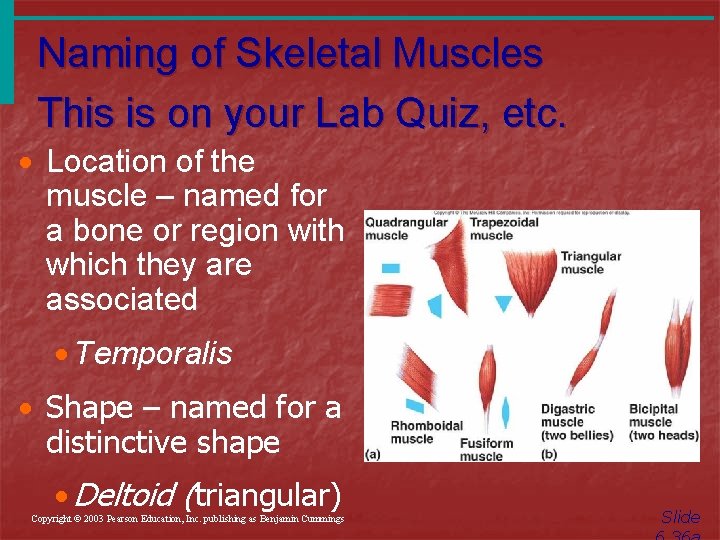
Naming of Skeletal Muscles This is on your Lab Quiz, etc. · Location of the muscle – named for a bone or region with which they are associated · Temporalis · Shape – named for a distinctive shape · Deltoid (triangular) Copyright © 2003 Pearson Education, Inc. publishing as Benjamin Cummings Slide
Naming of Skeletal Muscles · Relative size of the muscle · maximus (largest) · Minimus (smallest) · Longus (longer in length than in diameter) · Direction of muscle fibers · rectus (straight) · Oblique (at an angle) Copyright © 2003 Pearson Education, Inc. publishing as Benjamin Cummings Slide
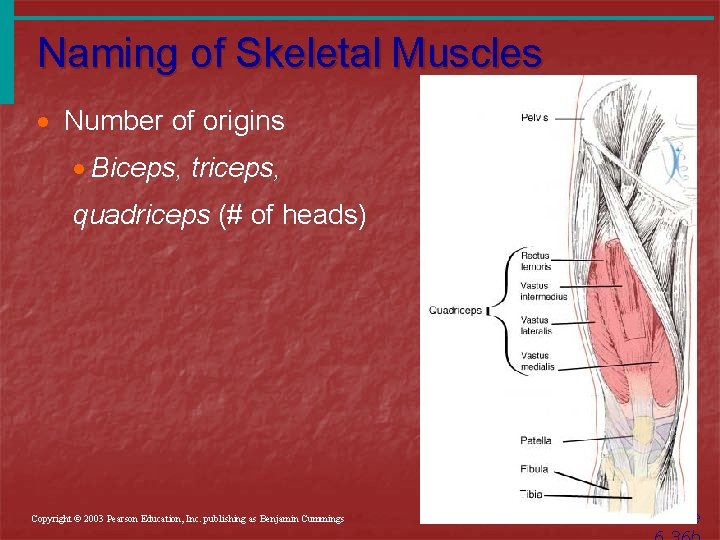
Naming of Skeletal Muscles · Number of origins · Biceps, triceps, quadriceps (# of heads) Copyright © 2003 Pearson Education, Inc. publishing as Benjamin Cummings Slide
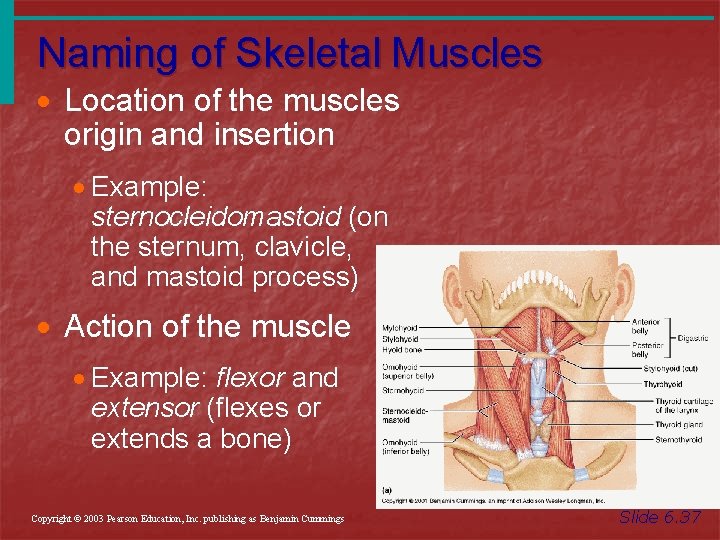
Naming of Skeletal Muscles · Location of the muscles origin and insertion · Example: sternocleidomastoid (on the sternum, clavicle, and mastoid process) · Action of the muscle · Example: flexor and extensor (flexes or extends a bone) Copyright © 2003 Pearson Education, Inc. publishing as Benjamin Cummings Slide 6. 37
FYI: Muscle Disuse n When a muscle is completely immobilized from: Enforced bed rest n Loss of neural stimulation n Injury n n Degeneration and loss of muscle mass begins n Can decrease at a rate of 5% per day
FYI: Disuse Atrophy n Flaccid n n Atrophy n n Muscle loses tone and becomes soft and flabby Loss of muscle mass Replaced by fibrous CT making muscle rehabilitation impossible May be delayed by electrical stimulation When muscle is totally deprived of neural stimulation: n Paralyzed muscle may ultimately atrophy to 25% of original mass
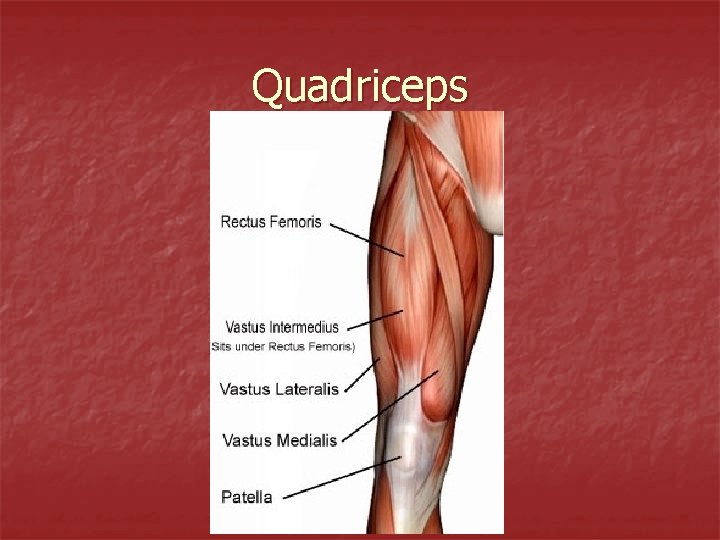
Major Muscles – this is on your Lab Quiz, etc. n Memorize the location of the muscles using the diagrams you were provided (Muscle Man diagram) Hamstrings: biceps femoris, semimembranosus, semitendinosus n Quadriceps: rectus femoris, vastus lateralis, vastus medialis, vastus intermedius (all insert into tibial tuberosity through quadriceps tendon and patellar ligament) n
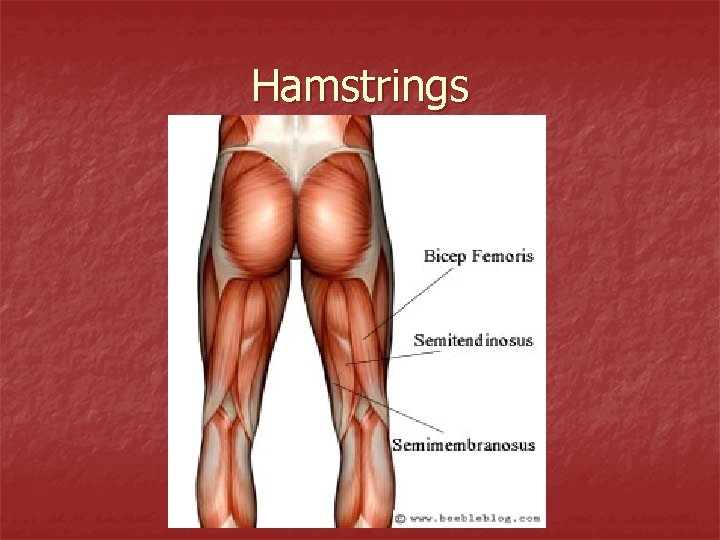
Hamstrings
Quadriceps

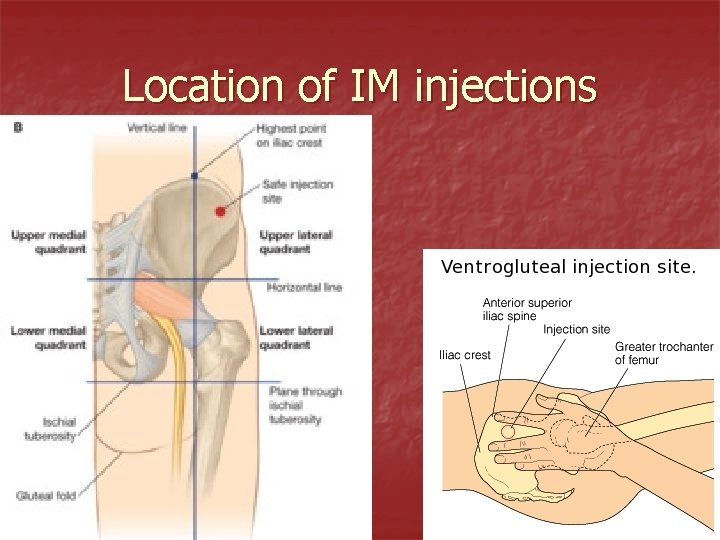
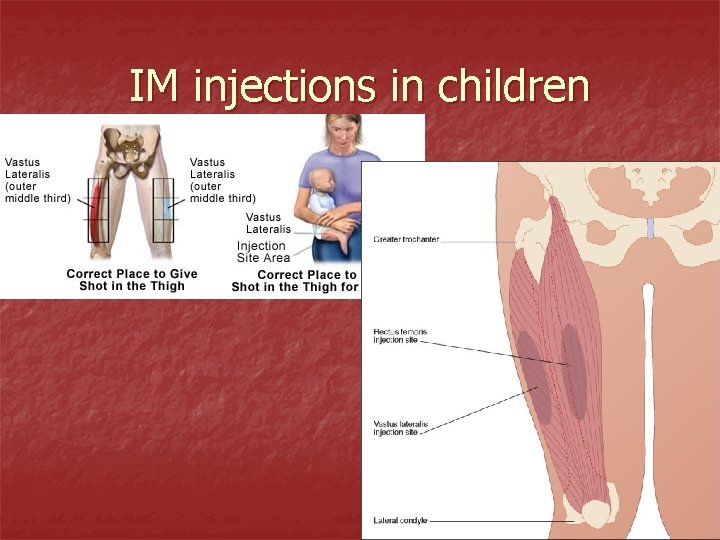
Locations of IM injections – this is on your Lab Quiz, etc. n n deltoid muscle gluteus medius – superior lateral quadrant used in order to avoid damaging underlying sciatic nerve vastus lateralis and rectus femoris are used for infant injections due to poor development of gluteal muscles and deltoid muscles
Location of IM injections
IM injections in children
Functional Characteristics of Muscles · Contractility – ability to shorten forcibly · Excitability – ability to receive and respond to stimuli · Elasticity – ability to resume resting length (recoil) · Extensibility – ability to be stretched or extended Copyright © 2003 Pearson Education, Inc. publishing as Benjamin Cummings Slide 6. 8
Function of Muscles · Responsible for all locomotion & manipulation · Smooth: vasoconstriction, peristalsis · Skeletal: locomotion & manipulation · Cardiac: pump Copyright © 2003 Pearson Education, Inc. publishing as Benjamin Cummings Slide 6. 8
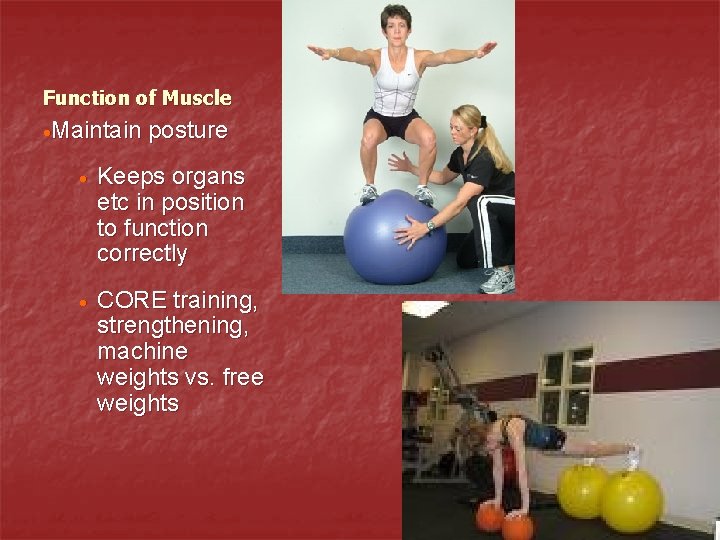
Function of Muscle ·Maintain posture · Keeps organs etc in position to function correctly · CORE training, strengthening, machine weights vs. free weights
Function of Muscles · Generate heat · By product of muscle metabolism & contractile activity (40% of body mass) · 25% cellular activities and 75% heat · Example: shivering uses muscle activity to generate heat when you are cold · Stabilize joints – muscle tone & tendons extremely important to stabilize joints Copyright © 2003 Pearson Education, Inc. publishing as Benjamin Cummings Slide 6. 8
Know your 3 muscle slides – these are on your test Also know the main features of each type of tissue – review your tissue chart and tissue unit notes
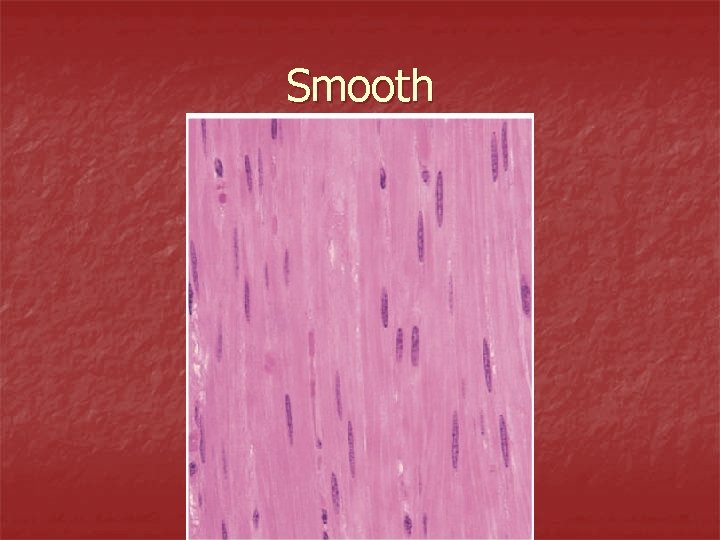
Smooth
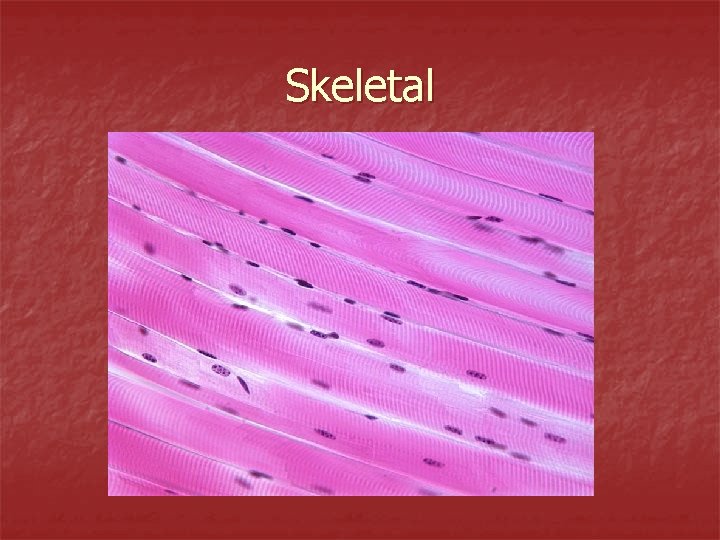
Skeletal
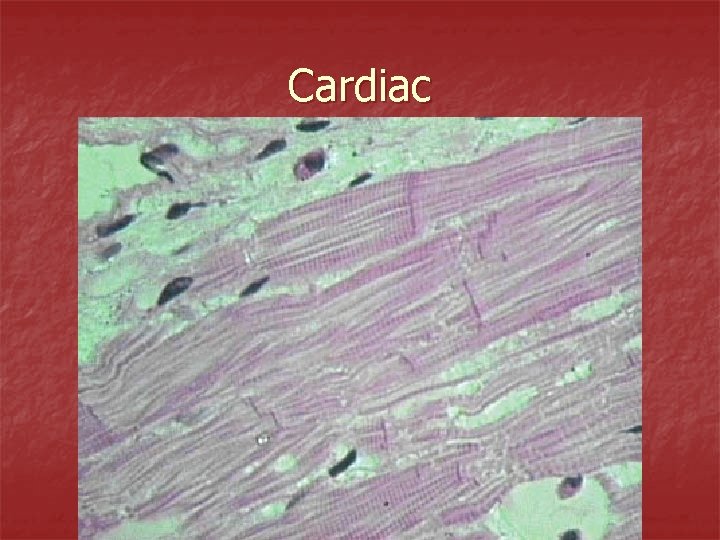
Cardiac
ORIGIN, INSERTION, ACTION, INNERVATION
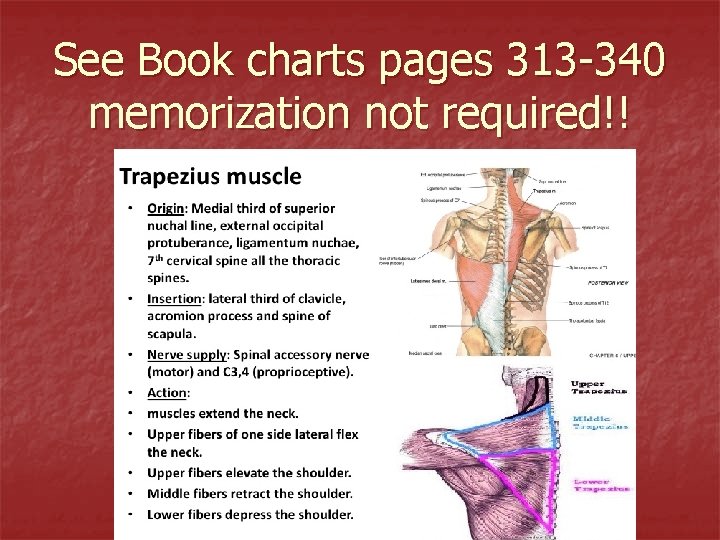
See Book charts pages 313 -340 memorization not required!!
For Lab Quiz n n n Complete your lab questions & have your 2 graphs stapled to the lab sheet. You will be able to use these on the quiz. Study your Muscle Man diagram – you are responsible for knowing these muscles for the quiz. Study pages 7 -8 of your notes – you are responsible for knowing this info for the quiz.
- Slides: 79