
Essentialism A short history of what Existentialism was
- Slides: 13
Essentialism A short history of what Existentialism was reacting against Andrew Jeffery, Instructor
Mythical Religious Essentialism • Long before philosophy and natural science got started, human beings had religious myth. • Nowadays, the word “myth” is frequently associated with falsehood, but originally a myth was a special kind of story, not necessarily false. • Myth functioned like a “script” for life. It explained the world, and moreover, a person who accepted/believed the myth could, in some sense, locate themselves within its narrative and thereby understand their role in the story of the world. • I. E. , Myth explained the Meaning of Life.
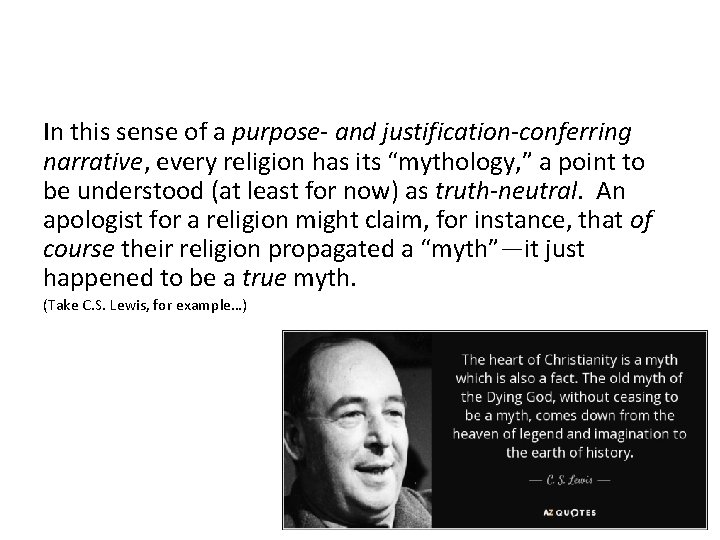
In this sense of a purpose- and justification-conferring narrative, every religion has its “mythology, ” a point to be understood (at least for now) as truth-neutral. An apologist for a religion might claim, for instance, that of course their religion propagated a “myth”—it just happened to be a true myth. (Take C. S. Lewis, for example…)
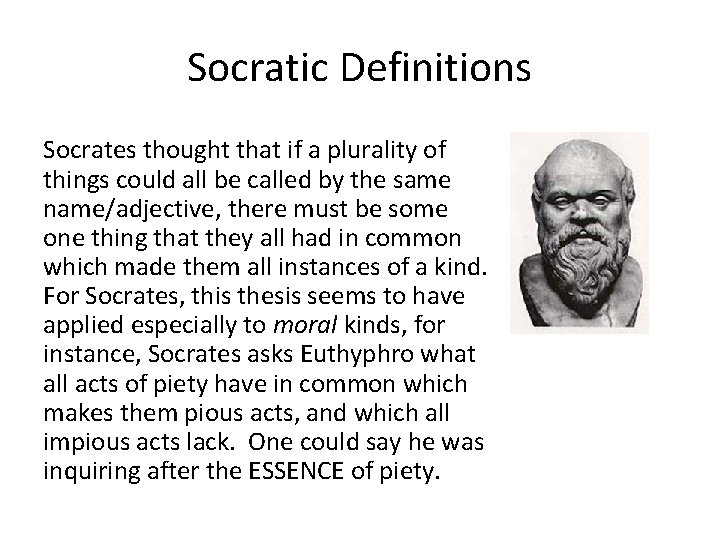
Socratic Definitions Socrates thought that if a plurality of things could all be called by the same name/adjective, there must be some one thing that they all had in common which made them all instances of a kind. For Socrates, this thesis seems to have applied especially to moral kinds, for instance, Socrates asks Euthyphro what all acts of piety have in common which makes them pious acts, and which all impious acts lack. One could say he was inquiring after the ESSENCE of piety.
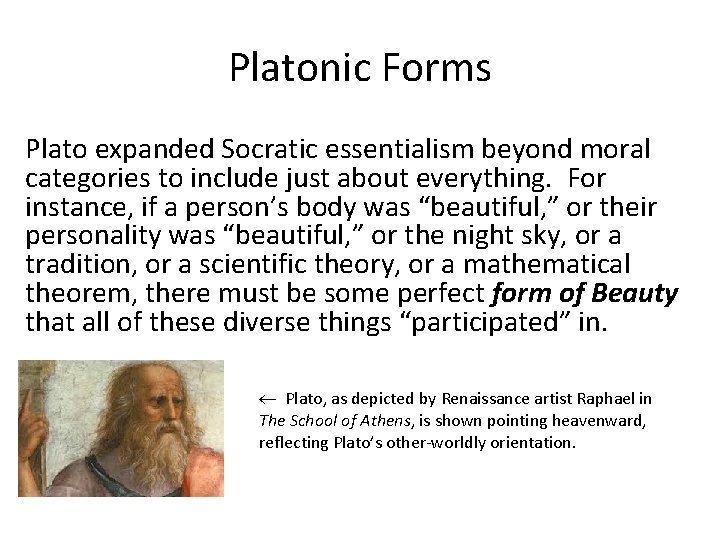
Platonic Forms Plato expanded Socratic essentialism beyond moral categories to include just about everything. For instance, if a person’s body was “beautiful, ” or their personality was “beautiful, ” or the night sky, or a tradition, or a scientific theory, or a mathematical theorem, there must be some perfect form of Beauty that all of these diverse things “participated” in. Plato, as depicted by Renaissance artist Raphael in The School of Athens, is shown pointing heavenward, reflecting Plato’s other-worldly orientation.
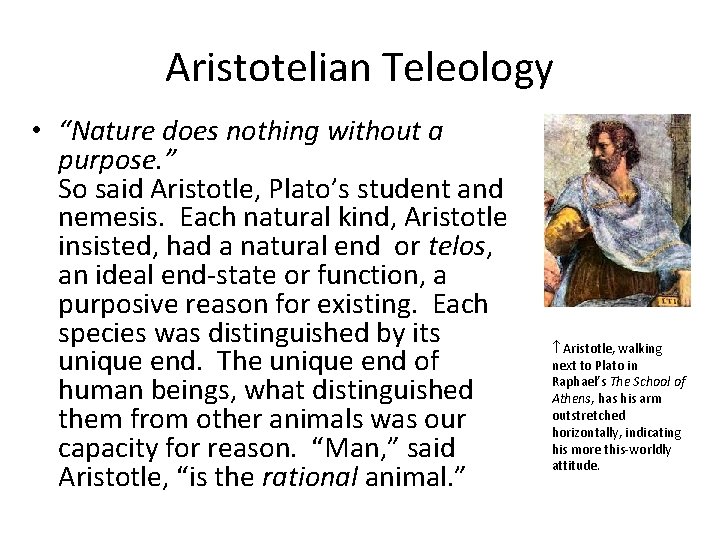
Aristotelian Teleology • “Nature does nothing without a purpose. ” So said Aristotle, Plato’s student and nemesis. Each natural kind, Aristotle insisted, had a natural end or telos, an ideal end-state or function, a purposive reason for existing. Each species was distinguished by its unique end. The unique end of human beings, what distinguished them from other animals was our capacity for reason. “Man, ” said Aristotle, “is the rational animal. ” Aristotle, walking next to Plato in Raphael’s The School of Athens, has his arm outstretched horizontally, indicating his more this-worldly attitude.
The False Naturalization of the Status Quo Aristotle tended to be rather self-congratulatory, with self-serving rationalizations that declared much of his cultural world to be ineluctable parts of the Natural Order. Many of the more negative connotations of “essentialism” stem from his prejudices. For instance: • Natural slavery—Aristotle regarded the slavery to be the natural telos of some people. In his Politics, he characterizes the natural household to consist of husband, wife, slave, and finally, children. • Racism—Also in his Politics, he asserted that some nationalities, such as the Persians, were “natural slaves, ” whereas the Greeks were “natural masters. ” • Sexism—Aristotle was also more patriarchal than his teacher Plato, holding the men to be essentially more rational than women, and thus the natural heads of the household and the State. • Aristocracy—Aristotle held that even among free men, some men are naturally superior, and only a leisure-class could aspire to the fullness of human excellence. His list of “virtues” includes some character traits that only a wealthy aristocrat could have exhibited.
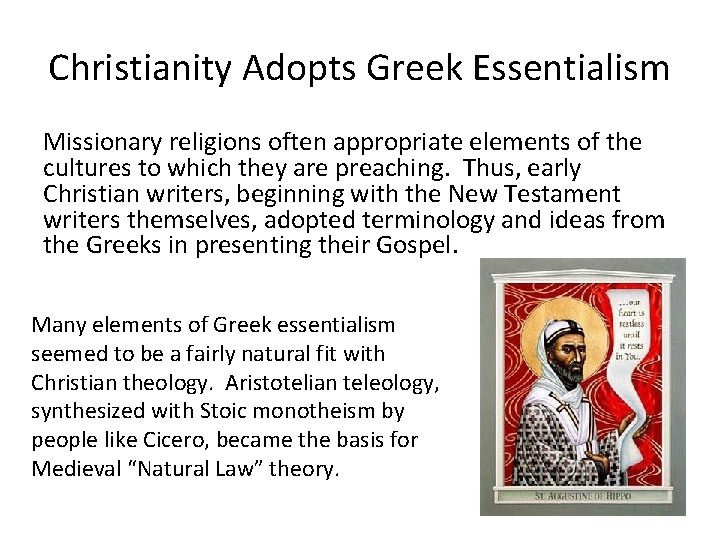
Christianity Adopts Greek Essentialism Missionary religions often appropriate elements of the cultures to which they are preaching. Thus, early Christian writers, beginning with the New Testament writers themselves, adopted terminology and ideas from the Greeks in presenting their Gospel. Many elements of Greek essentialism seemed to be a fairly natural fit with Christian theology. Aristotelian teleology, synthesized with Stoic monotheism by people like Cicero, became the basis for Medieval “Natural Law” theory.
The Medieval World • A Feudal Hierarchy, justified as according with a Divine/Natural Law • Ecclesiastical control of information and scholarship, all writing copied by hand • Anthropocentric view of the physical universe, A backward-looking, antiquity-respecting, Aristotelian paradigm of the sciences.
The Modern World The transition to “Modernity” precipitated by : • The rise of the commercial classes, upsetting the feudal order and creating a non-ecclesiastical market for learning. • The printing press, liberating the flow of information. • The Copernican Revolution • The Discovery (and subsequent colonization) of the Americas • The Protestant Reformation
Modern Essentialism For all this, the Moderns remained stubbornly essentialist. Everyone still assumed there were ineluctable, objective truths about human nature, even if there was dispute about what these were. Cartesians, for instance, held that humans had a dual nature—an immaterial soul contingently linked with a material body. Materialists, on the other hand, claimed that the mind was emergent property of the brain.
Essence and Accident From antiquity, essentialism has distinguished between the essential and accidental attributes of beings. • An essential attribute of a being is a non-contingent property that defines that being, and upon which its metaphysical and numerical identity depend. • An accidental attribute is one that an individual only happens to have, but might not have had. So for instance, that a whale is a mammal is true of the whale in any world in which it exists. Its mammalian nature is a part of its essence. But on the other hand, suppose an particular whale has a scar left from a harpoon. That feature of the whale is accidental to it.
Do you have an essence? Do you think you have essential properties? Are there truths about you that would remain true regardless of your history or choices or any other fact about the world? For instance, is your genetic code essential to you, or could you have had a completely different body, even different parents? Is there anything that is or would be true about you in any possible world in which you existed?