
Essential Tremor Red FlagsEpidemiology Part 2 of 7
- Slides: 10
Essential Tremor: Red Flags/Epidemiology Part 2 of 7 www. wemove. org Essential Tremor Slide Library Version 1. 0 - All Contents Copyright © WE MOVE 2001
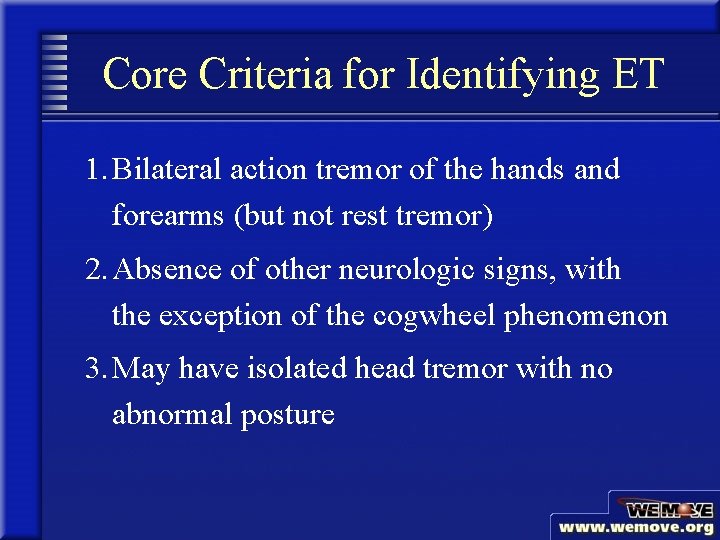
Core Criteria for Identifying ET 1. Bilateral action tremor of the hands and forearms (but not rest tremor) 2. Absence of other neurologic signs, with the exception of the cogwheel phenomenon 3. May have isolated head tremor with no abnormal posture www. wemove. org
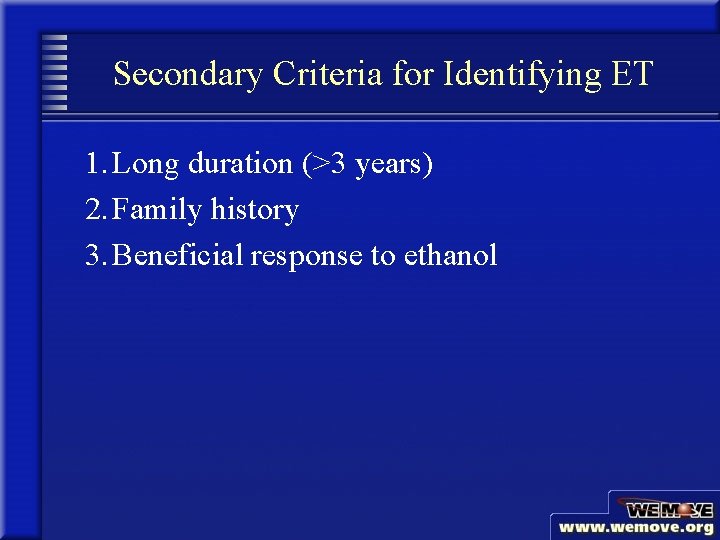
Secondary Criteria for Identifying ET 1. Long duration (>3 years) 2. Family history 3. Beneficial response to ethanol www. wemove. org
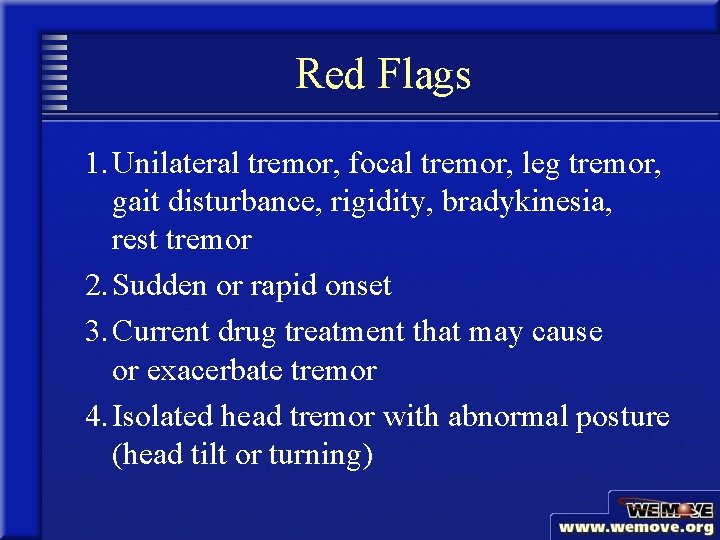
Red Flags 1. Unilateral tremor, focal tremor, leg tremor, gait disturbance, rigidity, bradykinesia, rest tremor 2. Sudden or rapid onset 3. Current drug treatment that may cause or exacerbate tremor 4. Isolated head tremor with abnormal posture (head tilt or turning) www. wemove. org
Epidemiology: Case Ascertainment Patients may not seek medical evaluation if… – Tremor is mild; associated with no functional disability; accepted as a part of life – Improperly attributed to “old age” – Associated social disability from tremor is not taken seriously – Patients are unaware that effective treatment options are available www. wemove. org
Challenge to determine true frequency of ET in general population due to. . . • Variation in the clinical criteria • Lack of consensus on the definition of ET • Difficulty in differentiating between mild forms of ET and exaggerated physiologic tremor (EPT) • Difficulties in classifying tremor when it is associated with other conditions (e. g. , dystonia and parkinsonism) www. wemove. org
Rajput: Incidence of ET Brin M, Koller W. Epidemiology and genetics of essential tremor. Mov Disord 1998; 13 (Suppl 3): 55 -63. www. wemove. org
Rajput: ET in Rochester, MN, USA • • 1935 to 1979 (45 -year study) Age at Dx: mean of 58 (2 to 96 years) Incidence: 23. 7/100, 000 (M=F) Prevalence: 305. 6/100, 000 Cervical dystonia in 3% Subsequent PD diagnosis in 2% Family history of tremor in 39% www. wemove. org
Salemi: Prevalence of ET Salemi G, Savettieri G, Rocca WA, et al. Prevalence of essential tremor: a door-to-door survey in Terrasini, Sicily. Neurology. 1994; 44: 61 -64. www. wemove. org
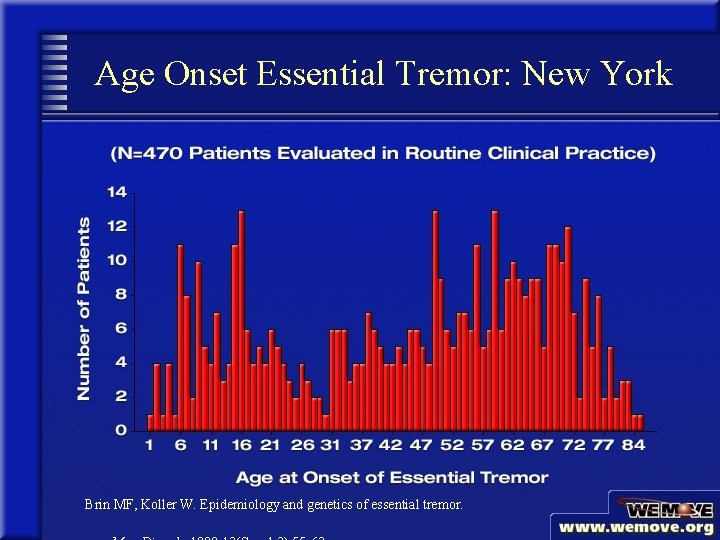
Age Onset Essential Tremor: New York Brin MF, Koller W. Epidemiology and genetics of essential tremor. www. wemove. org