
Essential Steps in Effective Advocacy Strategies Jenifer J
- Slides: 30
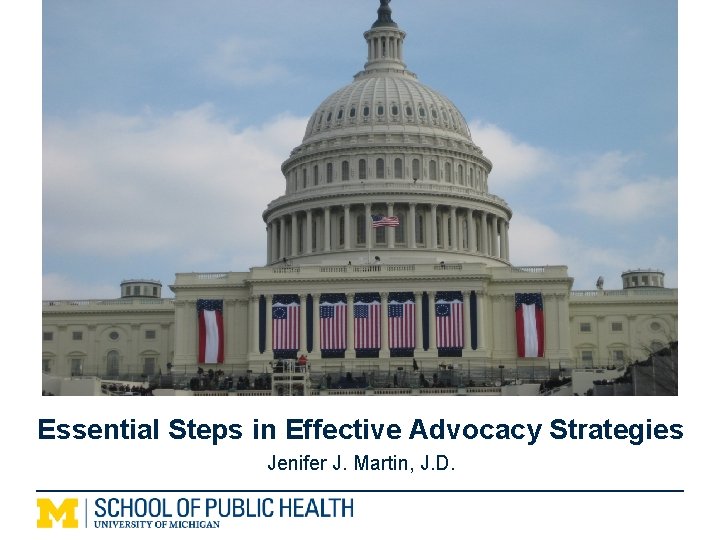
Essential Steps in Effective Advocacy Strategies Jenifer J. Martin, J. D.
Today’s Agenda • Why advocacy? • Review steps in effective advocacy strategies • Tips to help “bridge the partisan divide”
Overall Principles • Success is dependent on both substance and relationships • Please, please be gracious • First impressions matter • Rational v. emotional • Congenial v. adversarial
Overall Principles • • • Process expertise Broad application Etiquette and protocol No gum, hair twirling, nail picking… Please, turn off and store your phone It’s not rocket science!
Step #1: Identify Your Issue • What is the problem? • Do your research: be the expert and serve as a resource • Understand all sides of the issue, and all arguments, pro and con
Step #2: Define and Clarify Goal • What do you want the policymaker/decisionmaker to do? • Do not describe the problem without presenting a viable solution • SMART goal: specific, measurable, assignable, realistic, time-related
Step #2: Define and Clarify Goal • Include short, intermediate, and long-term goals (patience) • Include acceptable alternatives and compromises • Understand political context, realities, and limitations
Step #2: Define and Clarify Goal • Using research findings and substantive policy analysis, develop the “ask” • Proactive or reactive? • Take action, or protect/maintain the status quo? • Change current law or create a new law? • Can your goal be accomplished by executive order, or regulation? • OR are you educating policymakers for future action?
Step #2: World Peace? • Be as clear as possible about what you are asking the policymaker/decisionmaker to do • If appropriate, include the specific legislation/vehicle that addresses the issue, the lead sponsor, and the timing of future actions
Step #2: Sample “Ask” “I’m writing to urge you to support an amendment offered by Michigan Senators Stabenow and Peters to S. 2012, the Energy Policy and Modernization Act. This amendment would provide up to $400 million to the U. S. Environmental Protection Agency to help repair the water supply infrastructure in Flint, Michigan and protect its children from dangerous lead contamination. ”
Step #3: Know Your Audience • Who can accomplish your goal? • Identify decisionmaker: often not intuitive (legislation: not the White House!) • Authorization (policy) v. appropriation ($$$) • Elected official v. staff (be aware of term limits in Michigan!)
Step #3: Know Your Audience • Who influences the decisionmaker? – Media – Constituents – Interest groups/stakeholder organizations
Step #4: Learn the Process • What is the relevant process for accomplishing your goal? – Legislative? Executive order? Regulatory? • Understand each step and opportunities for influence • Be aware of timing • Learn the etiquette and protocol
Step #5: Find Your Allies • Who can help you accomplish your goal? • Identify and cultivate a champion • Internal advocate who shares your commitment to accomplishing your goal • Mole! Source of intelligence and information throughout the process • Possible examples: constituent elected officials, committee jurisdiction, state delegations, governors, leadership, caucuses
Step #5: Find Your Allies • Identify stakeholder organizations: what are they doing that is relevant to your goal? • Who shares your passion for accomplishing your goal? • Forge coalition to unite around a common goal • Include grassroots efforts to build out constituent engagement
Step #6: Develop Your Message • • • What will resonate with your decisionmaker? (Is it about money? ) Tailor messages to specific audiences Prepare talking points Address and refute opposing arguments in your pitch (using research/expertise) • Factor in both substantive and political context
Step #7: Advance Your Message • Identify opportunities to communicate your message to the decisionmaker • Cultivate personal relationships • Conduct in-person, face-to-face meetings • Provide testimony in public hearings • Hold briefings on your issue • Participate in elected officials’ “town hall” meetings • Invite decisionmaker/policymaker to come to you – visit project site, attend event, etc.
Step #7: Advance Your Message • Identify opportunities to communicate your message to the decisionmaker • Mail – letters, the old fashioned way! • Email (reality of post 9 -11 security) • Grassroots efforts that engage constituents • Media: strategic placement of op/eds • Social media (Facebook, Twitter) • Blogs • Participate in campaign activities
Step #8: Prepare Written Materials • Develop variety of written advocacy materials to share widely with decisionmakers/stakeholders • Prepare “leave behind” packet of information • Write concise “one-pager” advocating for your goal • Include supporting white papers, press, policy briefs, FAQs, fact sheets, academic articles, other relevant and compelling information • Tailor messages to specific audiences
Step #9: Advocate! Execute Strategy • Map out and execute your strategy • Be brief, concise, and clear (8 minute rule) • Network and build relationships (using informational interviewing approach)
Step #9: Advocate! Execute Strategy • Practice integrity, honesty, and respect • Be responsive to requests for additional information, answer questions, etc. • Be considerate of competing demands/time issues for decisionmakers
Step #9: Advocate! Execute Strategy • Guide to advocacy communications (written and oral) • Employ the 8 minute rule! – “Thank you for taking the time to meet/talk with me today. ” – Introduce yourself, the organization or cause you represent, and identify the reason for your visit (for example, specific legislation, upcoming vote, etc. ) – Explain why this is relevant to them and why they should care (local constituent issue, they are a member of a committee with an upcoming vote, etc. ) – Provide information, and address opposing points of view to arm them with answers to arguments and questions they may receive – Offer to serve as a resource and provide follow-up information – “Thank you for taking the time to meet/talk with me today. Please let me know how I may be helpful to you or your colleagues. It would be a pleasure. ”
Step #10: Followup • Write thank you notes! Order personal stationery! • For Capitol Hill correspondence, use email (post 9 -11) • Offer assistance, serve as a resource, answer questions, provide new information • Maintain contact and stay in touch to strengthen relationships
One Pager • The most important advocacy tool • Routinely used to persuade a policymaker, or a decisionmaker in your organization, to take a particular course of action • Use this in “leave behind” materials with policymakers/decisionmakers
One Pager • Headings and sections to organize key points • Bold/caps/underline for emphasis • Lots of white space, bullet points • Graphs and charts can be helpful
One Pager • No long citations (According to the CDC…) • Use common terms, spell out acronyms, define terms if necessary (for the lay reader) • Keep it simple • Intended to be a VERY quick read
One Pager • TITLE. State who you are/represent and the policy recommendation/goal you are seeking (the ask) • PROBLEM. First heading: provide background/overview on the issue to create context, describing the problem you are trying to address. Use statistics/examples to create a compelling sense of urgency to motivate the policymaker/decisionmaker to take the action you recommend. • SOLUTION. Second heading: describe the impact the action you recommend will have on the problem. Include statistics/examples to illustrate why this is the best solution.
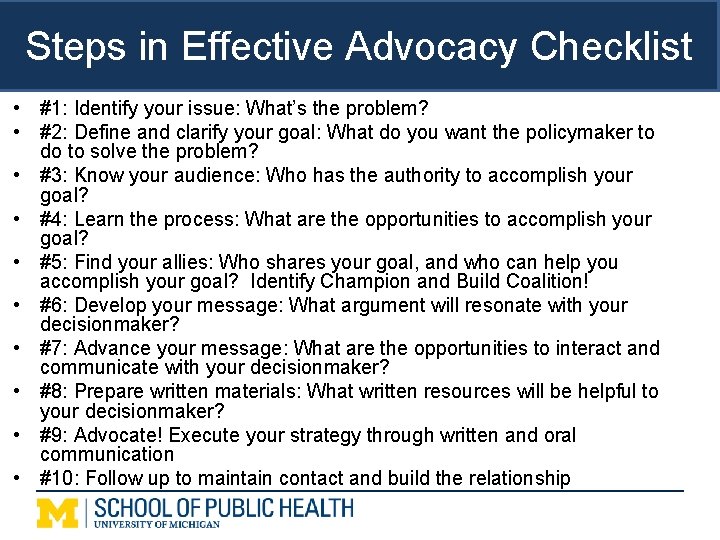
Steps in Effective Advocacy Checklist • #1: Identify your issue: What’s the problem? • #2: Define and clarify your goal: What do you want the policymaker to do to solve the problem? • #3: Know your audience: Who has the authority to accomplish your goal? • #4: Learn the process: What are the opportunities to accomplish your goal? • #5: Find your allies: Who shares your goal, and who can help you accomplish your goal? Identify Champion and Build Coalition! • #6: Develop your message: What argument will resonate with your decisionmaker? • #7: Advance your message: What are the opportunities to interact and communicate with your decisionmaker? • #8: Prepare written materials: What written resources will be helpful to your decisionmaker? • #9: Advocate! Execute your strategy through written and oral communication • #10: Follow up to maintain contact and build the relationship
In conclusion… Questions, ideas or feedback? martinjj@Umich. edu