
Essential Questions Who was Sir Isaac Newton What

- Slides: 24
Essential Questions • Who was Sir Isaac Newton? • What is the first Laws of Motion? • How do Newton’s Laws affect motion?
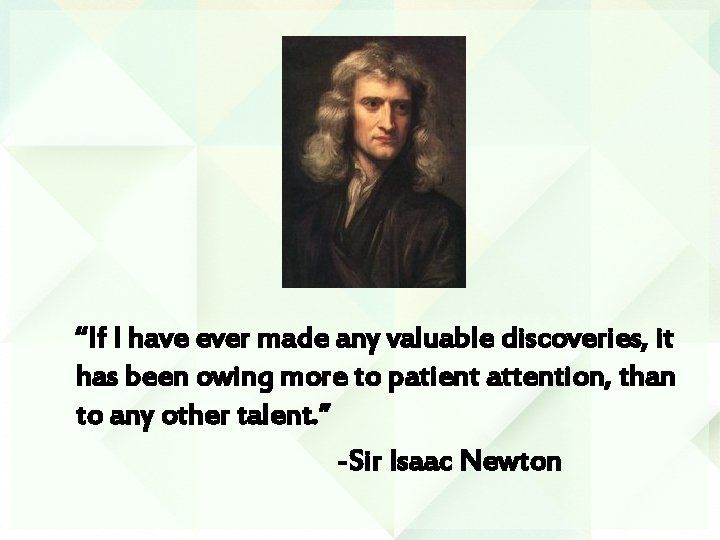
“If I have ever made any valuable discoveries, it has been owing more to patient attention, than to any other talent. ” -Sir Isaac Newton
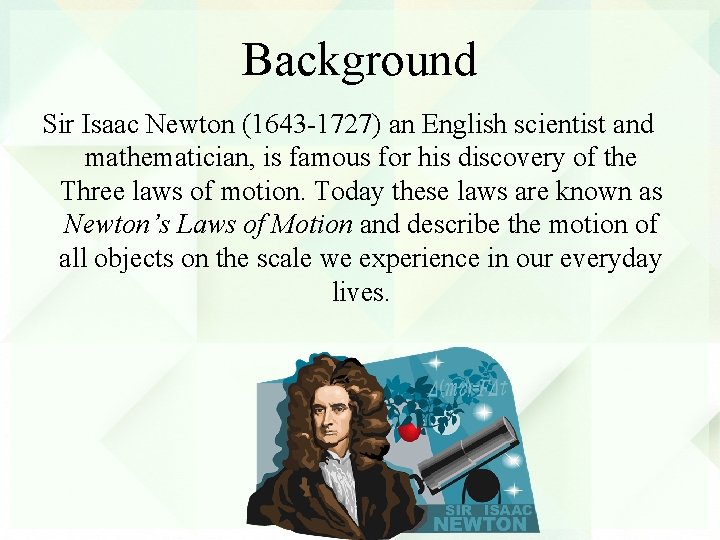
Background Sir Isaac Newton (1643 -1727) an English scientist and mathematician, is famous for his discovery of the Three laws of motion. Today these laws are known as Newton’s Laws of Motion and describe the motion of all objects on the scale we experience in our everyday lives.
While most people know what Newton's laws say, many people do not always know what they mean. 1. 2. If I carefully set this block here, what do you think will happen next? How do you know? If I decide to give this block a push, what will happen? How do you know?
Newton’s First Law “An object at rest tends to stay at rest and an object in motion tends to stay in motion unless acted upon by an unbalanced force. ” Law of Inertia
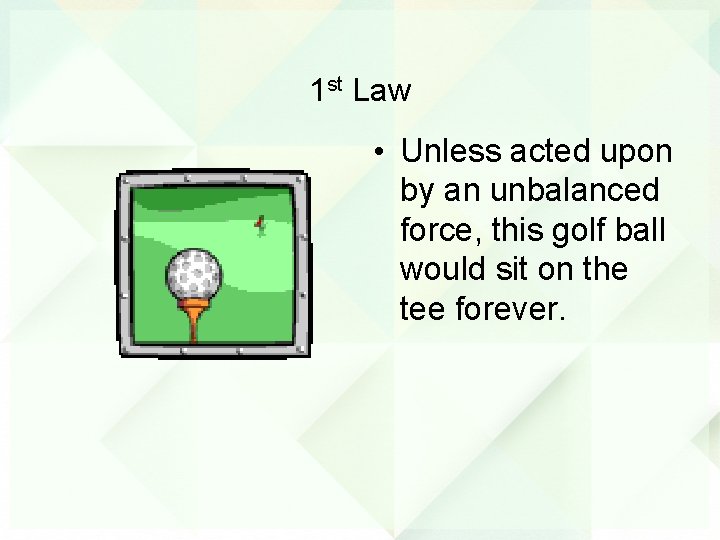
1 st Law • Unless acted upon by an unbalanced force, this golf ball would sit on the tee forever.
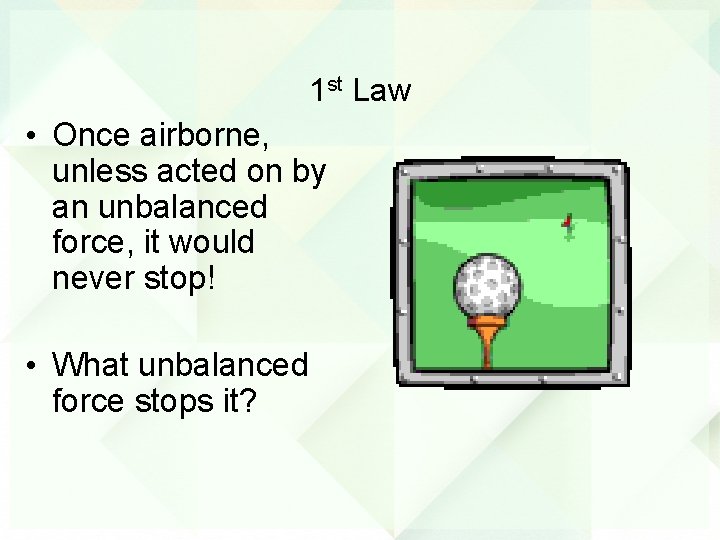
1 st Law • Once airborne, unless acted on by an unbalanced force, it would never stop! • What unbalanced force stops it?
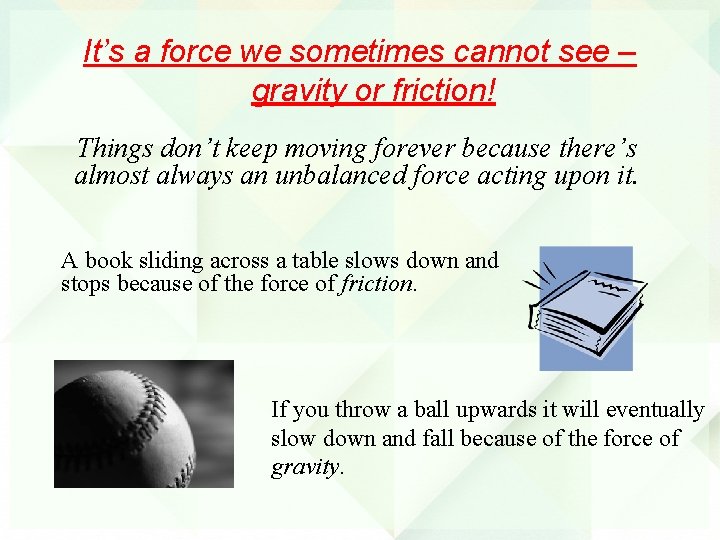
It’s a force we sometimes cannot see – gravity or friction! Things don’t keep moving forever because there’s almost always an unbalanced force acting upon it. A book sliding across a table slows down and stops because of the force of friction. If you throw a ball upwards it will eventually slow down and fall because of the force of gravity.
Let’s explore… • There are four main types of friction: • Sliding friction: ice skating • Rolling friction: bowling • Fluid friction (air or liquid): air or water resistance • Static friction: initial friction when moving an object
Inertia • Can an object move on its own? • NO!!!!!!! • INERTIA is the tendency of an object to remain at rest if it is resting or stay in motion if it is moving. • Slide a pencil gently across a table and watch it slide to a rest position. Which unbalanced force acted upon it to bring it to a resting position? • In the absence of that force, what would happen to the pencil?
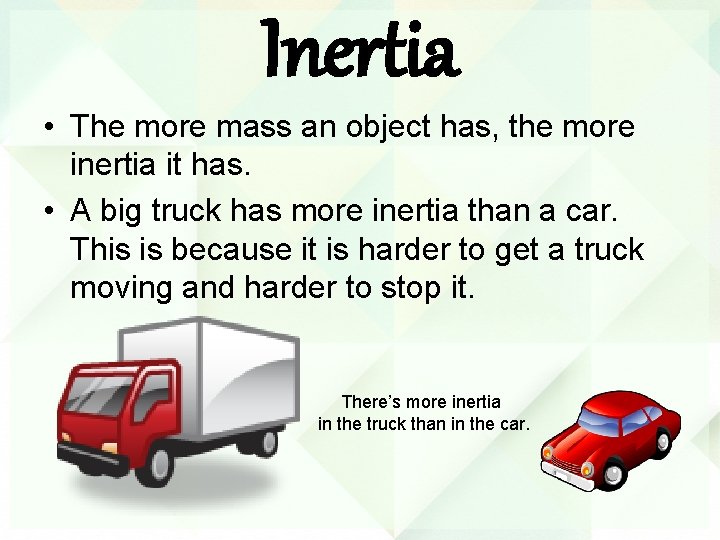
Inertia • The more mass an object has, the more inertia it has. • A big truck has more inertia than a car. This is because it is harder to get a truck moving and harder to stop it. There’s more inertia in the truck than in the car.
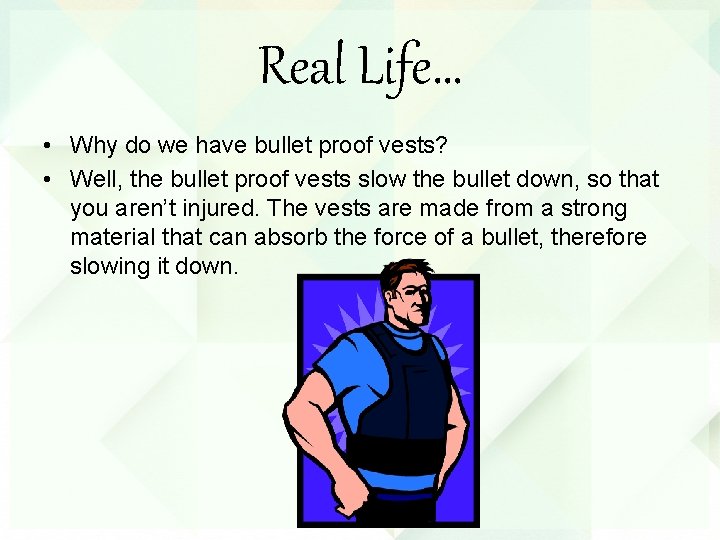
Real Life… • Why do we have bullet proof vests? • Well, the bullet proof vests slow the bullet down, so that you aren’t injured. The vests are made from a strong material that can absorb the force of a bullet, therefore slowing it down.
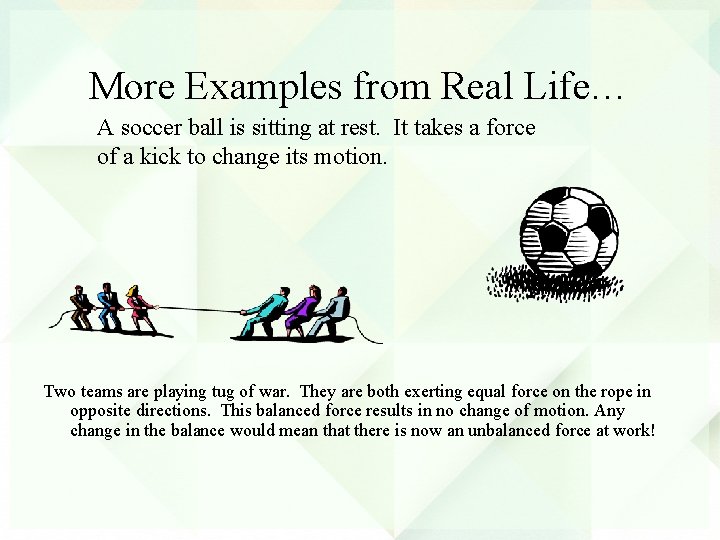
More Examples from Real Life… A soccer ball is sitting at rest. It takes a force of a kick to change its motion. Two teams are playing tug of war. They are both exerting equal force on the rope in opposite directions. This balanced force results in no change of motion. Any change in the balance would mean that there is now an unbalanced force at work!
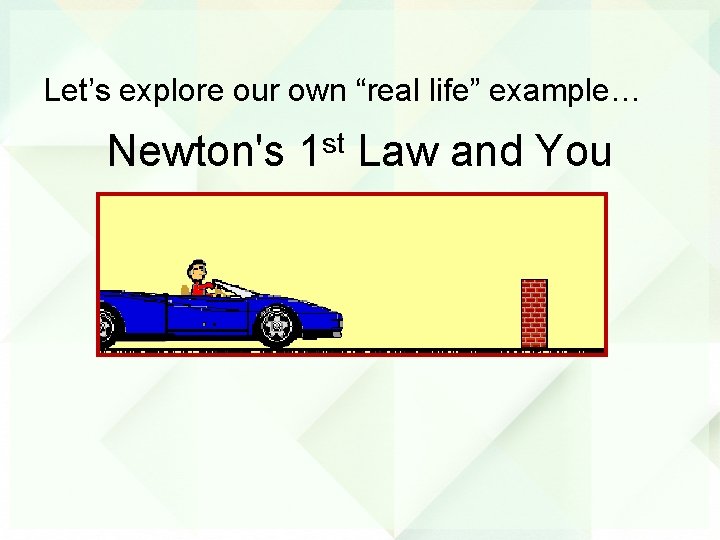
Let’s explore our own “real life” example… Newton's 1 st Law and You
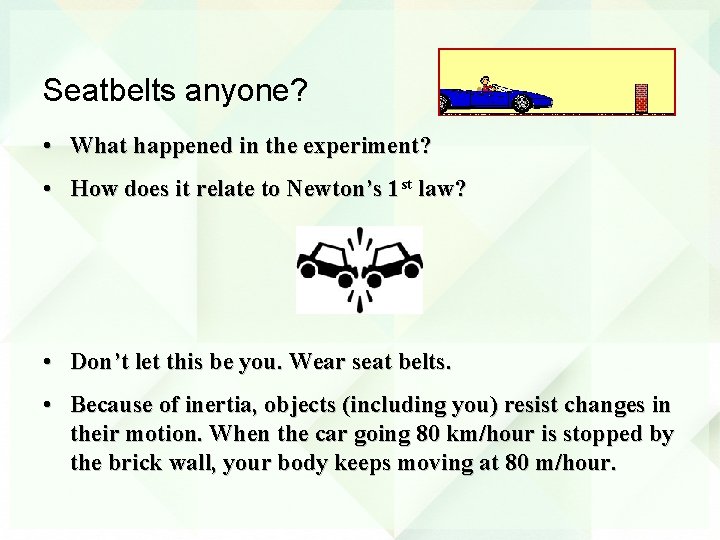
Seatbelts anyone? • What happened in the experiment? • How does it relate to Newton’s 1 st law? • Don’t let this be you. Wear seat belts. • Because of inertia, objects (including you) resist changes in their motion. When the car going 80 km/hour is stopped by the brick wall, your body keeps moving at 80 m/hour.
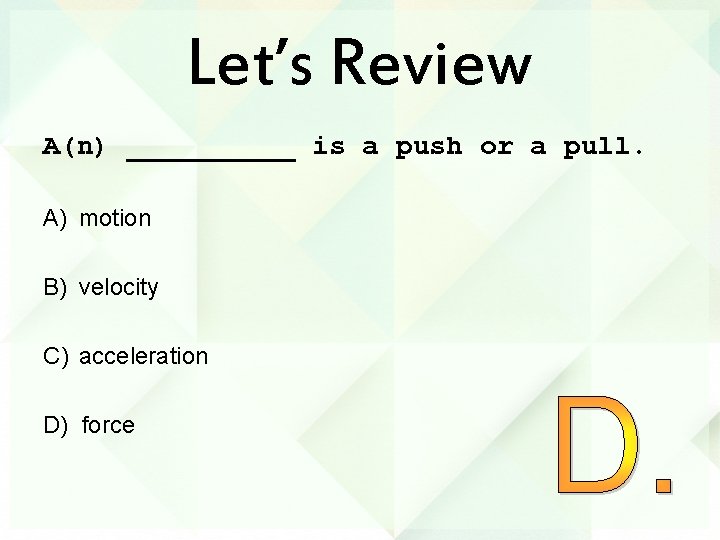
Let’s Review A(n) _____ is a push or a pull. A) motion B) velocity C) acceleration D) force
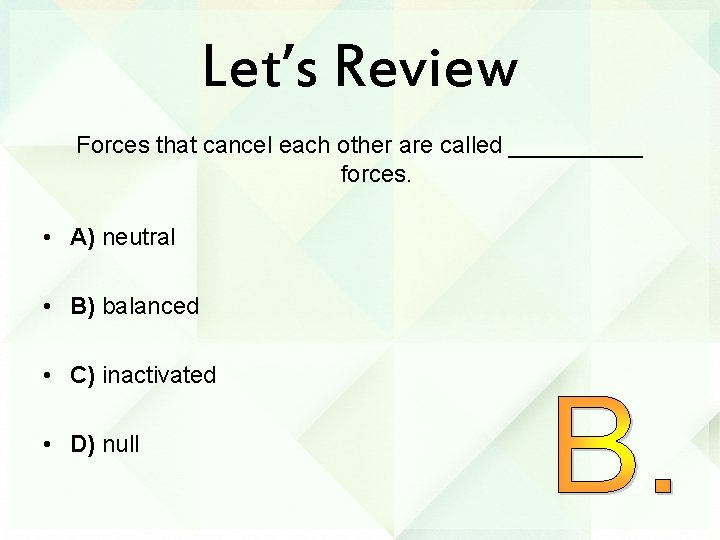
Let’s Review Forces that cancel each other are called _____ forces. • A) neutral • B) balanced • C) inactivated • D) null
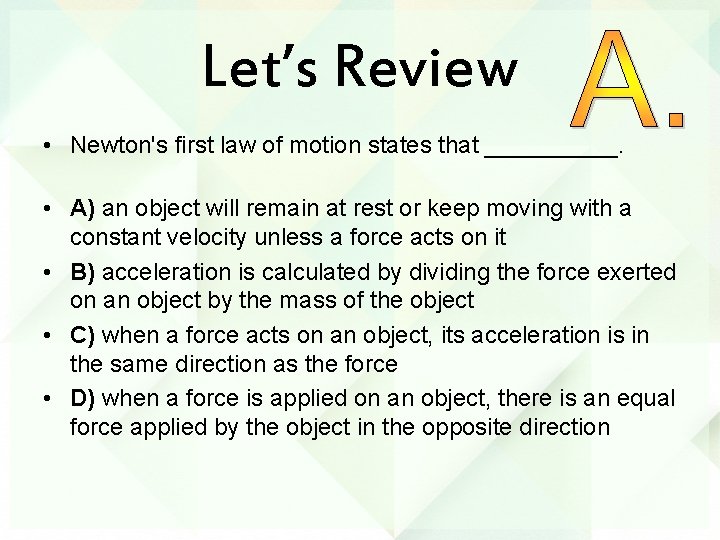
Let’s Review • Newton's first law of motion states that _____. • A) an object will remain at rest or keep moving with a constant velocity unless a force acts on it • B) acceleration is calculated by dividing the force exerted on an object by the mass of the object • C) when a force acts on an object, its acceleration is in the same direction as the force • D) when a force is applied on an object, there is an equal force applied by the object in the opposite direction
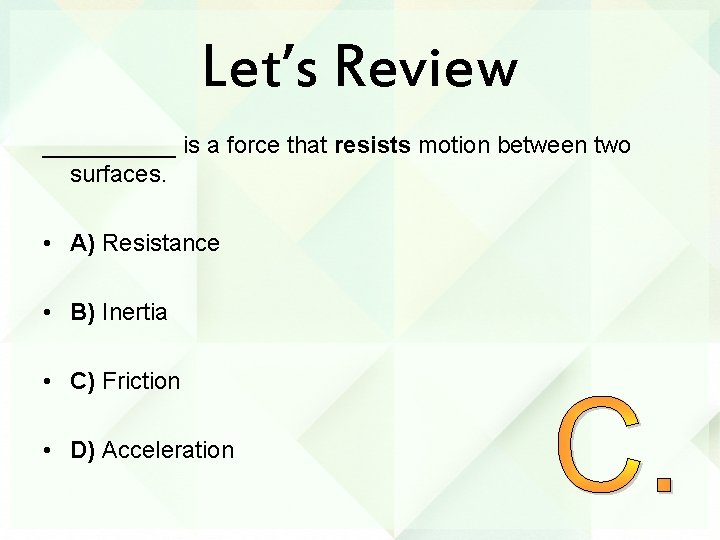
Let’s Review _____ is a force that resists motion between two surfaces. • A) Resistance • B) Inertia • C) Friction • D) Acceleration
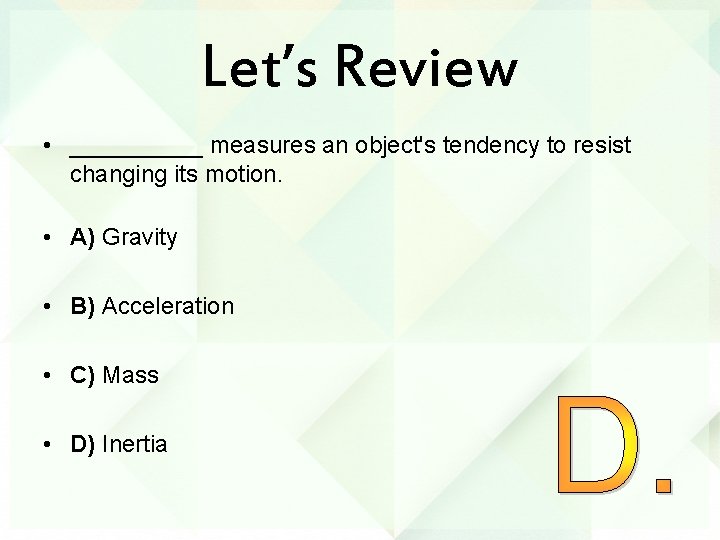
Let’s Review • _____ measures an object's tendency to resist changing its motion. • A) Gravity • B) Acceleration • C) Mass • D) Inertia
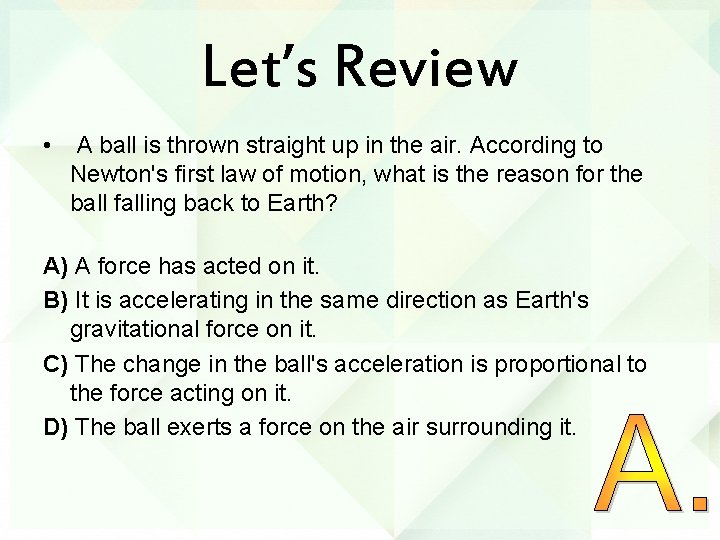
Let’s Review • A ball is thrown straight up in the air. According to Newton's first law of motion, what is the reason for the ball falling back to Earth? A) A force has acted on it. B) It is accelerating in the same direction as Earth's gravitational force on it. C) The change in the ball's acceleration is proportional to the force acting on it. D) The ball exerts a force on the air surrounding it.
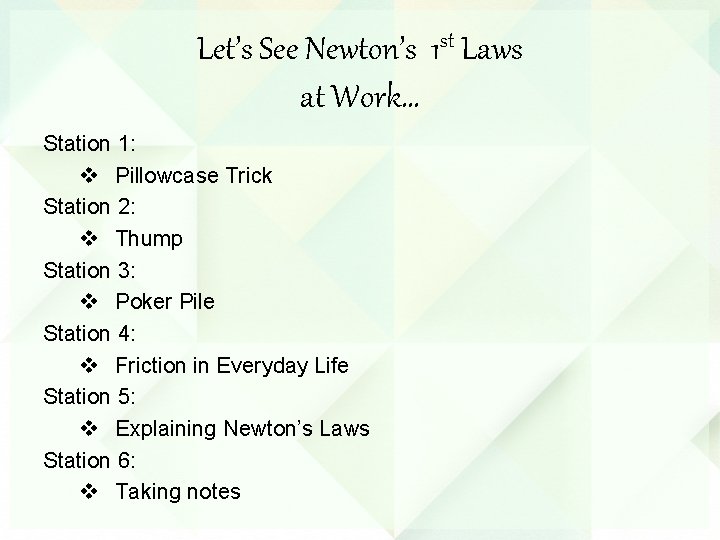
Let’s See Newton’s 1 st Laws at Work… Station 1: v Pillowcase Trick Station 2: v Thump Station 3: v Poker Pile Station 4: v Friction in Everyday Life Station 5: v Explaining Newton’s Laws Station 6: v Taking notes