
Essential Questions What is the difference between kinetic
Essential Questions • • What is the difference between kinetic energy and potential energy? How can you calculate kinetic energy? What are some different forms of potential energy? How can you calculate gravitational potential energy? Copyright © Mc. Graw-Hill Education Describing Energy
Change Requires Energy When something is able to change its environment or itself, it has energy. Energy is the ability to cause change. • Anything that causes change must have energy. • Energy has several different forms. Electrical, chemical, radiant, and thermal are examples. Copyright © Mc. Graw-Hill Education Describing Energy
Work Transfers Energy can also be described as the ability to do work. • Therefore, energy can be measured with the same units as work. • Energy, like work, can be measured in joules. Copyright © Mc. Graw-Hill Education Describing Energy
Systems A system is anything that you can imagine a boundary around. • It is useful to think of systems when describing energy. • A system can be a single object, such as a baseball, or a group of objects, such as the solar system. Copyright © Mc. Graw-Hill Education Describing Energy

Kinetic Energy Kinetic energy is the energy a moving object has because of its motion. • The kinetic energy of a moving object depends on the object’s mass and its speed, represented in the equation: Copyright © Mc. Graw-Hill Education Describing Energy
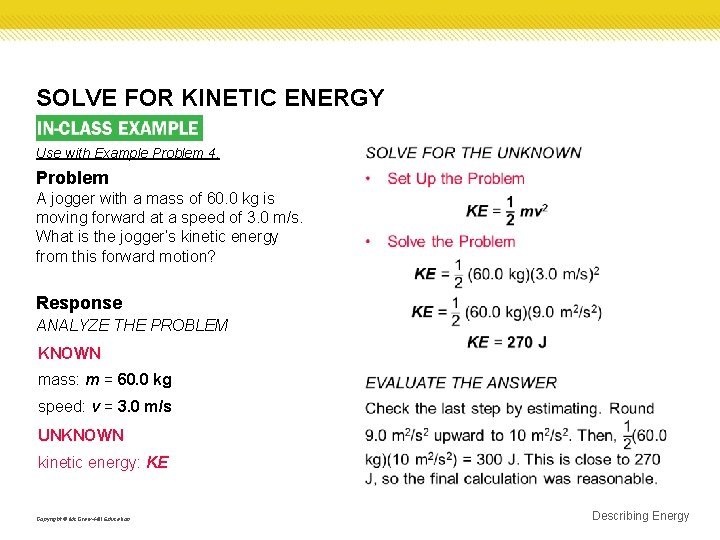
SOLVE FOR KINETIC ENERGY Use with Example Problem 4. Problem A jogger with a mass of 60. 0 kg is moving forward at a speed of 3. 0 m/s. What is the jogger’s kinetic energy from this forward motion? Response ANALYZE THE PROBLEM KNOWN mass: m = 60. 0 kg speed: v = 3. 0 m/s UNKNOWN kinetic energy: KE Copyright © Mc. Graw-Hill Education Describing Energy
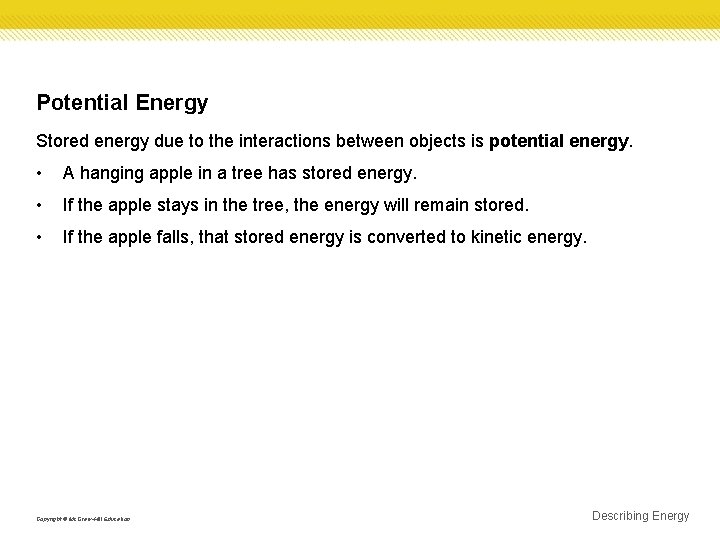
Potential Energy Stored energy due to the interactions between objects is potential energy. • A hanging apple in a tree has stored energy. • If the apple stays in the tree, the energy will remain stored. • If the apple falls, that stored energy is converted to kinetic energy. Copyright © Mc. Graw-Hill Education Describing Energy
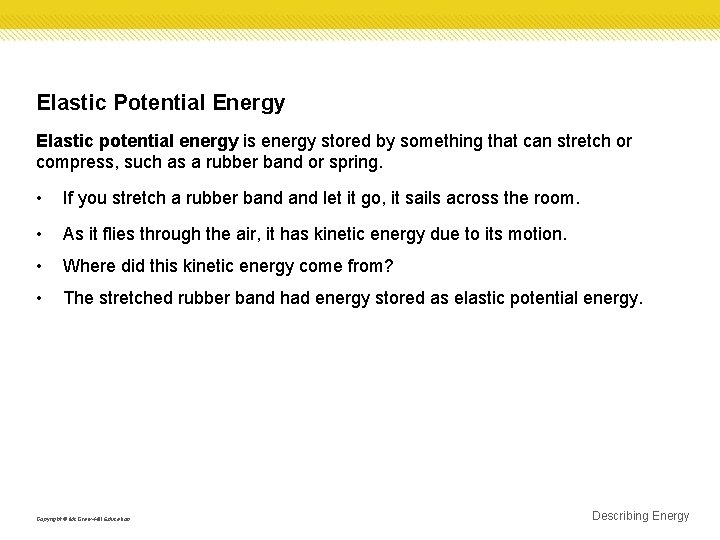
Elastic Potential Energy Elastic potential energy is energy stored by something that can stretch or compress, such as a rubber band or spring. • If you stretch a rubber band let it go, it sails across the room. • As it flies through the air, it has kinetic energy due to its motion. • Where did this kinetic energy come from? • The stretched rubber band had energy stored as elastic potential energy. Copyright © Mc. Graw-Hill Education Describing Energy
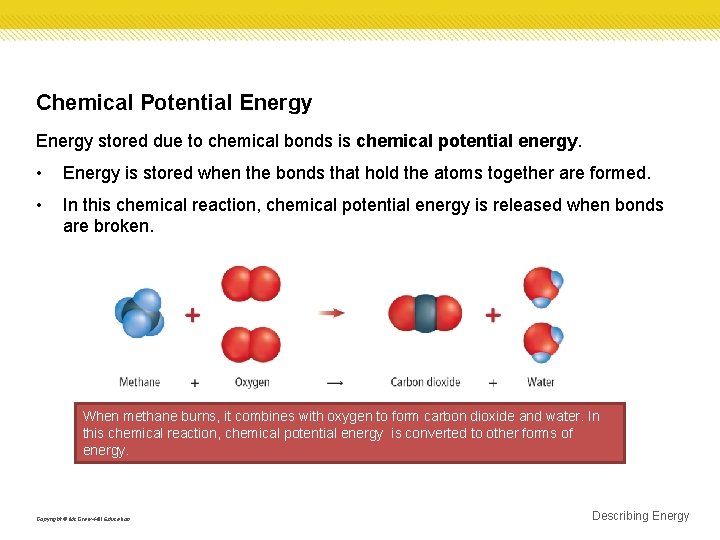
Chemical Potential Energy stored due to chemical bonds is chemical potential energy. • Energy is stored when the bonds that hold the atoms together are formed. • In this chemical reaction, chemical potential energy is released when bonds are broken. When methane burns, it combines with oxygen to form carbon dioxide and water. In this chemical reaction, chemical potential energy is converted to other forms of energy. Copyright © Mc. Graw-Hill Education Describing Energy
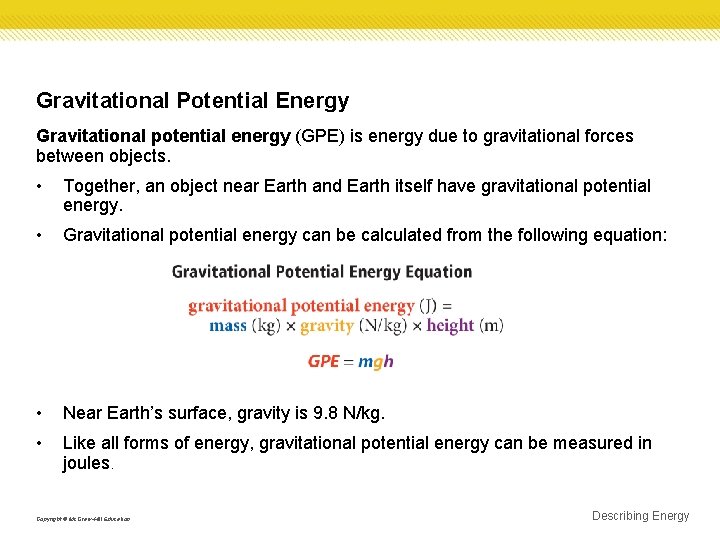
Gravitational Potential Energy Gravitational potential energy (GPE) is energy due to gravitational forces between objects. • Together, an object near Earth and Earth itself have gravitational potential energy. • Gravitational potential energy can be calculated from the following equation: • Near Earth’s surface, gravity is 9. 8 N/kg. • Like all forms of energy, gravitational potential energy can be measured in joules. Copyright © Mc. Graw-Hill Education Describing Energy
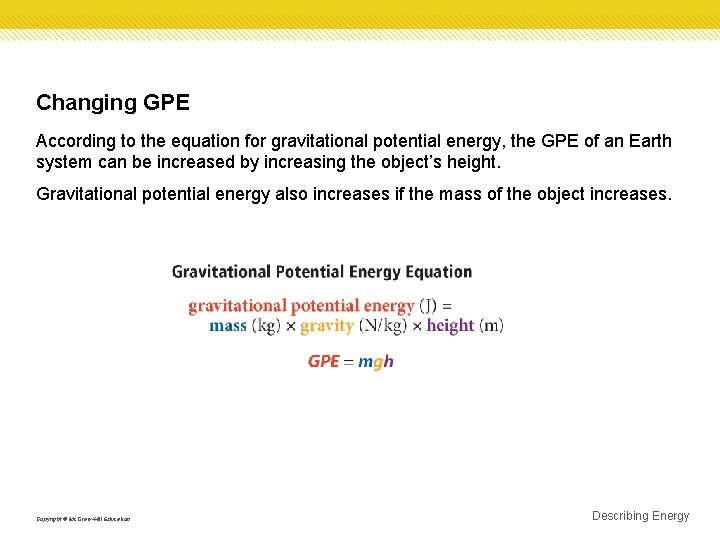
Changing GPE According to the equation for gravitational potential energy, the GPE of an Earth system can be increased by increasing the object’s height. Gravitational potential energy also increases if the mass of the object increases. Copyright © Mc. Graw-Hill Education Describing Energy
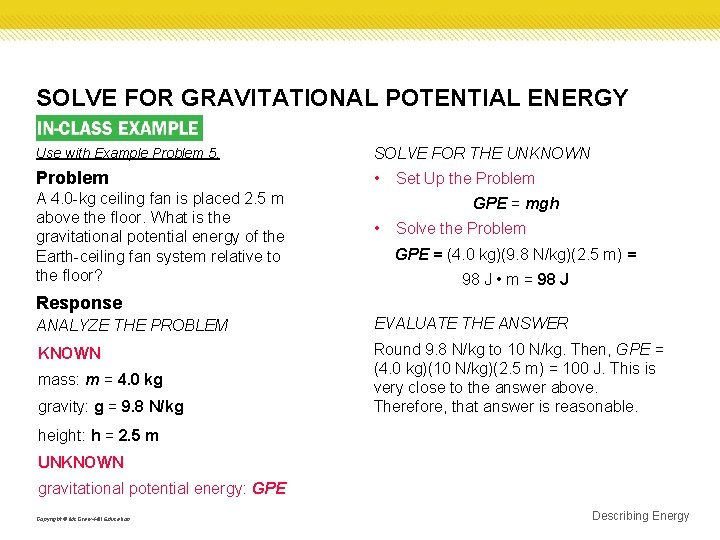
SOLVE FOR GRAVITATIONAL POTENTIAL ENERGY Use with Example Problem 5. SOLVE FOR THE UNKNOWN Problem • A 4. 0 -kg ceiling fan is placed 2. 5 m above the floor. What is the gravitational potential energy of the Earth-ceiling fan system relative to the floor? Set Up the Problem GPE = mgh • Solve the Problem GPE = (4. 0 kg)(9. 8 N/kg)(2. 5 m) = 98 J • m = 98 J Response ANALYZE THE PROBLEM EVALUATE THE ANSWER KNOWN Round 9. 8 N/kg to 10 N/kg. Then, GPE = (4. 0 kg)(10 N/kg)(2. 5 m) = 100 J. This is very close to the answer above. Therefore, that answer is reasonable. mass: m = 4. 0 kg gravity: g = 9. 8 N/kg height: h = 2. 5 m UNKNOWN gravitational potential energy: GPE Copyright © Mc. Graw-Hill Education Describing Energy
Review Essential Questions • • What is the difference between kinetic energy and potential energy? How can you calculate kinetic energy? What are some different forms of potential energy? How can you calculate gravitational potential energy? Vocabulary • energy • system • kinetic energy Copyright © Mc. Graw-Hill Education • potential energy • elastic potential energy • chemical potential energy • gravitational potential energy Describing Energy
- Slides: 13