
Essential Questions How do scientists design conduct controlled
- Slides: 14
Essential Questions: • How do scientists design & conduct controlled experiments? • What is the difference between a hypothesis & theory?
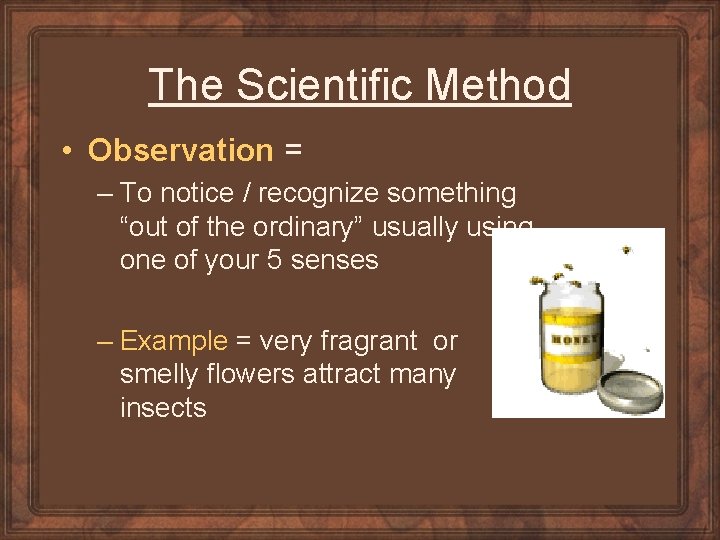
The Scientific Method • Observation = – To notice / recognize something “out of the ordinary” usually using one of your 5 senses – Example = very fragrant or smelly flowers attract many insects
The Scientific Method • Stating the problem = – Change the observation into a “why” question – Example = Why do very fragrant (smelly) flowers attract many insects?
The Scientific Method • Forming a Hypothesis = – Make an “best guess” to answer the problem. Write in an “If… Then…” statement – Example = If the flower is very fragrant (smelly), then it will attract many insects. OR If the flower is not very fragrant, then it will not attract many insects.
The Scientific Method • Testing the Hypothesis = – Design a controlled experiment which only tests 1 variable at a time
The Scientific Method Dependent Variable = Responding Variable • Is the variable that depends on the independent variable – Whether the insects are attracted or not Independent Variable = Manipulating Variable • Is the variable that you purposely change – how smelly the flower is
The Scientific Method Control • Is the setup in the experiment that mimics “normal” conditions AND is used to compare all other setups Constants = Controlled Variables • These are things that are kept the same between all the setups & trials – Type of flower/insect, age of flower/insect, type of scent… etc
The Scientific Method • Recording the Date – Qualitative = the quality is measured & recorded • The behavior of the insects as the are attracted to the flowers – Quantitative = the number measured & recorded • The number of insects that are attracted OR how fast the insects are attracted
The Scientific Method • Analyze the Data & Draw a Conclusion – This is where you look at you recorded data & look for general “trends” • Repeat & Report – Your data & conclusion must be repeatable so that it is “reliable”. Then you should report it to the scientific society so that others can critique it.
What is different between a hypothesis & a theory? Hypothesis Theory
Famous Scientific Experiments Redi Spallanzani Pasteur Needham
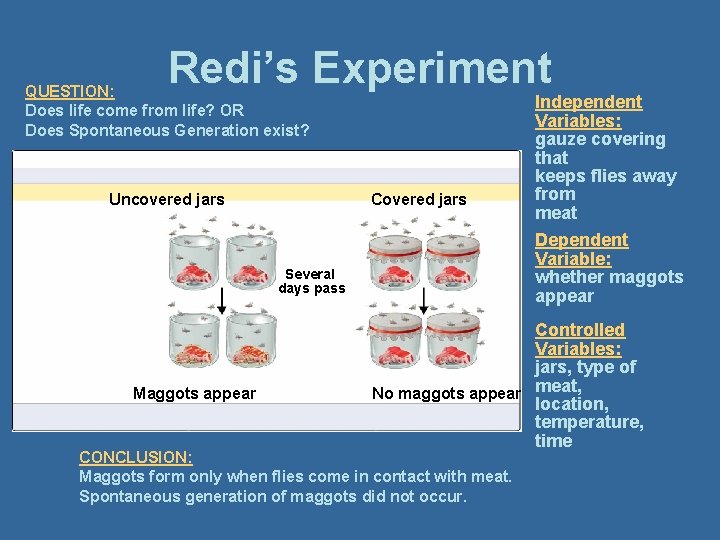
Redi’s Experiment QUESTION: Does life come from life? OR Does Spontaneous Generation exist? Uncovered jars Covered jars Dependent Variable: whether maggots appear Several days pass Maggots appear Independent Variables: gauze covering that keeps flies away from meat Controlled Variables: jars, type of No maggots appear meat, location, temperature, time CONCLUSION: Maggots form only when flies come in contact with meat. Spontaneous generation of maggots did not occur.
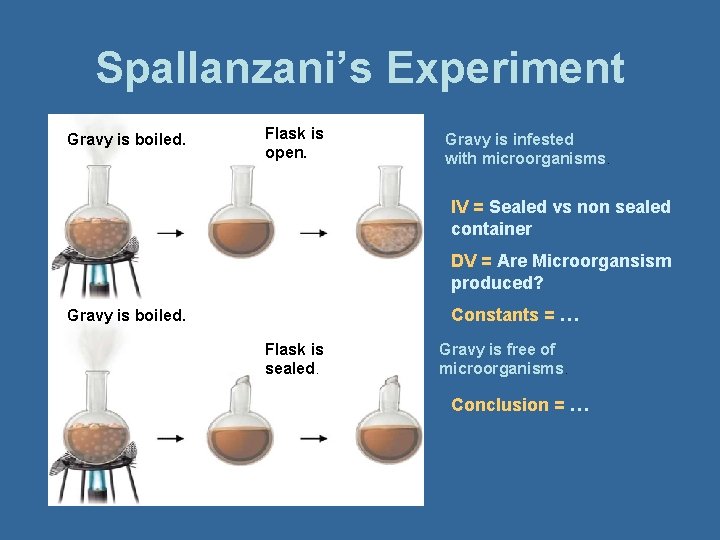
Spallanzani’s Experiment Gravy is boiled. Flask is open. Gravy is infested with microorganisms. IV = Sealed vs non sealed container DV = Are Microorgansism produced? Constants = … Gravy is boiled. Flask is sealed. Gravy is free of microorganisms. Conclusion = …
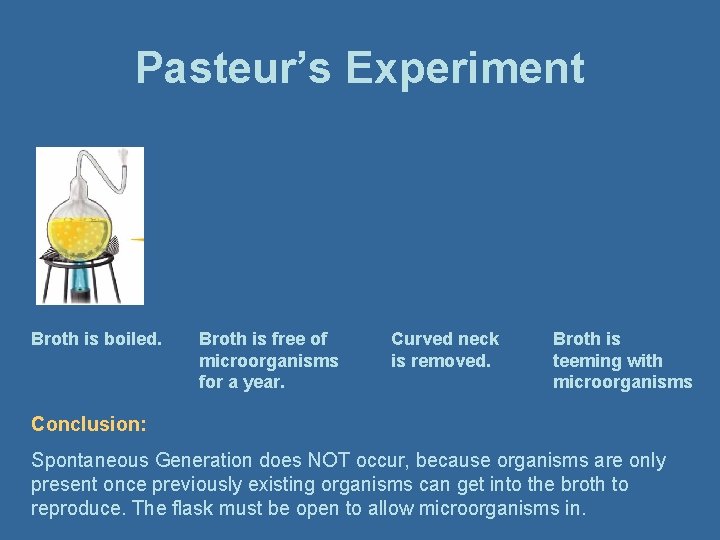
Pasteur’s Experiment Broth is boiled. Broth is free of microorganisms for a year. Curved neck is removed. Broth is teeming with microorganisms Conclusion: Spontaneous Generation does NOT occur, because organisms are only present once previously existing organisms can get into the broth to reproduce. The flask must be open to allow microorganisms in.