
Essential Questions How are features formed from magma
- Slides: 15
Essential Questions • How are features formed from magma that solidified under Earth’s surface described? • What are the different types of intrusive rock bodies? • What geologic processes result in intrusive rocks that appear at Earth’s surface? Copyright © Mc. Graw-Hill Education Intrusive Activity
Vocabulary Review New • igneous rock • • • Copyright © Mc. Graw-Hill Education pluton batholith stock laccolith sill dike Intrusive Activity
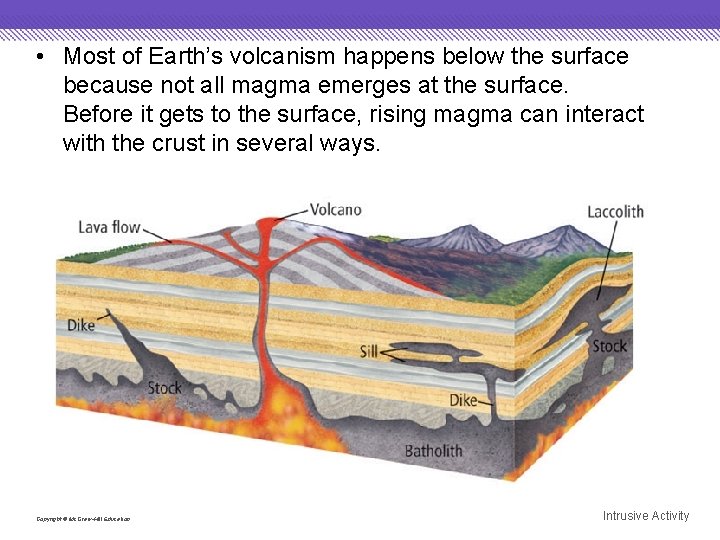
• Most of Earth’s volcanism happens below the surface because not all magma emerges at the surface. Before it gets to the surface, rising magma can interact with the crust in several ways. Copyright © Mc. Graw-Hill Education Intrusive Activity
• Magma can force the overlying rock apart and enter the newly formed fissures. • Magma can cause blocks of rock to break off and sink into the magma. • It can melt its way through the rock into which it intrudes. Copyright © Mc. Graw-Hill Education Intrusive Activity
Plutons • Plutons are intrusive igneous rock bodies, formed through mountain-building processes and oceanic collisions. • They can be exposed at Earth’s surface due to uplift and erosion and are classified based on their size, shape, and relationship to surrounding rocks. Copyright © Mc. Graw-Hill Education Intrusive Activity
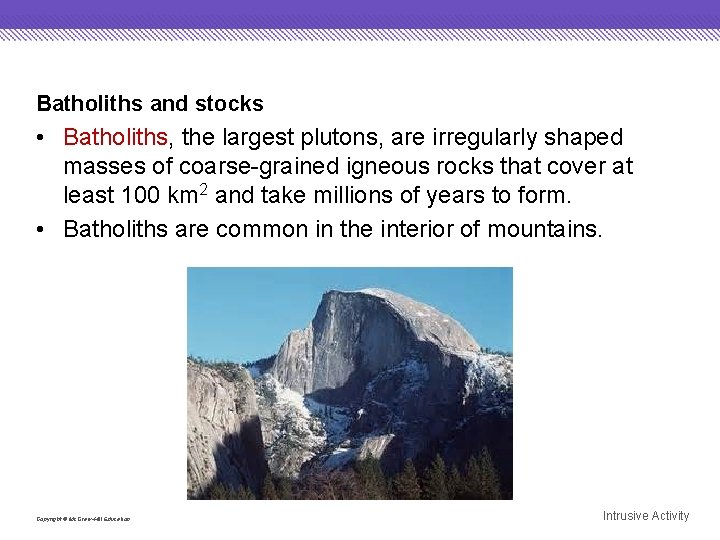
Batholiths and stocks • Batholiths, the largest plutons, are irregularly shaped masses of coarse-grained igneous rocks that cover at least 100 km 2 and take millions of years to form. • Batholiths are common in the interior of mountains. Copyright © Mc. Graw-Hill Education Intrusive Activity
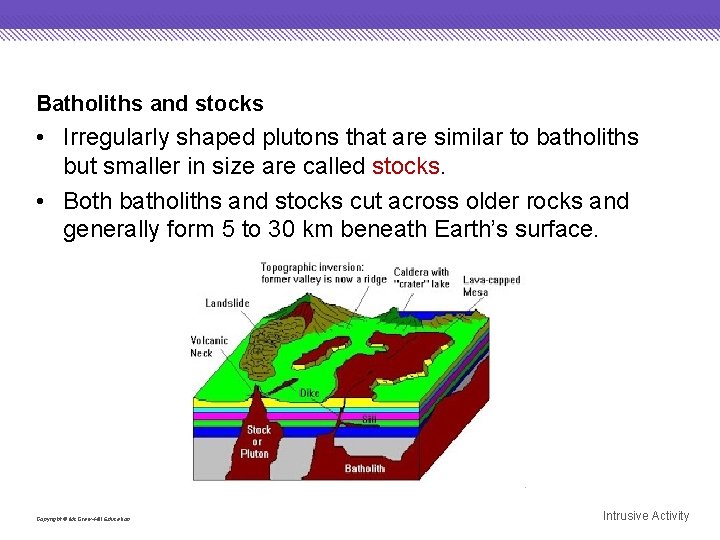
Batholiths and stocks • Irregularly shaped plutons that are similar to batholiths but smaller in size are called stocks. • Both batholiths and stocks cut across older rocks and generally form 5 to 30 km beneath Earth’s surface. Copyright © Mc. Graw-Hill Education Intrusive Activity
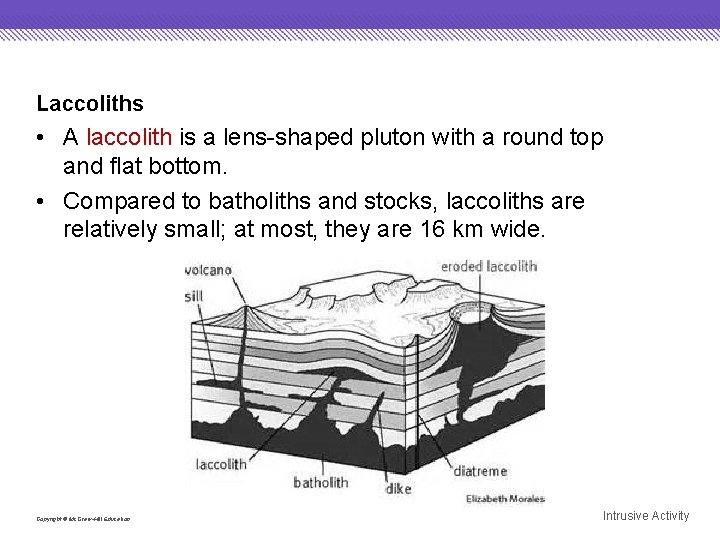
Laccoliths • A laccolith is a lens-shaped pluton with a round top and flat bottom. • Compared to batholiths and stocks, laccoliths are relatively small; at most, they are 16 km wide. Copyright © Mc. Graw-Hill Education Intrusive Activity
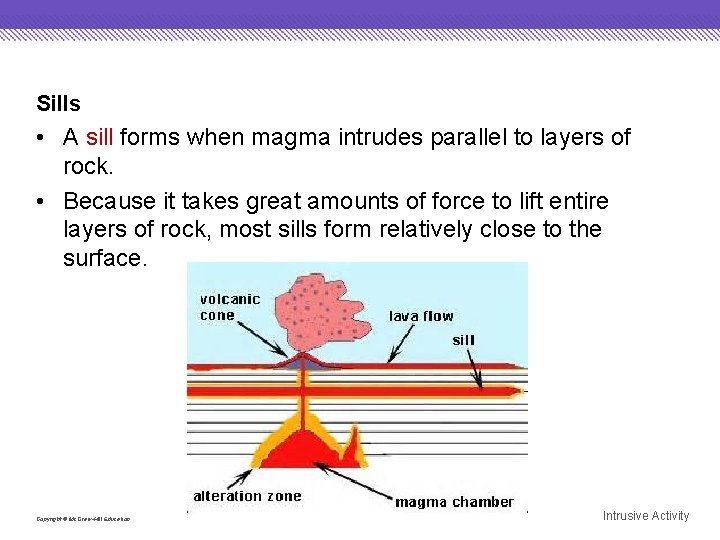
Sills • A sill forms when magma intrudes parallel to layers of rock. • Because it takes great amounts of force to lift entire layers of rock, most sills form relatively close to the surface. Copyright © Mc. Graw-Hill Education Intrusive Activity
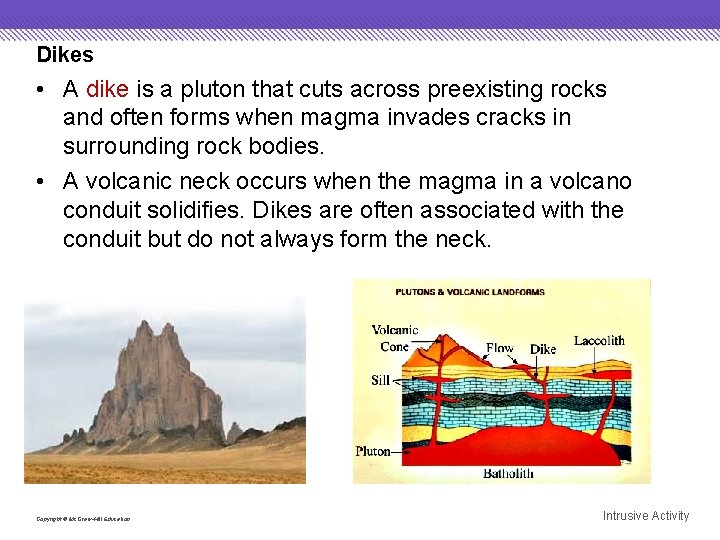
Dikes • A dike is a pluton that cuts across preexisting rocks and often forms when magma invades cracks in surrounding rock bodies. • A volcanic neck occurs when the magma in a volcano conduit solidifies. Dikes are often associated with the conduit but do not always form the neck. Copyright © Mc. Graw-Hill Education Intrusive Activity
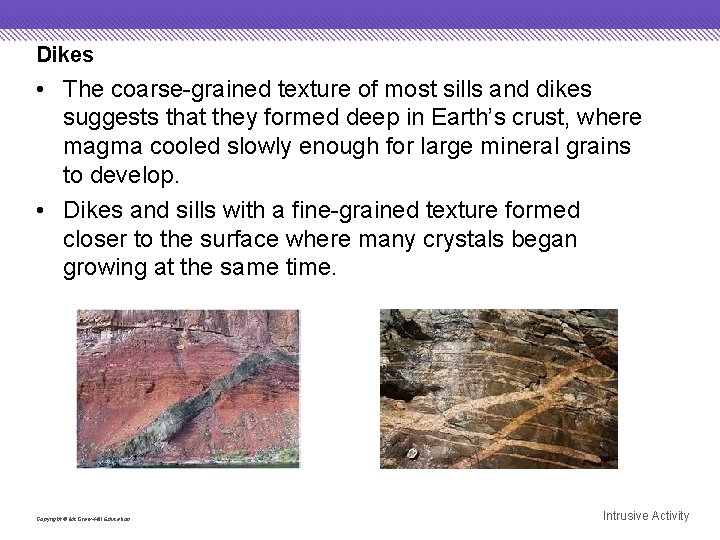
Dikes • The coarse-grained texture of most sills and dikes suggests that they formed deep in Earth’s crust, where magma cooled slowly enough for large mineral grains to develop. • Dikes and sills with a fine-grained texture formed closer to the surface where many crystals began growing at the same time. Copyright © Mc. Graw-Hill Education Intrusive Activity
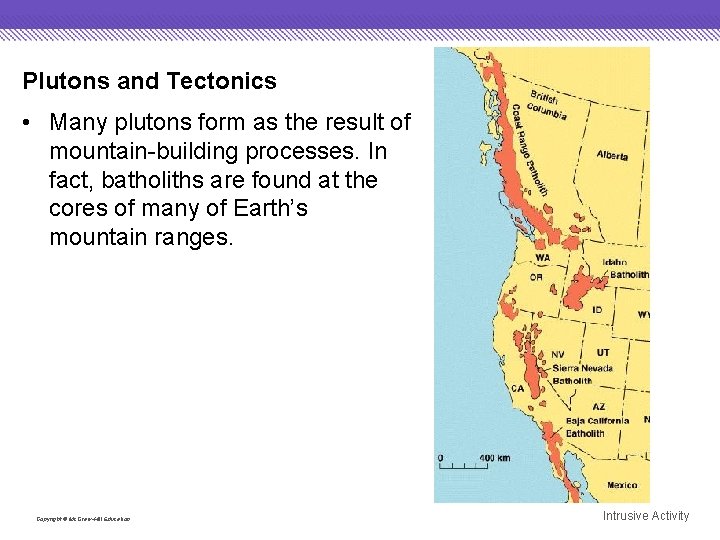
Plutons and Tectonics • Many plutons form as the result of mountain-building processes. In fact, batholiths are found at the cores of many of Earth’s mountain ranges. Copyright © Mc. Graw-Hill Education Intrusive Activity
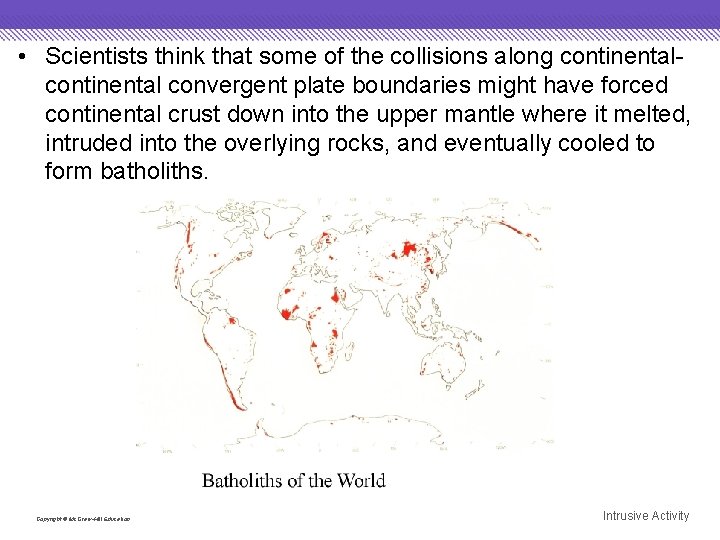
• Scientists think that some of the collisions along continental convergent plate boundaries might have forced continental crust down into the upper mantle where it melted, intruded into the overlying rocks, and eventually cooled to form batholiths. Copyright © Mc. Graw-Hill Education Intrusive Activity
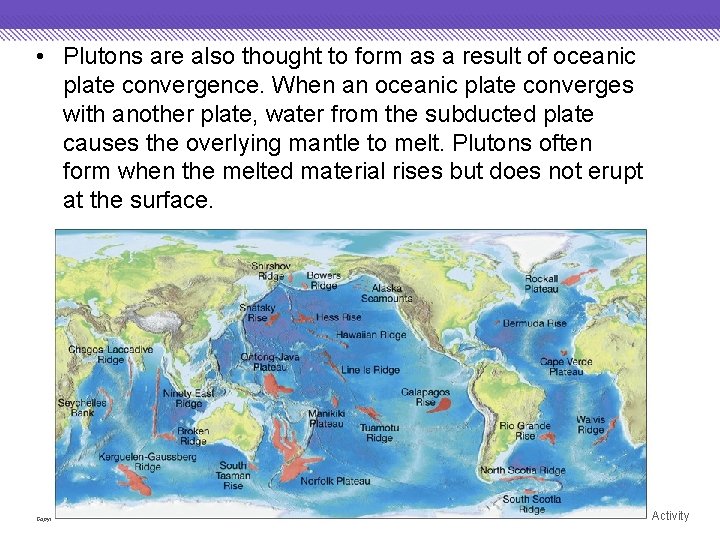
• Plutons are also thought to form as a result of oceanic plate convergence. When an oceanic plate converges with another plate, water from the subducted plate causes the overlying mantle to melt. Plutons often form when the melted material rises but does not erupt at the surface. Copyright © Mc. Graw-Hill Education Intrusive Activity
Review Essential Questions • How are features formed from magma that solidified under Earth’s surface described? • What are the different types of intrusive rock bodies? • What geologic processes result in intrusive rocks that appear at Earth’s surface? Vocabulary • pluton • batholith • stock Copyright © Mc. Graw-Hill Education • laccolith • sill • dike Intrusive Activity