
Essential Question Why is a knowledge of basic
Essential Question: Why is a knowledge of basic statistics helpful in real-world situations? Statistics and Probability 13. 1 Basic Statistics
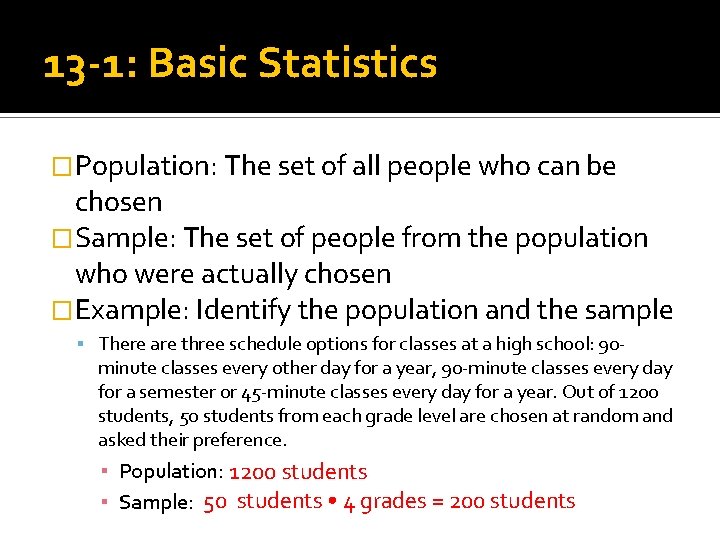
13 -1: Basic Statistics �Population: The set of all people who can be chosen �Sample: The set of people from the population who were actually chosen �Example: Identify the population and the sample There are three schedule options for classes at a high school: 90 - minute classes every other day for a year, 90 -minute classes every day for a semester or 45 -minute classes every day for a year. Out of 1200 students, 50 students from each grade level are chosen at random and asked their preference. ▪ Population: 1200 students ▪ Sample: 50 students • 4 grades = 200 students
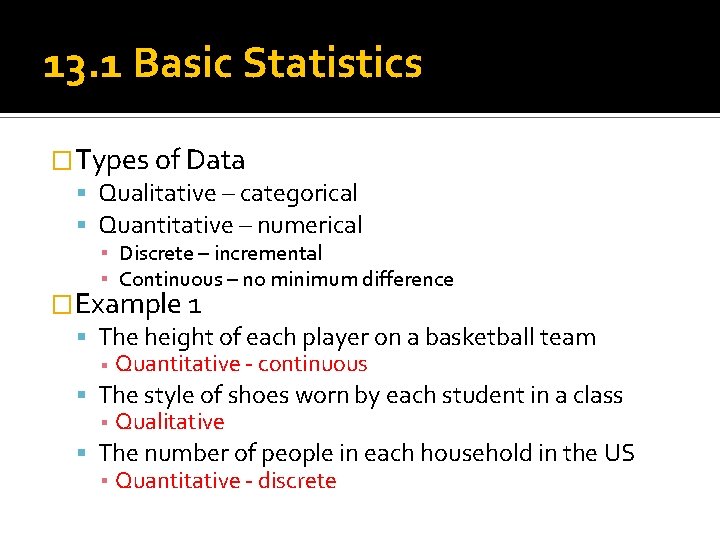
13. 1 Basic Statistics �Types of Data Qualitative – categorical Quantitative – numerical ▪ Discrete – incremental ▪ Continuous – no minimum difference �Example 1 The height of each player on a basketball team ▪ Quantitative - continuous The style of shoes worn by each student in a class ▪ Qualitative The number of people in each household in the US ▪ Quantitative - discrete
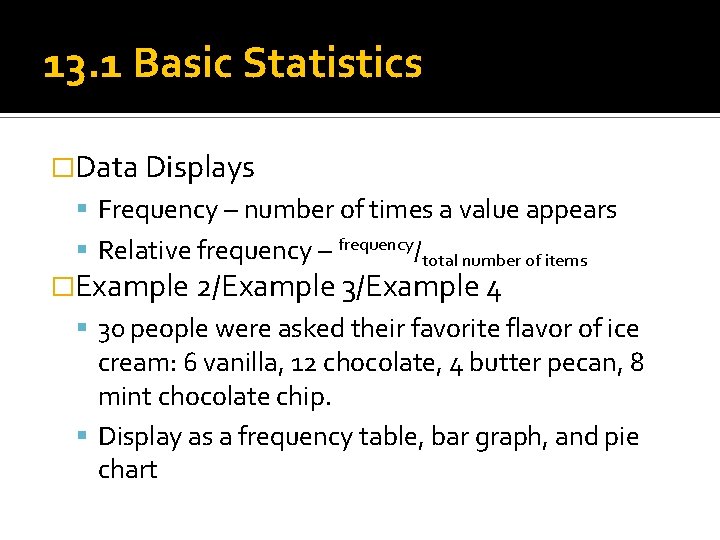
13. 1 Basic Statistics �Data Displays Frequency – number of times a value appears Relative frequency – frequency/total number of items �Example 2/Example 3/Example 4 30 people were asked their favorite flavor of ice cream: 6 vanilla, 12 chocolate, 4 butter pecan, 8 mint chocolate chip. Display as a frequency table, bar graph, and pie chart
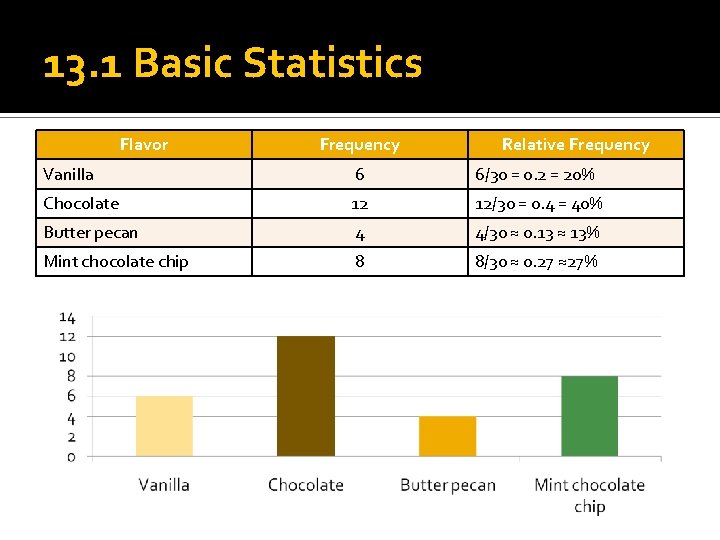
13. 1 Basic Statistics Flavor Frequency Relative Frequency Vanilla 6 6/30 = 0. 2 = 20% Chocolate 12 12/30 = 0. 4 = 40% Butter pecan 4 4/30 ≈ 0. 13 ≈ 13% Mint chocolate chip 8 8/30 ≈ 0. 27 ≈27%
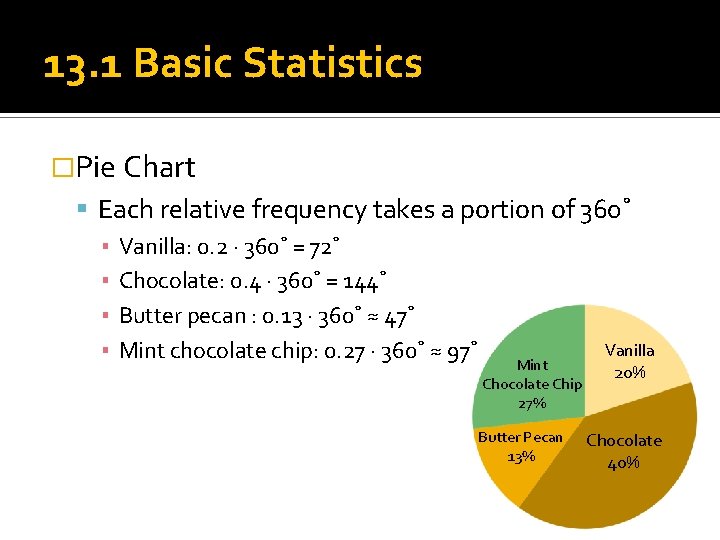
13. 1 Basic Statistics �Pie Chart Each relative frequency takes a portion of 360˚ ▪ Vanilla: 0. 2 ∙ 360˚ = 72˚ ▪ Chocolate: 0. 4 ∙ 360˚ = 144˚ ▪ Butter pecan : 0. 13 ∙ 360˚ ≈ 47˚ Vanilla ▪ Mint chocolate chip: 0. 27 ∙ 360˚ ≈ 97˚ Mint Chocolate Chip 27% Butter Pecan 13% 20% Chocolate 40%
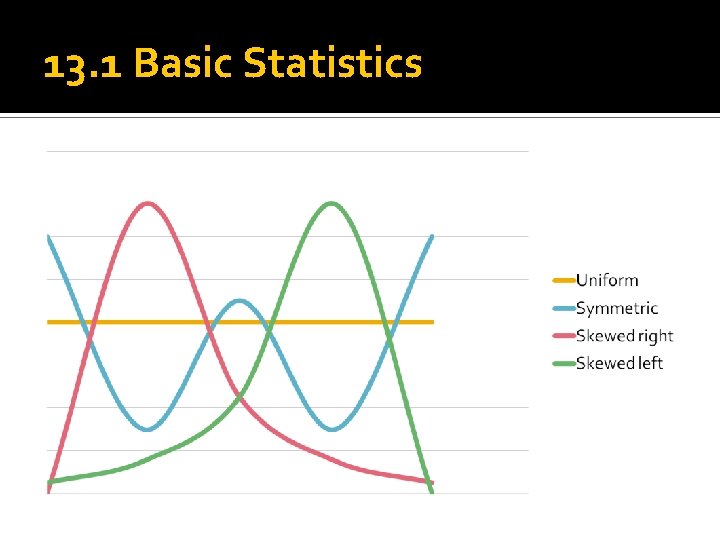
13. 1 Basic Statistics �Displaying Quantitative Data Curve types ▪ Uniform – all values have approximately same frequency ▪ Symmetric – right and left sides are mirror images ▪ Skewed right – right side lower than the left side ▪ Skewed left – left side lower than the right side Skewed means “screwed” Outlier – data far removed from the rest. ▪ Usually the culprit in skewed data
13. 1 Basic Statistics
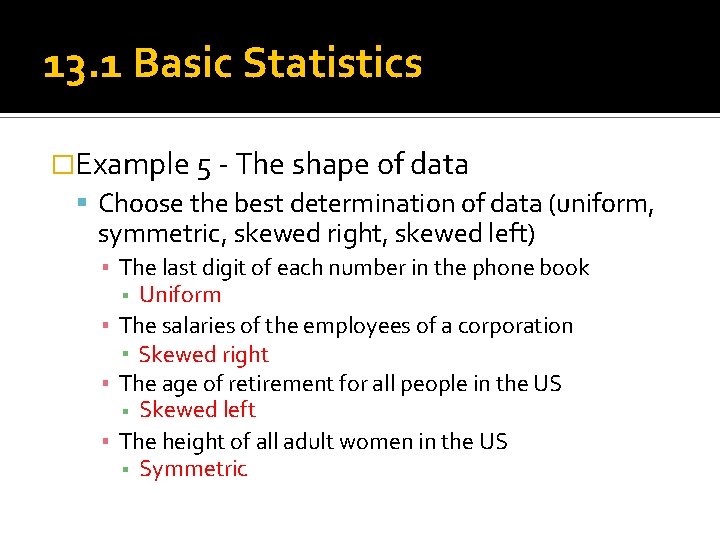
13. 1 Basic Statistics �Example 5 - The shape of data Choose the best determination of data (uniform, symmetric, skewed right, skewed left) ▪ The last digit of each number in the phone book ▪ Uniform ▪ The salaries of the employees of a corporation ▪ Skewed right ▪ The age of retirement for all people in the US ▪ Skewed left ▪ The height of all adult women in the US ▪ Symmetric
13. 1 Basic Statistics �Stem Plot Choose leading digit(s) as stems Arrange stems vertically Last digit is the leaf Provide a key
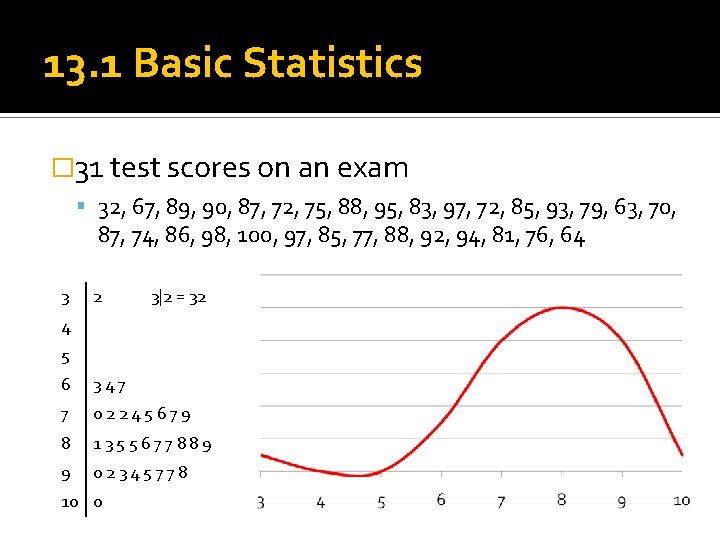
13. 1 Basic Statistics � 31 test scores on an exam 32, 67, 89, 90, 87, 72, 75, 88, 95, 83, 97, 72, 85, 93, 79, 63, 70, 87, 74, 86, 98, 100, 97, 85, 77, 88, 92, 94, 81, 76, 64 3 2 3|2 = 32 4 5 6 347 7 02245679 8 1355677889 9 02345778 10 0
13. 1: Basic Statistics �Assignment Page 851 Problems: ▪ 1 – 9 (all) ▪ 11, 15 ▪ 19 – 24 (all)
- Slides: 12