
Essential Key Performance Indicators for School Nutrition Success



- Slides: 40
Essential Key Performance Indicators for School Nutrition Success for Introduction to School Nutrition Leadership
Lesson Objectives • Calculate meal equivalents and apply the information to measure the performance of school nutrition programs. • Calculate average daily participation (ADP) and apply the information forecasting and making decisions pertaining to labor, food purchasing, and menu planning. • Interpret and analyze revenues on a monthly report to monitor trends of the current period, the previous period, and year-to-date of the school nutrition program. • Interpret and analyze expenditures on a monthly report to monitor and identify monthly and annual trends.
Lesson Objectives, continued • Calculate revenue per meal equivalent to determine if there is sufficient revenue to cover meal costs. • Calculate cost per meal equivalent to ensure the costs to produce a meal does not exceed the revenue per meal equivalent. • Calculate the cost as a percentage of revenue or operating ratios to analyze food cost or labor cost. • Calculate break-even point to determine financial feasibility of a new program, making better financial decisions, and creating annual benchmark goals.
Lesson Objectives, continued • Calculate and analyze the efficient monthly and annual use of inventory to control food and supply costs. • Calculate Meals per Labor Hour and apply the information to measure the productivity and production efficiency of the school nutrition program. • Calculate staff turnover rate to determine how often positions must be filled. • Calculate and analyze the time employees miss work in order to control labor cost.
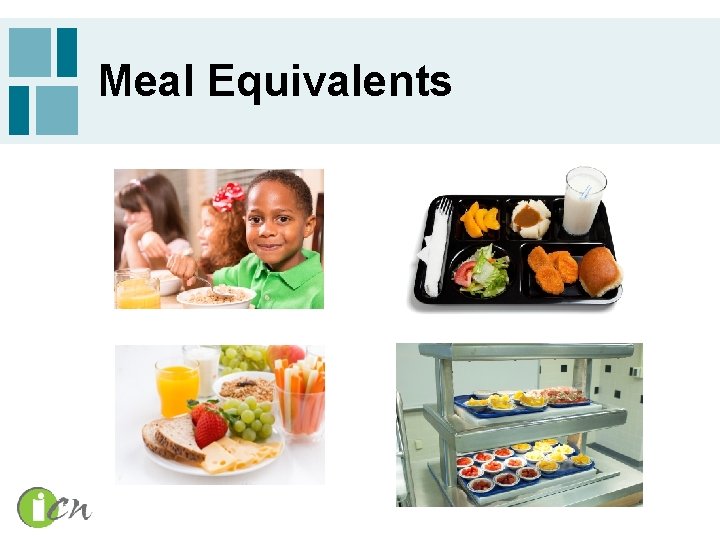
Meal Equivalents
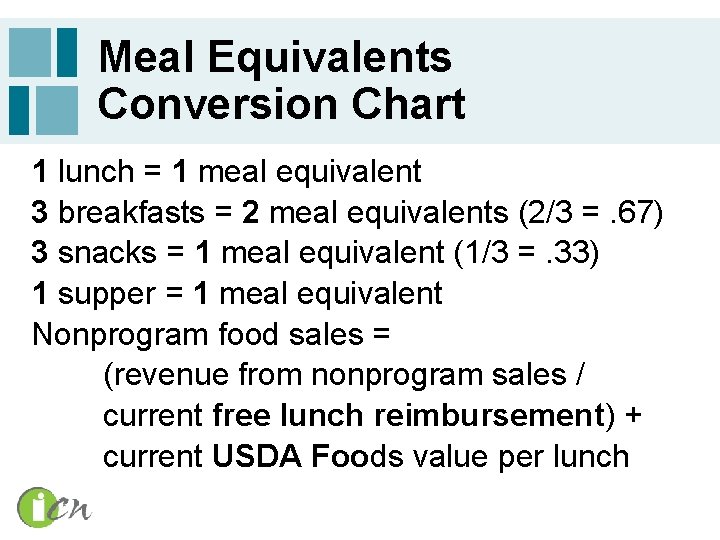
Meal Equivalents Conversion Chart 1 lunch = 1 meal equivalent 3 breakfasts = 2 meal equivalents (2/3 =. 67) 3 snacks = 1 meal equivalent (1/3 =. 33) 1 supper = 1 meal equivalent Nonprogram food sales = (revenue from nonprogram sales / current free lunch reimbursement) + current USDA Foods value per lunch
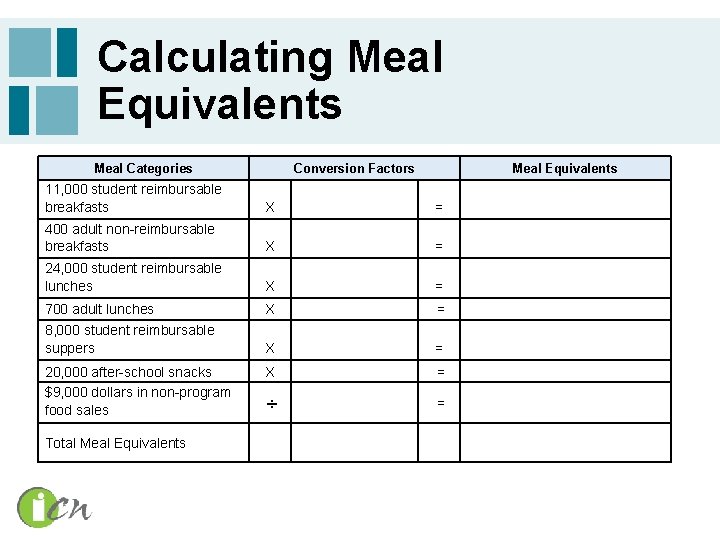
Calculating Meal Equivalents Meal Categories Conversion Factors Meal Equivalents 11, 000 student reimbursable breakfasts X = 400 adult non-reimbursable breakfasts X = 24, 000 student reimbursable lunches X = 700 adult lunches 8, 000 student reimbursable suppers X = 20, 000 after-school snacks $9, 000 dollars in non-program food sales X = ÷ = Total Meal Equivalents
Average Daily Participation
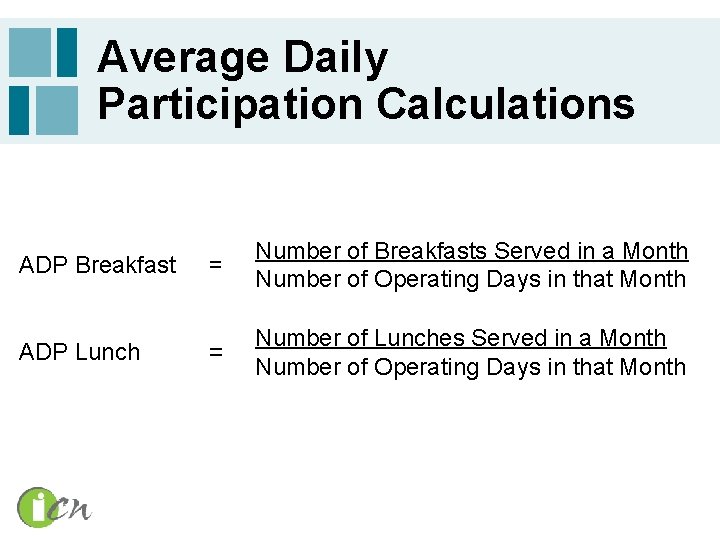
Average Daily Participation Calculations ADP Breakfast ADP Lunch = Number of Breakfasts Served in a Month Number of Operating Days in that Month = Number of Lunches Served in a Month Number of Operating Days in that Month
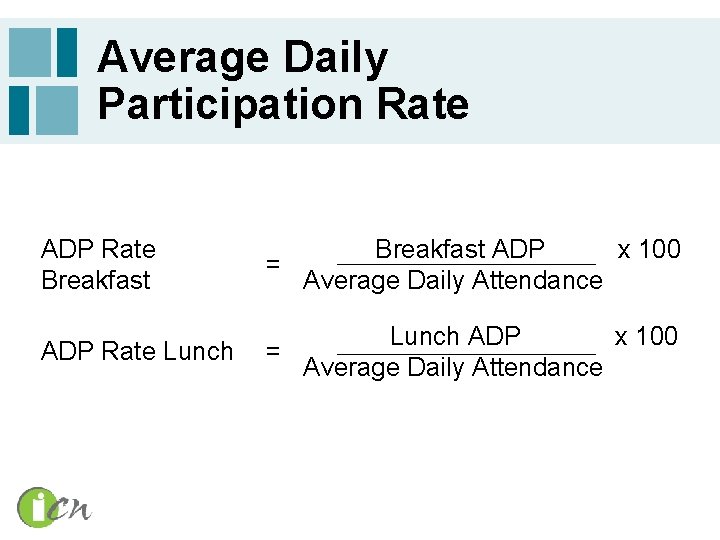
Average Daily Participation Rate ADP Rate Breakfast ADP x 100 = Average Daily Attendance ADP Rate Lunch ADP x 100 = Average Daily Attendance
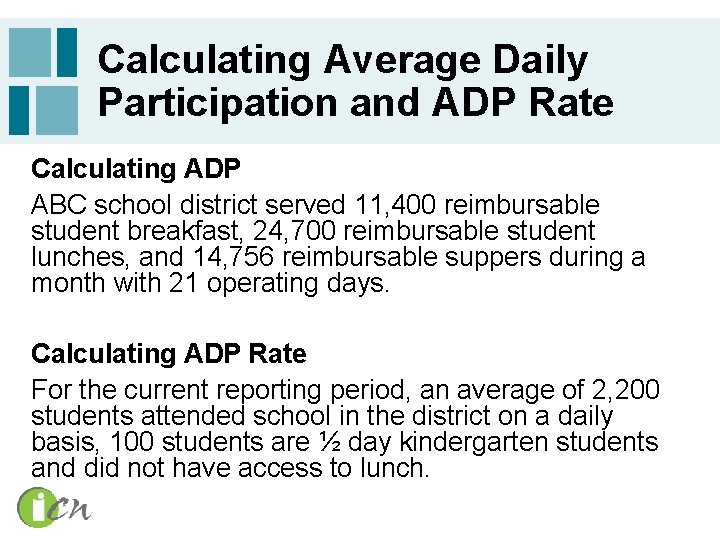
Calculating Average Daily Participation and ADP Rate Calculating ADP ABC school district served 11, 400 reimbursable student breakfast, 24, 700 reimbursable student lunches, and 14, 756 reimbursable suppers during a month with 21 operating days. Calculating ADP Rate For the current reporting period, an average of 2, 200 students attended school in the district on a daily basis, 100 students are ½ day kindergarten students and did not have access to lunch.
Revenues Money received
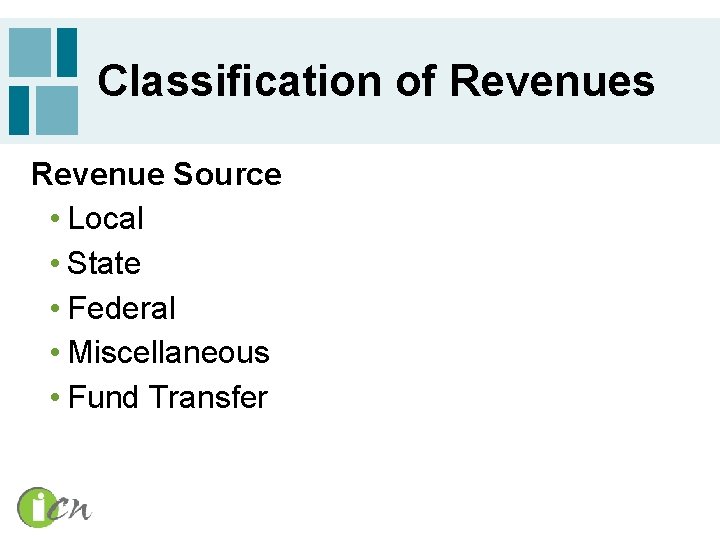
Classification of Revenues Revenue Source • Local • State • Federal • Miscellaneous • Fund Transfer
Expenditures
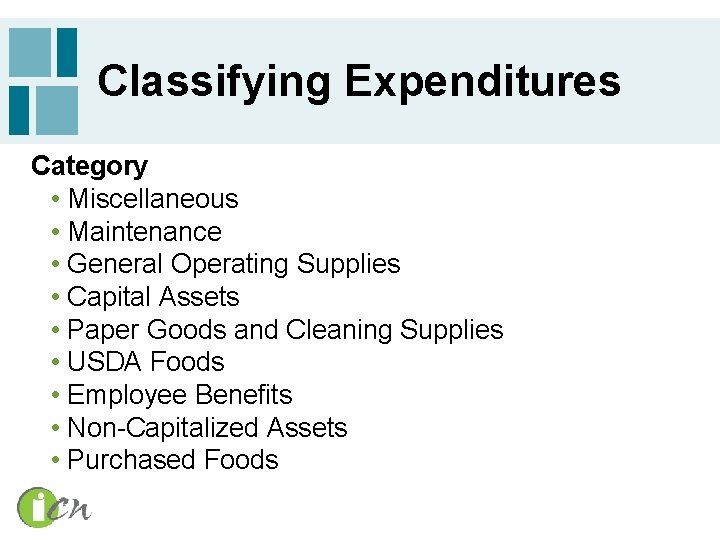
Classifying Expenditures Category • Miscellaneous • Maintenance • General Operating Supplies • Capital Assets • Paper Goods and Cleaning Supplies • USDA Foods • Employee Benefits • Non-Capitalized Assets • Purchased Foods
Revenue Per Meal Equivalent
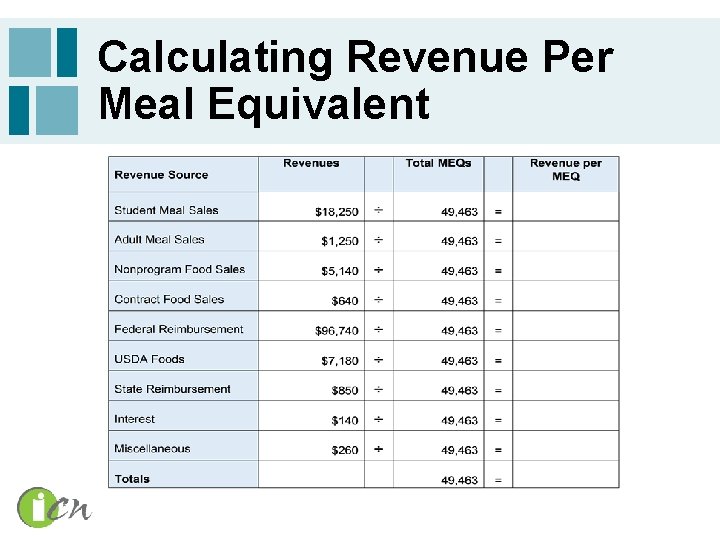
Calculating Revenue Per Meal Equivalent
Cost Per Meal Equivalent
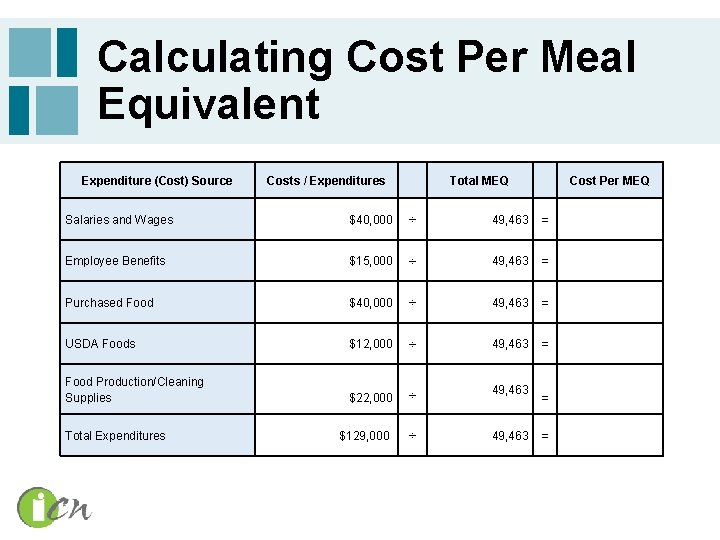
Calculating Cost Per Meal Equivalent Expenditure (Cost) Source Costs / Expenditures Total MEQ Cost Per MEQ Salaries and Wages $40, 000 ÷ 49, 463 = Employee Benefits $15, 000 ÷ 49, 463 = Purchased Food $40, 000 ÷ 49, 463 = USDA Foods $12, 000 ÷ 49, 463 = Food Production/Cleaning Supplies $22, 000 ÷ 49, 463 $129, 000 ÷ 49, 463 Total Expenditures = =
Cost as a Percentage of Revenue
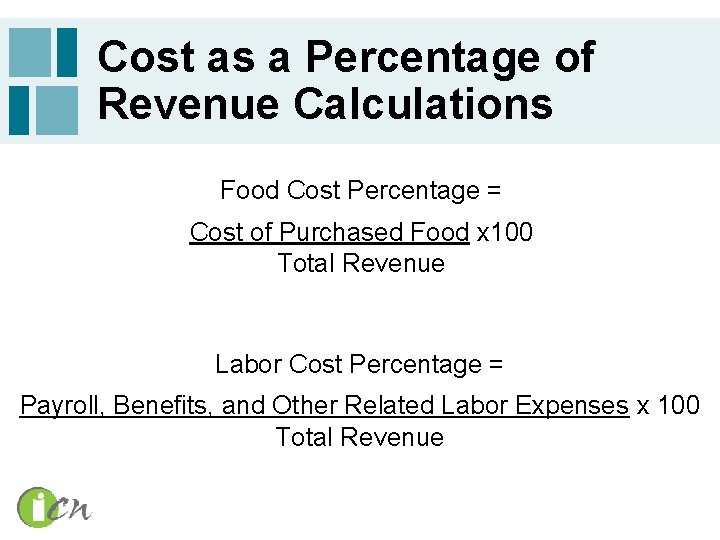
Cost as a Percentage of Revenue Calculations Food Cost Percentage = Cost of Purchased Food x 100 Total Revenue Labor Cost Percentage = Payroll, Benefits, and Other Related Labor Expenses x 100 Total Revenue
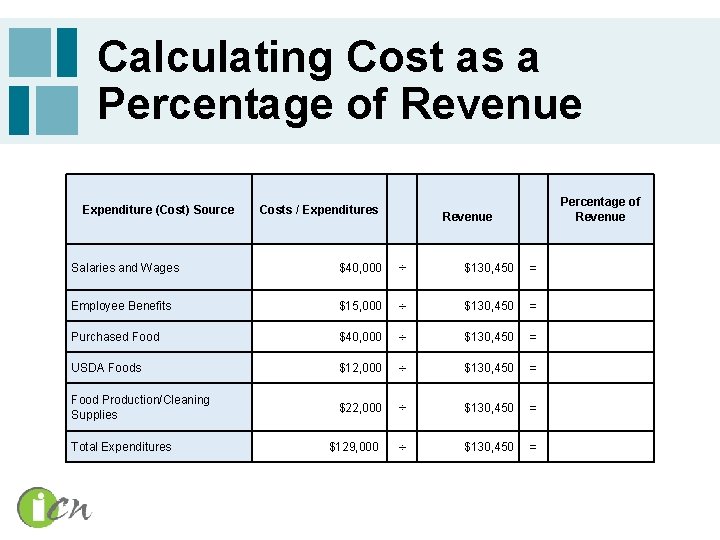
Calculating Cost as a Percentage of Revenue Expenditure (Cost) Source Costs / Expenditures Percentage of Revenue Salaries and Wages $40, 000 ÷ $130, 450 = Employee Benefits $15, 000 ÷ $130, 450 = Purchased Food $40, 000 ÷ $130, 450 = USDA Foods $12, 000 ÷ $130, 450 = Food Production/Cleaning Supplies $22, 000 ÷ $130, 450 = $129, 000 ÷ $130, 450 = Total Expenditures
Break-Even Point
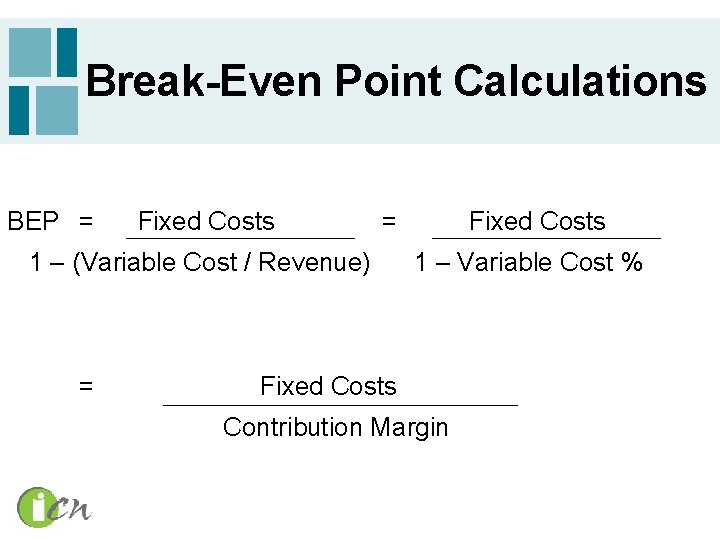
Break-Even Point Calculations BEP = Fixed Costs = 1 – (Variable Cost / Revenue) = Fixed Costs 1 – Variable Cost % Fixed Costs Contribution Margin
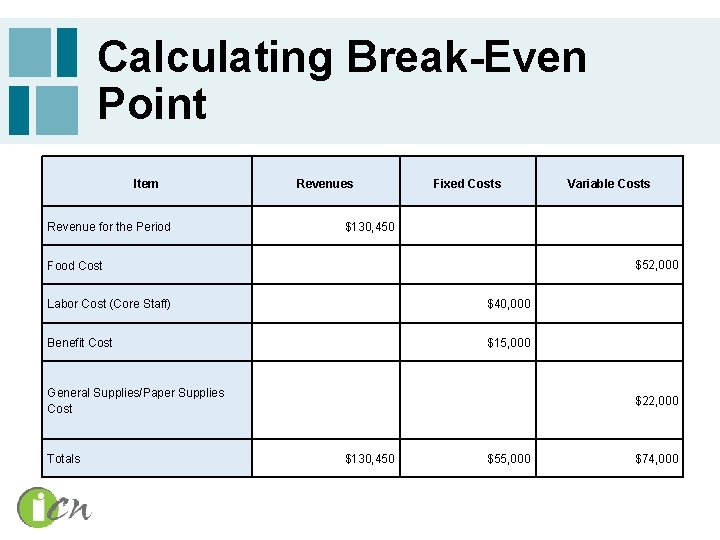
Calculating Break-Even Point Item Revenue for the Period Revenues Fixed Costs $130, 450 $52, 000 Food Cost Labor Cost (Core Staff) $40, 000 Benefit Cost $15, 000 General Supplies/Paper Supplies Cost Totals Variable Costs $22, 000 $130, 450 $55, 000 $74, 000
Inventory Turnover Rate
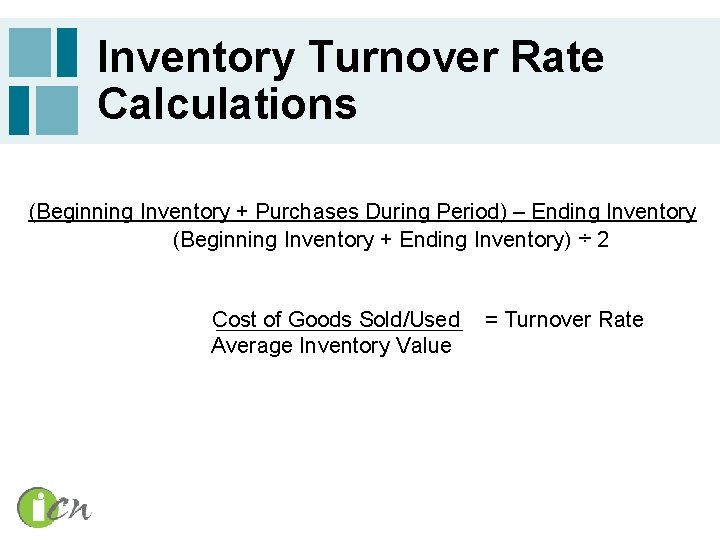
Inventory Turnover Rate Calculations (Beginning Inventory + Purchases During Period) – Ending Inventory (Beginning Inventory + Ending Inventory) ÷ 2 Cost of Goods Sold/Used Average Inventory Value = Turnover Rate
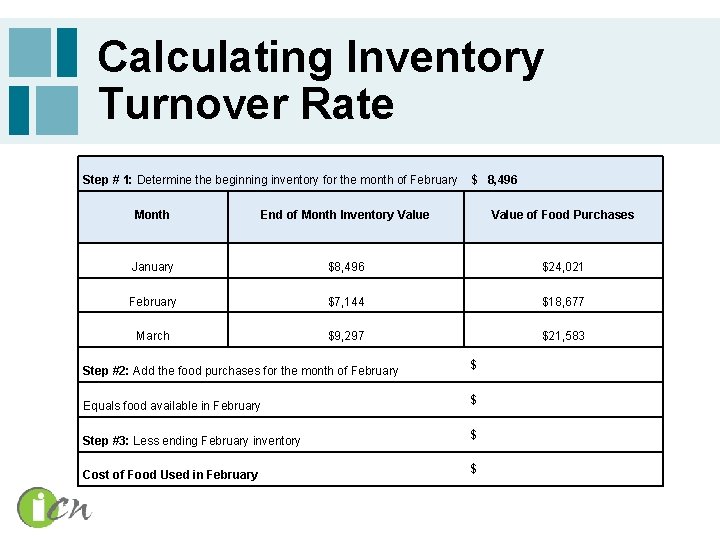
Calculating Inventory Turnover Rate Step # 1: Determine the beginning inventory for the month of February $ 8, 496 Month End of Month Inventory Value of Food Purchases January $8, 496 $24, 021 February $7, 144 $18, 677 March $9, 297 $21, 583 Step #2: Add the food purchases for the month of February Equals food available in February Step #3: Less ending February inventory Cost of Food Used in February $ $
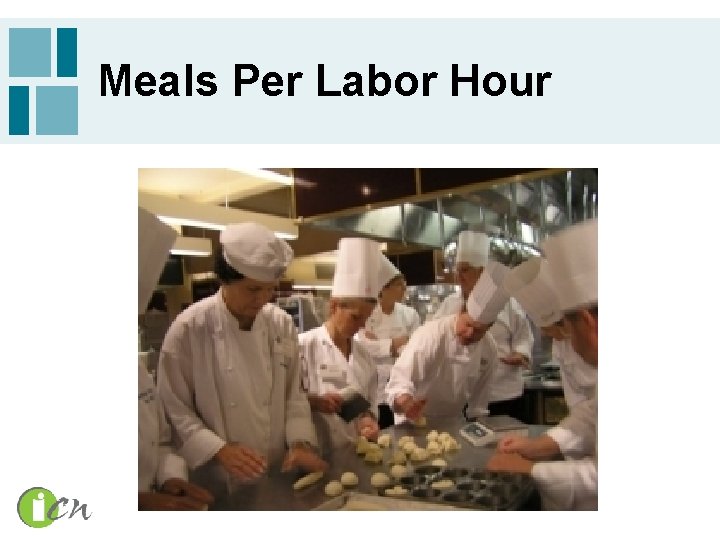
Meals Per Labor Hour
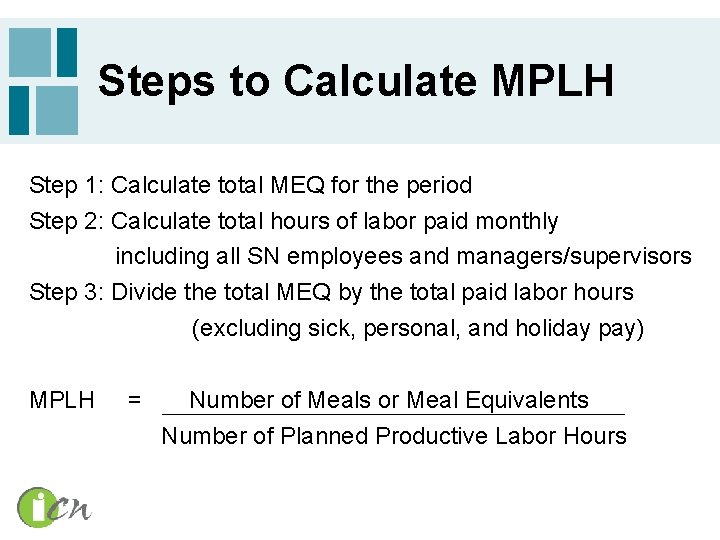
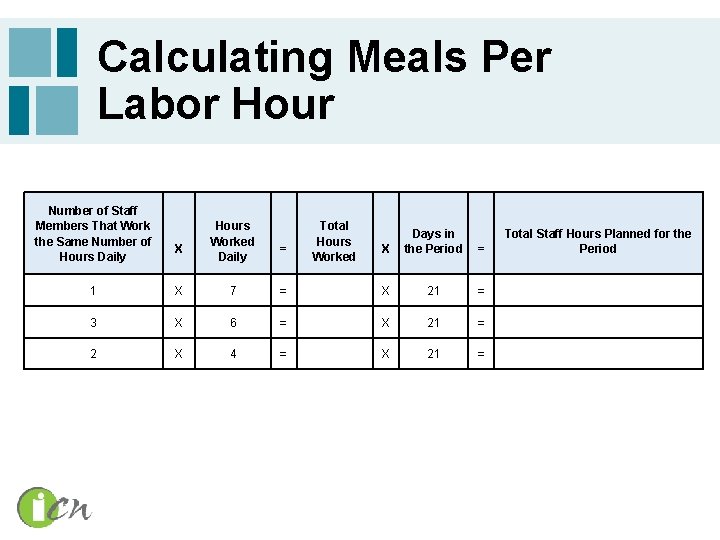
Steps to Calculate MPLH Step 1: Calculate total MEQ for the period Step 2: Calculate total hours of labor paid monthly including all SN employees and managers/supervisors Step 3: Divide the total MEQ by the total paid labor hours (excluding sick, personal, and holiday pay) MPLH = Number of Meals or Meal Equivalents Number of Planned Productive Labor Hours
Calculating Meals Per Labor Hour Number of Staff Members That Work the Same Number of Hours Daily X Hours Worked Daily = Total Hours Worked X Days in the Period = 1 X 7 = X 21 = 3 X 6 = X 21 = 2 X 4 = X 21 = Total Staff Hours Planned for the Period
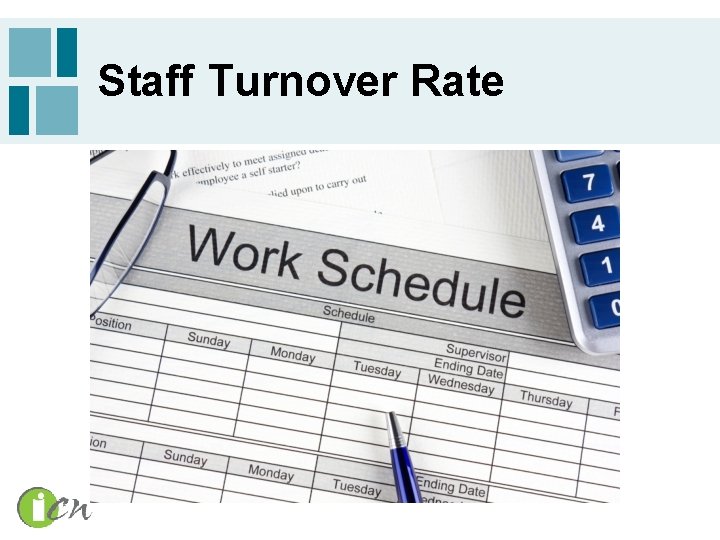
Staff Turnover Rate
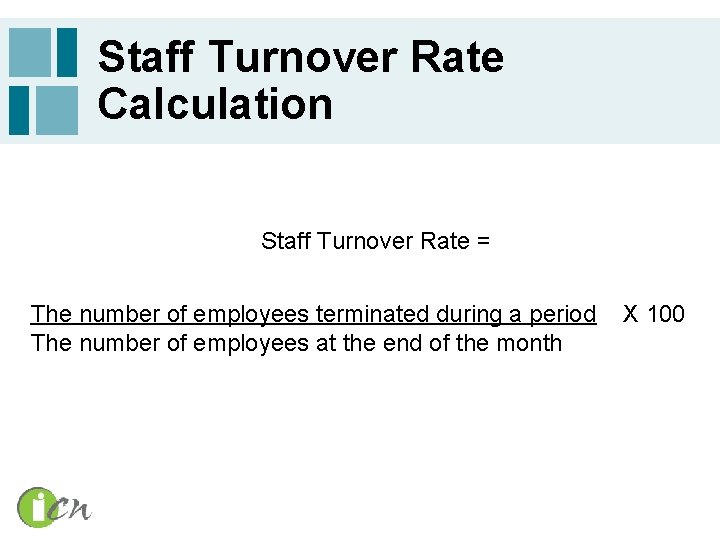
Staff Turnover Rate Calculation Staff Turnover Rate = The number of employees terminated during a period The number of employees at the end of the month X 100
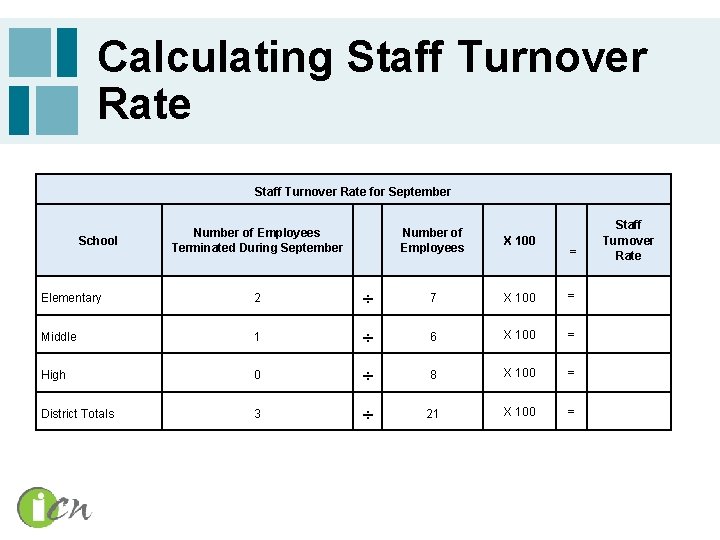
Calculating Staff Turnover Rate for September School Number of Employees Terminated During September Number of Employees X 100 = Elementary 2 ÷ 7 X 100 = Middle 1 ÷ 6 X 100 = High 0 ÷ 8 X 100 = District Totals 3 ÷ 21 X 100 = Staff Turnover Rate
Absenteeism Rate
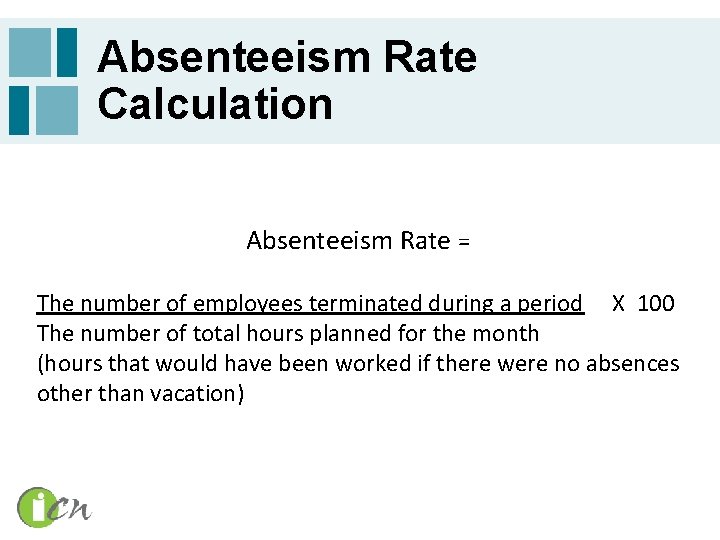
Absenteeism Rate Calculation Absenteeism Rate = The number of employees terminated during a period X 100 The number of total hours planned for the month (hours that would have been worked if there were no absences other than vacation)
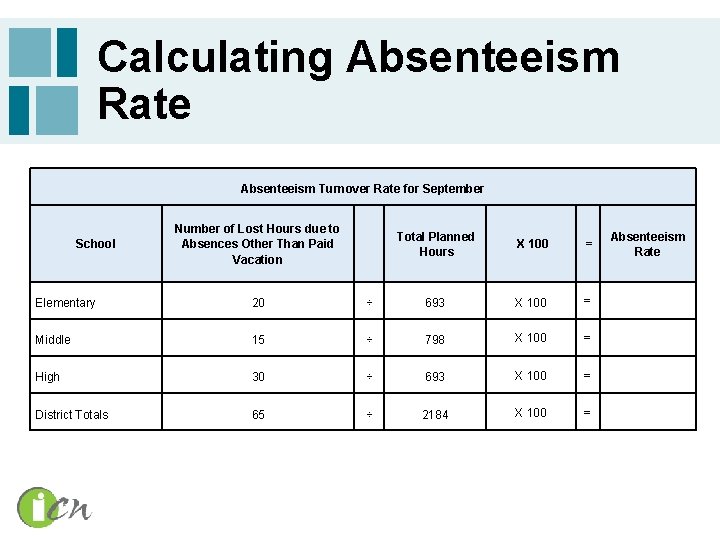
Calculating Absenteeism Rate Absenteeism Turnover Rate for September School Number of Lost Hours due to Absences Other Than Paid Vacation Total Planned Hours X 100 = Elementary 20 ÷ 693 X 100 = Middle 15 ÷ 798 X 100 = High 30 ÷ 693 X 100 = District Totals 65 ÷ 2184 X 100 = Absenteeism Rate
ABC School District Case Study
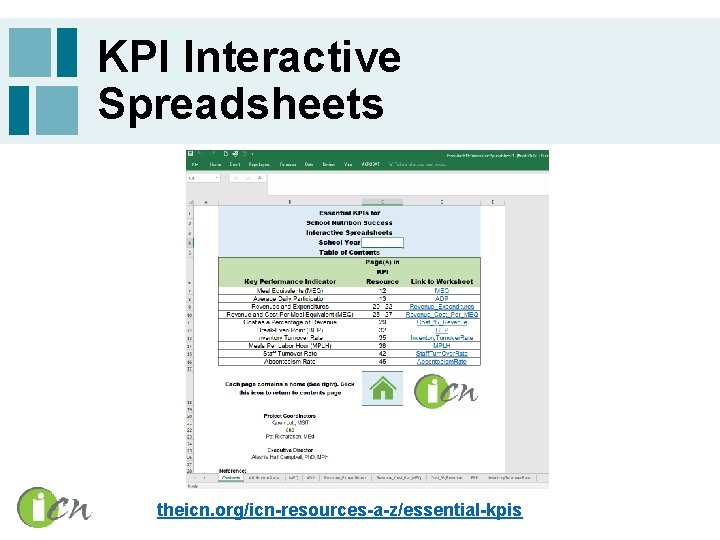
KPI Interactive Spreadsheets theicn. org/icn-resources-a-z/essential-kpis
Conclusion SMART Goals