
Essential Freedoms Bill of Rights 1 Freedom of
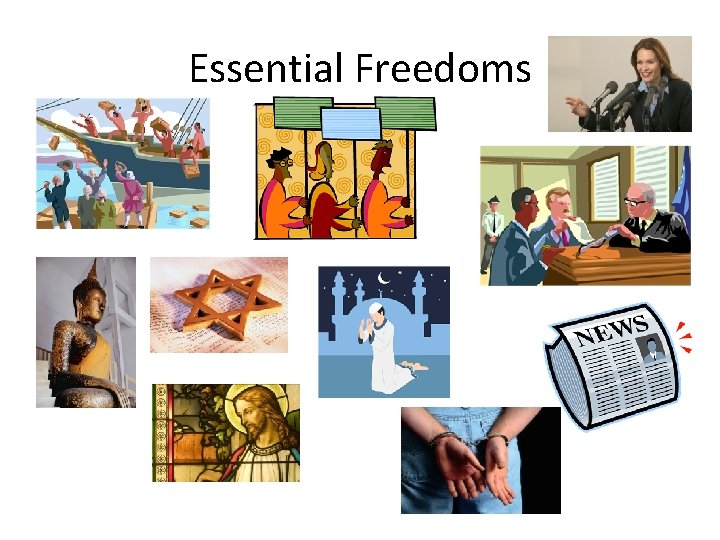
Essential Freedoms
Bill of Rights 1. Freedom of religion, speech, press, assembly, and petition. 2. Right to keep and bear arms in order to maintain a well-regulated militia. 3. No quartering of soldiers. 4. Freedom from unreasonable searches and seizures. 5. Right to due process of law, freedom from self-incrimination, double jeopardy
Bill of Rights continued 6. Rights of accused persons, e. g. , right to a speedy and public trial 7. Right of trial by jury in civil cases. 8. Freedom from excessive bail, cruel and unusual punishments. 9. Other rights of the people. (i. e. BOR is not an exhaustive list- people have other rights too!) 10. Powers reserved to the states (helps to define Federalism)
Consider these rights not listed in the “Bill of Rights” (incomplete list) § § § § Marriage Travel Privacy Procreation Freedom of association Due process of law/fair trial Innocent until proven guilty Right to vote
Key questions to consider: • • • What is “injustice”? What makes an election fair and free? What is the role of voting in a democracy? Who should be allowed to vote and why? What safeguards should be in place to prevent a democracy from eroding?
The History of Voting Rights as Case Study • White male property owners ONLY 1776 • Landless white men: 1856 • Non-white men: 1870 —Fifteenth Amendment to the US Constitution • Women: 1920 —Nineteenth Amendment to the US Constitution • Native Americans: 1924
Voting Rights • Residents of DC: 1961 — Twenty-third Amendment to the US Constitution • Elimination of the Poll Tax - Twenty-fourth Amendment to the US Constitution, 1964 • VOTING RIGHTS ACT of 1965. • Adults between 18 -21: 1971 — Twenty Sixth Amendment to the US Constitution
The Fifteenth Amendment 1870 Intention of the Amendment: To prevent states from denying the right to vote to any male citizen twenty-one years old or older on account of his race.
Practical Barriers To the Implementation of The Fifteenth Amendment into the 1960’s. 1. The Literacy Test: Required eligible voters to demonstrate their ability to read and write the English Language. 2. The Poll Tax: a tax voters were required to pay before being allowed to vote 3. Economic tactics: Eviction or termination of job 4. Intimidation tactics: Harrassment, KKK
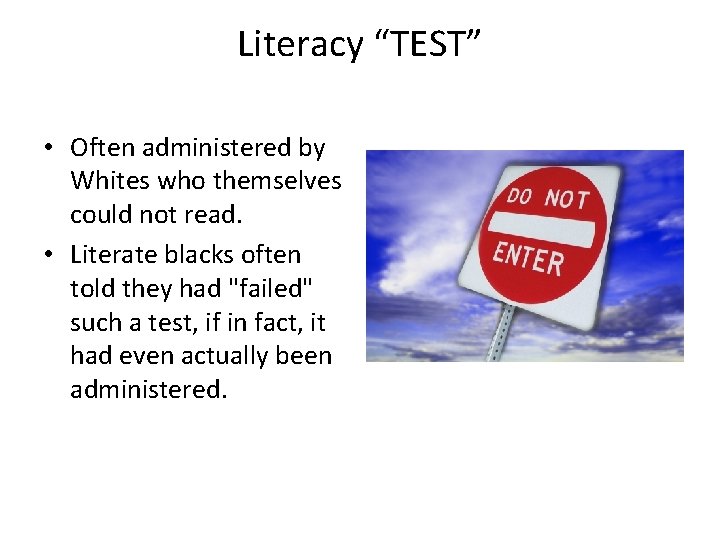
Literacy “TEST” • Often administered by Whites who themselves could not read. • Literate blacks often told they had "failed" such a test, if in fact, it had even actually been administered.
THE “GRANDFATHER” CLAUSE • Illiterate Whites had literacy test “waived” if grandfather had been able to vote • Most Blacks in the post Civil War era could not claim “grandfather” clause, as their grandfathers were slaves.
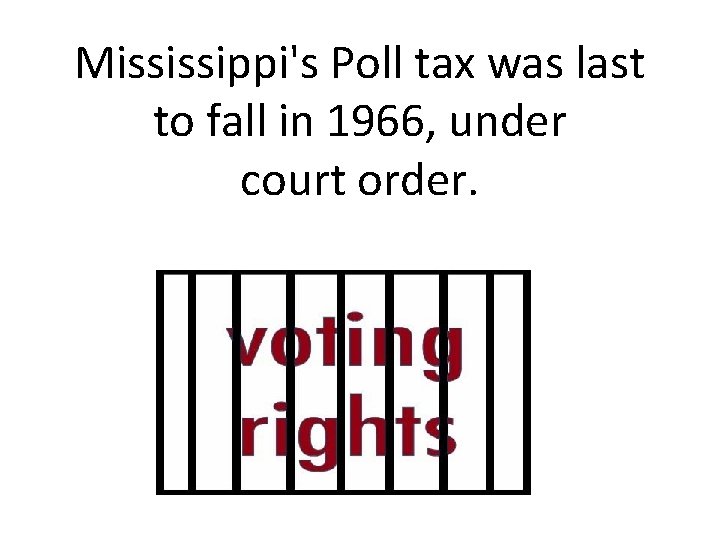
Mississippi's Poll tax was last to fall in 1966, under court order.
The Film: A Time for Justice Directed by Four-time Academy Award-winning filmmaker Charles Guggenheim. § It helps make clear why voting matters by exposing the events leading to the 1965 march for voting rights in Alabama – events that led to the passage of the landmark Voting Rights Act of 1965 § Witness the spirit of the civil rights movement through historical footage and the voices of those who participated in the struggle.
Amendment 14 - section 1 Passed by Congress June 13, 1866. Ratified July 9, 1868. All persons born or naturalized in the United States, and subject to the jurisdiction thereof, are citizens of the United States and of the State wherein they reside. No State shall make or enforce any law which shall abridge the privileges or immunities of citizens of the United States; nor shall any State deprive any person of life, liberty, or property, without due process of law; nor deny to any person within its jurisdiction the equal protection of the laws.
Amendment 15 - section 1 Passed by Congress February 26, 1869. Ratified February 3, 1870. The right of citizens of the United States to vote shall not be denied or abridged by the United States or by any State on account of race, color, or previous condition of servitude--
1965 VOTING RIGHTS ACT • Ensured state laws did not reduce access to the ballot for anyone, especially for minorities. • Dismantled discriminatory JIM CROW laws and practices. • Enforce the 14 th & 15 th Amendments • Further, any changes in state voting laws had to be approved by US Attorney General’s office to ensure they don’t violate Constitutional rights as guaranteed by the 15 th Amendment.
2013 Supreme Court Decision • June 25, 2013 - The US Supreme Court decides (5 -4) that formulated jurisdictions under Section 5 no longer have to have new voting laws pre-cleared by the attorney general or the federal district court in the District of Columbia. Chief Justice John Roberts explains that “our country has changed” and the formula “no longer characterize(s) voting in the covered jurisdictions. ”
September 12, 2018 • The report, “An Assessment of Minority Voting Rights Access in the United States, ” is released by the US Commission on Civil Rights. The bipartisan agency concludes that new state laws are making it more difficult for minorities to vote. It also notes that the Justice Department has done less to challenge those discriminatory laws since the Supreme Court struck down a core element of the 1965 Voting Rights Act in 2013.
The Situation today (March 2021) Source: The Washington Post, March 11, 2021 https: //link. gale. com/apps/doc/A 654605079/GIC? u=vol_ccv&sid=GIC&xid=c 8 63 ff 0 a • At least 250 new laws written by GOP lawmakers have been proposed in 43 states to limit mail-in, early in-person and Election Day voting. • Limits to early or absentee voting are the most common measures among this year's batch of proposed restrictions, with such bills on the table in 33 states.
In Georgia, for example, proposed changes include: • Limiting early-voting, including cutting back hours on weekends (in GA, eliminating Sundays, when many black people go after church) • Shortening voting hours (from 7 -7 to 9 -5) • Restrict the use of drop boxes for mail ballots (only one per 100, 000 voters) • Restrict number of polling places • Eliminate no-excuses absentee voting altogether • Require stricter forms of Identification on both inperson/mail in voting. • One proposal is to make it a misdemeanor to give food or water to voters in line.
- Slides: 20