
Essential Elements of Communication Theory Chapter 2 Are

- Slides: 24
Essential Elements of Communication Theory Chapter 2 Are you sitting in your assigned seat?
Ch. 1 Quiz Review 1. What is an organization? a) A company that makes a lot of money. b) A place where people communication towards a common goal c) A group of organs d) A place where people disagree all the time and never reach any goals. 2. What is business communication? a) A static, single channeled process which covers IC and EC in an organization. b) A dynamic, single channeled process which covers only IC in an organization. c) A static process that has many different ways to communication in an organization. d) An always changing process that has many different methods of communicating inside and outside of the organization. 3. Of the three types of internal communication, which is most important? a) DC b) HC c) UC d) All of them are equally important
Quiz Review (Cont. ) 4) True or False. Managers are the only ones who care about their company making money, so it’s not important to tell the other employees about what is happening with the company. a) True b) False 5) What does the PR department do? a) Advertise the company so no one wants to buy from them. b) Advertise the company so everyone wants to buy from them and tell the company of any possible problems. c) Tell the company of possible problems and keep the company away from the public. d) Says many good things about the company that are probably not true. *Next time please CIRCLE answers (if you get a paper quiz) or write in Uppercase (if you write on your own paper).
Case Study Homework I will call on a few of you to read your letter for the class, and then I will collect everyone’s homework.
Two Kinds of Communication Verbal communication (VC) 2) Nonverbal communication (NC) 1)
2. 1 – VERBAL COMMUNICATION Verbal Communication definition: “Communication that is carried out in either oral or written form with the use of words. ” *Verbal communication can BEST express all the ideas we want to communicate. l You can make your meaning the most clear using words. l Usually the most efficient way of communicating. l You are able to talk about things with your coworkers and ask their opinion. l In order to see what your employees think, you can send out a survey through email.
2. 1. 2 – Keeping & Disseminating (spreading) Information WE ARE SO FORTUNATE TO HAVE COMPUTERS!! l l l With the use of computers we feel like we are always in communication with the whole world! A few years ago, offices kept all of their information on paper. We can store whatever information we want in a computer. USB (flash drive) is the latest technology to transfer information quickly. You need to be careful though, if you don’t save the information several ways, you may lose it if your computer crashes.
2. 2 – NONVERBAL COMMUNICATION Nonverbal Communication definition: “Communication that is not carried out in words, but through one’s voice qualities, facial expressions, gestures, body movements, or attitudes towards space and time. ”
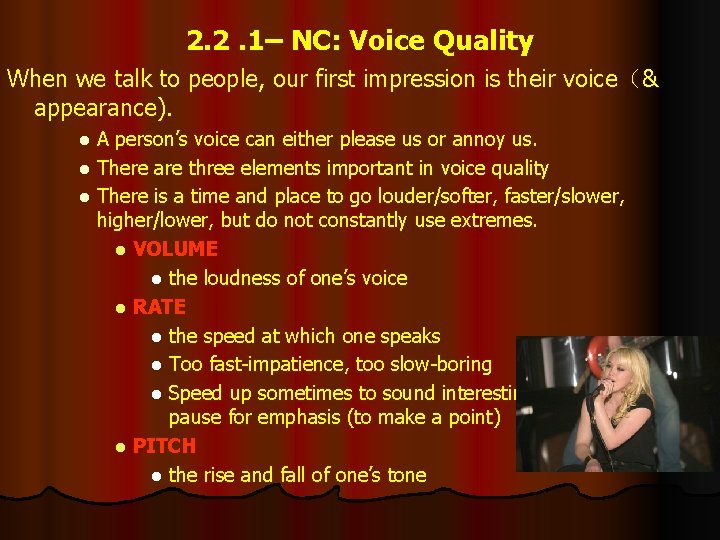
2. 2. 1– NC: Voice Quality When we talk to people, our first impression is their voice (& appearance). A person’s voice can either please us or annoy us. l There are three elements important in voice quality l There is a time and place to go louder/softer, faster/slower, higher/lower, but do not constantly use extremes. l VOLUME l the loudness of one’s voice l RATE l the speed at which one speaks l Too fast-impatience, too slow-boring l Speed up sometimes to sound interesting, pause for emphasis (to make a point) l PITCH l the rise and fall of one’s tone l
2. 2. 2– NC: Facial Expressions!! l Research tells us that we can send over 7, 000 messages just with our face.
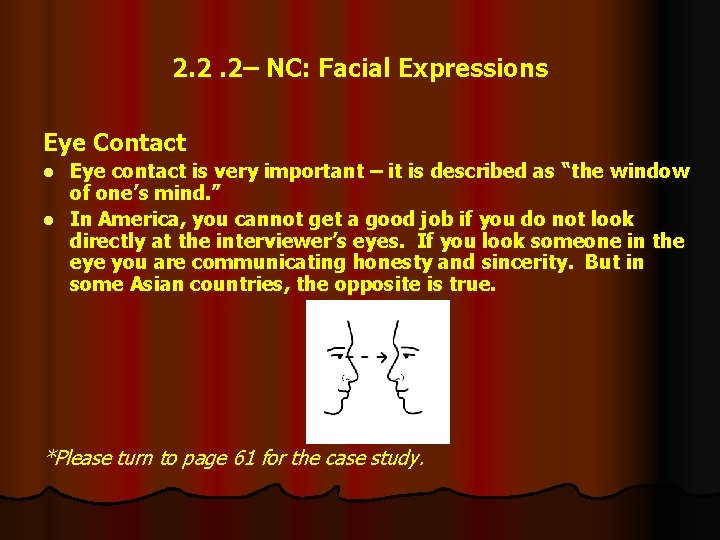
2. 2. 2– NC: Facial Expressions Eye Contact Eye contact is very important – it is described as “the window of one’s mind. ” l In America, you cannot get a good job if you do not look directly at the interviewer’s eyes. If you look someone in the eye you are communicating honesty and sincerity. But in some Asian countries, the opposite is true. l *Please turn to page 61 for the case study.
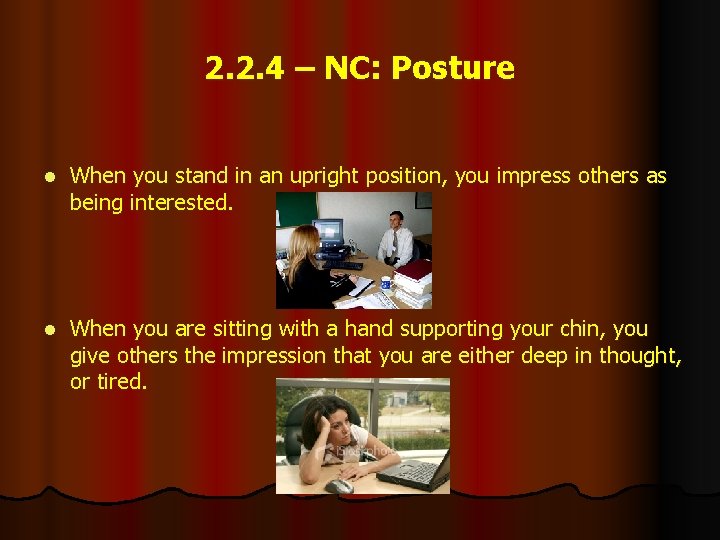
2. 2. 4 – NC: Posture l When you stand in an upright position, you impress others as being interested. l When you are sitting with a hand supporting your chin, you give others the impression that you are either deep in thought, or tired.
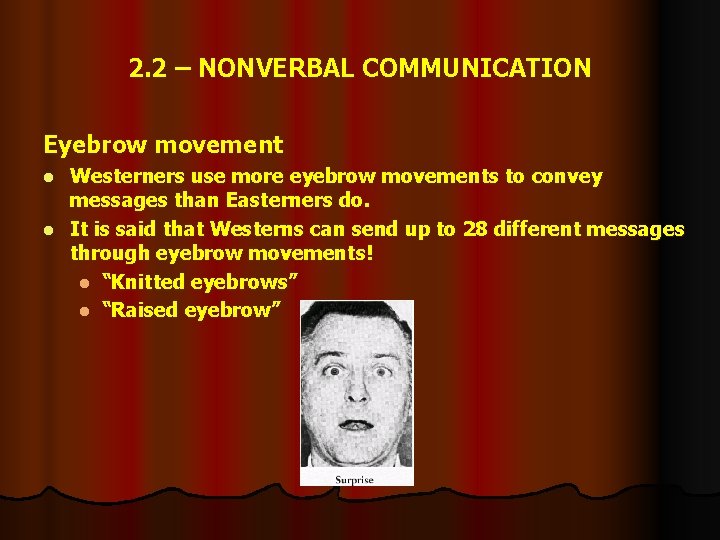
2. 2 – NONVERBAL COMMUNICATION Eyebrow movement Westerners use more eyebrow movements to convey messages than Easterners do. l It is said that Westerns can send up to 28 different messages through eyebrow movements! l “Knitted eyebrows” l “Raised eyebrow” l
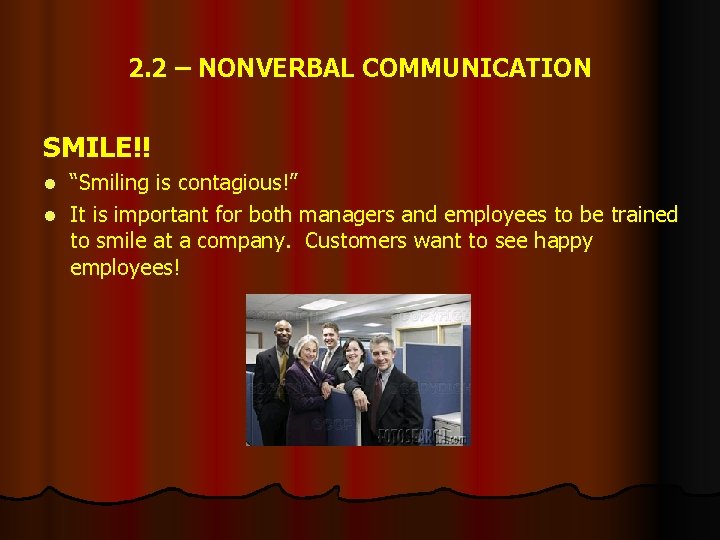
2. 2 – NONVERBAL COMMUNICATION SMILE!! “Smiling is contagious!” l It is important for both managers and employees to be trained to smile at a company. Customers want to see happy employees! l
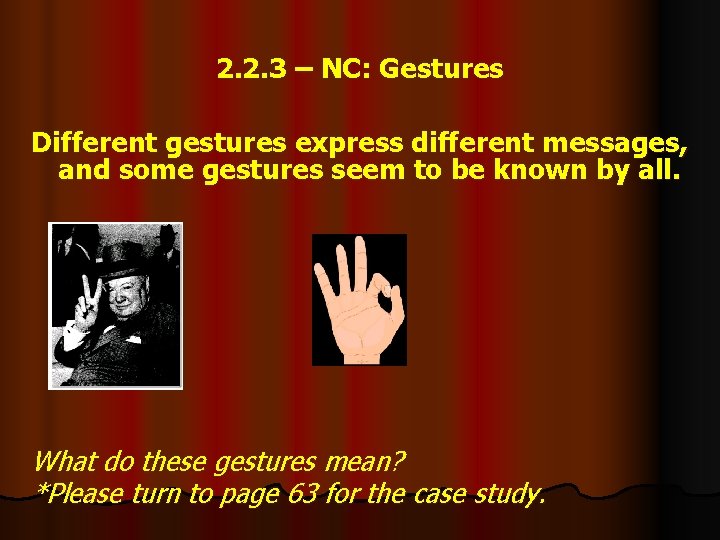
2. 2. 3 – NC: Gestures Different gestures express different messages, and some gestures seem to be known by all. What do these gestures mean? *Please turn to page 63 for the case study.
Communication & Culture l The more you study about other cultures & their customs, the better you can communicate and do business cross-culturally. l Different cultures especially understand nonverbal communication differently. l Look at the tips (guidelines) on p 65 on how to behave with people from other countries.
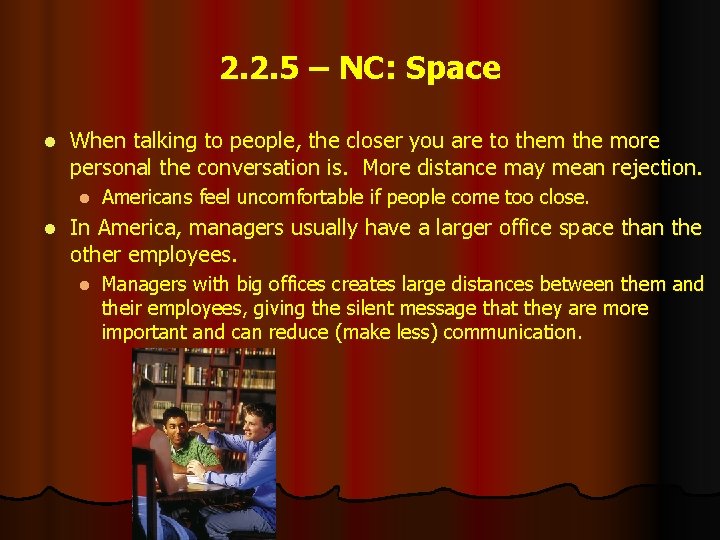
2. 2. 5 – NC: Space l When talking to people, the closer you are to them the more personal the conversation is. More distance may mean rejection. l l Americans feel uncomfortable if people come too close. In America, managers usually have a larger office space than the other employees. l Managers with big offices creates large distances between them and their employees, giving the silent message that they are more important and can reduce (make less) communication.
2. 3 – ELEMENTS OF COMMUNICATION l Communication has the following key elements: Message l Sender l Receiver l Channel l Perception l Feedback l
2. 3. 1 – ELEMENTS OF COMMUNICATION Message l A message can be verbal (more dependable) or nonverbal. It carries ideas from one person to another. l The message can be both verbal & nonverbal. l A verbal message includes oral messages (travels faster) and written messages (travels slower). l Must be careful with language barriers!
2. 3. 2 – ELEMENTS OF COMMUNICATION Sender/Receiver l The “sender” refers to the person who sends the message, and “receiver” is the person who is supposed to receive the message. l These roles are interchangeable. The “sender” needs to think of the receiver when he sends the message to make it clear & think about responses to their possible questions. l The “receiver” needs to ask questions so he can understand clearly. l Unclear messages can cause failures. l
2. 3. 3 – ELEMENTS OF COMMUNICATION Channel l Channels are different ways to send and receive messages. l Formal Communication channels l l Speech, business talk, presentation, business letter Informal Communication channels l Grapevine
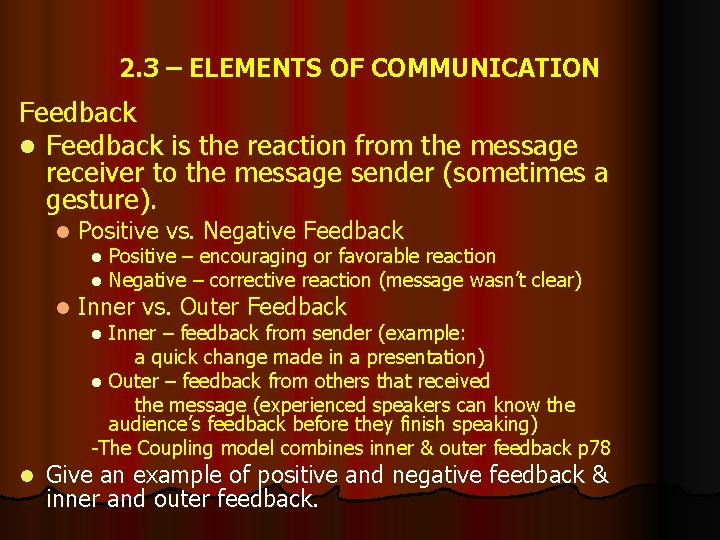
2. 3 – ELEMENTS OF COMMUNICATION Feedback l Feedback is the reaction from the message receiver to the message sender (sometimes a gesture). l Positive vs. Negative Feedback l l l Positive – encouraging or favorable reaction Negative – corrective reaction (message wasn’t clear) Inner vs. Outer Feedback Inner – feedback from sender (example: a quick change made in a presentation) l Outer – feedback from others that received the message (experienced speakers can know the audience’s feedback before they finish speaking) -The Coupling model combines inner & outer feedback p 78 l l Give an example of positive and negative feedback & inner and outer feedback.
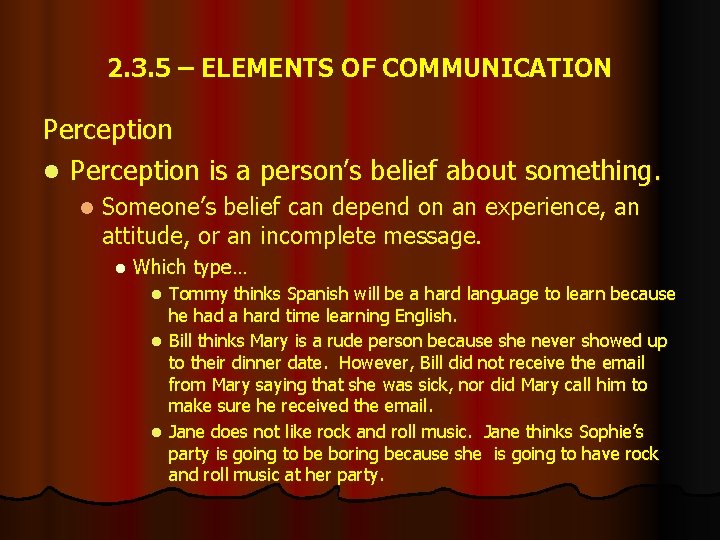
2. 3. 5 – ELEMENTS OF COMMUNICATION Perception l Perception is a person’s belief about something. l Someone’s belief can depend on an experience, an attitude, or an incomplete message. l Which type… Tommy thinks Spanish will be a hard language to learn because he had a hard time learning English. l Bill thinks Mary is a rude person because she never showed up to their dinner date. However, Bill did not receive the email from Mary saying that she was sick, nor did Mary call him to make sure he received the email. l Jane does not like rock and roll music. Jane thinks Sophie’s party is going to be boring because she is going to have rock and roll music at her party. l
Classwork/Homework Please answer “Questions for discussion” on pp 82 -83. Write your answers down. We will begin Ch. 3 next class.