
Essential efforts towards HIV Prevention and AIDS treatment
- Slides: 15
Essential efforts towards HIV Prevention and AIDS treatment and care in Penitentiary system HIV/AIDS EG meeting [Tallinn, Estonia, 03. 04. 2008] Dr. Zaza Tsereteli, MD, MPH ITA for EG on Prison Health
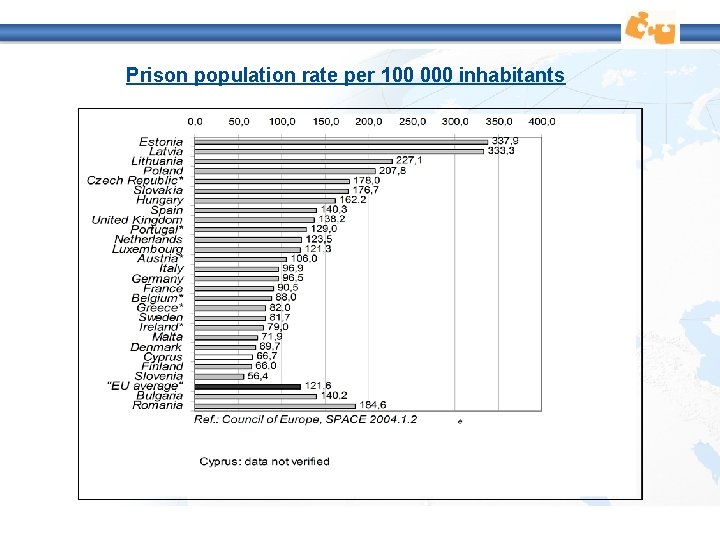
Prison population rate per 100 000 inhabitants
These figures have been updated by the Council of Europe for the situation in penal institutions on 1 st of September 2006. Estonia is after Russian Federation (608, 6), Ukraine (355, 3) holding the third most prisoners per 100, 000 population: 311, 6. In average, the prison population rate per 100. 000 inhabitants in the European Union is 121, 6 (with large variations between 56, 4 in Slovenia and 260, in Estonia). In many countries the number of prisoners has dramatically increased over the last two decades[i]. The Member States with the highest number of prisoners relative to the general population over the period 2003 -2005 were three Baltic States, Estonia and Latvia (both 329 prisoners per 100 000 head of population) and Lithuania (239). [i] Stöver, H. ; Weilandt, C. (2007): Drug use and drug services in Prisons. In: Møller, L. , Stöver, H. , Jürgens. , R. & Gatherer, A. (ed. ; 2007): Promoting health in prisons. The essentials. Copenhagen/Denmark
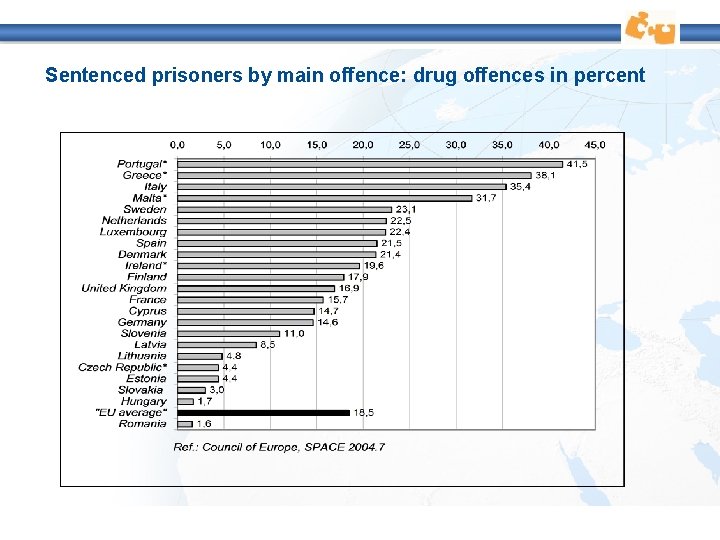
Sentenced prisoners by main offence: drug offences in percent
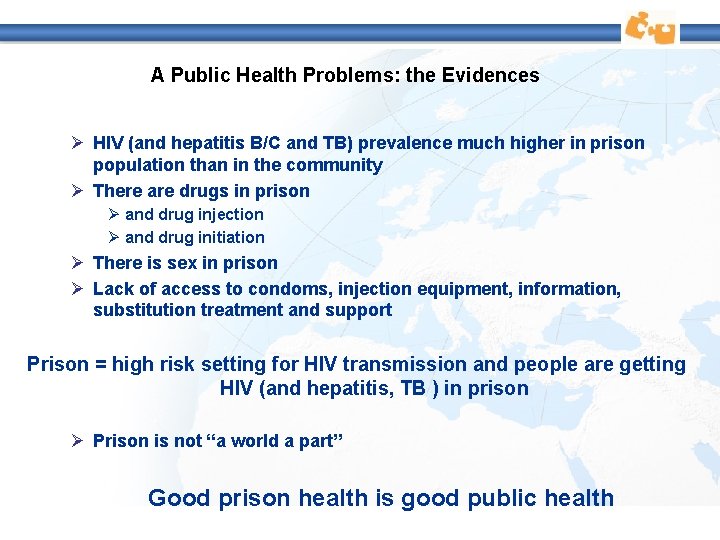
A Public Health Problems: the Evidences Ø HIV (and hepatitis B/C and TB) prevalence much higher in prison population than in the community Ø There are drugs in prison Ø and drug injection Ø and drug initiation Ø There is sex in prison Ø Lack of access to condoms, injection equipment, information, substitution treatment and support Prison = high risk setting for HIV transmission and people are getting HIV (and hepatitis, TB ) in prison Ø Prison is not “a world a part” Good prison health is good public health
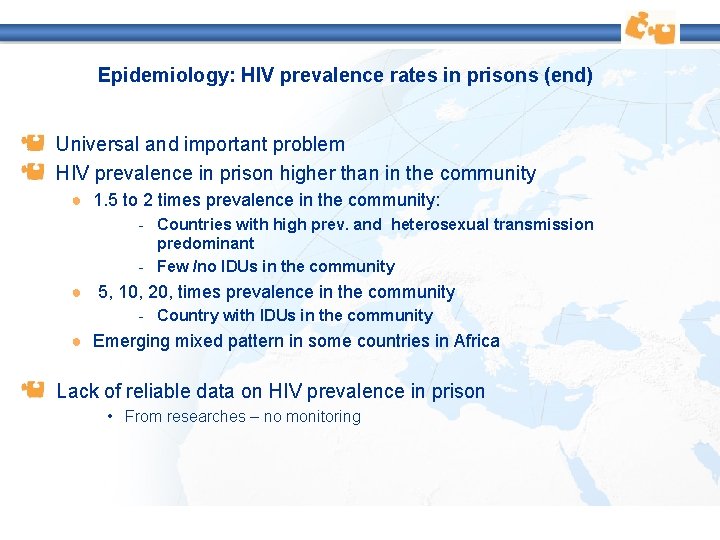
Epidemiology: HIV prevalence rates in prisons (end) Universal and important problem HIV prevalence in prison higher than in the community ● 1. 5 to 2 times prevalence in the community: - Countries with high prev. and heterosexual transmission predominant - Few /no IDUs in the community ● 5, 10, 20, times prevalence in the community - Country with IDUs in the community ● Emerging mixed pattern in some countries in Africa Lack of reliable data on HIV prevalence in prison • From researches – no monitoring
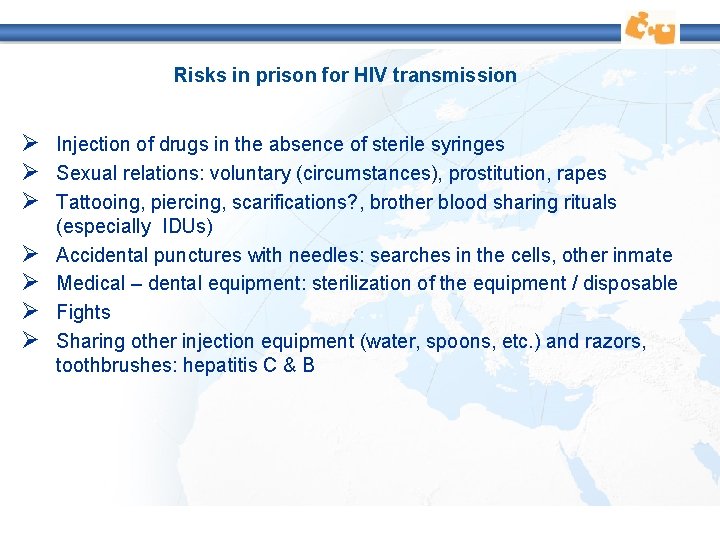
Risks in prison for HIV transmission Ø Injection of drugs in the absence of sterile syringes Ø Sexual relations: voluntary (circumstances), prostitution, rapes Ø Tattooing, piercing, scarifications? , brother blood sharing rituals Ø Ø (especially IDUs) Accidental punctures with needles: searches in the cells, other inmate Medical – dental equipment: sterilization of the equipment / disposable Fights Sharing other injection equipment (water, spoons, etc. ) and razors, toothbrushes: hepatitis C & B
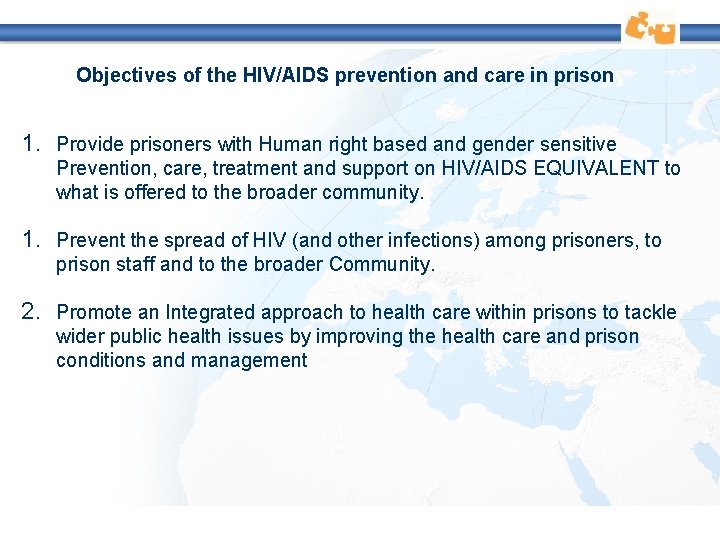
Objectives of the HIV/AIDS prevention and care in prison 1. Provide prisoners with Human right based and gender sensitive Prevention, care, treatment and support on HIV/AIDS EQUIVALENT to what is offered to the broader community. 1. Prevent the spread of HIV (and other infections) among prisoners, to prison staff and to the broader Community. 2. Promote an Integrated approach to health care within prisons to tackle wider public health issues by improving the health care and prison conditions and management
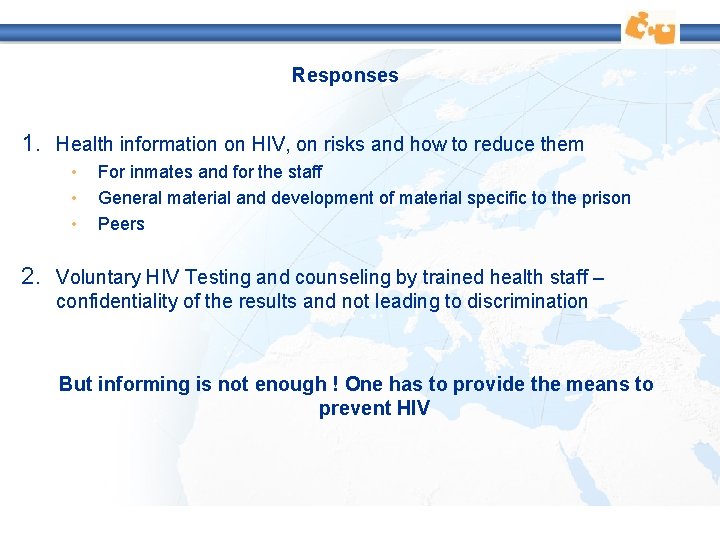
Responses 1. Health information on HIV, on risks and how to reduce them • • • For inmates and for the staff General material and development of material specific to the prison Peers 2. Voluntary HIV Testing and counseling by trained health staff – confidentiality of the results and not leading to discrimination But informing is not enough ! One has to provide the means to prevent HIV
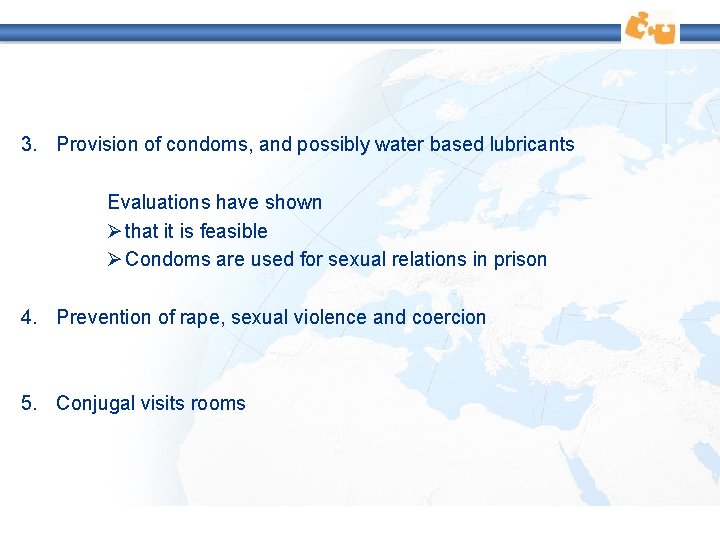
3. Provision of condoms, and possibly water based lubricants Evaluations have shown Ø that it is feasible Ø Condoms are used for sexual relations in prison 4. Prevention of rape, sexual violence and coercion 5. Conjugal visits rooms
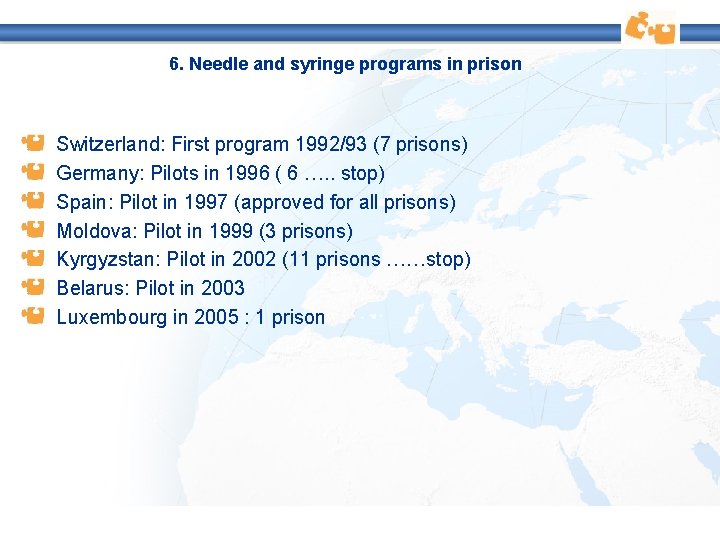
6. Needle and syringe programs in prison Switzerland: First program 1992/93 (7 prisons) Germany: Pilots in 1996 ( 6 …. . stop) Spain: Pilot in 1997 (approved for all prisons) Moldova: Pilot in 1999 (3 prisons) Kyrgyzstan: Pilot in 2002 (11 prisons ……stop) Belarus: Pilot in 2003 Luxembourg in 2005 : 1 prison
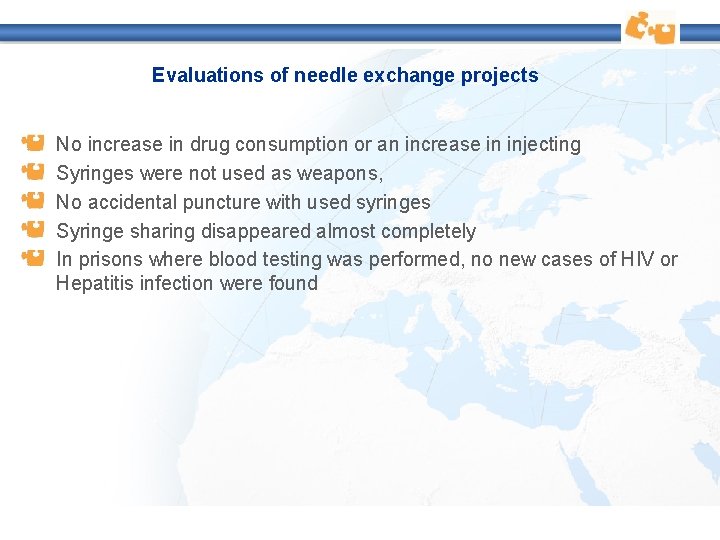
Evaluations of needle exchange projects No increase in drug consumption or an increase in injecting Syringes were not used as weapons, No accidental puncture with used syringes Syringe sharing disappeared almost completely In prisons where blood testing was performed, no new cases of HIV or Hepatitis infection were found
7. Bleach and decontamination strategies Ø Not very effective in prison Ø Probably not effective for hepatitis Ø Full strength bleach Ø Guideline to drug users on how to do Ø Danger: false security Ø Only if NSP not feasible 8. Safe tattooing equipment/information
9. Hepatitis B vaccination 10. Pre release HIV prevention: Information, Condoms, injection kits, methadone 11. Care and treatment of HIV + persons Ø Continuity of care assistance and treatment in the community Ø Follow-up of HIV + persons Ø Access to prevention of mother to child transmission treatment Ø Access to ARV therapy, care, including nutritional complements Ø Continuity of care and treatment in the community Ø Compassionate release 12. Monitoring system
Guards and health staff Ø Ø Ø Training on HIV and risks Training of staff on universal precautions provision of protective equipment (gloves) Access to post-exposition therapy Hepatitis B vaccination