
ESSENTIAL CORE COMPETENCIES FOR MILITARY IN THE CONTEMPORARY


- Slides: 18
ESSENTIAL CORE COMPETENCIES FOR MILITARY IN THE CONTEMPORARY SECURITY LANDSCAPE Brigadier Muhammad Wasi Ud Din Pakistan Army Commodore Olusegun Ferreira Nigerian Navy Group D
ESSENTIAL CORE COMPETENCIES FOR MILITARY IN THE CONTEMPORARY SECURITY LANDSCAPE 2
INTRODUCTION 3
SEQUENCE • • The Contemporary Security Landscape National Security Policy Military Policy and Objectives Essential Core Competencies ( Ways and Means to Achieve Military Objectives ) • What is Expected of Military 4
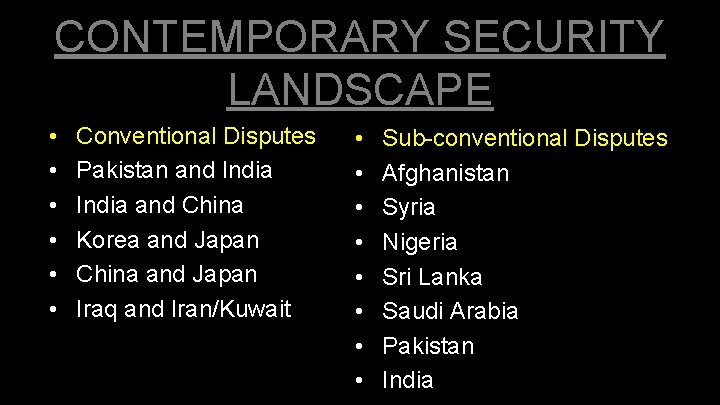
CONTEMPORARY SECURITY LANDSCAPE • • • Conventional Disputes Pakistan and India and China Korea and Japan China and Japan Iraq and Iran/Kuwait • • Sub-conventional Disputes Afghanistan Syria Nigeria Sri Lanka Saudi Arabia Pakistan India 5
NATIONAL SECURITY POLICY • National Aims and Objectives – Foreign Policy – Economic Policy – National Security Policy – Military Policy 6
MILITARY POLICY • Military Objectives / Policy • Military Strategy • Ways and Means to Achieve the Objectives ( Essential Core Competencies ) 7
ESSENTIAL CORE COMPETENCIES OF MILITARY The Military’s Core Competencies are Higher Level Organizational Descriptions that are Distinct from Tactical Missions and Tasks 8
CHALLENGES / THREATS • • Geo Strategic Competition Resources and Climate Management and Security Social Cohesion and Trust Efficient Governance Demographic Shifts Technological Innovation Hybrid and Asymmetric threats 9
GEO STRATEGIC COMPETITION • Military Philosophy Guided by Sound Geostrategic Policies and a Capstone Doctrine. • Physical Capacity Building • Rapid Mobility • Readyness • Leading Change
RESOURCES AND CLIMATE MANAGEMENT AND SECURITY • Resource Steward-ship - • • Involves the ability acquire and administer human, financial material and information resources in a manner that instills public trust and accomplishes the military’s mission. And to use new technologies to enhance decision making Working in Multicultural Environments Interagency Cooperation Cross Industry Teaming Interoperability Among Agencies
SOCIAL COHESION AND TRUST • • • Intelligence Surveillance & Reconnaissance Cross Culture Awareness Inculcating ‘Our Soldier Our Friend Attitude’ Leading Change Strategic Communication
EFFICIENT GOVERNANCE • Leadership • Harmonious Blend of Political Military and Diplomatic Domains • Adoption of Universal Value System • Robust Legal Architecture
TECHNOLOGICAL INNOVATION • • Individual Processes Technology Information Superiority
DEMOGRAPHIC SHIFTS • Language Proficiency • Other Communication Skills • Cross-Culture Awareness - Involves the ability to explain, advocate and express facts and ideas in convincing manner, and negotiate with individuals and groups internally and externally/ internationally
HYBRID AND ASYMMETRIC THREATS • Development of R & D • Force Protection
CONCLUSION What is Expected of Military 17
THANK YOU 18