
ESSENTIAL CONNECTIONS Ten Keys to Culturally Sensitive Child

- Slides: 23
ESSENTIAL CONNECTIONS: Ten Keys to Culturally Sensitive Child Care The Program for Infant Toddler Caregivers Developed Collaboratively by the California Department of Education and West. Ed
Essential Connections:
Keep in mind… • This video has a focus on the care for infants and toddlers. • Rules and environments in child care settings usually represent the dominant culture. • Families vary tremendously in how they follow cultural rules.
Key #1: Provide Cultural Consistency Young children need to feel good about where they come from.
Yolanda Torres • “The child’s culture is tied into the self-esteem. This is what we are looking at right from the beginning – to make a child feel good about himself” • “ If you shame a child because he is using his own language, you are telling the child that his parents don’t know how to raise him. ”
Carol Brunson Phillips “Teach children in a culturally consistent context, rather than teach culture to children. This means that the context of child care needs to be consistent with the child’s home context. ”
Key #2: Work Toward Representative Staffing • Employ caregivers who are of the same culture and who speak the same language as the children served. • Seek cultural representation at all levels of staff and management.
Louise Derman-Sparks • “We have to look at every aspect of policies and practices…how we recruit staff, train them, pay them, the working conditions, who are supervisors…”
Key #3 Create Small Groups • All infants benefit from small groups. • Large groups are chaotic and confusing. • In small groups caregivers have fewer cultures to relate to. • Small groups prevent misunderstandings.
Key #4: Use the Child’s Home Language • Home language supports the child’s identification with her family and culture. • Infants needs are met when home and childcare use the home language. • Infants feel powerful and self confident when their words are understood.
What If We Don’t Speak the Same Language? • Translate all written information. • Find an interpreter. • Learn basic “toddler” vocabulary.
Key #5: Make Environments Relevant • Materials should reflect the children and families you serve. • Materials should reflect their culture. • Develop an environment that focuses on the families in care.
Carol Brunson Phillips • “. . for very young children it is the interactions that communicate the culture in the child’s world. ”
Key #6 Uncover Your Cultural Beliefs • What are the roots of your child care practices? • What cultural values are reflected in your caregiving?
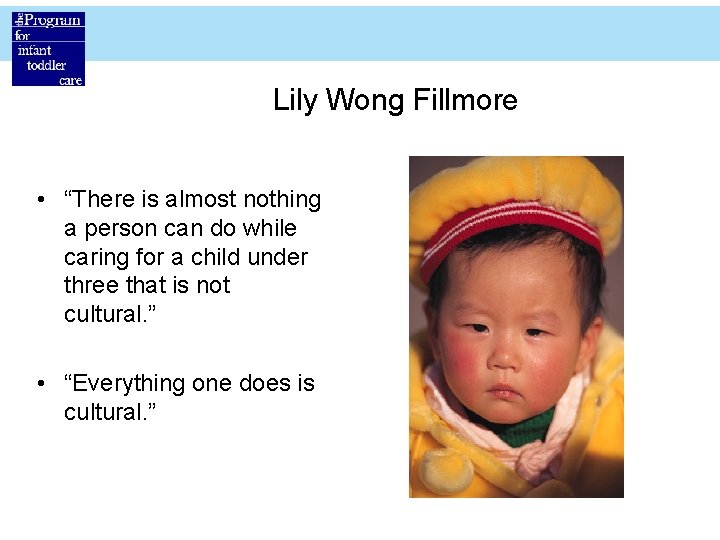
Lily Wong Fillmore • “There is almost nothing a person can do while caring for a child under three that is not cultural. ” • “Everything one does is cultural. ”
Key #7: Be Open to Perspectives of Others • Awareness of multiple perspectives on childrearing practices leads to respect for others’ beliefs. • Awareness of multiple perspectives on childrearing leads to a clearer understanding of your own perspective.
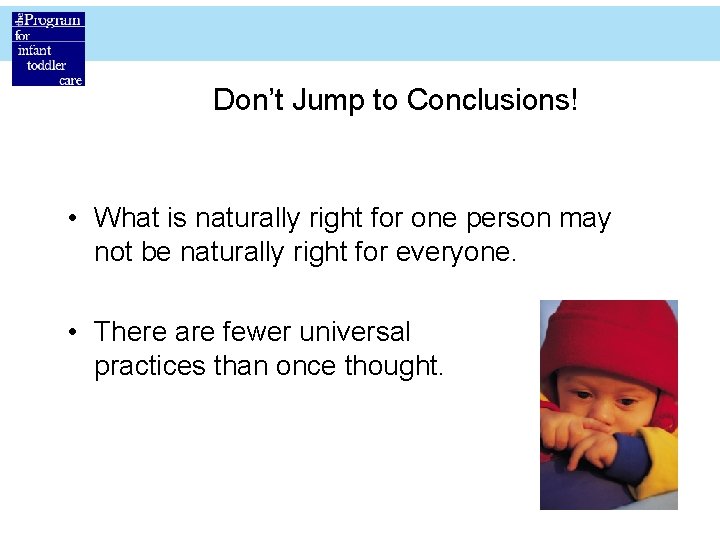
Don’t Jump to Conclusions! • What is naturally right for one person may not be naturally right for everyone. • There are fewer universal practices than once thought.
Louise Derman-Sparks • “Many caregivers think that behavior that makes them uncomfortable is wrong behavior, is developmentally inappropriate behavior, is unfair to children, or is harmful to children. ” “ Most of the time, it is simply different behavior. ” • “The power of culture is so great that anything that isn’t like our culture feels unnatural. ”
Key #8: Seek Out Cultural & Family Information • Gather information. • Have frequent conversations with parents. • Learn how things are done at home. • Learn what is important to the parents.
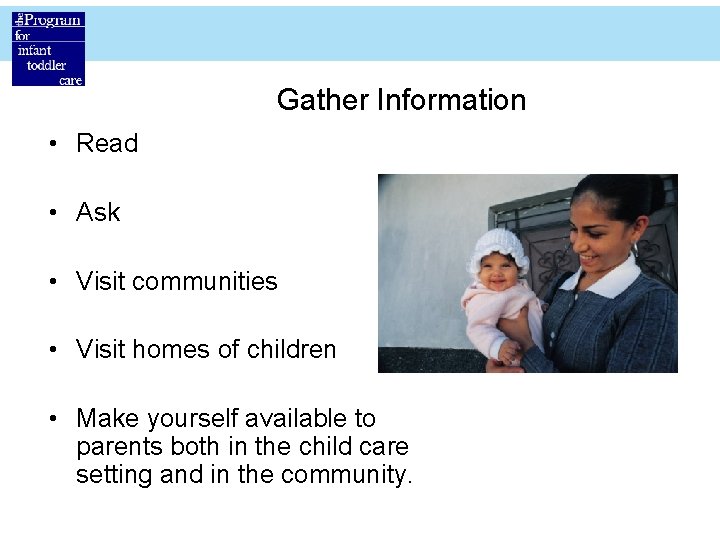
Gather Information • Read • Ask • Visit communities • Visit homes of children • Make yourself available to parents both in the child care setting and in the community.
Key #9: Clarify Values • Have an open discussion with the family when communication breaks down, or you find yourself confused about a family’s actions. • Ask yourself what is best for the child? • It takes time and persistence to discover the values behind strong feelings.
Key #10: Negotiate Cultural Conflicts • Negotiation is an essential part of parent/ caregiver relationships. • Negotiation is not easy. • Negotiation is a way of listening and coming to an agreement that takes both people’s values into consideration. • Negotiation is always a balancing act.
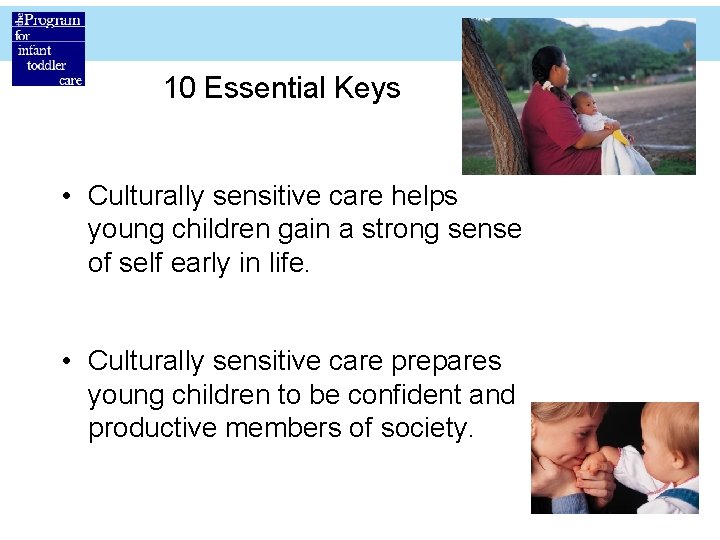
10 Essential Keys • Culturally sensitive care helps young children gain a strong sense of self early in life. • Culturally sensitive care prepares young children to be confident and productive members of society.